

In the highly competitive Indian food industry, from the field to the table, food safety and quality are of utmost importance. Today, consumers are highly particular, regulatory bodies are becoming increasingly stringent, and the world market is looking for nothing short of flawless standards. In the Indian food industry, it is not just about maintaining basic hygiene conditions; it is about proving that the food business operator has an effective, recognized, and renowned food safety management system in place, which is exactly where ISO 22000 certification comes into the picture, as it is an effective method of controlling food safety hazards. The objective of this blog is to explain what is ISO 22000 certification, what it means, its significance, its scope, and who benefits the most from this certification in the highly competitive Indian food industry.
Talk to Our Experts Today
Still unsure if ISO 22000 Certification is right for your business? Legal4sure’s food safety experts assess your facility, handle documentation & guide you through every audit step. Book your free consultation with Legal4sure today.
What is ISO 22000 Certification?
ISO 22000 standard (ISO 22000:2018) is a complete Food Safety Management System (FSMS). It is developed by the International Organization for Standardization and is not merely a set of rules, but rather a philosophy of prevention.
Unlike any other hygiene practices, iso food certification is not merely reactive, as it does not merely search for contaminants in the final product, but rather locates the possible entry points of these contaminants and stops them before they occur. It includes:
- HACCP Principles: This is done in order to identify and control food safety hazards.
- System Management: This is done in order to ensure that the whole business supports the system.
- Interactive Communication: This is done in order to keep all those concerned, including customers, aware of the safety hazards.
>Helpful Guide:- How to get ISO 22000 Certification for Food Safety Management
Frequent Questions by Founders about ISO 22000 Certification
- Is the ISO 22000 standard just one more piece of paperwork that will only slow us down?
- We already follow the FSSAI guidelines. Why add one more certification to the mix?
- Can’t we implement the advanced food safety system without disrupting our production workflow for weeks?
- Will the iso food certification really open more doors to larger clients and export markets?
- How are we going to train our existing staff to implement these new and more stringent international standards?
Why ISO 22000 is Becoming Important
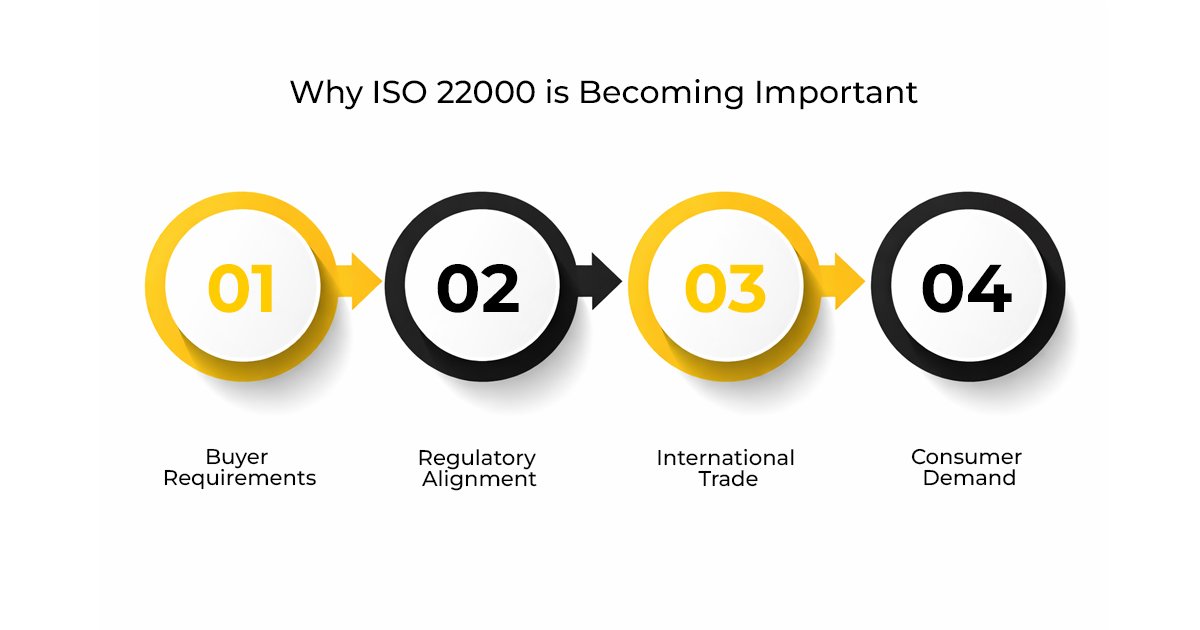 In today’s connected world, food safety is not just an expectation; it is a necessity that has become a global requirement. ISO 22000 has developed a standard that outlines the requirements of a food safety management system that comprises generally recognized key elements of food safety along the food chain, including the point of final consumption.
- Buyer Requirements: Today, an increasing number of large retailers, hospitality outlets, food product exporters, as well as domestic and international buyers, require their suppliers to obtain an ISO 22000 certification in the area of food safety.
- Regulatory Alignment: FSSAI is the regulatory body that lays down the basic guidelines for food safety regulations in India, but ISO 22000 provides a framework that is beyond the basic guidelines, thereby helping organizations comply with the regulations.
- International Trade: ISO 22000 is of particular interest to Indian food businesses that seek to expand their business into the international market, as it is a recognized symbol of an Indian company’s commitment to world-class food safety.
- Consumer Demand: Today, consumers are highly aware of the products they conusme, and ISO 22000 certification helps create an instant impression of trust and confidence in the products of the company.
>Helpful Guide:- ISO 22000 Certification Requirements in India (2026 Compliance Blueprint)
The Scope of ISO 22000 Certification
The ISO 22000 standard is special because it is not just relevant to the person flipping the burger or the person canning the juice. It is relevant to every single link in the supply chain. If your business touches food or touches the things that touch the food, then this standard is relevant to your business.
In order to make this easier to grasp, the scope can be divided into two major groups:
Organizations Directly Involved
This includes the businesses that are involved with the food itself. So this includes:
- Primary Producers: Agricultural farms (wheat, paddy, fruits), poultry farms, dairy farmers, and fisheries.
- Food Processors: Flour mills, spice grinding units, meat processing units, oil refineries.
- Manufacturers: Brands that make biscuits, snacks, ready-to-eat products, beverages.
- Food Service Providers: This is a massive sector in India and includes hotels, restaurant chains, cloud kitchens, and large-scale wedding caterers.
- Retailers & Wholesalers: Large supermarket chains like Reliance Fresh or More, and large-scale cash and carry wholesalers.
Organizations Indirectly Involved
Indian entrepreneurs are not aware that they can attain iso food certification without being in the food business. ISO 22000 is also applicable for:
- Packaging Manufacturers: Those companies that make food-grade plastic, glass jars, tin cans, or even the paper used for tea bags.
- Logistics & Storage: Owners of cold storage facilities and companies that transport goods across states, especially those that transport perishables.
- Additive & Ingredient Suppliers: Those companies that make food colors, preservatives, vitamins, and minerals used in food products.
- Service Providers: Pest control services, industrial cleaning services, and companies that make equipment used in the food industry (for example, ovens or conveyors).
>Helpful Guide:- FSSC 22000 vs ISO 22000: Why ISO 22000 Alone Is No Longer Enough for Serious Food Brands
Who Needs ISO 22000 Certification in India?
The ISO 22000 standard is for any business that touches the food chain, and it does not matter how big or small or how complex or simple your business is. If your goal is to achieve ISO 22000 food safety, then you need to see if your business comes under one of these categories:
| Business Category | Industry Examples | Why Do They Need ISO Food Certification? |
|---|---|---|
| Primary Producers | Crop farmers, Dairy farms, Poultry, Fisheries, and Spice plantations. | To control pesticides, veterinary drugs, and soil hygiene at the source. |
| Food Processors | Flour & Rice mills, Sugar refineries, Meat processing plants, and Oil mills. | To manage high-risk Critical Control Points during raw material conversion. |
| Food Manufacturers | Biscuits, Snacks, Beverages, Frozen foods, and Ready-to-eat brands. | To ensure consistency in safety and quality for mass-market retail and exports. |
| Hospitality & Service | Hotels, Cloud Kitchens, Restaurant chains, and Industrial Caterers. | To build brand trust and prevent foodborne illnesses in high-volume serving. |
| Logistics & Storage | Cold storage facilities, Food transporters, and Warehousing. | To guarantee that the Cold Chain and hygiene are maintained during transit. |
| Packaging & Ancillary | Manufacturers of Food-grade plastic, Tins, Paper, and Cleaning agents. | To ensure that packaging materials do not migrate harmful chemicals into the food. |
| Additive Producers | Makers of Food colors, Preservatives, Vitamins, and Flavoring agents. | To prove that the inputs used by other manufacturers are safe for human consumption. |
Key Takeaways
- Don’t get overwhelmed. Break down implementation into manageable phases, but always remember the bigger picture of a holistic food safety approach.
- Your passion for food safety is contagious. Be a role model in embracing the FSMS and food safety.
- Documentation should be viewed as the expression of knowledge to guarantee uniformity and safeguard your business.
- The ISO 22000 journey is one of continuous improvement. Cultivate a spirit of openness to feedback and opportunities to improve the ISO 22000 food safety management system.
- Don’t be afraid to seek the services of food safety ISO 22000 experts for businesses in India. It could save you time and money.
>Top trending Guide:- BRC Full Form, Meaning, Certification Process & Cost in India (2026 Guide)
Frequently Asked Questions
What are the benefits of ISO 22000 certification and its benefits India?
Benefits of implementing ISO 22000 will include enhanced consumer confidence, improved market access, operational efficiencies and a competitive advantage in the food industry of India and the world.
What is ISO 22000 certification meaning and requirements?
It certifies a food safety management system (FSMS), which identifies and controls food safety hazards. Requirements include implementing PRPs, HACCP principles, and a strong management system.
What is the food safety iso certification process India?
The process involves understanding the standard, gap analysis, developing a food safety management system (FSMS), management review, selection of certification body and finally stage 1 and stage 2 audits.
Who is eligible for ISO 22000?
Any food business in the food chain, ranging from primary producers, manufacturers, processors, transport and storage companies, to retail stores and food service outlets.
Why is ISO needed for a food business?
It increases credibility, food safety, market access to larger buyers, regulatory compliance, and a commitment to global best practices.
What are the ISO requirements India-specific for food businesses?
Though ISO 22000 is a global standard, Indian companies need to ensure that they adhere to FSSAI regulations. So, both global and local standards are met.
Is ISO 22000 certification expensive for a small food business?
There is a cost associated with implementing this standard, but the long-term benefits such as having access to larger markets, reducing wastage and improving credibility make this a strategic investment.