
Today, Indian consumers in the food segment are very conscious about quality and transparency of the entire food chain right from the farm to the fork. In this competitive scenario, merely having a basic license is not enough to get market trust. On the other hand, an FSSAI license is more about granting legal permission to operate, whereas ISO 22000 Certification can be considered as a global license to lead.
No matter if you are a newly found organic startup, a huge dairy processing company, or a packing material manufacturer, it is very important that you realize your position in the global food safety chain. In this article, we look into which particular sectors have to prioritize getting this certification, the types of businesses that stand to gain the most, and the exact times when these voluntary safety norms turn into a compulsory business requirement.
What is ISO 22000 Certification?
ISO 22000 standard (ISO 22000:2018) is a complete Food Safety Management System (FSMS). It is developed by the International Organization for Standardization and is not merely a set of rules, but rather a philosophy of prevention.
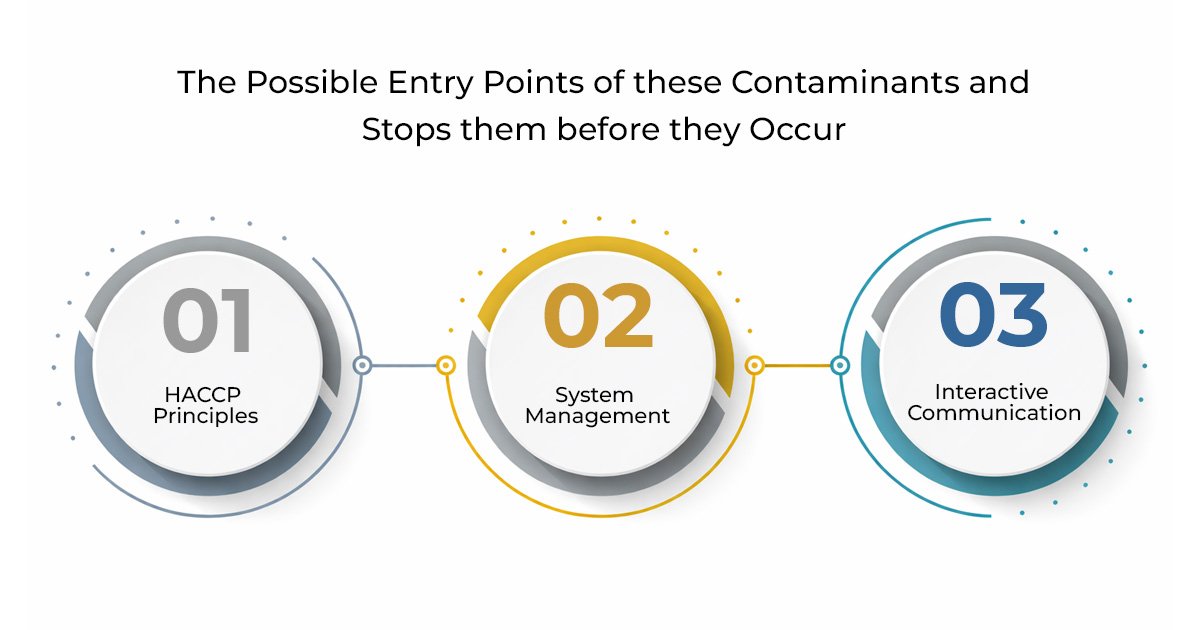
Unlike any other hygiene practices, iso food certification is not merely reactive, as it does not merely search for contaminants in the final product, but rather locates the possible entry points of these contaminants and stops them before they occur. It includes:
- HACCP Principles: This is done in order to identify and control food safety hazards.
- System Management: This is done in order to ensure that the whole business supports the system.
- Interactive Communication: This is done in order to keep all those concerned, including customers, aware of the safety hazards.
Frequent Questions by Founders about who needs ISO 22000 Certification
- We already have FSSAI. Why do buyers still ask for ISO?
- Is ISO 22000 only for manufacturers, or does it apply to our packaging unit too?
- We are a small operation with 20 employees. Is this standard even relevant for us?
- Our buyer sent us an audit checklist that mentions FSMS. Is that the same as ISO 22000?
- We are exporting to the Middle East. Our freight forwarder mentioned we might need this. What exactly is required?
Who Needs ISO 22000 Certification
Here is where much of the confusion arises, as people mistakenly think that ISO 22000 applies only to very large food manufacturers. It does not. The standard clearly states that it is intended for all organizations involved in the food supply chain. You can refer to this table to find out if your company qualifies:
| Type of Business | Do They Need ISO 22000? | Major Operations |
| Food manufacturers & processors | Yes — this is the core target | Buyers, exports, scale |
| Ingredient & raw material suppliers | Yes | Vendor approval requirements |
| Food packaging companies | Yes | Supplying to certified manufacturers |
| Cold chain & logistics operators | Yes | Institutional contracts, export supply chains |
| Agricultural produce exporters | Yes | APEDA, EU, or Gulf market access |
| Catering & institutional food service | Yes | Government or corporate contracts |
| Food equipment manufacturers | Situational | Supplying to ISO-certified food plants |
| Restaurants & standalone cafes | Rarely | Unless doing B2B supply or exports |
Keypoint: Whether your company qualifies for iso 22000 does not depend on your size or turnover but rather on your role in the food supply chain and your customers.
>Helpful Guide:- ISO 22000 Certification Requirements in India (2026 Compliance Blueprint)
When Does ISO 22000 Stop Being Optional and Start Being Unavoidable?
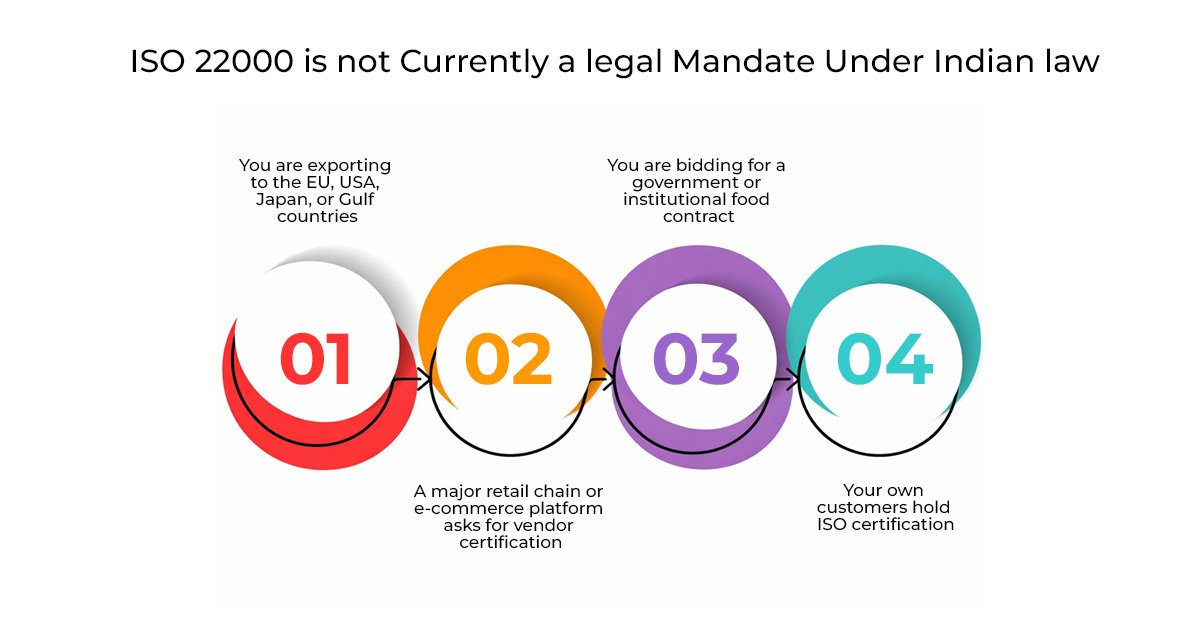
ISO 22000 is not currently a legal mandate under Indian law. But calling it voluntary misses the practical reality. Here are the situations where the iso requirement becomes impossible to ignore:
- You are exporting to the EU, USA, Japan, or Gulf countries. These markets expect you to implement internationally recognised food safety standards. As a matter of fact, buyers and regulators in these regions will require your FSMS certification before anything else.
- A major retail chain or e-commerce platform asks for vendor certification. Most e-commerce platforms have approved vendor lists, which only includes vendors with iso food business certification. In fact, without such certification, you do not qualify at all.
- You are bidding for a government or institutional food contract. Such contracts for example school midday meals, hospital catering, defence canteens, and airline catering usually point to ISO 22000 or a similar FSMS standard as a requirement for participation.
- Your own customers hold ISO certification. If your customers are ISO certified themselves and you supply them with ingredients or packaging, their standard which is already ISO 22000 certified will require them to control their supplier risk. So, they will give you the requirement as well.
- You are scaling from regional to national distribution. The moment your product regularly crosses state lines, institutional buyers and distributors will ask for certifications that you have never needed at a smaller scale.
How to Get ISO 22000 Certification
The certification process is not difficult at all, however, it is important for you to think about it as a system-building exercise rather than a paperwork exercise.
- Perform a gap analysis: Identify areas of your current food safety practices that do not meet the requirements of ISO 22000:2018. Be honest, this measure will prevent you from costly unexpected issues later on.
- Determine your scope: Select which products, sites, and processes you aim to have certified. Properly defining the scope helps to limit the audit time and expenses.
- Develop your FSMS manuals: This should consist of your food safety policy, hazard analysis, prerequisite programmes (PRPs), HACCP plans, and operational procedures.
- Educate the staff: The food safety team and production employees should know the standard well enough to be able to discuss with an auditor their control measures not just to show them a binder.
- Run at least one internal audit cycle: This reveals the non-conformities that you can rectify without an auditor’s observation. Besides, it shows the maturity of the system.
- Hold your management review: ISO 22000 underlines the need for top management commitment. A documented review meeting is a prime piece of evidence that auditors usually seek first.
- Stage 1 audit document review: The certification body you have selected will review your food safety management system (FSMS) documentation and identify any gaps before the on-site visit.
- Stage 2 audit on-site verification: The auditor will come to your facility to check if your documented system is indeed being implemented on the floor. Any non-conformities found at this stage must be resolved before certification can be granted.
- Get your certificate: This is valid for 3 years, with yearly audits to monitor compliance. Remember, the certificate reflects the degree of your commitment to continuing the system.
>Helpful Guide:- ISO 22000 Certification for Small Food Businesses Made Simple
Advantages Of Getting ISO 22000 Certification
Getting ISO food company certification is a no brainer, since apart from qualifying for more contracts, here is what it offers in terms of operational value:
- You build a fully traceable and auditable food safety system that facilitates the management of recalls and dealing with regulators.
- You gain entry into bigger supply chains that were earlier inaccessible to you, including exports and organised retail.
- You curb internal waste and inconsistencies as the process of developing an FSMS compels you to standardise what was earlier relying on tribal knowledge.
- You establish a legal safeguard for your business. If a product complaint or regulatory inspection arises, written ISO 22000 compliance records prove that your business prioritised food safety, and that factor makes a difference in a hearing.
>Helpful Guide:- ISO 22000 Certification Cost In India – Expert Cost Breakdown
Key Takeaways
- Start your gap analysis before a customer even raises the question.
- Don’t confuse getting FSSAI compliant with having a food safety management system in place.
- Initially, keep the scope of your certification narrow. Focus on your main product lines and leading facility.
- The internal audit that you conduct is worth more than the external one. If you discover non-conformities on your own, you can fix them quietly.
- Be sure to allot proper attention to the surveillance audits. A suspended certificate due to system lapse in between audits hurts your credibility more than their not having one do.
>Top Trending Guide:- BRC Full Form, Meaning, Certification Process & Cost in India (2026 Guide)
Frequently Asked Questions
Who needs ISO 22000 certification in food industry India?
Any company in India that is part of the food supply chain must take into consideration the ISO 22000, especially if they are supplying organised buyers, export markets or the government.
What are the ISO 22000 eligibility criteria for companies?
There are no minimum size, turnover, or employee count requirements. Any organisation that is part of the food chain and wants to demonstrate a systematic approach can apply.
What is the ISO certification requirement for food business when exporting?
When exporting to the EU, USA or Gulf markets, ISO 22000 is practically a mandatory certification. These markets see it as a trustworthy standard for food safety management, and most buyers there require certification before they approve a vendor.
Is ISO required for food manufacturers in India by law?
Not universally by Indian law, but it is a de facto requirement for food manufacturers that want to supply organised retail chains, win institutional tenders, or access export markets. Legally optional; commercially unavoidable at scale.
What does ISO food company certification actually cover?
It covers your entire Food Safety Management System — hazard analysis, prerequisite programmes, HACCP-based controls, supplier management, traceability systems, corrective action procedures, and top management oversight. It is a full-system standard, not just a product test.
What are the ISO food requirements a business must meet before applying?
You must have a documented FSMS, completed hazard analysis, defined prerequisite programmes, operational control procedures, an internal audit cycle, and evidence of management review.
What are the ISO 22000 eligibility criteria for small food businesses specifically?
There are none. The standard is explicitly designed to be scalable. Small businesses typically start with a tightly scoped certification covering their primary product lines, which reduces documentation burden and audit costs while still achieving full ISO 22000 certification.