

In the competitive environment of the food industry in India, going beyond the minimum requirements of FSSAI and achieving international safety standards is not only an option but a necessity. Whether you’re a small-scale food manufacturer looking to penetrate the retail market in India or a large-scale manufacturer looking to export to the European and Middle Eastern markets, the ultimate benchmark in safety and quality is the ISO 22000 certification for food manufacturers.
Achieving iso food safety certification demonstrates a commitment to global standards. This blog is a complete blueprint for the year 2026, and in the coming paragraphs, we’ll demystify the entire process of obtaining the ISO 22000 certification, including the rigorous safety requirements, the implementation process, and the costs you need to budget for in the current year.
What Are the Requirements of ISO 22000 Certification for food manufacturers
ISO 22000:2018 is a Food Safety Management System standard. It does not tell you how you must operate your factory; it tells you what you must achieve with your Food Safety Management System. This is a subtle but important difference for anyone seeking iso food certification india.
This is what the food safety certification requirements iso food safety certification looks like in practical terms – the basics that all manufacturers must have in place:
| Requirement | What It Means in Practice |
| Food Safety Policy | A documented commitment from top management to manage food safety proactively, not reactively. |
| Hazard Analysis (HACCP) | Identify every biological, chemical, and physical hazard in your process and define control measures for each. |
| Prerequisite Programmes (PRPs) | Your foundational hygiene and operational controls – cleaning schedules, pest control, water quality, staff hygiene, and so on. |
| Operational PRPs & CCPs | Specific, measurable controls at critical points in your process where a hazard must be prevented or eliminated. |
| Traceability System | The ability to trace any product batch forward to the customer and backward to the raw material supplier, within a defined timeframe. |
| Supplier Management | A documented process for evaluating, approving, and monitoring your ingredient and packaging suppliers. |
| Internal Audit Programme | At least one full internal audit cycle per year, covering all processes within your certification scope. |
| Management Review | A formal meeting where top management reviews the performance of the FSMS and makes decisions on improvements. |
| Corrective Action Procedures | A documented system for responding to non-conformities, identifying root causes, and verifying that fixes actually work. |
Step by Step Process of getting ISO 22000 certification for Food manufacturers
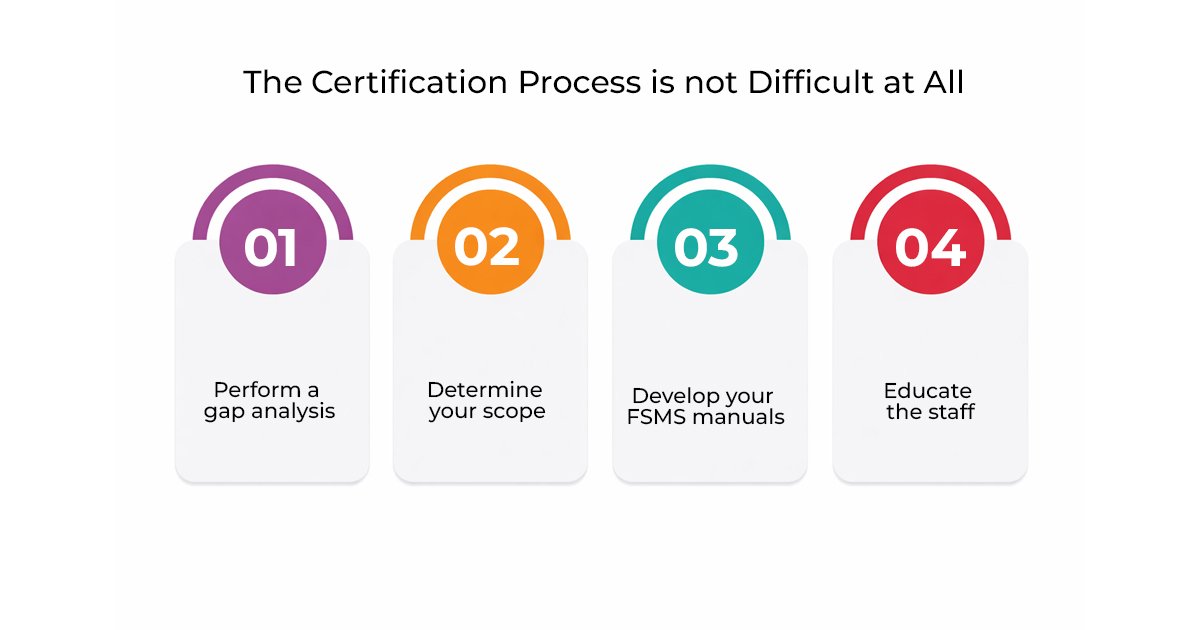
The certification process is not difficult at all, however, it is important for you to think about it as a system-building exercise rather than a paperwork exercise. Following a structured path is essential for success in the iso food industry.
- Perform a gap analysis: Identify areas of your current food safety practices that do not meet the requirements of ISO 22000:2018. Be honest, this measure will prevent you from costly unexpected issues later on.
- Determine your scope: Select which products, sites, and processes you aim to have certified. Properly defining the scope helps to limit the audit time and expenses.
- Develop your FSMS manuals: This should consist of your food safety policy, hazard analysis, prerequisite programmes (PRPs), HACCP plans, and operational procedures.
- Educate the staff: The food safety team and production employees should know the standard well enough to be able to discuss with an auditor their control measures not just to show them a binder.
- Run at least one internal audit cycle: This reveals the non-conformities that you can rectify without an auditor’s observation. Besides, it shows the maturity of the system.
- Hold your management review: ISO 22000 underlines the need for top management commitment. A documented review meeting is a prime piece of evidence that auditors usually seek first.
- Stage 1 audit document review: The certification body you have selected will review your food safety management system (FSMS) documentation and identify any gaps before the on-site visit.
- Stage 2 audit on-site verification: The auditor will come to your facility to check if your documented system is indeed being implemented on the floor. Any non-conformities found at this stage must be resolved before certification can be granted.
- Get your certificate: This is valid for 3 years, with yearly audits to monitor compliance. Remember, the certificate reflects the degree of your commitment to continuing the system.
>Helpful Guide:- Who Needs ISO 22000 Certification in India? – Industries, Business Types & When It Becomes Mandatory
What is the cost of ISO 22000 Certification for Food Manufacturers
Costs for iso food certification india depend heavily on your starting point, facility size, and product complexity. However, here are some realistic ranges for iso food certification india based on what manufacturers have actually spent:
| Business Size | Approximate Total Cost | Typical Timeline |
| Micro / small manufacturer
(1–2 product lines, single unit) |
₹80,000 – ₹1,50,000 | 3 to 4 months |
| Mid-size processor
(multiple SKUs, 1 plant) |
₹1,50,000 – ₹3,50,000 | 4 to 6 months |
| Large manufacturer
(multi-product, multi-site) |
₹3,50,000 – ₹7,00,000+ | 6 to 9 months |
ISO Food Industry Certification Cost Breakdown
Certification body fees: ₹40,000 to ₹1,20,000+ depending on the body (NABCB-accredited bodies carry the most weight in India), facility size, and number of auditor-days required.
Consultant fees: ₹40,000 to ₹2 00 000 depending on scope, the consultant’s experience, and whether they handle documentation end-to-end or just advise. Avoid cutting solely on cost here a poorly built FSMS intended merely to pass one audit is a risk.
Annual surveillance audits: Usually ₹25,000 to ₹60,000 per visit, depending on the facility size and the certification body.
>Helpful Guide:- ISO 22000 Certification Cost In India – Expert Cost Breakdown
How Long Is ISO 22000 Certification Valid and What Does the Renewal Process Look Like?
| Stage | Detail |
| Certificate validity | 3 years from the date of issue |
| Year 1 surveillance audit | Conducted 9–12 months after initial certification |
| Year 2 surveillance audit | Conducted 9–12 months after the first surveillance audit |
| Recertification audit | Full audit at the end of Year 3 to renew for another 3-year cycle |
| What triggers an unscheduled audit | A major non-conformity, product recall, or significant change in your process or facility |
| What happens if you miss a surveillance | The certification body can suspend or withdraw your certificate |
The 3-year certification cycle is certainly not a 3-year break. You are required to keep your FSMS alive and well throughout the entire cycle, by carrying out internal audits, revising your hazard analysis when there are changes in the processes, and ensuring your documents are always up-to-date.
The renewal audit (recertification) is actually a complete audit, not a less extensive one like the surveillance. If your system has deviated from the original during the period from Year 1 to Year 3, the recertification audit will bring it out into the open. Manufacturers who see the certificate as a target rather than a practice are often hit with substantial non-conformities at renewal and the subsequent suspension in some cases.
Advantages Of Getting ISO 22000 Certification for Food Manufacturers
Getting ISO food company certification is a no brainer, since apart from qualifying for more contracts, here is what it offers in terms of operational value:
- You build a fully traceable and auditable food safety system that facilitates the management of recalls and dealing with regulators.
- You gain entry into bigger supply chains that were earlier inaccessible to you, including exports and organised retail.
- You curb internal waste and inconsistencies as the process of developing an FSMS compels you to standardise what was earlier relying on tribal knowledge.
- You establish a legal safeguard for your business. If a product complaint or regulatory inspection arises, written ISO 22000 compliance records prove that your business prioritised food safety, and that factor makes a difference in a hearing.
Key Takeaways
- Conduct a gap analysis yourself before engaging a consultant. By identifying your gaps first, you can clearly brief your consultant and avoid paying for services your team can perform internally.
- Don’t create your food safety management system only to pass an audit. Instead, design it in a way that helps you manage your factory better.
- Choose a certification body based on the one your buyers trust, rather than on who offers the lowest price. A certificate from a body that your buyer does not recognise won’t help you solve anything.
- The 3-month period of implementation before your Stage 2 audit is not a waiting time, during this time you should be able to uncover all the shortcomings your internal team can find.
- Look at surveillance audits as a normal business process, not as an annual event that causes you stress.
>Top trending Guide:- BRC Full Form, Meaning, Certification Process & Cost in India (2026 Guide)
FAQs
What does iso 22000 certification for food manufacturing companies india actually require from a business?
It entails a Food Safety Management System (FSMS) that is documented and operational, including a food hazard analysis and control point program, traceability, and supplier management, and has been in operation for at least 3 months.
What are the food safety certification requirements iso 22000 india mandates before an audit?
Your FSMS should be operational, having completed at least one internal audit cycle and a management review meeting before the Stage 2 audit.
How does the iso certification process for food factory operations work in India?
It is a 2-stage audit, starting with a document review and followed by a Stage 2 on-site audit. The entire process from gap analysis to certification is 4 to 9 months.
How long iso valid once a food manufacturer receives the certificate?
Your certificate is valid for 3 years, subject to passing the mandatory surveillance audits in years 1 and 2 to avoid suspension.
What does the iso renewal process look like at the end of the 3-year cycle?
At the end of the 3-year cycle, a full recertification audit is carried out, which is similar in scope to the original Stage 2 assessment to confirm continued compliance.
What is iso validity india?
Generally, the certificate is valid for 3 years, but you need to pass the surveillance audits in years 1 and 2.