

The manufacturing industry is one of India’s biggest industries, employing thousands of people and covering a range of industries from textiles and auto parts to pharmaceuticals and food processing. However, as global supply chains become increasingly complex and international buyers are forced to conduct more and more stringent due diligence, one question is increasingly being asked at factory gates across India: Do you have a SEDEX certification?
In this guide, we will cover all that manufacturers in India need to know about SEDEX certification for manufacturers.
What Is SEDEX Certification for Manufacturers?
SEDEX stands for Supplier Ethical Data Exchange. It is a global non-profit membership organisation that offers a platform for sharing ethical supply chain information. Therefore, SEDEX certification for manufacturers is not a certificate that is given by any government body. It is more of a status that indicates that your facility has successfully completed a SMETA audit and that your ethical trade information is verified and accessible to your buyers via the SEDEX platform.
Therefore, when buyers from abroad claim that they need SEDEX manufacturing certification, they are actually stating that your facility must have successfully completed a Self-Assessment Questionnaire (SAQ) and that your SMETA audit report is uploaded and shared with them via the SEDEX platform.
For Indian manufacturers exporting to Europe, the UK, the US, and Australia, SEDEX certification for manufacturers is no longer a distant dream. It is a basic necessity that is equivalent to obtaining an ISO certificate and an export licence.
>Helpful Guide:- Urgent Buyer Requirement: Sedex / SMETA Audit Needed Immediately—What’s the Solution?
Why SEDEX Certification for Manufacturers Matters in India
The pace of ethical sourcing has increased exponentially over the last decade. The UK Modern Slavery Act, the German Supply Chain Due Diligence Act, and the EU Corporate Sustainability Due Diligence Directive require global brands to audit the conditions in which their goods are manufactured. Indian factories are at the core of this global supply chain.
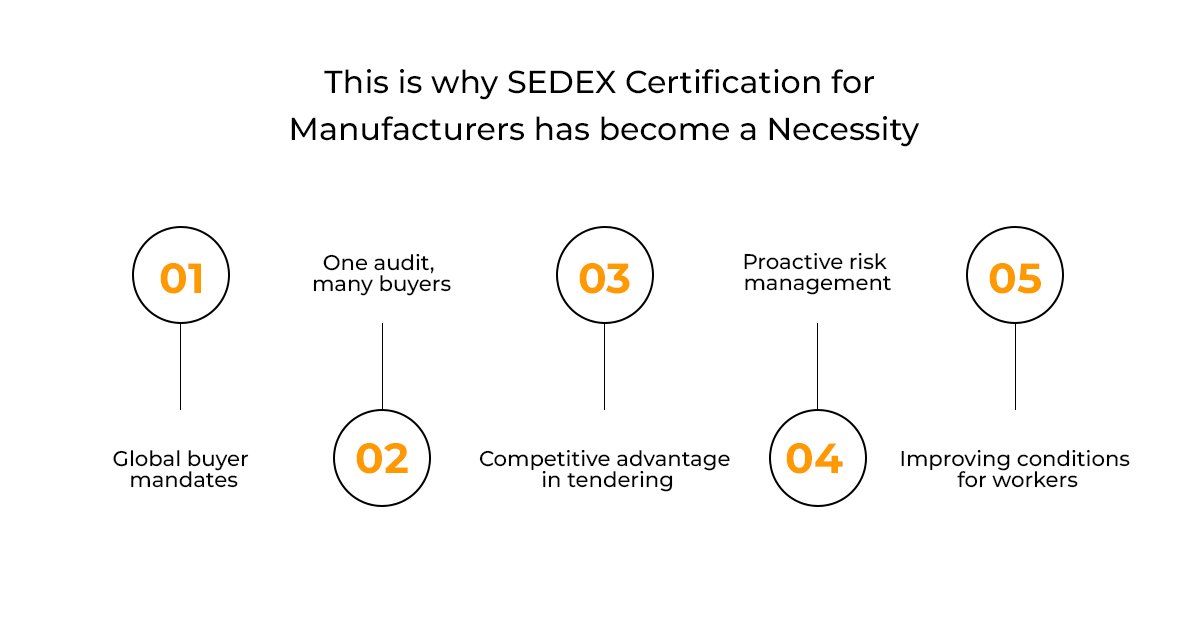
This is why SEDEX certification for manufacturers has become a necessity:
- Global buyer mandates: H&M, Primark, IKEA, Marks & Spencer, Walmart, and many more require all Tier 1 and increasingly Tier 2 suppliers to be SEDEX-certified
- One audit, many buyers: Your SMETA audit report is downloadable by all associated buyers of your SEDEX account, saving you from repeat audits for each buyer
- Competitive advantage in tendering: Manufacturers who are SEDEX-certified are always preferred over non-certified companies in tendering and shortlisting
- Proactive risk management: Manufacturers who undergo the SEDEX audit process are able to mitigate potential labor, safety, and environmental issues before they turn into expensive non-compliance issues
- Improving conditions for workers: Manufacturers who undergo the SEDEX audit process are able to bring about real improvements in working conditions, resulting in lower employee attrition
>Helpful Guide:- Top Mistakes to Avoid in Sedex SMETA Audits | Social Audit
SEDEX Certification for Manufacturing Companies India: Process Overview
The SEDEX certification for manufacturing companies india process is a well-defined process. Here is how it works end to end.
Step 1: Register on the SEDEX Platform
The first step in the SMETA audit certification process is to register your facility on the SEDEX platform at www.sedex.com. Membership to SEDEX is a prerequisite for SMETA audit certification. SEDEX offers two types of membership to its suppliers:
- AB Member – Suppliers who buy and sell to other SEDEX members
- B Member – Suppliers who sell to SEDEX-registered buyers only
Membership fees for Indian suppliers to SEDEX range from $150 to $300 per annum based on membership levels.
Step 2: Complete the Self-Assessment Questionnaire (SAQ)
Before scheduling the SMETA audit, you will be required to complete a Self-Assessment Questionnaire on the SEDEX platform. The Self-Assessment Questionnaire covers labor practices, health and safety, environment, and business ethics.
Step 3: Link With Your Buyer on SEDEX
Your buyer is required to initiate a link request on SEDEX to link with you. Once linked, your buyer will be able to view your audit report and SAQ responses.
Step 4: Choose an Approved Audit Body
The SEDEX SMETA audit needs to be performed by an approved body. In India, there are various approved bodies functioning across key industrial areas such as Delhi NCR, Mumbai, Bengaluru, Tirupur, Surat, and Ludhiana. Some of these approved bodies include Bureau Veritas, SGS, Intertek, and ELEVATE.
Step 5: Pre-Audit Preparation
In this step, many suppliers face difficulties. Before the actual auditing process begins, you will be required to prepare and present various documents such as wage registers, attendance records, and contracts to your auditor. Other key areas to prepare for include health and safety risk assessments, fire drill records, environmental permits, and waste disposal records. An assessment is recommended before the actual auditing process.
Step 6: On-Site Audit
In this step, the approved body will visit your factory for one to two days to carry out the actual auditing process. The SMETA audit process will include a combination of document review, interviewing workers, interviewing management, and a facility walkthrough. The workers will be interviewed confidentially. This is a key step and cannot be tampered with.
Step 7: Corrective Action Plan (CAPR)
The auditor prepares a CAPR after the audit. This contains all the non-conformities identified during the audit. Non-conformities are classified as Critical, Major, and Minor. If there are any instances of child labour or forced labour, the audit fails. Non-conformities must be addressed within a set timeframe.
Step 8: Report Shared on SEDEX
Once all the issues are resolved, the final SMETA report is shared on the SEDEX platform with your associated buyers.
>Helpful Guide:- Benefits Of SEDEX Certification For Your Supply Chain
Documents Needed For SEDEX Certification for Manufacturing
| Pillar | Documents Required |
| Labour Standards | Employment contracts, wage registers, attendance records, overtime records, age verification documents, leave records |
| Health & Safety | Factory licence, fire NOC, fire drill records, first aid training certificates, machine inspection logs, accident registers, PPE issue records |
| Environment | PCB consent certificate (Consent to Operate), ETP maintenance records, effluent test reports, hazardous waste disposal records, energy & water logs |
| Business Ethics | Anti-bribery policy, code of conduct signed by management, grievance mechanism records, supplier sub-contracting agreements |
SEDEX Certification for Manufacturers: Cost Breakdown in India
Costs vary significantly depending on the size of the factory, the sector, and the need for external consultant support. The table below provides a realistic cost estimate for Indian manufacturers.
| Cost Component | Estimated Cost |
| SEDEX B Membership (Annual) | ₹12,000 – ₹20,000 |
| Gap Assessment | ₹15,000 – ₹45,000 |
| SMETA 2-Pillar Audit | ₹35,000 – ₹75,000 |
| SMETA 4-Pillar Audit | ₹55,000 – ₹1,25,000 |
| Document Preparation Support | ₹10,000 – ₹35,000 |
| CAPR Closeout Support | ₹10,000 – ₹30,000 |
| Total Estimated Investment | ₹75,000 – ₹2,20,000+ |
Note that these are one-time costs per audit cycle. SMETA reports are valid for a period of one to two years, after which a re-audit has to be performed in order to renew the active SEDEX certification for the manufacturers.
>Helpful Guide:- Cost Of SEDEX Certification 2026: Full Pricing Breakdown
Which Industries Need SEDEX Certification?

SEDEX certification for manufacturers is most commonly required in the following sectors:
- Garments and textiles
- Home furnishings and handicrafts
- Food and beverages
- Engineering and auto components
- Packaging manufacturers
- Chemical and pharmaceutical contract manufacturers
>Top trending Guide:- BRC Full Form: All 3 Meanings Explained — Food, Export and Education (2026 Guide)
Frequently Asked Questions
What is the SEDEX certification for manufacturing companies India process?
The process includes registering on SEDEX, completing a SAQ, linking to your buyer, and then passing a SMETA audit before your report goes live.
What are the SEDEX audit requirements for manufacturers India?
The requirements include having factory licenses, wage and attendance records, PCB certificates, fire safety records, and having written policies on ethics and grievance issues in all four areas of the SMETA audit.
How does the SEDEX registration process for factories India work?
The SEDEX registration for factories includes registering on SEDEX, creating a factory-specific account on SEDEX, paying the membership fees, and then filling in a detailed SAQ before linking to a buyer.
What are SEDEX requirements India specifically?
The SEDEX requirements in India include Factories Act, Minimum Wages Act, PCB, and ILO core conventions. Auditors check for legal compliance and implementation of ethical trade practices on the factory floor.
What SEDEX documents needed for the audit?
The documents include employment contracts, wage registers, time and attendance records, factory licence, fire NOC, PCB consent certificate, ETP records, code of conduct policy, and anti-bribery policy.
How long does SEDEX certification for manufacturers take in India?
The time taken between registration and publication of a live audit report is between 2 to 4 months. This period can be longer if non conformances are to be addressed.
Is SEDEX certification for manufacturers mandatory by law in India?
It is not mandatory under Indian law. In effect, it is mandatory for factories that sell to international buyers who are registered with SEDEX and will not work with suppliers that are not certified.