
In today’s global supply chain, SEDEX certification for small business is becoming more and more important. Whether you are looking to export or are a supplier looking to work with international buyers, learning about SEDEX india requirements can give your business a competitive edge. In this guide, we will cover everything small business owners need to know about SEDEX certification, from the costs to the specific SEDEX benefits small business organizations can expect.
What is SEDEX Certification for Small Business?
SEDEX certification for small business means that your company becomes a member of the SEDEX (Supplier Ethical Data Exchange) scheme, which verifies your company’s adherence to responsible sourcing criteria. The SEDEX scheme is a worldwide solution that enables companies to prove their commitment to ethical business practices, labor policies, environmental regulations, and health & safety policies.
For small businesses, SEDEX certification means that you can prove to other companies that you adhere to ethical policies in your operations. Many multinational companies require their suppliers to be members of the SEDEX scheme, which means that having SEDEX certification for your small company can increase your opportunities in the international market, whether you are in India or any other country.
Importance of SEDEX Certification for Small Business
In today’s business environment, the requirement of SEDEX export standards for businesses is of utmost importance. For instance, today’s retailers, brands, and multinational companies are demanding that their supply chain partners should be members of SEDEX.
For small businesses, especially in emerging markets such as India, SEDEX export requirements can be both an opportunity and a challenge for businesses, as they would require investment in order to improve their access to premium international buyers who would be willing to pay premium prices for their products.
Benefits of SEDEX Certification for Small Business
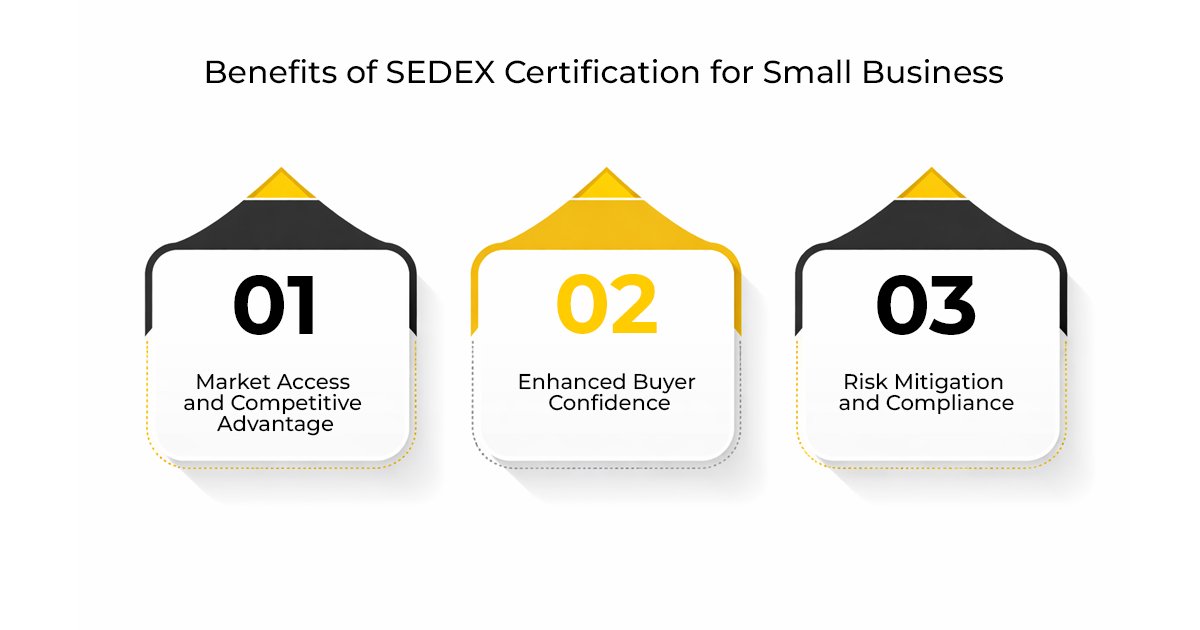
- Market Access and Competitive Advantage
One of the greatest advantages of SEDEX certification for small business organizations is that it helps them access global markets. In fact, there are a number of international buyers who search for SEDEX-certified suppliers on the SEDEX platform. This helps them increase business opportunities that might not have otherwise been available.
Small business organizations that are certified by SEDEX often report that they receive a number of inquiries from large multinational companies and brand names.
- Enhanced Buyer Confidence
SEDEX is also beneficial to small businesses in the sense that it offers third-party validation of your ethical credentials. Audits carried out by SEDEX auditors will verify your claims of ethical credentials in labor practices, safety of workers, environment, and business ethics. This will give international buyers confidence in your supply chain.
For small businesses, this is extremely valuable. Without SEDEX membership, international buyers may be apprehensive about working with unknown suppliers, which are perceived to be of higher risk. SEDEX membership is therefore an equalizer for small businesses to compete with larger suppliers.
- Risk Mitigation and Compliance
Adhering to SEDEX standards enables small businesses to minimize compliance risks. This is because the process of self-assessment forces businesses to scrutinize their activities and make the required improvements. This is essential in avoiding costly non-compliance.
Furthermore, the SEDEX mandatory india regulations are becoming more and more strict. However, having the SEDEX standard ensures that your business is not affected.
>Helpful Guide:- Urgent Buyer Requirement: Sedex / SMETA Audit Needed Immediately—What’s the Solution?
Process Of SEDEX Certification for Small Business
Step 1: Register and Become a SEDEX Member
The first step in the SEDEX certification process for small business India is the registration process on the SEDEX platform. You need to visit the SEDEX website and register your company. In the process of registering your company with SEDEX, you need to provide basic details about your company.
The process of membership registration with SEDEX is easy and can be completed in just a few hours. However, it is important to note that the details provided during the time of registration should be correct in order to avoid any delays in the certification process. Once the registration process is complete, you can access the SEDEX member portal.
Step 2: Complete the Self-Assessment Questionnaire
The next step, after your company gains membership, is to fill out a comprehensive questionnaire called the SAQ, which is divided into four modules: labor practices, health and safety, environmental responsibility, and business ethics. It is an essential tool for SEDEX requirements for small companies india.
The SAQ process can take 1-3 weeks, depending on your company’s preparedness to fill out the questionnaire.
Step 3: Prepare Documentation
While working on the SAQ, all supporting documentation should be collected. This documentation could be in the form of payroll records, contracts, safety certifications, environmental permits, audit reports, etc. When it comes to small company requirements in SEDEX certification, documentation could be in the form of:
- Employee contracts and records
- Wage registers and payroll documentation
- Health and safety policies and records
- Environmental compliance certificates
- Code of conduct/business ethics documentation
Step 4: Schedule and Conduct the Audit
Once your documentation is ready, it is time to schedule your audit appointment with an approved auditor of SEDEX. The duration of the audit may vary from 1-3 days for small companies. This is where the SEDEX certification process for small business india gets concrete.
What to expect from the SEDEX certification audit:
When you undergo an audit, your claims as specified in your SAQ will be verified. In addition, it will also be verified whether your documented policies and procedures are being implemented in your business.
Step 5: Address Non-Conformances
Once the audit is done, you will receive a report containing details of non-conformances found. These are of critical, major, or minor nature. It is your responsibility to implement corrective action plans for non-conformances found. These are to be done within a stipulated time frame.
For small businesses, non-conformances may include developing or improving policies, documentation, and training of employees. A verification will be done by the auditor to ensure that all non-conformances are addressed.
Step 6: Receive Certification
After all the non-conformances are resolved to the satisfaction of the auditor, you would be issued your SEDEX certification. Your company would be listed on the SEDEX platform as a certified supplier, making you visible to international buyers. The validity of your SEDEX certification would be for 24 months, after which you would have to undergo the process of re-certification.
>Helpful Guide:- Top Mistakes to Avoid in Sedex SMETA Audits | Social Audit
Cost of SEDEX Certification for Small Business
Membership Costs
SEDEX membership is free for small businesses and suppliers. There are no recurring membership fees, making it an accessible entry point for companies exploring ethical certification.
Audit Costs
The cost of external audit depends on several factors, including the number of employees, facility size, number of sites, and duration of audit. The more employees or larger the facility, the more it will cost.
Here is a table showing the cost of external audit for small businesses in India depending on company size:
| Company Size | Audit Duration | Cost |
| Micro (10-50 employees) | 1 day | ₹30,000 to ₹40,000 |
| Small (51-150 employees) | 1-2 days | ₹50,000 to ₹65,000 |
| Medium (151-250 employees) | 2-3 days | ₹75,000 to ₹100,000 |
Internal Implementation Costs
| Cost Category | Estimated Cost Range |
| Consultation & Documentation Support | ₹15,000 to ₹40,000 |
| Staff Training & Awareness Programs | ₹10,000 to ₹30,000 |
| Policy Development & Documentation | ₹10,000 to ₹25,000 |
| Infrastructure & Safety Improvements | ₹20,000 to ₹60,000 |
| Record Keeping Systems & Management | ₹5,000 to ₹15,000 |
| Total Internal Costs | ₹60,000 to ₹170,000 |
For small businesses that already have sound practices, these costs may be minimal. However, for small businesses that need improvements, these costs should be factored into the budget.
This is a general overview of all the costs involved in the initial SEDEX certification process.
| Cost Component | Cost Range (INR) |
| SEDEX Membership | FREE |
| Third Party Audit | ₹30,000 to ₹100,000 |
| Internal Implementation | ₹60,000 to ₹170,000 |
| Total Initial Investment | ₹90,000 to ₹270,000 |
Surveillance Audit Costs
SEDEX certification is valid for a period of 24 months. After this time, a re-certification audit will be required, and this will have the same costs as the initial audit. In addition, there are some buyers who may require surveillance audits to be carried out within the certification period, and this will be less expensive but should be budgeted for.
>Helpful Guide:- Cost Of SEDEX Certification 2026: Full Pricing Breakdown
Is SEDEX Certification Mandatory in India?
One of the first questions that small businesses often have is whether SEDEX mandatory india regulations exist. From a legal standpoint, it is true that technically, being certified by SEDEX is not mandatory in India. However, SEDEX required export standards make it effectively mandatory for businesses that wish to export to certain countries or brands.
For example, major international brands in certain sectors, such as apparel, footwear, food processing, etc., often demand that their suppliers be certified by SEDEX. Therefore, for them, being certified by SEDEX is effectively mandatory.
Also, certain export-oriented sectors in India have started making it a standard practice for businesses in that sector to be certified by SEDEX. This is because they believe that being certified by SEDEX is good for India’s reputation in the global market, which in turn is good for Indian businesses.
For small businesses that do not currently have any business with international brands, being certified by SEDEX is not necessarily mandatory. However, if small businesses get ahead of the curve with regards to being certified by SEDEX, then they could stand to reap significant benefits.
>Helpful Guide:- Benefits Of SEDEX Certification For Your Supply Chain
Overcoming Challenges in SEDEX Certification for Small Business
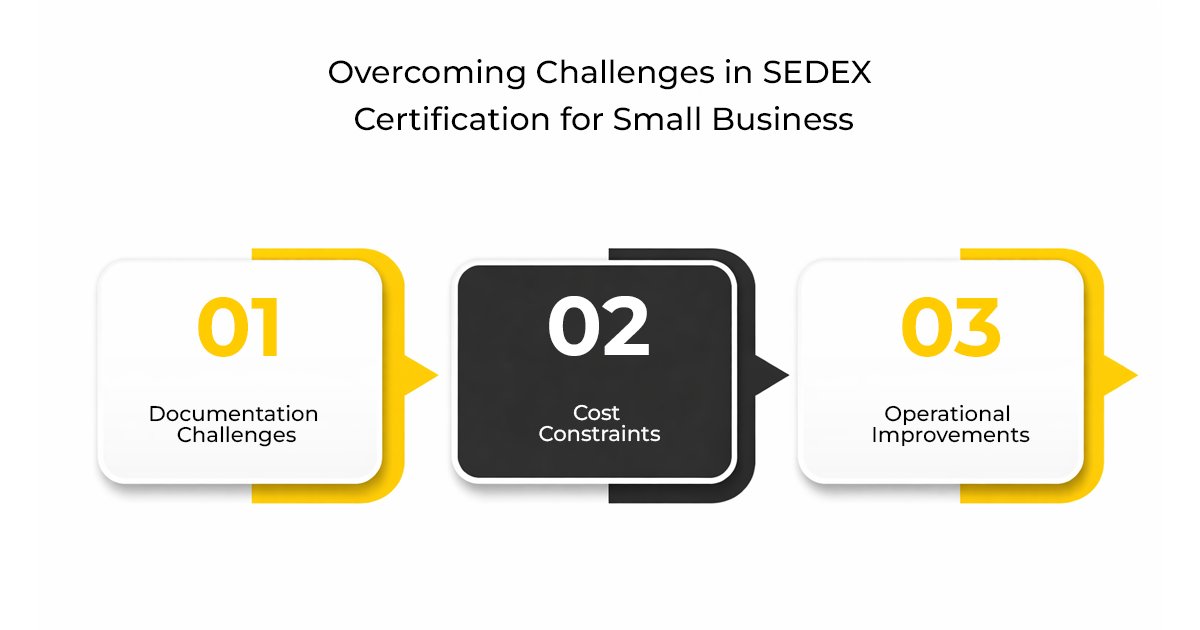
Documentation Challenges
Small businesses often have difficulties with documentation requirements during SEDEX certification small company processes. To avoid this, documentation systems should be put in place from the beginning. Digital documentation tools should be used if possible, and all employees should be made aware of the need for documentation.
Cost Constraints
For small-scale operations, the costs of audits may mean a sizable investment. In order to keep costs low, quotes from a number of approved auditors should be sought, and there may be opportunities for cost sharing through industry associations. The long-term benefits of gaining access to international markets outweigh the initial costs.
Operational Improvements
Some of the small businesses may require substantial changes in their operations to comply with the requirements of the SEDEX standard. It is important to address such changes in an orderly fashion by prioritizing key issues, engaging employees in the process of improvements, and seeking professional assistance from industry experts if necessary.
It is worth noting that by seeking to comply with the requirements of the SEDEX standard, businesses can experience improved operational efficiencies, employee satisfaction, and lower probabilities of violating regulations, all of which are beyond the scope of the standard itself.
Key Takeaways
- SEDEX certification of small business in India proves ethical and responsible business practices to international buyers
- SEDEX certification involves membership, self-assessment, and audits to check compliance
- SEDEX certification of small business in India has several benefits, including access to markets and buyers
- SEDEX certification is mandatory for certain export practices, but the costs of certification are manageable if planned properly
- SEDEX certification in India has witnessed tremendous growth in small exporters who want to access international markets.
>Top trending Guide:- BRC Full Form: All 3 Meanings Explained – Food, Export and Education (2026 Guide)
Frequently Asked Questions
What are the SEDEX requirements for small companies india?
The requirements involve membership registration, completion of the self-assessment questionnaire, documentation of labor practices, health and safety, environmental issues, and passing the third-party audit.
How long does the SEDEX certification process for small business india typically take?
The process usually takes between 2-4 months after the membership registration. However, this depends on your own preparedness and the speed at which you address the audit issues.
What are the main benefits of SEDEX certification for small business?
The benefits of joining the SEDEX certification scheme involve access to global markets and the ability to be visible on the SEDEX platform for international buyers.
Is SEDEX certification mandatory for exporting from India?
Not mandatory by the Indian government, but SEDEX required export standards mean that most international buyers require it. For companies who wish to win premium export deals, obtaining certification is practically essential.
How often must small companies undergo SEDEX re-certification?
SEDEX certification is valid for 24 months. After this period, companies have to undergo a complete re-certification audit. Some buyers may also require surveillance audits to be conducted within the validity period.
Can small businesses with limited resources afford SEDEX certification?
Yes. It is free, and the cost of an audit (₹30,000-₹100,000) is within the reach of most small businesses, provided it is amortized over the 24-month validity period.
What are the SEDEX export rules for ethical trade?
Exporters must register on the SEDEX platform and pass a SMETA audit (2-pillar or 4-pillar) covering labor, safety, and ethics to be approved by international buyers.