

Suppose you are running a food processing business in India and are preparing yourself for an FSSC 22000 Certification. One of the most important steps that you need to undertake before undergoing the audit process is getting your documentation sorted. Your auditor will examine not only your process flow but also your documents. The absence of one important document can put you behind schedule.
This blog will provide you with all FSSC 22000 certification documents needed for your food processing business in India in 2026. From policy documentation to system documentation, everything that you should consider while preparing for your FSSC 22000 Certification is listed below.
Why FSSC 22000 Certification Documents Matter for Food Businesses in India
FSSC 22000 (Food Safety System Certification 22000) is an internationally recognized Food Safety Management System certification based on ISO 22000, Sector Specific PRP (Prerequisite Programmes) & Scheme of the FSSC. Being a manufacturer, exporter or processor in India, getting this certification will automatically ensure that you meet food safety criteria globally.
Documentation will be the foundation of your FSMS. Without adequate documentation, even the best procedures will not be able to prove their worth through any auditing firms. Since India has various competing bodies like FSSAI, it is important to comply with both standards through adequate documentation.
FSSC 22000 Certification Documents Required
The following is a detailed checklist of all the documents required for obtaining the FSSC 22000 certification. The checklist is divided into categories.
Organizational and System-Level FSSC 22000 Certification Documents
This chapter includes the most important certificates related to the food safety management system at an organizational level.
- Food Safety Policy: Food Safety Policy signed and dated by the top management.
- Scope of the FSMS: Scope of the food safety management system is mentioned in this certificate.
- Organization Structure: Updated organization structure of the food safety management system.
- Minutes of Management Review Meeting: Record of minutes of management review meeting.
- Internal Communication: Internal communication procedures relating to food safety.
- External Communication: External food safety communication with authorities and others.
Food Safety Plan Documentation (HACCP-Based)
This is the most important set of FSSC 22000 certification documents. The Food Safety Plan shall incorporate principles of HACCP and align with ISO 22000 requirements.
- Hazard analysis document: Complete list of all biological, chemical, and physical hazards at each process step.
- HACCP plan: Documented Critical Control Points (CCP), critical limits, monitoring, correction action, and verification.
- Flow diagrams and on-site verification: Process flow diagrams validated with on-floor operations.
- PRPs documentation: Documented PRP program addressing cleaning and sanitation, pest management, allergens, personnel hygiene, and maintenance.
- OPRPs: Operational controls documented for hazards not covered by CCPs.
- Food safety objectives: Targets defined to support the organization’s food safety policy.
Mandatory Procedures as FSSC 22000 Certification Documents
The FSSC guidelines state that certain procedures must always be put into place. There is no room for compromise when considering a food processing business that aims to get certified.
- Document Control Procedure: Outlines the processes involved in document creation, review, approval, distribution, and disposal.
- Record Control Procedure: Indicates how records are maintained and controlled for auditing purposes.
- Corrective Action Procedure: Details the process of identifying, investigating, and correcting problems within the facility.
- Internal Audit Procedure: Describes the planning, conduct, reporting, and follow-up of internal audits.
- Allergen Control Procedure: Specifically deals with issues related to allergen cross-contamination.
- Product Recall and Withdrawal Procedure: A documented procedure and contingency plan for recalling hazardous products from the market.
- Traceability Procedure: Details the traceability process, starting from the procurement of materials until their production.
- Emergency Preparedness and Response Procedure: Contingency plans for food safety emergencies.
Monitoring and Measurement Records as FSSC Audit Documents
The auditors will pay close attention to these documents when conducting the FSSC audit documents review process. Make sure that all monitoring documents have accurate and retrievable information.
- CCP Monitoring Documents: Temperature recording, timing, and other CCP measurement data.
- Calibration Documents: Certificates and logs for all monitoring and measurement devices employed in food safety critical operations.
- Sanitation and Cleaning Documents: Sanitation schedule and log for all cleaning activities.
- Pest Management Documents: Pest management services reports and internal inspections logs.
- Supplier Evaluation Documents: Qualification, evaluation, and monitoring performance of all suppliers’ documents.
- Incoming Material Inspection Documents: Log of all raw material inspections, lab test results, and acceptance/rejection status.
Training and Competency Documentation
Incomplete documentation of training is a common weakness in FSSC audit readiness. It is imperative that you keep these up-to-date and properly organized.
- Training Documentation of All Staff Members:This includes food handling staff, supervisory staff, and the food safety team.
- Training Documentation for Competence of Food Safety Team:Proof that the food safety team possesses the necessary credentials and experience.
- Hygiene Training Documentation:Documentation that confirms all staff members are trained to maintain proper hygiene standards.
- Induction Documentation for Visitors/Contractors:Evidence that visitors and contractors are informed about hygiene and safety standards.
India-Specific Regulatory Documents for FSSC Audit Checklist India
For Indian food companies, the FSSC audit checklist india would require the inclusion of legal and regulatory compliance documentation as well.
- FSSAI License/Registration Document: A valid and current FSSAI license.
- State Pollution Control Board Consent: Required if you have manufacturing facilities that need environmental permission.
- Water Quality Test Report: This is a report from the laboratory to prove that your facility has potable water quality (important for manufacturers of beverages and processed foods).
- Fire NOC & Factory License: Legal and regulatory compliance documentation required according to Indian laws.
- Compliance Register: This is a record of all legal food safety requirements according to Indian and international standards.
FSSC Scheme-Specific Additional Requirements
Apart from the ISO 22000 standard, there are additional requirements for the FSSC 22000 scheme. These requirements need to be documented separately.
- Food Fraud Vulnerability Assessment: Documentation for evaluating and mitigating the threat of economically motivated food fraud.
- Food Defense Plan: Documentation for evaluating and mitigating the threat of intentionally contaminating food products.
- Use of FSSC 22000 Logo and Certificate: Proof that the FSSC 22000 logo has been used appropriately in accordance with the scheme.
- Preparedness for Unannounced Audits Documentation: Internal documentation of readiness for an unannounced audit.
FSSC Audit Steps: How Documents Are Reviewed
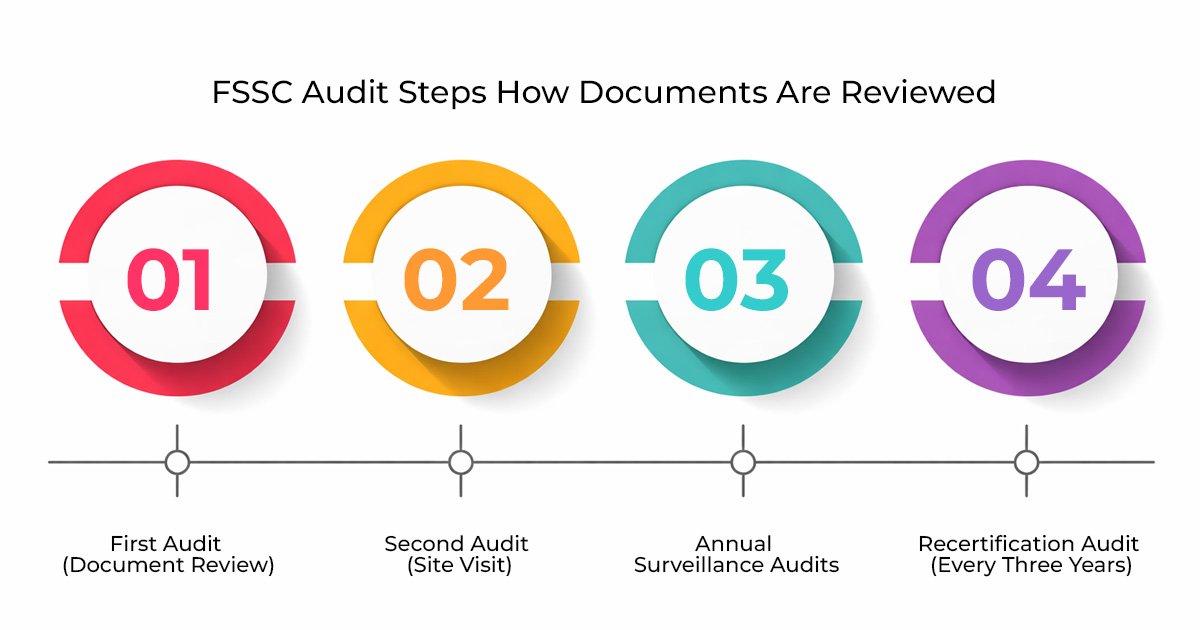
Understanding the FSSC audit steps helps food businesses structure their documentation correctly. A typical FSSC 22000 certification audit follows this sequence:
- First Audit (Document Review): Here, auditors will check your FSMS documentation, including the Food Safety Plan, mandatory processes, and FSSC audit documents, against the requirements of the standard. All gaps noted at this stage should be addressed prior to the next stage.
- Second Audit (Site Visit): At this stage, the auditor will determine whether what you have documented in the FSSC audit documentation matches reality. There will be an inspection of monitoring documents and interviews of workers during this visit.
- Annual Surveillance Audits: After certification, annual surveillance audits take place, where revised documents, employee training records, and management review results will be checked.
- Recertification Audit (Every Three Years): This audit involves reviewing all FSSC 22000 documents and compliance with requirements.
FSSC Audit Preparation: Tips for Managing Your FSSC 22000 Certification Documents
- Conduct Gap Analysis: Do a gap analysis between your current list of documents and the requirements set out in the FSSC 22000 standard.
- Versioning and Revisioning: All documents must have a version number, revision number, and the signature of the authorizing individual. Outdated versions need to be stored and deleted from live storage.
- Document Mapping: The document storage needs to be mapped according to the clauses under the FSSC 22000 standard.
- Document Management System: Even a well-maintained drive will suffice as a document management system for Indian SMEs looking to get certified under the FSSC 22000 certification.
- Mock Audits: Run a simulated audit in the company using your FSSC audit checklist india.
- Document Retrieval Training: Auditors often ask for certain records at the drop of a hat. Team members should know which folder to go to whenever required.
Common Documentation Mistakes That Derail FSSC 22000 Certification
However, even experienced food companies commit mistakes in their documentation which lead to significant nonconformities. Below is a list of the most commonly found mistakes during audits performed in India according to FSSC standards:
- Undated/Unsigned Documents: Documentation that is neither dated nor signed cannot be used as an evidence of the processes being carried out by the company.
- Outdated Procedures: The use of outdated procedures leads to inconsistency between documentation and practice.
- Incomplete HACCP Study: One of the main reasons for failure in Stage 1 is omission of hazard analysis concerning certain ingredients and operations.
- Lack of Traceability Information: Being unable to trace a finished product to its raw ingredients is one of the most important problems.
- No Evidence of Management Review: Many companies undertake management review meetings but have no proof of the same.
>Helpful Guide:- FSSC 22000 Certification Cost In India: Complete Process
Key Takeaways
- Documentation of FSSC 22000 certifications covers required procedures, records, food safety plans, and system documentation.
- Specific Indian regulations like FSSAI licenses should also be considered along with international standards of FSSC.
- Good maintenance of an FSSC checklist prevents problems for food companies during FSSC audit documents check.
- Documents need to be kept in control versions, updated, and available to the auditor during FSSC audit document review.
- Good document preparation saves time for audits and improves the likelihood of successful certification.
Top Trending Guide:- BRC Full Form: All 3 Meanings Explained – Food, Export and Education (2026 Guide)
Frequently Asked Questions
What is the FSSC 22000 certification required documents checklist india food businesses must prepare?
The checklist includes your Food Safety Plan, HACCP documentation, mandatory procedures, monitoring records, training logs, supplier evaluation records, and India-specific regulatory documents such as your FSSAI license.
What are the FSSC audit documentation requirements india auditors focus on most?
Auditors prioritize the HACCP plan, CCP monitoring records, corrective action logs, and internal audit reports as core FSSC audit documentation requirements india. Missing or incomplete records in these areas typically result in major non-conformities.
Where can I find the complete FSSC certification document list?
The official FSSC certification document list is derived from ISO 22000:2018, your sector-specific PRP standard, and the FSSC 22000 additional requirements. This blog compiles it all in one place for easy reference.
How should I prepare for the FSSC audit checklist india review stage?
Organize your documents by FSSC 22000 clause, ensure all records are current and signed, and conduct an internal mock audit using the FSSC audit checklist india before your Stage 1 assessment.
What are the key FSSC audit steps for a first-time certification?
The FSSC audit steps include Stage 1 (document review), Stage 2 (on-site audit), and then ongoing annual surveillance audits. Completing a gap analysis and full document preparation before Stage 1 is critical for success.
How long does FSSC audit preparation take for an Indian food business?
Typically, FSSC audit preparation takes three to six months, depending on the current state of your documentation and food safety system. Businesses with existing ISO or FSSAI systems often complete it faster.
Are FSSAI documents considered part of the FSSC 22000 certification documents required?
Yes, FSSAI license documents form part of the regulatory compliance evidence within your FSSC 22000 certification documents required package, particularly for demonstrating legal compliance under applicable Indian food laws.