
As far as business enterprises are concerned, when they are looking into various certifications available on an international level, the discussion about SA 8000 and ISO 9001 is the most popular topic of confusion among all. Although both are internationally accredited, both provide credibility to consumers and stakeholders alike, they play very different roles. The distinction between the two becomes important, and the choice for the right certification becomes significant.
In this article, we explain the differences between the two certifications in simple terms so that you may be able to choose whether you need either or both certifications for your business enterprise.
SA 8000 vs ISO 9001: What Are These Certifications
SA 8000
Social Accountability 8000, also known as SA 8000, is an internationally accepted standard designed by Social Accountability International (SAI). This international standard addresses issues relating to social accountability in the workplace, including issues concerning child labor, forced labor, health and safety, freedom of association, discrimination, discipline, hours of work, and compensation. These issues have their origins in internationally recognized human rights standards, such as those set out in ILO conventions.
SA 8000 is particularly pertinent for manufacturers and suppliers who are concerned with showing social accountability rather than quality management issues.
ISO 9001
The ISO 9001 quality management system is the most globally implemented quality management system standard, issued by the International Organization for Standardization. The standard offers a process-oriented approach and focuses on meeting customer needs, quality control, and continuous improvement.
ISO 9001 differs from SA 8000 since the former standard focuses exclusively on quality management, whereas the latter includes social standards related to employees’ rights and working conditions.
SA 8000 vs ISO 9001: A Side-by-Side Comparison
This is the direct comparison between SA 8000 and ISO 9001 on the key aspects.
| Parameter | SA 8000 | ISO 9001 |
|---|---|---|
| Focus Area | Social accountability & worker rights | Quality management systems |
| Issuing Body | Social Accountability International (SAI) | International Organization for Standardization (ISO) |
| Primary Beneficiary | Employees / Workers | Customers / End-users |
| Scope | Labour practices, ethics, human rights | Process quality, customer satisfaction |
| Audit Type | Third-party social audits | Third-party quality audits |
| Applicable Industries | Manufacturing, textiles, supply chain | All industries universally |
| Renewal Cycle | Annual surveillance + 3-year re-cert | 3-year cycle with annual surveillance |
| India Relevance | High for export-oriented factories | High across all sectors |
SA 8000 vs ISO 9001: Core Differences Explained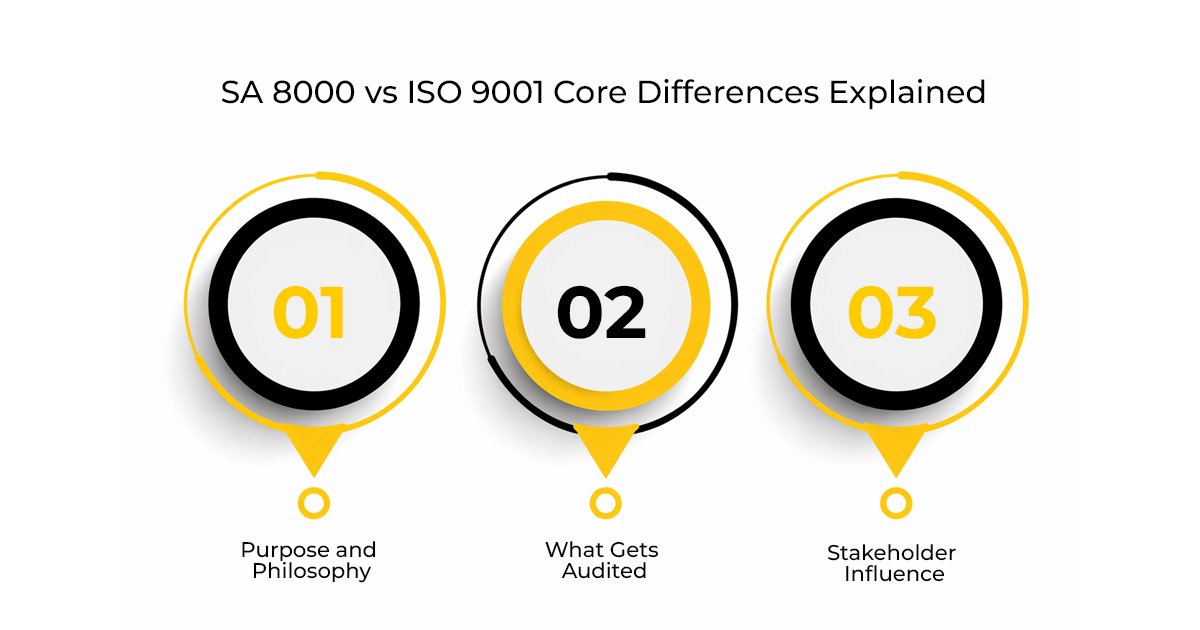
- Purpose and Philosophy
Probably the most obvious distinction between SA 8000 and ISO 9001 is in the nature of their purposes. SA 8000 represents a human rights standard: it aims at preventing abuse of labor in all aspects. In contrast, ISO 9001 represents an approach to achieving high-quality products and services, i.e., it is about ensuring high customer satisfaction.
When contrasting social accountability against quality management, one can say that the first certification demonstrates ethical accountability while the latter is about operational efficiency and reliability.
- What Gets Audited
As far as the audit of SA 8000 is concerned, there will be checks of factories, conversations with employees (including confidential ones), review of salaries, examination of contracts, and assessment of health and safety conditions. The auditor searches for any evidence of forced labor, extra working hours, exploitation of children, etc.
Regarding the audit of ISO 9001, this involves inspection of documentation, evaluation of quality control procedures, verification of internal auditing, results of management reviews, implementation of corrective actions, etc. There is no requirement to interview workers – only to examine the quality management system itself.
- Stakeholder Influence
The SA 8000 standard is mainly stakeholder-oriented, driven by buyers from Europe and North America who seek ethical procurement commitments. The ISO 9001 standard is a customer-oriented standard that is contractually mandatory in most industries such as the healthcare, automobile manufacturing, and information technology sectors.
From an Indian manufacturer’s perspective, determining which certification (SA 8000 vs. ISO 9001) is more advantageous for exporting products to foreign markets requires evaluating the target markets. For example, European fashion and retail brands require SA 8000 compliance, whereas ISO 9001 is required by almost all industries globally.
SA 8000 vs ISO 9001 for Manufacturers in India
The manufacturing industry in India, especially clothing, leather, household goods, and processed foods, is increasingly being put under social compliance pressure by international buyers. Should I opt for SA 8000 or ISO 9001 for my manufacture in India is certainly not a trivial issue.
A number of big Indian exporters have been certified in both. SA 8000 provides a competitive advantage to them when dealing with ethical buyers in Europe and the US, whereas ISO 9001 caters to quality considerations of business clients globally. Small manufacturers usually opt for ISO 9001 certification first because of its wider utility in commerce, after which they can obtain the SA 8000 standard as they grow in export volume.
Buyers in government-led procurements as well as the Indian domestic market usually prefer ISO 9001. International buyers who buy in highly-regulated industries generally require an SA 8000 or even an SMETA (Sedex Members Ethical Trade Audit).
SA 8000 vs ISO 9001: Can a Company Have Both
Yes, in most instances, having both would be the right strategic approach. One of the most commonly asked questions among growing manufacturing firms is whether a firm can possess both SA 8000 and ISO 9001.
The two standards are indeed complementary; whereas ISO 9001 guarantees that all your processes and products are quality-based, SA 8000 will guarantee that your employees are treated with dignity and respect. Both will therefore paint the entire picture of responsible and quality-minded organizations.
There are even similarities with regards to documentation. Both standards require commitment from management, internal audit, and continuous improvement. With good planning, documentation frameworks can be made to overlap without any problems.
Furthermore, most certification firms provide integrated audits for both certifications, making it easy to obtain and retain them.
SA 8000 vs ISO 9001: Which Is Better For Your Business
No standard solution exists regarding whether SA 8000 is preferable to ISO 9001, and vice versa, since it all comes down to your particular business approach and target audience.
Select SA 8000 when:
- You run a manufacturing or supplying company in the clothing, textile, leather, or food sector
- Your customers hail from Europe or North America and expect proof of ethical sourcing
- The pressure from NGOs, the press, or ESG analyses by investors increases
- You aim for a socially responsible image as an employer
Select ISO 9001 when:
- Your customers need documented systems of quality management
- The field you operate in is one of services, technologies, healthcare, or engineering
- You would like to streamline your internal operations and avoid defects
- You are bidding for governmental or corporate projects
Think about both certificates if you are an export producer catering to global consumers interested in high-quality products and manufacturing based on ethical principles.
Also read: SA 8000 Certification In India – Get Certified Quickly
Key Takeaways
- SA 8000 safeguards workers’ rights while ISO 9001 guarantees the quality of products/services, both are concerned with completely different aspects of organizations.
- Where SA 8000 and ISO 9001 differ is that one certifies whether you are treating your workers well, while the other certifies the performance of your systems.
- Exporters of manufactured goods in India will have to comply with the SA 8000 certification since it is becoming mandatory for ethical sourcing buyers in international markets.
- The two certifications can indeed coexist within your organization – the standards complement each other and can be audited together.
- The optimal decision would be contingent upon the nature of your industry as well as markets and buyer demands; if in doubt, choose ISO 9001 first, followed by SA 8000.
SA 8000 vs ISO 9001: Key Differences & Which Certification Your Business Needs
Get expert help to choose the right certification and ensure hassle-free compliance for your business.
Frequently Asked Questions
What is SA 8000 certification?
SA 8000 is an international standard on social accountability. Certification implies that a company complies with regulations regarding ethical treatment of workers, including no child labor, no forced labor, safe working conditions, proper working hours, and fair wages.
Who needs SA 8000 certification in India?
Manufacturers and suppliers exporting products like textiles, leather goods, electronics, and consumer goods—especially those working with European or American brands—often require SA 8000 certification.
How to get SA 8000 certification in India?
Start with a gap analysis, develop policies, implement required changes, conduct internal audits, and then undergo certification by an accredited body. The process typically takes 3 to 6 months.
What is the SA 8000 certification process step by step in India?
The steps include understanding the standard, gap analysis, policy creation, implementation, internal audit, certification body selection, Stage 1 and Stage 2 audits, corrective actions, and final certification with ongoing surveillance audits.
What are the SA 8000 certification requirements for factories in India?
Requirements include no child or forced labour, workplace safety, freedom of association, no discrimination, regulated working hours, fair wages, and a documented management system.
Is SA 8000 mandatory for export?
It is not legally mandatory, but many international buyers require it contractually, especially in garments, leather, and furniture sectors.
How long is SA 8000 certification valid in India?
Certification is valid for three years, with surveillance audits conducted every six months.
What is the difference between SA 8000 and ISO 9001?
SA 8000 focuses on social accountability and worker rights, while ISO 9001 focuses on quality management systems and consistent product/service delivery.
Can you get SA 8000 and ISO 9001 together?
Yes, many organizations obtain both certifications simultaneously, and some certification bodies offer integrated audits to reduce cost and effort.
Which is better SA 8000 or ISO 9001?
Neither is universally better. ISO 9001 is broadly applicable across industries, while SA 8000 is essential for businesses focused on ethical labor practices.
What is better for export: SA 8000 or ISO 9001?
SA 8000 is often preferred by European and US buyers for ethical sourcing, while ISO 9001 is required across most industries for quality assurance.
How does the cost of SA 8000 compare with ISO 9001?
SA 8000 audits may be more intensive due to social compliance checks, but overall certification costs are similar. Integrated audits can reduce expenses.
Is SA 8000 vs ISO 9001 relevant for manufacturers in India?
Yes, both are highly relevant. ISO 9001 ensures quality compliance, while SA 8000 is increasingly required by international buyers for ethical sourcing.
How do these certifications impact business reputation?
SA 8000 enhances trust with employees and ESG-focused stakeholders, while ISO 9001 demonstrates operational excellence. Together, they significantly strengthen brand credibility.