India has the biggest food processing industry in the world. The sector plays a pivotal role in the country’s economic development by forming an integral part of the gross domestic product (GDP) and generating employment opportunities for millions of people. But along with such massive production comes the great responsibility for ensuring that each food product that finds its way to consumers’ tables complies with quality and safety standards.
Good manufacturing practices food industry standards form the basis for food safety control systems. It will become especially important to comply with the good manufacturing practices in the food industry as the year 2026 approaches with stricter regulations from FSSAI and growing export demand.
This comprehensive guide provides all necessary information about GMP compliance food manufacturers India.
What Are Good Manufacturing Practices Food Industry
GMP in the food industry is defined as a set of standards, procedures, and controls implemented in order to make sure that food items are consistently manufactured and controlled in accordance with their quality and safety requirements. The GMP standards cover all the aspects of manufacturing, ranging from the procurement of the raw materials to the shipment of the finished product.
The GMP requirements in India have been standardized and made enforceable through the Food Safety and Standards (Licensing and Registration of Food Businesses) Regulations, 2011, under the aegis of the Food Safety and Standards Authority of India (FSSAI). The Indian GMP standards have been heavily influenced by the guidelines laid down by Codex Alimentarius, ensuring that Indian GMP standards are internationally acceptable.
GMP in the food industry primarily covers six areas:
- Premises and plant design
- Equipment maintenance and sanitation
- Personnel hygiene and training
- Raw material control and traceability
- Production and process control
- Documentation and record-keeping
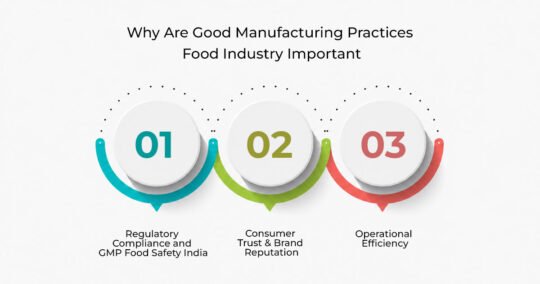
Why Are Good Manufacturing Practices Food Industry Important
The significance of good manufacturing practices cannot be understated in the field of food production. The number of people falling sick from consuming contaminated food is very high in India, and a significant portion of them can be attributed to poor manufacturing practices.
-
Regulatory Compliance and GMP Food Safety India
GMP compliance is mandatory under the licensing process of FSSAI. As per Schedule 4 of the FSS Regulations, all license holders must fulfill certain infrastructure, hygiene, and process requirements. Non-compliance could result in penalties, license cancellation, or product seizures under the provisions of the Food Safety and Standards Act, 2006.
In addition to national laws, there is growing pressure from overseas buyers on GMP food safety India. Countries receiving Indian food exports like the EU, US, and the Gulf countries will audit or get certification from an FSSAI-accredited body.
-
Consumer Trust and Brand Reputation
GMPs act as an excellent point of differentiation for food establishments that operate in the highly competitive Indian market scenario. Today’s consumers are well-aware of the issues related to food safety, and one mistake regarding contamination can permanently affect the image of the establishment.
-
Operational Efficiency
There are some operational advantages that accrue from adopting good manufacturing practices in the food industry. The standardisation of processes reduces waste and minimises the likelihood of expensive product recalls. Good manufacturing practices also engender a sense of responsibility among the workforce.
>Helpful Guide:- GMP Certification in India: Process, Cost, Documents & Who Needs It
GMP Guidelines Food Industry India: Key Requirements Explained
The GMP standards that the food industry adheres to as per the FSSAI Schedule 4 are very exhaustive. Below are the most crucial aspects that all food manufacturers should know and comply with.
-
Premises and Location
The premises of food processing units should be distant from any source of contamination, like open sewers, garbage sites, and other industrial pollutants. The buildings should be built in such a way that they are inaccessible by any means of dirt, dust, and contamination. Sufficient light and ventilation should be provided in the building. The walls, floors, and ceilings should be smooth and waterproof.
-
Equipment and Machinery
All the equipment that is likely to have contact with the food product should be fabricated out of non-toxic and non-reactive material. Stainless steel is preferred in such a case. The machinery should be easily accessible for cleaning purposes. Regular calibration of the measuring instrument is also essential.
-
Personnel Hygiene Under Good Manufacturing Practices Food Industry Standards
The workers form one of the major causes of food contamination. The Good Manufacturing Practice standards in the food industry in India stipulate that food handlers should:
- Maintain high levels of personal cleanliness and wear protective clothes
- Wash their hands before entering the processing areas
- Inform their supervisors about any illness or injury that might pose a risk of contamination
- Receive regular training on food handling practices and compliance with GMP guidelines
- Food handlers are expected to present a medical fitness certificate during an FSSAI audit.
-
Raw Material Control
It is important for food manufacturers to comply with Good Manufacturing Practices in India to ensure that all raw materials used in the production process come from reliable sources and are quality-tested on arrival at the facility. Non-conforming raw materials should be segregated and disposed of.
-
Production and Process Control
The Standard Operating Procedure should cover every step in the manufacture of products. Heat, pH, mixing ratio, etc., which are considered critical control points, have to be checked and documented. Batch coding and traceability system should exist in order to facilitate quick recall if required.
-
Cleaning and Sanitation
It is a requirement that a written programme for cleaning and sanitization be kept for all facilities and equipment. The schedule for cleaning, the chemicals being used and the concentrations, along with the names of the personnel assigned, have to be recorded. Pest control programmes are also a part of GMP requirements in the food industry.
-
Documentation and Record-Keeping
Documentation can be said to be the most audited part of GMP. The FSSAI inspectors will check the records regarding cleaning, calibration, training, suppliers’ certificates, batch documentation, and complaints from customers, among other records. It never happened, if it was not documented.
How to Implement Good Manufacturing Practices Food Industry India: A Step-by-Step Approach
Many food manufacturing firms consider GMP adoption difficult, particularly smaller companies that do not have specialized quality assurance departments. This is a realistic and staged approach to adopting GMP in Indian food manufacturing firms by 2026.
Step 1: Conduct a GMP Gap Assessment
Prior to implementing any modifications, undertake a comprehensive evaluation of the current manufacturing process based on the requirements outlined in FSSAI Schedule 4. Conduct an inspection of your facility while referencing a detailed list of issues that must be addressed. Determine which deficiencies are most critical and feasible to address first.
Step 2: Develop an Implementation Plan
From your gap analysis, develop a step-by-step implementation plan with specific timelines. Allocate responsibilities for each task to a dedicated individual. Attempting to accomplish everything simultaneously usually results in inadequate outcomes. Concentrate on tackling urgent risks, particularly those involving staff health and sanitary conditions.
Step 3: Write and Train on SOPs
The SOPs form the basis of GMPs. Write practical SOPs for each crucial operation in the appropriate local language so that everybody understands what it says. Carry out training sessions and keep attendance registers. Training should not be done once; it should be a continuous process.
Step 4: Implement Documentation Systems
Establish good recording systems. Many food companies in India will have adopted digital GMP systems by 2026, but a manual system is just as good provided it is kept consistent. The important thing about keeping records is that it has to be done in real time.
Step 5: Conduct Internal Audits
After implementing the GMP systems, perform internal audits on a consistent basis, at least once per quarter. Employ a standardized audit checklist based on FSSAI standards. Internal audits will assist in identifying any shortcomings in terms of compliance before any external inspection.
Step 6: Engage a Third-Party Auditor
It is quite common for many food industries to have a pre-audit performed by a third-party auditor prior to applying for renewal of their license or for exports.
>Helpful Guide:- 7 Principles of HACCP: Complete Guide for Food Manufacturers in India
Common Challenges Faced in Good Manufacturing Practices Food Industry
While there are obvious advantages, the compliance process of food manufacturers in India is faced with some persistent difficulties:
- Absence of trained quality assurance staff, especially within SMEs
- Rejection of changes by seasoned employees used to less formal approaches
- Expenses associated with upgrading facilities, especially old manufacturing plants
- Poor documentation practice, which is as much an issue of culture as it is of procedure
- Maintaining GMP standards in multiple locations
These issues can be overcome with committed leadership, training investments, and sometimes the help of knowledgeable GMP consultants who understand the unique demands of the GMP guidelines for the food industry in India.
Good Manufacturing Practices Food Industry and Its Relationship with HACCP
Discussion on GMP and HACCP is always in tandem, and rightfully so. GMP creates the hygiene standards and procedures on which HACCP depends for its operation. If there is no proper GMP in the system, HACCP will fail to deliver the necessary results.
In the context of the Food Safety Management System (FSMS) by FSSAI, food processing units must have HACCP on top of GMP. For companies that wish to export their products or sell in premium retail outlets within India, obtaining either ISO 22000 or FSSC 22000 certifications, which also incorporate GMP standards, has become increasingly prevalent in 2026.
The Future of Good Manufacturing Practices Food Industry in India
The food regulatory environment in India is advancing at a swift pace. The FSSAI has gradually enhanced its process of enforcement and inspection by implementing risk-based inspection practices and boosting surveillance activities on high-risk food products. In 2026, important trends that will influence GMP in the Indian food industry include:
- Compliance software: The FoSCos system of the FSSAI is increasingly being utilized for licensing, auditing, and compliance activities, thereby compelling manufacturers to adopt digitalization.
- Third-party audits: Increasingly stringent third-party audit obligations for more food products, especially those meant for exports.
- Sustainability considerations: GMP policies must incorporate provisions for sustainable production practices such as minimizing waste, efficient water use, and energy conservation.
- Labeling conformity: There will be an overlap between packaging and labeling requirements and GMP standards, thus demanding adherence to labeling requirements through document maintenance.
Food companies that implement strong GMP systems now will be much better equipped to face future regulatory pressures.
Key Takeaways
- GMP adherence is compulsory under the FSSAI guidelines for all licensed food producers in India.
- Good manufacturing practice implementation in the food sector encompasses hygiene, machinery, employees, and documentation.
- Violation of GMP requirements for food industry India may lead to license revocation, product recall, or even legal sanctions.
- Food industry GMP standards India are consistent with the guidelines set by the Codex Alimentarius.
- A detailed GMP implementation roadmap can help food companies prevent contamination and gain customer confidence. >Read Also:- HACCP Certification Cost in India: Complete Fee Breakdown 2026
Frequently Asked Questions
What are good manufacturing practices in the food industry?
Good Manufacturing Practices (GMP) in the food industry refer to a set of guidelines that ensure food is consistently produced, processed, and handled under hygienic conditions to minimize contamination risks.
Why is GMP important in the food industry?
GMP is essential for protecting consumers from contaminated food, ensuring compliance with FSSAI regulations, reducing the risk of product recalls, and enhancing brand reputation in domestic and international markets.
How to implement GMP in food manufacturing?
Implementation involves conducting a gap analysis based on FSSAI Schedule 4, developing SOPs, training employees, maintaining documentation, and performing regular internal audits.
What are GMP requirements for food manufacturers in India 2026?
GMP requirements include compliance with FSSAI Schedule 4 covering premises, equipment, hygiene, raw material control, processing standards, and documentation, with increasing focus on digital records and audits.
What does a complete GMP requirements guide for the food industry in India cover?
It covers facility design, equipment standards, hygiene practices, raw material control, process documentation, cleaning procedures, pest control, and traceability systems as per FSSAI guidelines.
How to implement GMP in a small food business in India?
Small businesses should start with a basic GMP gap assessment, create simple SOPs (preferably in local language), improve hygiene practices, maintain records, and seek guidance from FSSAI consultants if needed.
What is the penalty for non-compliance with GMP food safety regulations in India?
Non-compliance can result in improvement notices, suspension or cancellation of licenses, product seizure, and financial penalties under the Food Safety and Standards Act, 2006.