
The Indian textile and manufacturing industries are under increasing scrutiny to prove their sustainable ways of doing business. And now more than ever before, whether it is from a national or international perspective. This is where certification for the global recycled standard has become a desirable way of showing that a company takes responsibility for its manufacturing. Whatever may be the role of the organization, recycler, fabric manufacturing company, or exporter, knowing what the global recycled standard India means will give you an upper hand in the industry.
Here is a detailed discussion about everything you need to know from the concept of the global recycled standard India to the process of getting certification for the standard India.
What Is Global Recycled Standard Certification
Global Recycled Standard (GRS) is an international and voluntary full product standard initiated by Textile Exchange. Its key features include requirements regarding recycled content, chain of custody, social and environmental impacts, and chemicals restrictions. In other words, it tries to answer a particular question for customers: Is this product really containing what it is claimed, and how sustainably was it produced?
What is the global recycled standard India practically? It is the internationally recognized standard adopted by Indian companies engaged in manufacturing, recycling, trading, and exporting of recycled-content products. These can be products made out of recycled polyester, recycled cotton, recycled nylon, recycled metals, and other types of raw material used in many fields of economic activities apart from textiles.
GRS is owned and managed by Textile Exchange, while certification itself is provided by independent certifying bodies that work under supervision of Textile Exchange. Companies possessing certification for global recycled standards may issue scope certificates as well as transaction certificates for their products.
Why Global Recycled Standard Certification Matters for Indian Businesses
India ranks high among textile, garment, plastic products, and recycling products in terms of exports in the world market. Due to increased sustainability requirements in important importing countries like the Green Claims Directive by the EU, the need for Indian exporters to prove their recycled products claims has risen.
These are the reasons why global recycling standards certification is now essential for business success:
-
Access to International Markets
International retailers and B2B customers now consider GRS certification mandatory before partnering with suppliers. The absence of the certification means that Indian companies will lose orders to firms in other nations that are certified.
-
Credibility of Recycled Content Claims
The certificate is a proof that percentages of recycled content on the label correspond to reality. Thus, an Indian firm will not be accused of greenwashing and face potential repercussions for making such claims.
-
Alignment with ESG Goals
Possession of an international recycled standard certificate shows to investors and bankers that the company cares about environmental issues. It also makes the company more attractive to lenders since it shows commitment to sustainable development.
Who Needs Global Recycled Standard Certification in India
Certification under the global recycled standard involves all those organisations that purchase, process, manufacture, or sell products made of recycled material and want to make any claims concerning the use of the recycled material in such products. This will include, among others:
- Recyclers and waste processors who recycle waste either from consumption or from industry into basic raw materials
- Yarn spinners, weavers, and fabric makers who produce fabric out of recycled yarns
- Garment makers and exporters who use certified fabric in their production process
- Producers of plastic products like bottles that use recycled PET and other recycled polymers
- Traders, buying houses, and importers dealing in GRS-certified products
- Manufacturers of home textiles, technical textiles, and non-wovens
Since this is a chain of custody certification, each of the organisations involved in the supply chain should have GRS certification. For example, a garment exporter cannot claim GRS certification unless his/her upstream suppliers are also GRS certified.
>Helpful Guide:- GRS Certification Cost in India: Complete Fee Breakdown for Textile & Apparel
GRS Standard Requirements India: What You Need to Meet
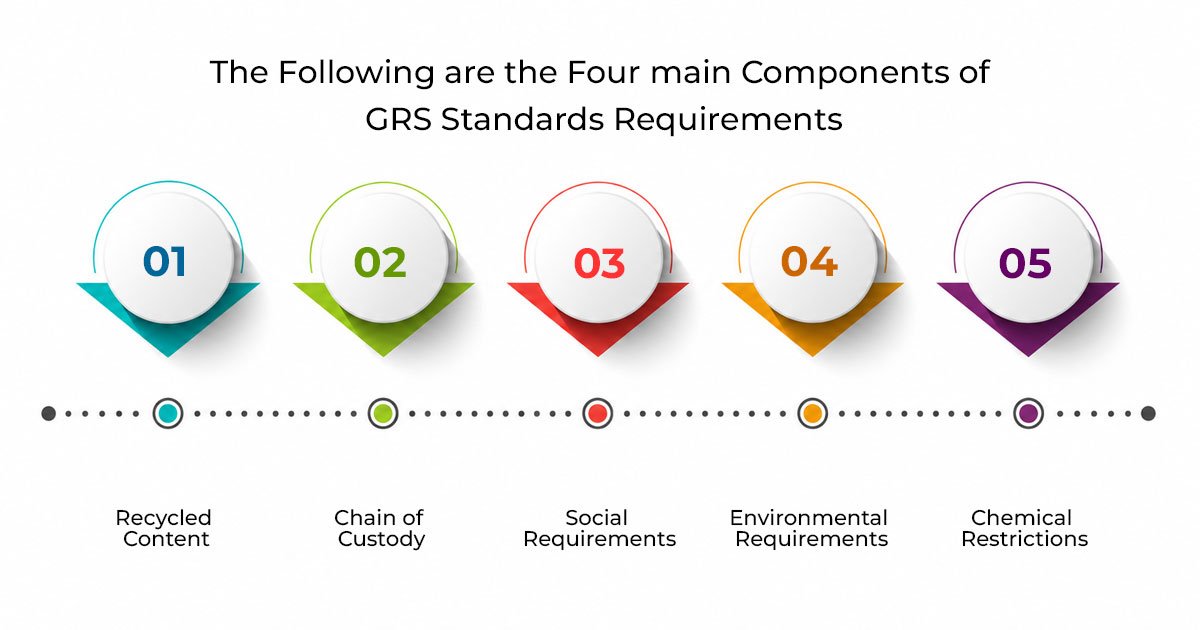
To begin with the process of GRS certification process India, one needs to have a clear understanding of the GRS standard requirements India. The following are the four main components of GRS standards requirements:
-
Recycled Content
In order for products to qualify for the use of the GRS logo, they must contain at least 20 percent recycled input materials. Products having 50 percent or more recycled content can use the “GRS” label, while others having less than that may use content claim statements.
-
Chain of Custody
Companies need to show complete traceability of their products from the stage where the recycled products are made until they reach the market. This process is shown using Transaction Certificates given after each sale of the GRS product.
-
Social Requirements
The companies involved must follow ILO guidelines concerning issues such as prohibition against child labour and forced labour.
-
Environmental Requirements
Certified facilities will be required to have environmental policies, treat waste and wastewater properly, and work towards minimizing their environmental impact.
-
Chemical Restrictions
Certified facilities should adhere to the GRS RSL for their particular manufacturing processes. The purpose is to avoid any harmful chemicals being included during manufacture.
Your Gateway to Sustainable Textile Compliance
Boost export credibility with trusted GRS certification services.
How to Get Global Recycled Standard Certification in India: Step-by-Step
The procedure for the global recycled standard certification process step by step in India consists of a number of well-defined steps as outlined below:
Step 1: Understand the Standard and Assess Eligibility
First of all, you should familiarize yourself with the most current version of the GRS document which can be downloaded from the Textile Exchange website. Check if your product contains the minimum recycled content as specified in the GRS standard, and identify the facilities in your supply chain which are going to require certification.
Step 2: Select an Accredited Certification Body
Identify a certification body (CB) accredited by Textile Exchange to perform audits according to the GRS standard in India. There are a number of international CBs which provide this service in India, such as Control Union, Bureau Veritas, TÜV Rheinland, Intertek, and SGS.
Step 3: Submit an Application
Fill in the application form issued by your selected CB. Provide details about your facility, the products you would like to have certified, your suppliers, and your QMS.
Step 4: Document Review and Pre-Audit Preparation
Your documentation will be reviewed by the CB. Your business might be required to submit purchase records, supplier’s certificates, waste disposal policies, social compliance documents, and chemical management records. These deficiencies need to be sorted out before conducting an on-site audit.
Step 5: On-Site Audit
A representative of the certification body conducts an audit at your site to ensure that your manufacturing practices comply with GRS standard requirements India. The areas audited include material traceability, production records, social compliance, environmental management, and chemical management. This step is the most important in the GRS certification process India, where adequate preparations help ensure passing on the first try.
Step 6: Corrective Actions (If Required)
If any non-conformities are found, you will be allowed a certain time to take remedial measures and provide evidence. Minor non-conformities have to be corrected within 30 days, whereas major ones require further attention.
Step 7: Certification Decision and Scope Certificate Issuance
Upon completion of all requirements, the certification body issues a Scope Certificate (SC). The scope certificate contains information about your manufacturing facility, certified products, and recycled materials used in the manufacture of products. The scope certificate is valid for a period of one year.
Step 8: Transaction Certificates for Each Sale
Every time that you sell your GRS-certified products, you are required to give your customer a Transaction Certificate (TC). The transaction certificate system is handled by Textile Exchange via its online portal (CERT ID / Higg Index).
Costs and Timelines for Global Recycled Standard Certification in India
Cost for obtaining global recycled standard certification in India depends on the auditing agency that is involved, the size of your facility, the number of product categories, and the complexity of the supply chain you have. Some pointers about costs in this regard are provided below:
- Application charges can be anywhere between INR 50,000 and INR 2,00,000 per facility
- Multi-site certifications are more costly but offer value for money per site
Renewal audits tend to be cheaper than initial certification audits
When it comes to the time taken, the global recycled standard certification process step by step India typically takes two to four months.
Maintaining Your Global Recycled Standard Certification
GRS global certification for recycled standards is not a one-off accomplishment; it calls for constant compliance and an annual renewal process. Some best practices that you should follow to keep your GRS certification include:
- Ensuring that all supplier scope certifications are up-to-date and that they are checked against the Textile Exchange CERT ID system before any purchase
- Having an accurate record of all transaction certificates for GRS products sold
- Performing an internal audit annually to detect areas of non-compliance ahead of the renewal audit
- Updating social and environmental policies as the business grows
- Providing GRS training to procurement, production, and compliance personnel
Key Takeaways
- GRS is an internationally accepted voluntary standard which confirms the recycled content in products as well as sustainable production methods used in the supply chain.
- Any organization in India which involves itself in sourcing, processing, manufacturing, or trading any product which contains recycled content can avail the benefits of GRS certification.
- The certification is provided through the accredited third-party agency and involves an audit of documents as well as site visits.
- Organizations which have been awarded GRS certification enjoy a competitive advantage in the international markets such as EU, USA, and Japan, where there is a demand for recycled content products.
- The entire process of GRS certification India generally takes two to four months.
Frequently Asked Questions
What is Global Recycled Standard certification?
Global Recycled Standard certification is an internationally recognized voluntary standard that verifies recycled content, chain of custody, social practices, environmental management, and chemical restrictions throughout the supply chain.
What is Global Recycled Standard and who needs it in India?
The Global Recycled Standard is a chain-of-custody certification system for businesses handling recycled materials. In India, it is required by recyclers, textile manufacturers, garment exporters, processors, and traders making recycled content claims.
How to get Global Recycled Standard certification in India?
To obtain GRS certification in India, businesses must select an accredited certification body, submit an application, complete documentation review, undergo an on-site audit, close any non-conformities, and receive the Scope Certificate.
What is the Global Recycled Standard certification process step by step in India?
The GRS certification process in India includes eligibility assessment, selecting a certification body, application submission, documentation review, production audit, corrective action closure, Scope Certificate issuance, and ongoing management of Transaction Certificates.
Who needs Global Recycled Standard certification in India specifically?
Any facility in India involved in processing, manufacturing, recycling, or trading recycled-content products may require GRS certification. This includes textile mills, garment exporters, plastic recyclers, and sourcing companies.
How long does the GRS certification process in India take?
The GRS certification process in India generally takes between 2 and 4 months depending on documentation readiness, audit scheduling, and the time required to resolve non-conformities.
What are the key GRS standard requirements India businesses must meet?
Key GRS requirements include maintaining at least 20% recycled content, implementing chain-of-custody controls, meeting social compliance standards, managing environmental impacts, and following restricted chemical substance requirements.