
If you are an Indian company that wants to do business in the European Economic Area (EEA), then obtaining CE marking certification in India will be one of the most important regulations for you to get acquainted with. The CE marking is more than a symbol of quality; it is a mandatory indication of whether your product satisfies the necessary European criteria in terms of safety and health.
This article contains all of the information about what CE marking is, its relevance, the process of obtaining CE marking in India, the documentation needed, and the cost of certification.
What Is CE Marking Certification India
CE Marking, which stands for Conformité Européenne, is a mandatory conformity marking for goods to be sold in the EEA. This shows that the goods have met all the necessary requirements of EU legislation and directives pertaining to health, safety, and environmental protection.
CE marking certification India acts as an entry point into the highly profitable European market. Note that this CE marking certificate does not come from any official institution or agency – it is merely a self-certification of conformity to EU directives by the producer (or its authorized representative in Europe).
CE marking is applicable to many different types of products such as:
- Electricity & Electronic Equipment
- Medical Devices
- Industrial & Machinery Equipment
- Personal Protective Equipment (PPE)
- Toys and Children’s Products
- Construction Products
- Telecommunications Equipment
The absence of CE marking will make the export of Indian goods to the European market illegal. One should note that CE marking is not a quality certification like ISO.
CE Marking Certification India
Your trusted path to European market access & product compliance.
Who Needs CE Marking Certification India
Certification of CE Marking in India pertains to the following entities:
- Indian Manufacturers: Any Indian manufacturer of products to be sold in EEA countries needs to get their products certified by CE marking prior to exporting.
- Importers and Distributors: In case you import products from India and sell them in the EU under your brand name, you are considered a manufacturer and will have to ensure your compliance with CE marking.
- OEM and Contract Manufacturers: Indian OEMs manufacturing products for other European companies will also have to comply with CE marking as per the terms of the supply agreement.
- Indian Startups & SMEs Going Global: Any Indian startup or small and medium sized enterprise going global and seeking entrance into European markets will have to understand CE marking.
If your product qualifies for any CE Directive, there is no alternative to getting your products certified via CE marking.
Step by Step Process to get CE Marking Certification India
The CE marking certification process step by step in India involves several structured stages. Here is a detailed breakdown of the CE marking process in India:
Step 1: Identify Applicable EU Directives
Identification of relevant directives is the first stage in CE marking process India for your product. One product may be covered by more than one directive. An electric toy, for instance, must meet the requirements of the Toy Safety Directive as well as the Low Voltage Directive.
Step 2: Check if a Notified Body Is Required
If your product falls within categories that include medical devices, PPE, certain types of electrical equipment, and other goods, a third-party assessment by a Notified Body is mandatory. Notified Bodies are testing organisations appointed by the governments to perform CE marking process India. For lower risk products, manufacturer self-declaration is enough.
Step 3: Product Testing and Evaluation
Next, you must test your product on conformity to all the requirements of the EU directives. Your product can be tested in any certified laboratory, either in India or elsewhere. Reputed laboratories in India, accredited in Europe, are often selected to save expenses at CE marking process India.
Step 4: Prepare Technical Documentation
Technical documentation is one of the essential elements of the CE marking certification process step by step India. It should consist of the following components:
- Description and design of the product
- List of relevant Directives and standards
- Results of tests
- Report of risk assessment
- User instructions and labeling information
- Draft Declaration of Conformity
Documentation must be stored for no less than 10 years after the product has been placed on the market.
Step 5: Issue the EU Declaration of Conformity (DoC)
At this stage, you should prepare and issue the EU Declaration of Conformity signed by the manufacturer (or EU authorised representative) stating that the product complies with all relevant requirements of the European Union.
Step 6: Affix the CE Mark
The CE mark should be applied to the product itself, packaging, or other accompanying documents in a visible, clear, and indelible way. The smallest dimension of the CE symbol should not be less than 5 mm. In case the product had been tested by a notified body, its four-digit identification number should be added to the mark.
Such documents are critical for your CE marking certification in India and must remain updated for the entire lifecycle of the product.
Documents Required for CE Marking Certification India
It becomes critical to know about the CE marking cost in India and the documents required before embarking on the process. Some of the documents required include:
| Stage / Service | Estimated Cost (INR) |
|---|---|
| Consultant / Advisory Fees | INR 20,000 – INR 80,000 |
| Product Testing (Lab Fees) | INR 30,000 – INR 2,50,000 |
| Notified Body Assessment (if required) | INR 1,00,000 – INR 5,00,000+ |
| Technical File Preparation | INR 15,000 – INR 60,000 |
| EU Authorised Representative | INR 20,000 – INR 80,000 per year |
| Translation of Documents | INR 5,000 – INR 30,000 |
- Technical File/Technical Construction File: This is the complete set of documents that show how the product has been designed and tested.
- Test Reports: Test reports by accredited labs showing that the product conforms to the relevant harmonized standards.
- Risk Assessment Report: A document highlighting the risks involved with the use of the product.
- EU Declaration of Conformity: This document is issued by the manufacturer or his authorized representative in the EU market.
- User Manuals/Instructions for Use: The documents must be available in the languages of the country the product will be sold.
- Product Drawings/Schematics: These documents must contain technical drawings detailing how the product was constructed.
- Bill of Materials (BOM): This document is prepared to show the bill of materials used in manufacturing the product.
- Company Registration Documentation: This must show proof of company registration by the Indian manufacturer.
- Authorized Representative Declaration: In cases where the manufacturer does not have a legal entity in the EU market, then he must employ an EU Authorised Representative.
Cost Breakdown Of CE Marking Certification India
CE mark costs in India depend on multiple factors including the type and nature of the product, the applicable directive(s), and the need for a notified body. The CE marking cost in India cannot be fixed since there are several factors involved.
Here is a rough estimate of the CE marking cost India:
The entire cost of CE marking in India for a simple product could range from INR 50,000 to 80,000, while more complicated products that require a Notified Body could cost INR 5,00,000 or even INR 10,00,000.
Investing in CE marking is worthwhile – it provides access to over 30 European nations and proves the legitimacy of the product to international customers.
How Long Does CE Marking Certification India Take
However, the time taken for CE marking certification in India will be affected by several considerations. Generally,
- Low-risk products: 4-8 weeks (when the testing and documentation process is simple).
- Medium-complexity products: 2-4 months (if there are multiple directives applicable or when minor modifications to the design have to be made post testing).
- High-risk products (such as medical devices and PPE): 6 months up to more than one year (because of the mandatory involvement of Notified Body and clinical/field tests).
Common causes for delays may include insufficient technical documentation, product failures necessitating redesign, problems finding a suitable Notified Body, or lack of promptness from the EU Authorized Representative. Hiring a skilled CE marking consultant at the onset of the CE marking procedure in India will greatly reduce processing time.
Is CE Marking Certification India Mandatory for Export
Yes. CE marking is a legal requirement for all products falling under at least one of the EU directives if the products are to be placed in the European Economic Area (EEA), which consists of the EU member countries Norway, Iceland, and Liechtenstein.
In case your product needs to have CE marking but lacks it when on the EU market, market supervision agencies may:
- Demand removal of the product from the market
- Impose penalties on the producer or the importer
- Publicly warn against or ban the product
- Pursue legal action
It should be pointed out that CE marking is not mandatory for products only distributed inside India or imported into non-EEA countries. CE marking is becoming more and more recognized as an international mark of quality and even asked for by customers elsewhere.
Tips for a Smooth CE Marking Certification India
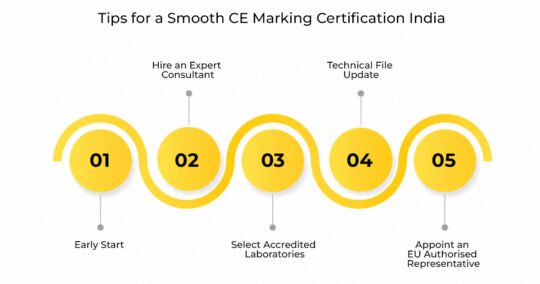
To make the process of CE marking certification in India as effective as possible, here are a few suggestions:
- Early Start: The CE marking process should begin at the product design stage and not at the manufacturing stage. This way, you will avoid any potential redesign costs.
- Hire an Expert Consultant: An expert consultant familiar with the process of CE marking certification in India can be beneficial as he/she can guide you regarding the proper directives and other aspects as well.
- Select Accredited Laboratories: Select laboratories accredited under NABL to avoid additional time and cost. Also, these labs are accepted in Europe as well.
- Technical File Update: Any modifications made in the product design will have to be updated in the technical file as well.
- Appoint an EU Authorised Representative: For companies based in India but having no presence in the EU region, it is essential to appoint an EU Authorised Representative.
Key Takeaways
- Certification by CE marking in India is compulsory for products being shipped to EEA nations.
- The CE marking procedure in India comprises finding the applicable directives, testing, creation of technical documents, and putting a CE mark on the goods.
- The cost of CE marking in India depends on the type of products and usually falls between INR 50,000 and INR 5,00,000 or more.
- The time required for the certification process may take anything from a few weeks to a number of months.
- Having a consultation from a certified body or Notified Body greatly simplifies the CE marking certification procedure in India.
Frequently Asked Questions
What is CE marking certification in India?
CE marking certification in India refers to obtaining CE compliance for products manufactured in India that are intended for sale in the European Economic Area. The CE mark confirms that the product meets EU safety, health, and environmental protection requirements.
Is CE marking mandatory for export to Europe?
Yes, CE marking is mandatory for products covered under EU directives and regulations before they can legally be sold in the European Economic Area.
How to get CE marking certification in India?
To obtain CE marking in India, manufacturers must identify applicable EU directives, conduct product testing, prepare technical documentation, issue the EU Declaration of Conformity, and affix the CE mark before export.
What is the CE marking certification process step by step in India?
The CE marking process includes identifying applicable EU directives, determining whether a Notified Body is required, conducting testing, preparing the technical file, issuing the Declaration of Conformity, and placing the CE mark on the product.
What is the CE marking cost and documents required in India?
CE marking costs in India generally range from ₹50,000 to ₹5,00,000 or more depending on the product category and testing requirements. Key documents include the technical file, test reports, risk assessment, Declaration of Conformity, user manual, and company registration documents.
How long does CE marking take in India?
The CE marking process may take between 4 and 8 weeks for simple products, while complex or high-risk products may require 6 months to 1 year depending on testing and approval requirements.
Can an Indian company self-certify for CE marking?
Yes, Indian manufacturers can self-certify many low-risk products by preparing the required technical documentation and issuing the Declaration of Conformity. However, high-risk products such as medical devices and PPE may require approval from a Notified Body.