
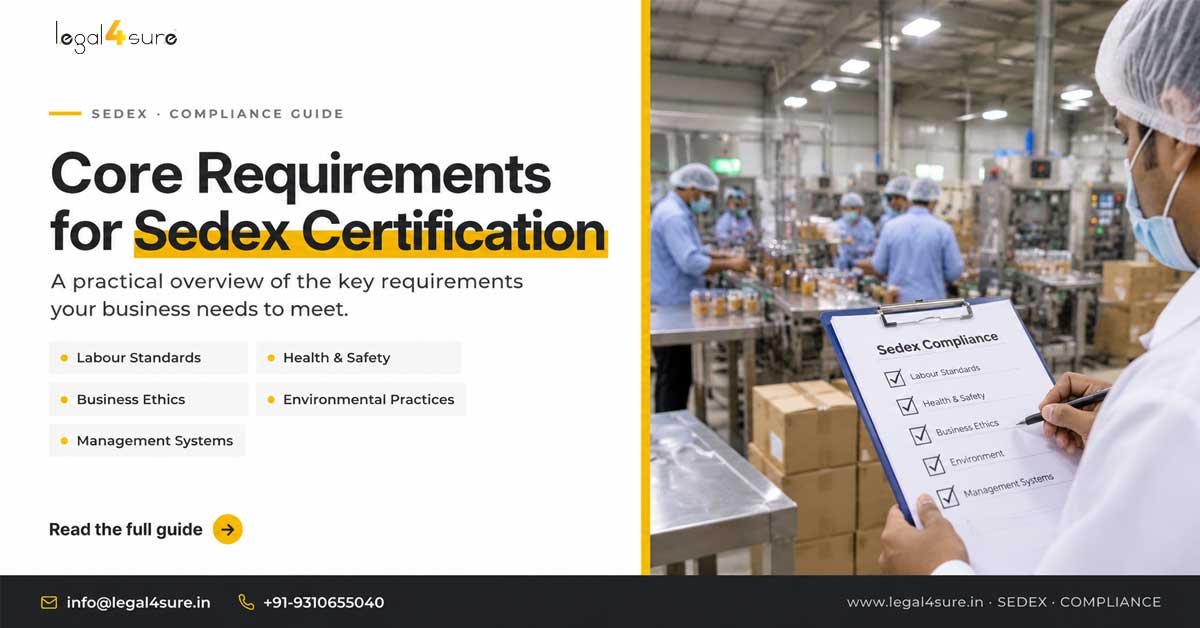
Now, customers from the UK, Europe and USA simply ask Indian exporters one thing before placing orders – can you prove your track record of ethical trading on Sedex? Sedex membership certification criteria depend on meeting 4 pillars (Labour Standards, Health & Safety, Environment and Business Ethics), all of which are validated via SMETA audit process. Once these requirements are met, a gateway will open up for big international purchasers, who only deal with Sedex members.
Sedex – Supplier Ethical Data Exchange – is a non-profit membership organization, which aims to facilitate exchange and management of ethics and sustainability data within global supply chains. This guide includes information about 4 pillars, auditing process, documentation that the auditor needs, relevant Indian laws and estimated costs.
This guide is basically informational, including a checklist and comparison table.
What Is Sedex Certification, Exactly?
Sedex is a membership organisation which is non-profit in nature, which was founded in the UK and has more than 85,000 members at present across the world. It applies to suppliers and buyers alike and does not have its own certification programme.
The Sedex certification, as commonly used, is becoming a Sedex member and having a SMETA audit for the four pillars: Labour Standards, Health & Safety, Environment and Business Ethics.
There are a few things that should be noted from the start:
- Eligibility – Companies can become an A member (buyer and supplier) or B member (suppliers only) and pay membership fees every year.
- No certificate – compliance is demonstrated via SMETA audit performed by accredited auditors and Sedex doesn’t charge for the audit.
- Indian companies – there are thousands of manufacturing companies in India from textile industry, pharmaceuticals, food processing and engineering which are sourcing through Sedex platform and they need to comply with Indian labour laws besides international standards.
- Reasons – membership helps buyers perform due diligence and some multinational companies accept Sedex members only.
If you are still at the first step, our guide on Sedex registration India explains how to register as an A or B member.
Why Buyers Prefer Sedex-Compliant Suppliers
Suppliers who are Sedex compliant are preferred by buyers because they make the buyer’s supply chain assessment process easier.
1. It Makes It Easier For The Buyer To Conduct Due Diligence
Membership with Sedex helps in conducting the buyer’s due diligence in relation to his supply chain. There is no need for him to follow up each of the supplier separately to collect information regarding the supplier’s ethics.
2. It Indicates a Consistent Approach to Ethical Trading
Being a member of the Sedex network shows that ethical trading is one of your regular approaches rather than a temporary one. The buyers see this as a sign of integrity and professionalism on your part.
3. It Provides Independent Findings to the Buyer
The SMETA audit is conducted by an independent auditor who reports to the Sedex portal together with non-conformities and corrective actions.
4. It Meets the Requirements of Their Brands
Most international brands, especially environmentally concerned ones, require suppliers to be socially and environmentally responsible. In some cases, only members of Sedex will do.
The Core Benefits of Meeting Sedex Requirements
Here’s where the benefits actually show up, in practical terms.
Same Platform, Fewer Back and Forth Communications
Sedex has been designed with the purpose of trading and managing data in the supply chain. The SAQ and the audit report are kept in one single platform, and there is no repetition of questionnaires and document requests from the buyer.
Fewer Audit Findings
Doing your audit in advance by checking the checklist and doing an internal gap analysis ensures you identify issues before the audit and avoid non-conformances.
Good Reputation on the Platform
Closure of non-conformances within the stipulated time ensures that you have a good reputation on the Sedex platform. And this is what buyers check before auditing you again.
Access to UK, European and US Retailers
Indian exporters who supply products to UK, European and US retailers are required to provide a Sedex audit report. This will help you in meeting the requirements without any delay.
Buyer Trust and Retention
Membership in Sedex displays your integrity, ethics, social consciousness and environmental consciousness. This helps you develop the trust of the buyer and retain the buyer.
Reduced Cost of Corrections
Professional support before the audit ensures there are no requirements for corrections post-audit.
An Advantage in Vendor Reviews
The large multinational corporations who limit their business dealings only to the Sedex members will not even look at suppliers who do not belong to the Sedex organization. Filling out the SAQ and SMETA report is a big advantage for you among the supplier list.
Sedex Requirements: Quick Comparison
The table below shows how a compliant supplier differs from a non-compliant one in practice.
| Benefit | Non-Compliant Supplier | Compliant Supplier |
|---|---|---|
| Buyer access | May be left out by buyers who accept only Sedex members | Can work with buyers that accept only Sedex members |
| Buyer due diligence | Buyer has little ethical trade data to review | SAQ and SMETA report sit on the Sedex portal |
| Audit readiness | Gaps found during the audit | Gaps found earlier through gap analysis |
| Documentation | Records scattered or missing | Contracts, payroll and drill records filed |
| Corrective work after audit | More fixes, often under time pressure | Fewer fixes, closed within the stipulated time |
| Buyer trust | Ethical commitment is hard to prove | Shows integrity and social and environmental awareness |
What Does It Take to Meet the Core Requirements for Sedex Certification?
You need to meet the four SMETA pillars, register on Sedex, complete the SAQ and keep documents ready for the auditor.
- Labour standards – no child, forced or bonded labour, written contract, prompt payment above the minimum wage, and no more than 60 work hours per week.
- Health and safety – fire exits, fire extinguishers, fire drill, proper ventilation and lighting, proper sanitation, written risk assessment and first aid.
- Environment – adherence to environmental laws, proper waste management, reduced energy consumption and emission, and water conservation.
- Business ethics – an anti-bribery and anti-corruption policy, honest accounting, ethical dealings, and whistleblower policy.
- Sedex membership and self-assessment questionnaire (SAQ) – join as an A/B member and fill out the SAQ through the Sedex portal.
- SMETA documents and Indian law – employment contract, payslips, attendance sheets, fire drill record, waste disposal record, factory license, GST/PAN, PF/ESI record, and subcontractors’ agreement.
There is also a particular sequence in which the entire process works. It goes like registering at Sedex, completing SAQ, conducting an internal gap analysis, engaging an approved SMETA auditor, getting the audit done, allowing the auditor to upload the report on the portal and closing all the non-conformances within the specified period of time. Buyers can determine whether the 2-pillar audit (Labour and Health & Safety) or full 4-pillar audit is necessary for your organization.
Suppliers from India also need to maintain the Factories Act, 1948, Shops & Establishment Act, state minimum wage notifications, Maternity Benefits Act and Pollution Control Board clearance.
These documents also get reviewed during the auditing along with Sedex pillars. Therefore, Sedex audit document checklist for India must include these.
Common Mistakes Indian Suppliers Make When Pursuing Sedex

- Disregarding the internal gap analysis process. Evaluate your current procedures against the basic prerequisites and fill all the gaps before scheduling an auditor.
- Incomplete human resources documentation. Ensure that your signed agreements and payroll documentation for at least 12 months along with work schedule are stored, since these are the first HR documents requested by SMETA auditors.
- Not caring about work hours. Make sure that your employees work no more than 60 hours per week, including overtime, have at least one rest day a week and have their working hours logged.
- Neglecting non-conformances following the audit process. Address all issues identified during the audit in order not to affect your position on the portal.
- Believing that Sedex will give a certificate or that compliance with Indian laws is enough. The audit is SMETA, and you have to comply with both laws and international ethics requirements.
When Sedex Certification Makes the Most Sense
- There is a request for a SMETA audit report and/or Sedex membership from the client.
- You provide UK/European/US retail.
- You would like to have a relationship with big international companies that accept Sedex members only.
- You have environmentally conscious brands.
- You have textile/pharmaceutical/food processing/engineering business and do exporting via international supply chain.
- You have Sedex membership soon to expire and want to make recertification plans.
If you export only occasionally and no buyer has asked yet, Sedex matters less right now, but a basic gap analysis is still worth doing so you are ready when the request comes.
Key Takeaways
- Sedex Membership Scheme is used for sedex compliance, which is confirmed by means of a SMETA audit, not a certificate.
- The four pillars include Labor Standards, Health & Safety, Environment and Business Ethics.
- In the case of India, manufacturing firms have to conform to both national regulations (Factories Act) and international requirements along with the provision of provident funds.
- Checklist and gap analysis before SMETA Audit will ensure that there are no non-conformities.
- Fees include yearly membership fees, auditor fees, consultation fees, etc.
- Only sedex members are considered by buyers who accept only sedex members.
Conclusion
There are basic criteria that have to be met for obtaining Sedex certification; four main elements, the completed SAQ and the SMETA audit based on good documentation. These will provide easier entry to the international market and make sure there will be no unpleasant surprises during audits. Since buyers have been requesting Indian companies to show their Sedex audit reports, these are now mandatory rather than optional. Find out how to proceed further with our guide on Sedex Certification Consultant Services.
Meet Global Buyer Requirements with Sedex Compliance Support
Prepare your business for SMETA audits with Legal4Sure’s expert Sedex compliance support. Get guidance on all four pillars—labour standards, health and safety, environment, and business ethics—along with documentation reviews, gap assessments, mock audits, and corrective action support to strengthen compliance and build international buyer confidence.
Frequently Asked Questions
What are the core requirements for Sedex certification?
Registration of the organization in Sedex and completion of a SAQ along with SMETA audit for Labor standards, Health & safety, environment and business ethics. You can use the SMETA 4 pillar audit checklist to facilitate yourself.
How do the Sedex requirements help Indian manufacturers?
These will provide you with access to international buyers and will also provide a checklist of SMETA documents and procedures. Indian suppliers will also have to comply with legislations like the Factories Act and provident fund provisions.
Why do buyers prefer suppliers who meet Sedex requirements?
They enable the buyers’ supply chain due diligence process and also give assurance regarding consistency in approach to ethical trading. Even some major international organizations accept only Sedex members.
Is Sedex certification mandatory?
Since Sedex is a membership program and not mandatory, it is dependent upon your buyers. Most buyers, especially UK, Europe and American retailers are asking for Sedex audit reports from Indian exporters.
Can my company hold Sedex certification directly?
Registration as A and B member happens for your organization in Sedex but there is no Sedex certificate. Compliance with Sedex is through SMETA audit.
How is Sedex different from SMETA?
Sedex is the membership system wherein the information is exchanged, while SMETA is the audit process done by the authorized auditors. The SMETA report is then submitted to the Sedex system.
Does meeting Sedex requirements reduce costs?
The cost of corrections can be saved, as consultancy will minimize the need for corrective actions post audit. Membership budget of ₹20,000 to ₹1,00,000+, audit cost of ₹60,000 to ₹2,50,000 and consulting of ₹30,000 to ₹1,50,000.