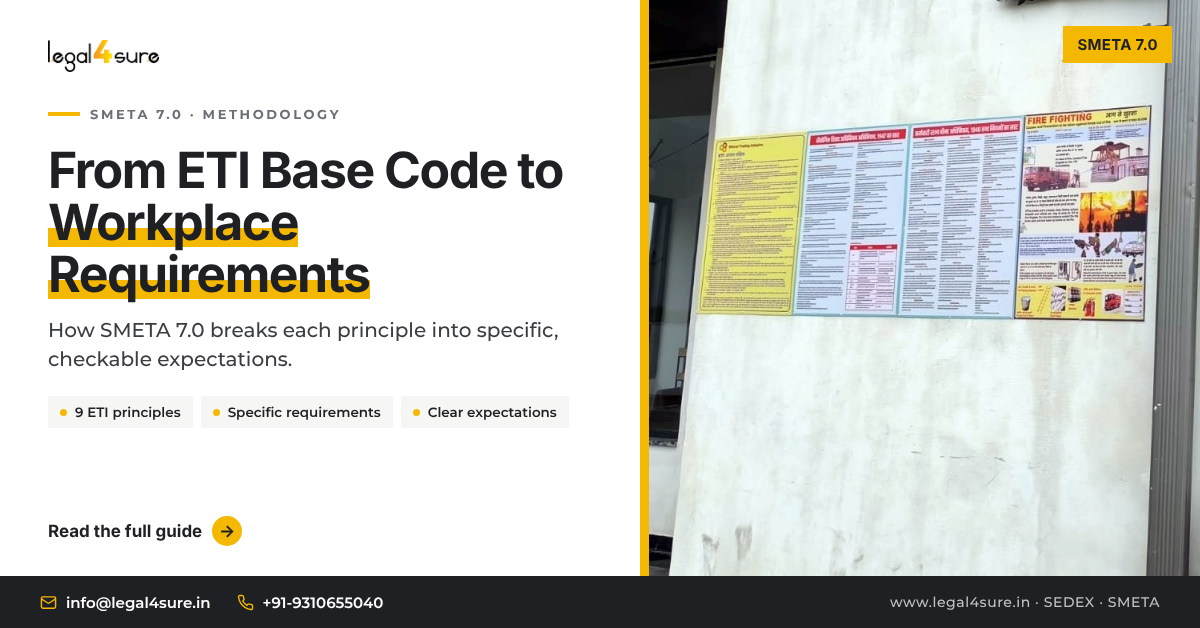
If you ask three suppliers what a SMETA auditor will check, you may get three different answers. This was a major issue in the past.
The ETI Base Code is built around principles, which can lead to different interpretations of what needs to be checked at a workplace. SMETA 7.0 addresses this issue. One of the key changes in this version is that the ETI Base Code has been broken down into specific workplace requirements that auditors can check during the audit.
This article describes this process and its components. The goal of this article is to help suppliers prepare for such audits and buyers understand their audit reports. The target audience of this article are factory managers, compliance officers, and buyers who read Sedex audit reports.
SMETA 7.0 Requirements at a Glance
Short Definition – SMETA 7.0 requirements refer to the auditable criteria developed by Sedex for ethical trade audits. In particular, the major difference is the inclusion of the Workplace Requirements, where each ETI Base Code article and Sedex article was subdivided into distinct criteria. Each criterion is evaluated based on the Code and local regulations, and evidence supporting the auditor’s conclusion is documented.
SMETA means Sedex Members Ethical Trade Audit. Sedex, an abbreviation of Supplier Ethical Data Exchange, is the non-profit membership organisation that developed the audit, and the audit report is shared via the Sedex website among buyers.
In particular, version 7.0 has retained the well-known 2-pillar/4-pillar framework. The only difference is the precise way of defining the labour, health & safety and environmental criteria.
How Does SMETA 7.0 Use the ETI Base Code?
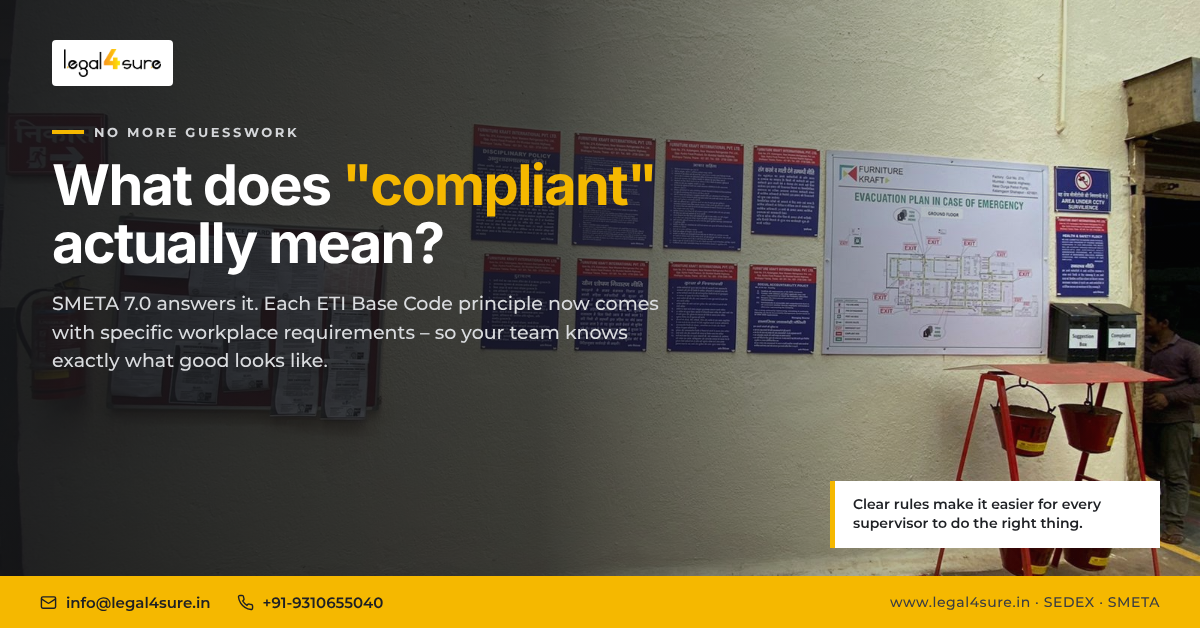
SMETA 7.0 adopts the ETI Base Code as the benchmark for labor practices and converts it to Workplace Requirements which guide the auditor on what to verify. The local laws are applicable along with the Code and the more stringent between the two will be the benchmark.
The Ethical Trading Initiative (ETI) Base Code is based on international Labor Organization (ILO) conventions. Some of the issues include freedom of association, no forced labor, safe working conditions, fair remuneration, and restricted working hours.
There are some additional areas under Sedex that have been built above ETI Base Code, which includes responsible recruitment, living wages, and responsible sub-contracting. All these combined form the buyer’s expectation from a supplier.
The clause, “Working conditions are safe and hygienic,” alone cannot provide any guidance on what to inspect.
What Are the Workplace Requirements in SMETA 7.0?
The SMETA 7.0 Site Requirements are a numbered list of verifiable items contained in Annex 4 of the Sedex manual. It describes what the site should do in relation to each Base Code area. The auditor then notes the evidence for the finding.
Each requirement has an identifier that consists of the Base Code area number followed by a letter, for instance, 1.C. It makes the findings attributable. Non-conformance in the report refers to a particular requirement rather than to a generic title.
The annex was published in August 2024 and revised in August 2025. Make sure that your auditor is using the latest edition.
Before and after: what changed for suppliers
| Aspect | Earlier SMETA versions | SMETA 7.0 |
|---|---|---|
| Audit basis | Auditors worked from the Code wording and their own judgement. | Auditors assess a defined list of workplace requirements. |
| Consistency | Interpretation could vary between audit firms. | A shared checklist reduces the room for different readings. |
| Evidence | Recording practice varied. | Auditors record the evidence behind each requirement. |
| Supplier preparation | Suppliers often guessed what would be checked. | Suppliers can self-assess against the same list. |
ETI Base Code Requirements and Their Audit Areas
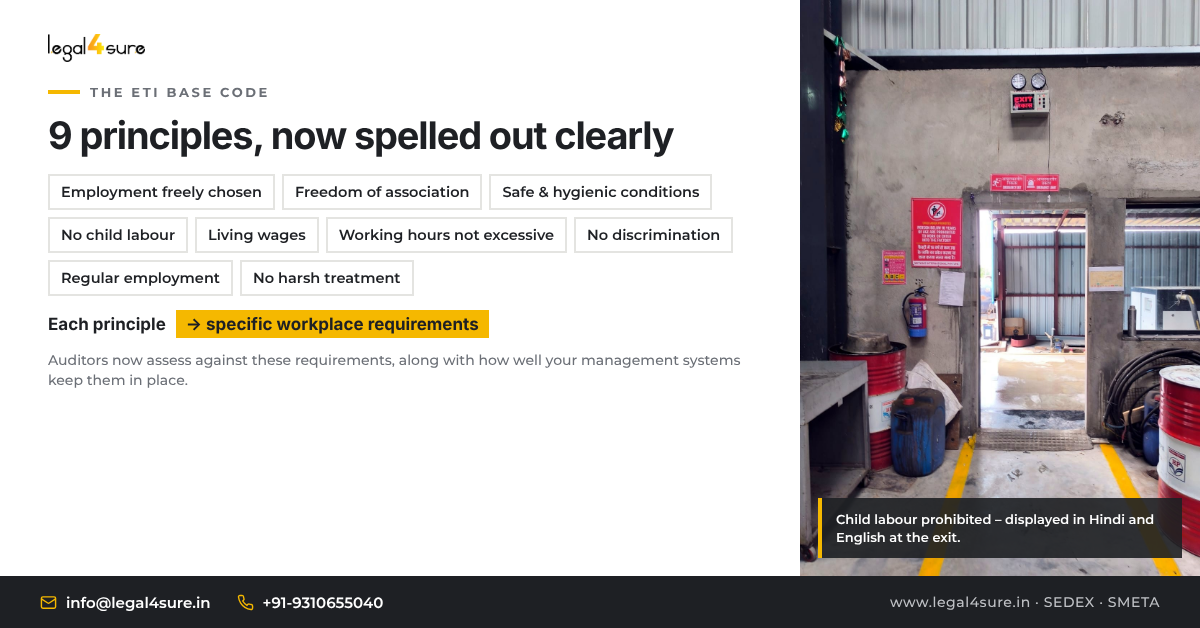
The Workplace Requirements are organised by Base Code area. Here’s what each area typically involves on the ground.
| Base Code area | What auditors typically look at |
|---|---|
| 0. Enabling accurate assessment | An accurate site description, Sedex profile, and honest access to records and workers. |
| 1. Employment is freely chosen | No forced, bonded, or prison labour; workers free to leave; no retained identity papers. |
| 1.A Responsible recruitment | Recruitment fees, contracts, agency use, and right-to-work checks. |
| 2. Freedom of association | Whether workers can form or join organisations, or have alternative ways to be heard. |
| 3. Safe and hygienic conditions | Fire safety, machinery, chemicals, first aid, sanitation, and worker housing. |
| 4. No child labour | Age verification and protections for young workers. |
| 5. Legal wages / 5A. Living wages | Pay against legal minimums, payslips, deductions, and how pay compares to living wage benchmarks. |
| 6. Working hours | Legal limits, voluntary overtime, and rest days. |
| 7. No discrimination | Hiring, pay, promotion, and dismissal practices. |
| 8. Regular employment / 8A. Sub-contracting | Written contracts, use of labour agents, and homeworkers. |
| 9. No harsh treatment | Disciplinary rules, harassment prevention, and grievance channels. |
| 10A / 10B. Environment | Environmental permits and management, at 2-pillar or 4-pillar depth. |
SMETA 7.0 Compliance Requirements: What Auditors Look For
Meeting SMETA 7.0 compliance requirements means showing evidence, not just having policies. Auditors normally rely on three sources and check that they agree with each other.
- Documents: contract, payroll, timesheets, permits, training records, and policies.
- Interviews: discussions with employees usually conducted off the site of management.
- Observations: what the auditor actually sees on-site, in the dormitories, and at the exits.
A mismatch between any two of these is where findings come from.
A working hours example
Assume that it is the working hour requirement. In this case, the auditor will check time sheets against payroll and also question employees about how many days they have worked during the month, and if the overtime is voluntary.
In case time sheets reveal the six-day week but workers report a seven-day week, this will be considered a finding despite your policy. Requirement checks practice, not paper work.
When findings are raised
- Non-compliance: The requirement has not been met, and the report details the evidence.
- Observations: An area that does not meet the threshold for non-compliance but still requires consideration.
- Good Practice: Positive initiatives undertaken by the site.
SMETA 7.0 Audit Criteria Beyond the Workplace Requirements
Workplace Requirements are part of a larger audit framework. These are combined by Sedex with the SMETA 7.0 Management Systems Assessment (MSA) for assessing your management of internal labor and ethical risks.
This is important to understand because Workplace Requirements measure whether standards are currently being met, while the MSA measures if you have the right systems in place to maintain them.
2-pillar vs 4-pillar audits
| 2-pillar | 4-pillar | |
|---|---|---|
| Covers | Labour standards and health and safety. | Adds environment and business ethics. |
| Typical use | Buyers focused on labour conditions. | Buyers who want a broader picture. |
| Time on site | Shorter. | Longer, with additional assessment time. |
Your buyer usually decides which one you need, so ask before you book.
How to Prepare for the Specific Workplace Requirements Under SMETA 7.0
Start by treating Annex 4 as your own checklist. If you can show evidence against each item before the auditor arrives, the audit becomes a confirmation rather than a surprise.
- Make sure to get approval for a 2-pillar or 4-pillar audit from your client.
- Download the most up-to-date Workplace Requirements annex from Sedex.
- Do a gap assessment internally for each Base Code section, beginning with hours, pay, and safety.
- Make sure that timesheets, payrolls, and contracts match up.
- Assess your management system – policies, risk assessments, training, and grievances.
- Inform managers about the interview process and how it is pressure-free.
The majority of the time, it is common practice for teams to invite the SMETA Audit Consultant for the gap checking process, since the outsider sees what the insider does not anymore. It is in this step where we work with our suppliers with Legal4sure.
Why the Breakdown Helps Buyers and Suppliers
To the buyer, there will be consistency in the reports because of the established requirements. The finding on one of the requirements shall mean the same whether the factory happens to be situated in Tiruppur or Turkey.
To the supplier, the advantage will come from predictability. There will be something specific to prepare for and the corrective action will be against a named requirement.
Limits to keep in mind
- The clear audit is indicative of the day that the auditor came, not everyday of the year.
- The standards provide the minimum. Other buyers may have their own standards in addition to these.
- Paperwork alone does not guarantee good management of hours, wages, and safety issues.
That’s why the Management Systems Assessment matters. It asks whether your controls will hold after the auditor leaves.
Common Mistakes Suppliers Make
- Skipping the Workplace Requirements in the Base Code to see what will be checked.
- Following policies that lack evidence of implementation.
- Ignores local laws where there are stricter provisions than those in the Code.
- Disconnect between timekeeping and payroll records.
- Trains employees on how to answer questions during interviews, something auditors easily notice.
- Treats the Management Systems Assessment as an afterthought.
The last two cause the most damage. Both signal to an auditor that the site is managing the audit rather than the workplace.
Key Takeaways
- Requirements of SMETA 7.0 split the ETI Base Code into specific, audit-able Workplace Requirements.
- Each requirement is given a number for easier traceability of audit findings to one single requirement.
- The auditor examines practice through documentation, employee interviews, and observations.
- Management System Assessment tests the sustainability of compliance.
- Using the Annex as a self-assessment tool is the quickest way to prepare.
Conclusion
However, the 7.0 SMETA requirements eliminate any need for guessing because you now have a checklist. The ETI Base Code is still the benchmark, but the Workplace Requirements spell out how the benchmark is actually evaluated.
This is great news for suppliers. You get to see the list, check where you stand relative to the list, and then fix the problem areas.
SMETA 7.0 Requirements: ETI Base Code Breakdown
Understand SMETA 7.0 workplace requirements with expert support from Legal4Sure. Get assistance with ETI Base Code compliance, workplace gap assessments, audit preparation, documentation, and Management Systems Assessment to strengthen audit readiness.
Frequently Asked Questions
What are the workplace requirements in SMETA 7.0?
They are numbered, auditable criteria specifying the requirements of the site for each ETI Base Code principle.
How does SMETA 7.0 use the ETI Base Code?
It takes the Code as a benchmark and formulates requirements which are assessed together with the local legislation.
What are the specific workplace requirements under SMETA 7.0?
These include recruitment, wages, working hours, health and safety, and treatment of workers with their corresponding identification numbers.
Can you give SMETA 7.0 ETI Base Code workplace requirements explained simply?
Each Base Code principle is a check list requirement, which is verified through documentation, interviews, and observation.
Does local law still matter under SMETA 7.0?
Yes. Audits are conducted based on the Code as well as local laws, whichever is stricter.
What is the Management Systems Assessment?
It looks at how good your site is in managing risks associated with labor and ethics, beyond satisfying the current standards.
Where can I find the SMETA 7.0 workplace requirements?
They are found in Annex 4 of the Sedex manuals.