
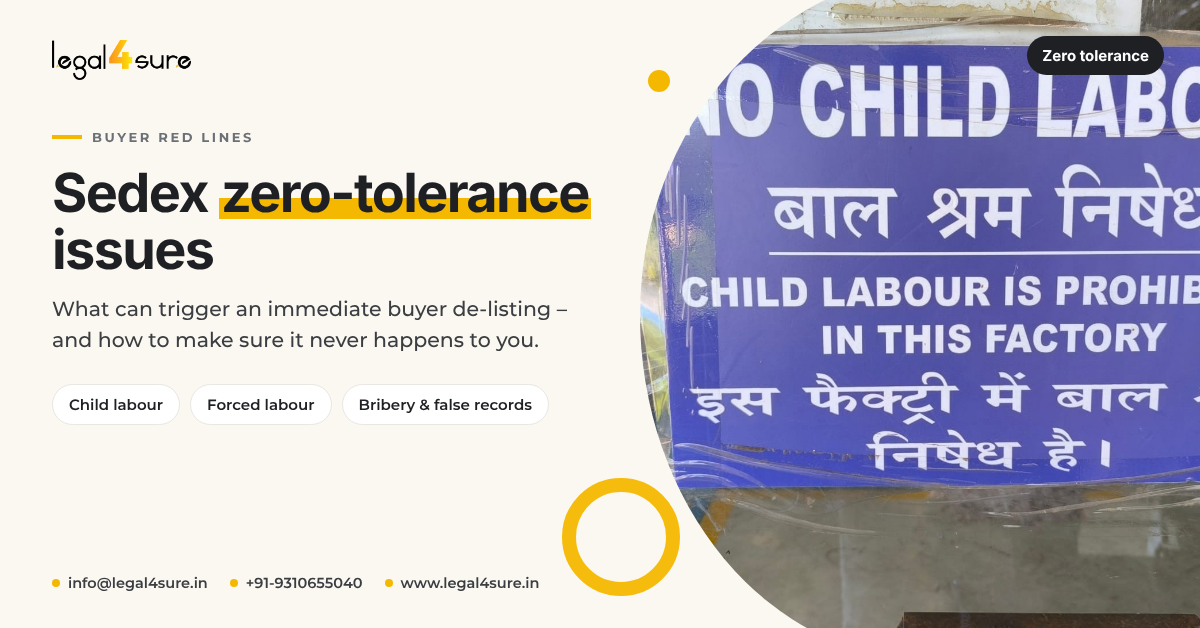
These sedex zero tolerance issues are audit violations so serious that customers are empowered to stop buying from or de-list your company before you complete a correction process.
What’s important for suppliers to understand is that Sedex is a platform and does not have the power to de-list you; that decision lies with your buyer based on their code of conduct and your audit data.
We have seen firsthand at Legal4sure how suppliers have lost their business due to issues that could have been avoided had they taken steps months in advance. This article provides details of sedex zero tolerance issues.
What Are Zero Tolerance Issues in a Sedex Audit?
In Sedex audits, zero tolerance problems are breaches of basic human rights or safety concerns considered unacceptable by buyers under any condition whatsoever. There is no grace period for zero tolerance problems and they are escalated instantly, leaving the decision between suspension or termination of the relationship up to the buyer.
No one-size-fits-all list exists. The SMETA guidelines suggest that auditors immediately draw attention to the worst problems, after which the buyer compiles its own list using its supplier code of conduct.
Zero tolerance vs ordinary non-conformities
| Factor | Zero tolerance finding | Major or minor finding |
|---|---|---|
| Response speed | Immediate containment | Weeks to months, per the CAPR |
| Who gets told | Auditor escalates quickly; buyer often contacts you directly | Listed in the report and shared on the Sedex Platform |
| Buyer reaction | Order hold, investigation, possible de-listing | Agreed corrective action plan |
| Recovery | Verified remediation and buyer re-approval | Closure evidence and follow-up check |
Everything else, from missing signage to an isolated record gap, stays in the ordinary Sedex audit non-conformities bucket. Those are fixable inside a standard timeline.
What Issues Trigger Zero Tolerance in a Sedex Audit?
The usual triggers sit across the labour standards, health and safety, and business ethics pillars. This table shows the Sedex audit critical issues we see buyers escalate most often.
| Issue | What auditors look for | Typical buyer reaction |
|---|---|---|
| Child labour | Workers below legal minimum age, forged age documents | Immediate escalation, child-centred remediation plan |
| Forced or bonded labour | Retained ID documents, recruitment fees, debt, threats | Order suspension and investigation |
| Imminent safety danger | Locked or blocked exits, no fire safety, unsafe structure | Stop work in the area, urgent fix |
| Violence, abuse, harassment | Physical punishment, sexual harassment, intimidation | Investigation, possible exit |
| Bribery and obstruction | Gifts to the auditor, hidden areas, coached workers, falsified records | Often de-listing, because trust is gone |
| Unauthorised subcontracting | Production at undeclared sites (buyer-specific) | Order hold until approved |
The last two rows will probably take you by surprise. Manipulating records and coaching employees may receive harsher penalties than the initial misconduct, since this means the buyer cannot trust anything on your site.
Bribery is directly related to the fourth pillar of business ethics. In case you need to prepare for the 4-Pillar audit, get familiar with the Sedex 4-Pillar expectations regarding business ethics, which includes anti-bribery and whistleblower policies.
Can a Sedex Audit Finding Lead to Buyer De-Listing?
Yes. An audit finding under Sedex can result in de-listing by your buyer if it is a zero tolerance violation, if a critical finding remains unresolved past its deadline for resolution, or if you withhold evidence. This isn’t decided by Sedex. It’s up to your buyer according to its own policy.
Buyers weigh several factors before acting:
- Severity: Was the harm or imminent threat of harm to the workers?
- Response: How quickly did you address the problem and inform them?
- Truthfulness: Did the information in the documents and interviews match the auditor’s observations?
- Reoccurrence: Reoccurrence of an issue is worth far more than one time occurrence.
- Legal Exposure: Legislation like the UK Modern Slavery Act and the EU CSDDD force brands to react quickly to any severe audit findings.
The consumer is also more forgiving than he was five years ago. Due diligence regulations, NGO investigations, and retail auditing ensure that an unresolved serious violation may result in an image problem for the brand, not only for the vendor.
How Auditors Handle Zero Tolerance Findings on Site
SMETA auditors do not depend on only one source. They compare workers’ answers, documents, and observations on the factory floor, and it’s a discrepancy among all three that can often raise red flags.
In case of a serious finding, the auditor will proceed based on the audit company’s escalation policy and SMETA guidelines. In any case, you will find out about this at the final meeting, even though the buyer may be informed at the same time.
- Interviews indicate the salary that the employees get, the person keeping their documentation, and whether they are free to move away.
- Documentation indicates age, work hours, wages, and mode of recruiting the workers.
- Site walk indicates access points, protection of machinery, chemical storage, and the condition of the dormitories.
An illustrative example
Consider a food packaging unit that employs contract workers using a labour agent. Three workers tell the auditor that the labour agent maintains a copy of their identification card and also collects a placement fee, whereas the records maintained by the unit’s Human Resource (HR) department are clean.
The auditor identifies forced labour red flags and the buyer suspends orders. The unit pays back the fees, gives back the documents, changes the labour agent and informs the buyer within a day. Following the second audit, orders resume. Suppliers who deny the problem seldom have such an outcome.
How Buyers React: A Typical Sequence
Every buyer runs its own process, but the Sedex zero tolerance findings that can lead to buyer de-listing usually follow a similar path.
| Stage | What happens | Typical timing |
|---|---|---|
| Escalation | Auditor flags the finding to the audit firm and buyer | Within hours to a day or two |
| Buyer contact | Buyer’s ethical trade team calls you, may hold new orders | Day 1 to 3 |
| Investigation | You submit root cause, containment and worker protection steps | Day 3 to 14 |
| Remediation | Buyer verifies, sometimes through a follow-up or unannounced audit | Week 2 to 8 |
| Decision | Reinstatement, probation or exit | Varies by buyer |
Treat these timings as a guide, not a rule. Your buyer’s supplier agreement sets the real deadlines.
What to Do in the First 72 Hours
If an auditor raises a zero tolerance issue, speed and honesty matter more than perfect paperwork. Follow this order:
- End the behavior. Eliminate the risk factor, turn over the detained documents or disengage the involved supervisor.
- Protect the affected employees. No retaliation, no coercion, no interference with interviews.
- Tell your buyer yourself. They will find out anyway from the audit firm, and they will trust you more if you tell them yourself.
- Determine the source of the problem. Use the 5 Why’s approach and involve labor agents and contractors.
- Maintain all documentation exactly as is. Do not edit, substitute or back-date any documents.
- Provide a written action plan. Follow the buyer’s format or the Sedex CAPR template with ownership and dates.
- Conduct an independent assessment. Get another pair of eyes to check for errors before the buyer catches them.
Sedex Buyer Compliance Requirements to Check Now
Do not wait for the audit findings to see the rules set by your client. In Sedex Audit, the buyer will have an insight about your facility, hence their rules will determine what follows. Extract the following elements:
- Supplier Code of Conduct and the specific zero-tolerance list.
- The time window within which critical issues can be raised, usually between 24 to 72 hours.
- Whether 2-Pillar or 4-Pillar audit is required.
- Remedial deadline and rights to re-audit.
- Subcontracting regulations and labour agencies regulations.
Prevention Checklist for Suppliers
Most zero tolerance findings start as small gaps that nobody owned. A quarterly mock audit catches them early.

- Verify the age of all new employees with government identification.
- Do not retain any passports, Aadhaar cards, or other certificates.
- Eliminate recruitment fees and audit your labor agents.
- Maintain open, visible, and labeled escape routes and conduct fire drills.
- Create an anti-corruption policy and educate your gatekeepers about the auditor protocol.
- Maintain a functional grievance process that employees can actually use.
- Maintain just one set of true accounting records. Having two will ruin your career.
Common Mistakes That Turn a Finding Into a De-Listing
- Organizing the books prior to the arrival of the auditor.
- Briefing the employees regarding what to say in their interviews.
- Taking several days to inform the purchaser.
- Punishing the employees for being honest.
- Rectifying the factory issue but disregarding the labor agent at fault.
- Considering an infraction not serious due to no injuries incurred.
If your group is overloaded, Legal4sure can conduct a practice audit and evaluate your proof prior to the real one. Avoid getting assistance from outside sources if your location has had clean audits recently and has a compliance manager.
Key Takeaways
- Zero-tolerance issues involve child labor, forced labor, imminent danger, abuse, and bribery.
- Sedex does not delist suppliers because the buyer makes that call.
- If there are falsified documents and obstruction, the contract is ended quicker than the violation itself.
- Contain the problem and inform your buyer within the first 72 hours.
- Refer to your buyer’s code of conduct now and not after the problem is found.
Conclusion
Zero tolerance Sedex problems are never really a surprise. The result of missing age verification, labor representatives, fire safety and documentation issues that were not dealt with.
Know the rules of your buyer, conduct genuine internal audits and take quick action whenever there is a problem. Legal4sure can assist suppliers in doing just that.
Address Critical Sedex Audit Issues Before They Put Buyer Relationships at Risk
Identify and resolve Sedex zero tolerance findings with expert guidance from Legal4Sure. Get support with audit readiness, root cause analysis, corrective action planning, and evidence preparation to strengthen compliance, protect workers, and help maintain buyer confidence.
Frequently Asked Questions
What are zero tolerance issues in a Sedex audit?
These are violations of workers’ core rights or safety such as the use of child labour, forced labour, or any imminent danger that buyers consider unacceptable straight away.
Can a Sedex audit finding lead to buyer de-listing?
Yes. These include zero tolerance findings, serious non-compliance issues or concealment of information that can lead the buyers to suspend or terminate the supply relationship. This decision is made by the buyer and not Sedex.
What issues trigger zero tolerance in a Sedex audit?
These are child labour, forced labour, imminent safety hazard, violence or abuses, bribery of auditors and falsified records.
Which Sedex zero tolerance findings that can lead to buyer de-listing are hardest to recover from?
These are bribery, falsified records and forced labour. The buyers find these issues as a trust breach issue; thus, even after quick resolution, the buyers do not allow you to retain your contract.
Does Sedex itself de-list suppliers?
No. Sedex runs the platform and SMETA methodology. Only the buyer can suspend or de-list you as a supplier.
How fast must I report a zero tolerance finding to my buyer?
This depends on your supplier agreement with your buyer but most buyers expect you to notify them of a zero tolerance finding within 24 to 72 hours from the time of the finding.
Can a supplier be reinstated after de-listing?
Sometimes. Buyers usually want verified remediation, a clean follow-up audit and a fresh approval before restarting orders.