
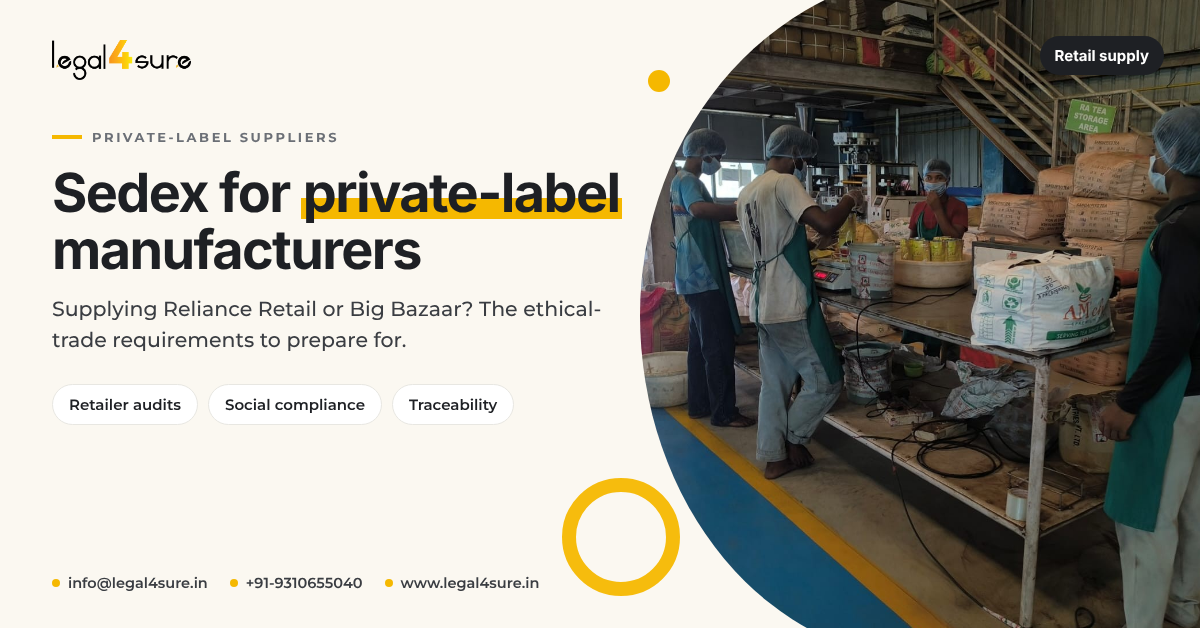
There is no general Indian legal requirement for private label suppliers to undergo a Sedex audit. In most cases, this requirement comes from the retail chain or buyer. When you sell a product under your own brand name but another company manufactures it, you also take on the reputational risk linked to how that company treats its workers. Buyers may ask you to demonstrate responsible working practices through a SMETA audit, with the audit report shared through Sedex.
That is why manufacturers continue to search for the “requirement” of Reliance Retail or Big Bazaar. The answer to the query is not yes and no. Yes, Reliance Retail publishes its Business Partner Code of Conduct. But there is nothing published officially saying that every private label supplier has to have a Sedex audit.
At Legal4sure, we help suppliers decipher the true requirement before undertaking such an expensive audit process. This article explains the situations where Sedex audit is required, the audit requirements of private label unit and preparedness.
What Are the Sedex Requirements for Private-Label Manufacturers?
Summary of Answer: Typical Sedex requirements for private-label manufacturers include the following: Sedex supplier membership, completion of SAQ and SMETA audit conducted by an independent auditor and made available to the retailer. This is dictated by the buyer, not the law; the scope and deadlines depend on each specific retailer and type of goods.
Private label is when the retailer owns the brand, and you manufacture the products. When something goes wrong in the supply chain, consumers blame the retailer, not the manufacturing facility. This explains why retailers put pressure on ethics verification for the facilities producing their proprietary brands.
Sedex is the name of the membership platform. SMETA stands for Sedex Members Ethical Trade Audit – the auditing approach used. Sedex is not an auditing body and you do not obtain a certificate or approval from them. Instead, you will have a report prepared and a plan of actions, which you decide to share with some connected buyers.
| Requirement | What it involves for you |
|---|---|
| Sedex membership | A supplier account on the platform, linked to the retailer that requested it |
| Self-Assessment Questionnaire | Site details, workforce profile, policies and management systems |
| SMETA audit | On-site audit by an independent auditor, 2-pillar or 4-pillar as the buyer decides |
| Corrective action plan | A CAPR closing every finding with evidence |
| Report sharing | Results visible to the buyers you choose to link |
Do Private-Label Suppliers Need a Sedex or SMETA Audit?
Neither legally required nor automatic. If the retailer has any sourcing policies or contracts that require an audit by Sedex or SMETA, then the private label supplier would have to comply with such a request. This is common, since one SMETA audit covers multiple customers.
Ask your buyer five questions before making any booking:
- Is Sedex or SMETA mandatory, or can you accept equivalent audits?
- Are you after a 2-pillar or 4-pillar audit?
- Would you prefer that the audit be announced or unannounced?
- What is the deadline for uploading the report?
- Which locations are covered: our factory, our job works, or both?
These determine the cost and schedule of the audit. Ignoring these is the single most frequent cause of double audits.
Sedex Audit Requirements for Private-Label Suppliers to Reliance Retail
The following has been reported in public documents. The sustainability reporting from Reliance states there is a Business Partner Code of Conduct which forbids child labor, forced labor and discrimination, and requires safe and healthy workplaces. There is also information about third-party assessments of high-spending suppliers, and greater oversight in riskier ESG categories.
The following has NOT been made public is a company-wide requirement for all private label suppliers to have SMETA certification. So remember that Sedex should be considered only one of the acceptable ways of proving compliance, not a compulsory procedure. A wise strategy:
- Ask your category manager or onboarding representative about the existing code and audit requirements in writing
- Compare each point in the Business Partner Code of Conduct with your practices on-site
- If Sedex is one of the acceptable formats, get your buyer’s linking details and deadline
- If other audit format is required, ask if SMETA report will be accepted in its place
A note on Big Bazaar
Many suppliers still search for Big Bazaar requirements. The chain’s ownership and store network changed after Future Group’s financial troubles, so treat older vendor onboarding documents as outdated. Reconfirm requirements directly with whichever retailer you’re supplying now.
SMETA Audit for Private-Label Suppliers: What Auditors Check
A private label unit will go through the same SMETA audit as any other manufacturer. The auditor uses the ETI Base Code for auditing as per SMETA 7.0, and only independent auditors from Affiliate Audit Companies approved by Sedex can perform this audit. The basic scope will include:
- Labor standards: wages, working hours, contracts, age verification, discrimination, freedom of association, and discipline
- Safety and health: fire safety, machinery guarding, handling chemicals, first aid, and fire drill
- Environment and Business Ethics (4-pillar only): waste, energy and emission data, license, anti-corruption policy, and whistleblowing facility
- Extra components: right to work, sub-contracting and home working
| Aspect | 2-Pillar audit | 4-Pillar audit |
|---|---|---|
| Pillars covered | Labour standards, health and safety | Adds environment and business ethics |
| Typical buyer ask | A baseline social audit | Fuller evidence on environment and ethics |
| Preparation load | Lighter | Heavier: environmental data, ethics policies |
How the process runs
- Register yourself in Sedex as a supplier and connect to the requesting retailer.
- Answer the SAQ honestly. The auditors will use it for comparing with their observations.
- Define scope with your buyer: pillars, sites, and audit type.
- Book an independent auditor from any approved Affiliate Audit Company.
- Get the audit done: documentation audit, site walk-through, interviews, and closure meeting.
- File the CAPR and close out findings with evidence.
- Distribute the report to connected buyers via the platform.
Sedex Compliance for Indian Manufacturers: Private-Label Pain Points
- Multiple factories and work forces: many private label lines use third parties; identify whose facilities will be audited by the buyer and declare any subcontracting truthfully
- Peak seasons: holiday and promotion manufacturing creates more overtime and temporary employment
- Contract and agency labour: salaries, employment terms, and PF / ESI should be in line with your records
- Packaging and labelling lines: these are typically manual operations with high manpower requirements that attract extra attention
- Retailer-specific provisions: retailer’s code of conduct could be more extensive than SMETA criteria
Packaging needs special consideration. If you have internal packaging or get your packaging from packaging suppliers, the buyer may audit these facilities. Check out our Sedex Audit for Packaging Suppliers article.
Sedex Requirements for Retail Suppliers: Checklist and Decision Framework
- Ensure that all categories of employees are mapped: permanent, contract, trainees, and agency
- Compare data on attendance, wages, and payslips for the same period
- Verify overtime, weekly rest days, and holidays
- Inspect site for fire escapes, machine guards, chemical storage facilities, and personal protective equipment
- Make sure licenses, NOCs for fire and pollution control are valid
- Review your policy on child labor, grievances, and bribery
Should you audit early or wait for the buyer?
Advantages of doing this early: One report can be used by multiple customers, it is easier and quicker to onboard, and you find issues according to your schedule.
Disadvantages: This involves cost, consumes management time, and results become apparent to connected customers. If there has not been any request from any retailer and you have one customer only, then waiting is sensible. Just make sure that your data is audit ready.
Common Mistakes Private-Label Manufacturers Make
- A Certificate is expected. SMETA will provide a report and actions taken but no Pass/Fail.
- Bookings are made even before finalizing the scope of the audit, only to realize that the buyer requires either a 4-pillar or Job-work unit.
- Agency workers are completely ignored despite being the majority in the packing and loading areas.
- SAQ is filled in a very optimistic way. Discrepancies in SAQ and Site Visit are the quickest ways to raise questions.
- Corrective actions are closed without any evidence. Read how to prepare for a Sedex SMETA Audit: 30-day plan.
When Outside Help Makes Sense
Usually, there is only one small group to do production, customer communication, and SAQ. The expert will be able to assist you in registration, the SAQ, the gap analysis, and the corrective action plan. In Legal4sure, all begins with analyzing the buyer’s specific requirements so that you do not audit what was not requested.
There is one point of warning. No expert can audit your organization or give guarantees on the result. Any expert offering a “Sedex certificate” sells non-existent service.
Key Takeaways
- Private-label manufacturing Sedex requirements are determined by the retailer, not by any legal framework.
- The typical offering includes Sedex membership, SAQ, SMETA audit, and closure of the corrective action.
- There has not been any publicly available regulation requiring all Reliance Retail vendors to have Sedex, so please confirm in writing.
- Please confirm the pillar, sites, type of the audit, and the deadline.
- Just one truthful and properly prepared SMETA will be enough for a few retailers.
Conclusion
Requirements from Sedex for a private label manufacturer may sound complicated, but that’s only due to different wording used by retailers in their requests. The essence is always the same – becoming a member, filling out a questionnaire, having an independent audit and solving problems supported by proof.
First, have a written request from your buyer, organize the paperwork about your workers, and think about the audit as an investment rather than a one-off task. If you need someone else’s opinion prior to auditing, Legal4sure can do it with you.
Meet Retailer Requirements and Strengthen Supplier Trust
Prepare your private-label manufacturing facility for buyer audits with expert support for Sedex registration, SAQ completion, SMETA audit preparation, gap assessment, and corrective action closure. Legal4Sure helps you understand retailer-specific requirements and improve audit readiness before your next supplier review.
Frequently Asked Questions
What Sedex requirements apply to private-label manufacturers?
Usually it’s Sedex membership, SAQ and SMETA audit performed by an independent auditor, shared with the requesting retailer.
Do private-label suppliers need a Sedex or SMETA audit?
Only if the buyer requires it in the terms of engagement. Many do, so make sure to clarify in writing.
What are the Sedex requirements for private-label manufacturers supplying retail companies in India?
Each retailer defines the scope independently, for example pillars, sites and deadlines. Clarify those with your buyer before scheduling the audit.
What are the Sedex audit requirements for private-label suppliers to Reliance Retail?
Reliance has published its Business Partner Code of Conduct, however, we have not found a publicly available blanket Sedex requirement yet. Ask your buyer.
Does a SMETA audit for private-label suppliers result in a certificate?
No, you get an audit report and an action plan with no pass/fail decision.
Can one Sedex audit serve several retailers?
Yes, if they all accept it. You connect them through the Sedex platform and manage access to your audit.
How often will a retailer ask for a repeat Sedex audit?
The buyer sets the cycle. Ask for the renewal schedule in writing when you are onboard.