
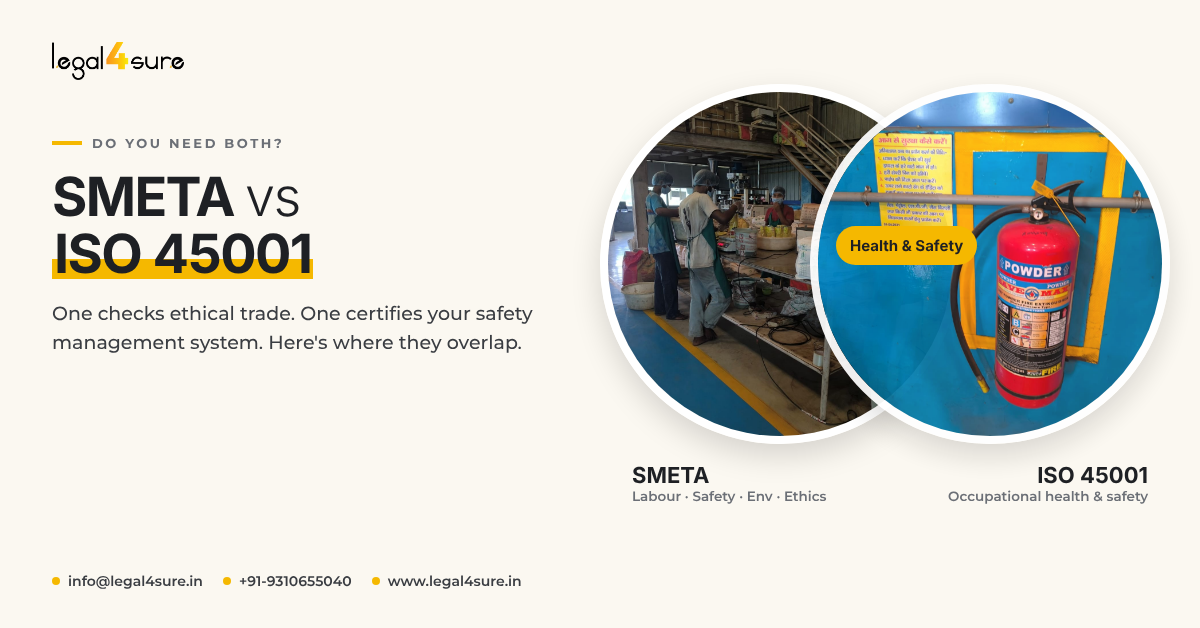
The Ethical Trade Team of one purchaser requests a SMETA audit. The Procurement Department of another client requests ISO 45001. Both mention health & safety, and voila, it seems that now you are requested to do exactly the same thing.
It is the above-mentioned intersection which makes SMETA VS ISO 45001 so confusing to the factory owner, EHS manager or Compliance Director. The two frameworks address the same theme, yet they measure and evaluate different things.
This guide from Legal4sure explains where they differ, where they overlap, and how to decide whether you need one or both.
What Is the Difference Between SMETA and ISO 45001?
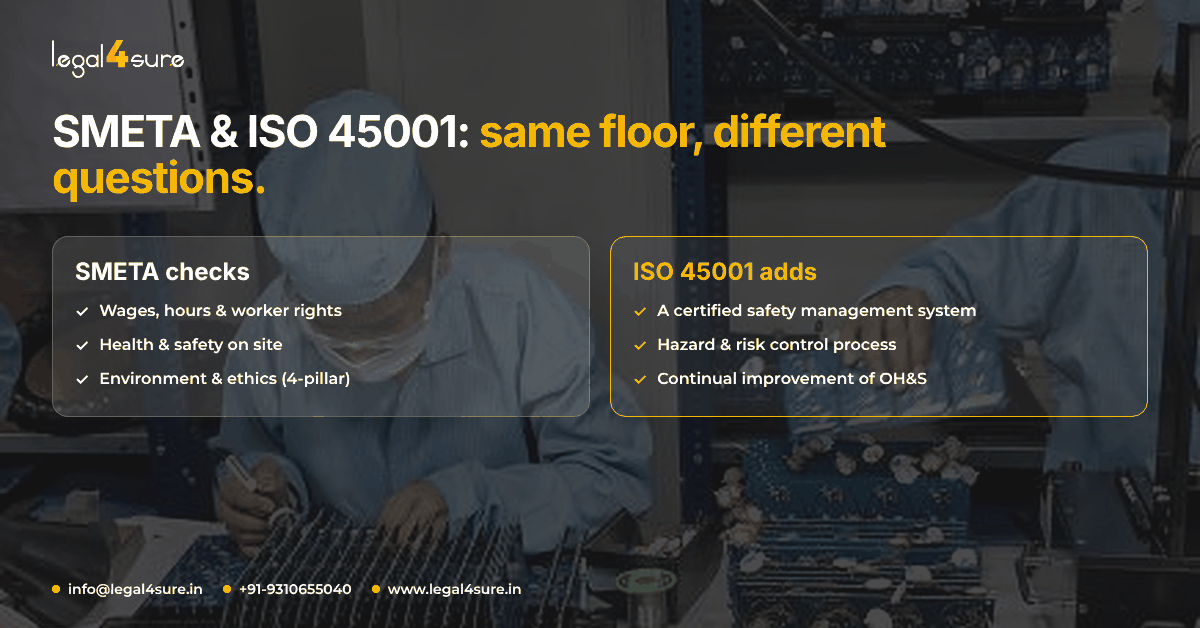
The SMETA is an ethical trade audit initiated by the buyers which measures the health and safety of a facility once. The ISO 45001 is an internationally recognized Occupational Health and Safety Management System which is certified by an accreditation institution. Both do not substitute each other, but rather most of the manufacturing facilities require either of them as asked by their buyers.
The key difference is what is being audited. SMETA reviews how your site deals with its workers and how it functions on a day-to-day basis, and publishes the results to the buyers. ISO 45001 provides certification that your company has an established management system for prevention of injuries and illnesses arising out of work.
Three differences account for most of the confusion:
- Scope: SMETA considers labor standards, health & safety, and, in the 4-Pillar format, environment and business ethics. ISO 45001 deals with occupational health and safety alone.
- Approach: SMETA evaluates current state of affairs with reference to the ETI Base Code and local regulations. ISO 45001 evaluates the effectiveness of systems to identify and control occupational hazards.
- Impetus: SMETA is demanded by the buyers. ISO 45001 is voluntary and initiated either by customers, tender requirements, or your internal safety strategy.
What Is a Sedex SMETA Audit?
The Sedex SMETA audit is an ethical trade audit conducted by an independent audited company using the Sedex system. The audit assesses the compliance of the site with the ETI Base Code as well as the national legislation, producing an audit report with findings and not a pass/fail certification.
It’s up to buyers which version they would prefer.The announced, semi-announced and unannounced formats are covered in our guide to SMETA audit types, and the pillar choice is covered in our Sedex 2-Pillar vs 4-Pillar comparison.
SMETA health and safety requirements
Health and safety is a core pillar in both SMETA versions. Auditors look at:
- Health and safety policy, risk assessment and safety management.
- Fire safety: means of escape, fire alarms, extinguishers, fire drills and fire safety of premises.
- Machine guarding, electrical safety and handling of chemicals.
- Safety gear, first aid, accident reporting and worker safety training.
- Welfare amenities such as drinking water, sanitary latrines, canteen and accommodation.
Strengths and limits of SMETA
- A single report can be used by multiple buyers who are connected, thereby avoiding duplication of audit.
- Interviews help highlight issues that cannot be detected through documents.
- The drawback is that it is only a point-in-time process, giving very little insight into your safety system performance between audit periods.
What the auditor does on site
Documents are inspected, walkthroughs are done, and workers are interviewed individually. It’s important since a neat document does not cover up a blocked fire exit and a clean floor doesn’t make up for lack of training documents.
Every non-conformity is entered into the Corrective Action Plan Report, which is then closed in the agreed upon time frame. How to get prepared for the Sedex SMETA audit is described in the following article.
What Is ISO 45001 Certification?
ISO 45001 certification indicates that the organization has in place an occupational health and safety management system that conforms to the international standard released in 2018. The system is audited by a certification body accredited by a governing body, after which a certificate is issued.
What the standard asks for
- Commitment from leadership and a written safety policy.
- Identifying hazards, assessing risk, and control measures.
- Consultation and participation by workers, including workers’ representatives.
- Emergency planning, incident investigations, and taking corrective action.
- Internal auditing, management review, and continuous improvement.
There is another requirement within ISO 45001 that demands compliance with legal and other requirements. The standard, however, does not have its own injury criteria or exposure limits.
How certification works
- Upgrade the management system and conduct training.
- Perform internal audits and perform management reviews.
- Get your Stage 1 documentation review and Stage 2 on-site audit done.
- You will receive your certificate valid for 3 years.
- Pass annual surveillance audits and get re-certified.
In India, certification organizations are normally accredited by NABCB, so be sure to look into the same.
Strengths and limits of ISO 45001
- It creates a repeatable system, thus making safety independent of specific people.
- It is recognized both sector-wise and internationally, covering industrial and construction industry chains.
- Disadvantage: it does not provide for wage, labor hours, child labor, or ethical issues of business, which are important for ethical trade buyers.
SMETA vs ISO 45001: Side-by-Side Comparison
Here’s how ISO 45001 vs SMETA compares on the points buyers and EHS teams raise most often.
| Factor | SMETA | ISO 45001 |
|---|---|---|
| What it is | Ethical trade audit methodology | Occupational health and safety management system standard |
| Who runs it | Sedex; audits by approved third-party audit firms | ISO; certificates from accredited certification bodies |
| Scope | Labour, health and safety, plus environment and business ethics in 4-Pillar | Occupational health and safety only |
| Approach | Checks site conditions and practices against the ETI Base Code and local law | Checks that a management system finds hazards, controls risks and keeps improving |
| Output | Audit report with non-conformities and a corrective action plan | Certificate on a three-year cycle |
| Who asks for it | Retail and brand buyers | Customers, tenders or the company’s own safety goals |
| Worker involvement | Confidential worker interviews are central | Worker consultation and participation are required |
| Validity | Set by each buyer’s re-audit cycle | Three years, with annual surveillance audits |
Effort, Cost and Timeline: What to Expect
SMETA audit is an occurrence. Preparations take place over a few weeks; payments are made towards Sedex membership and man-days of the auditor. Payments will vary depending on the number of employees, the size of the factory, and the choice of pillars.
ISO 45001 is a project. The preparation of systems, training, internal auditing, and certification bodies takes place; you will continue to make payments yearly for surveillance purposes. This should be planned over months, not weeks.
Where SMETA and ISO 45001 Overlap
The two are concerned with hazards management, emergency preparedness, training, and employee participation in decision making processes. The overlap exists and it works to your advantage because if you have an ISO 45001 in place, your risk assessment, training matrix, incident recording system, and drill reports are already in place to present to the auditor.
For instance, imagine a food packaging factory based in Gujarat, which supplies to a UK retailer and a client in the automotive industry. While the UK retailer requires a 4-Pillar SMETA audit, the automotive client wants ISO 45001 audit. Your safety management systems will cover for SMETA requirements but SMETA goes a step further in covering labour, remuneration, working hours, and ethical considerations that ISO 45001 does not cover.
The other way around, the SMETA audit does not evaluate the improvement of your safety management systems year by year.
Is ISO 45001 Required If a Company Has a SMETA Audit?
No. ISO 45001 is not necessary for SMETA and a certificate for ISO 45001 does not make you exempt from SMETA audits. The auditors will judge your facility independently. The certificate will help with the health and safety pillar, but it will not replace the required audit by the buyer.
Do Companies Need Both SMETA and ISO 45001? A Decision Framework
Work through these steps:
- Study the supplier code of your buyers. The one that mentions SMETA, plan that audit first.
- Study the customer contract and tender to see if ISO 45001 is required. Some industries mention it as a requirement.
- Analyze your risk profile. Machinery, chemicals, or hot work makes a formal system even more valuable.
- Analyze your past audit results. Repetitive health and safety issues indicate a poor system.
- Compare the cost of both to the orders they protect.
If you need both, many factories start with SMETA because buyer orders depend on it, then grow toward ISO 45001 as the safety system matures.
SMETA only is sufficient where
- All your clients talk about Sedex while no one asks you for ISO 45001.
- Your premises are at low risk, and you have small safety issues.
ISO 45001 only is sufficient where
- All your customers are industrial and do not use Sedex.
- You require safety management without having any ethical trade clients.
Both are required where
- You deal with ethical trade and industrial clients simultaneously.
- You require a single safety management for multiple SMETA audits.
Getting help can shorten the path. An experienced Sedex Consultant India or SMETA Audit consultant can map your existing safety records to both standards before you spend on either.
Common Mistakes to Avoid
- Taking for granted that ISO 45001 certification will be sufficient for a SMETA audit.
- Considering SMETA to be a hanging certification.
- Preparing safety documentation just prior to the audit such that it is inconsistent with what employees say.
- Neglecting fire safety and building concerns, which always lead to critical non-conformances.
- Beginning the process of ISO 45001 certification without even considering whether any customer needs it.
Checklist: Align Your Safety Evidence for Both
- Health and Safety policy document with assigned responsibilities.
- Risk assessments conducted and updated for each process/area.
- Training and induction records for all employees.
- Fire drill records and safe exit routes.
- Accidents & Near Misses report book with actions taken.
- Minutes of worker safety committee meetings.
Key Takeaways
- The SMETA audit looks at site conditions for buyers, whereas ISO 45000 is an assessment of the health and safety management system.
- Health and safety within SMETA is just one of a number of pillars, whereas ISO 45001 deals with safety only.
- ISO 45001 is not needed for SMETA and does not replace the audit.
- The buyers’ documentation determines which standard or both should be followed.
- Having excellent documentation for ISO 45001 makes SMETA health and safety audits much easier.
Conclusion
But does it mean that either SMETA or ISO 45001 is enough for any factory? No, because SMETA gives an answer to one question asked by your buyer, and ISO 45001 gives an answer to another.
First, write down what your buyers and clients demand, and then develop one documentation of safety, which will satisfy both of your needs. If you need a second opinion on it, Legal4sure can check your documentation for both standards.
Prepare for SMETA Audits and ISO 45001 Requirements with Confidence
Not sure whether your factory needs a Sedex SMETA audit, ISO 45001 certification, or both? Legal4Sure can help you review buyer requirements, assess health and safety documentation, identify compliance gaps, and prepare your facility for audits and certification.
Frequently Asked Questions
What is the difference between SMETA and ISO 45001?
SMETA is an ethical trade audit conducted by buyers in multiple pillars. ISO 45001 is a certificate of an occupational health and safety management system.
Is ISO 45001 required if a company has a SMETA audit?
No. There’s no requirement of that from SMETA and the certificate doesn’t substitute the audit.
Do companies need both SMETA and ISO 45001?
When both of them are required by buyers in the case of SMETA and by customers/tenders in the case of ISO 45001.
Is there a difference between SMETA and ISO 45001 requirements for health and safety?
Yes. SMETA inspects working conditions, while ISO 45001 – health and safety management system that controls risks.
Does ISO 45001 certification replace a SMETA audit?
No. Buyers expect a SMETA report and the auditor will assess your site independently.
Does having ISO 45001 make a SMETA audit easier?
Typically, yes. The reason is that risk assessment, training and incident reports are already done.
How long is ISO 45001 certification valid?
For three years and one-year surveillance audits between them.