What you hear from your customer is, “We require a Sedex audit.” But there’s just one piece of information they fail to mention that could make all the difference: 2-Pillars or 4-Pillars? Your choice will influence the extent of your audit, your prep time, and your fee. Choose wrongly and you might find yourself paying twice.
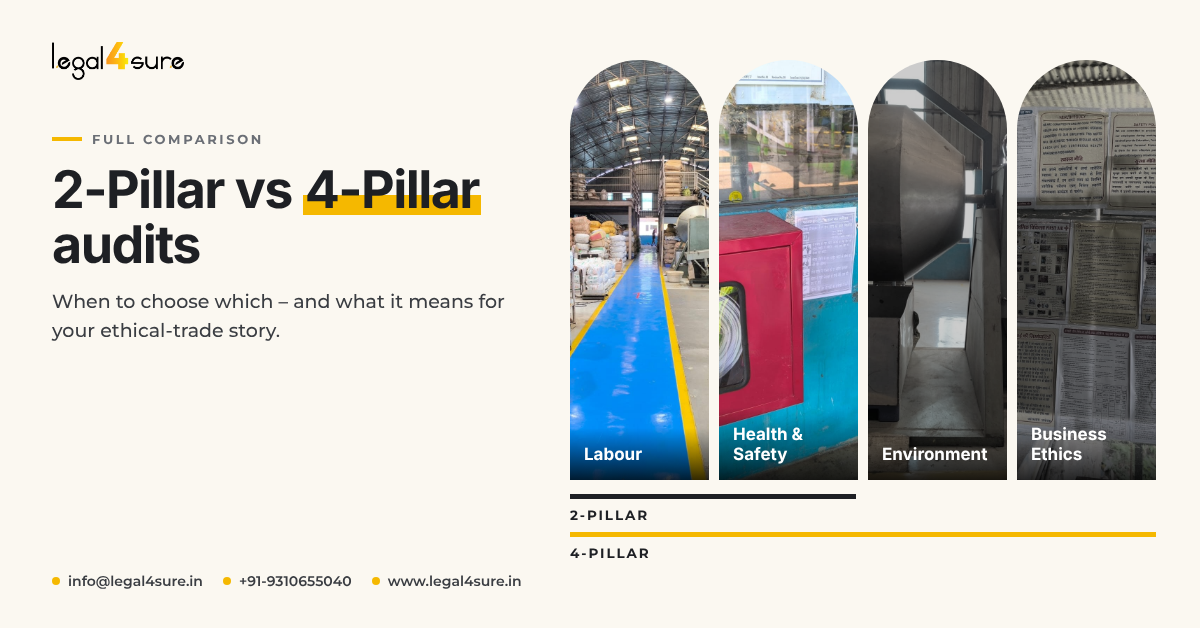
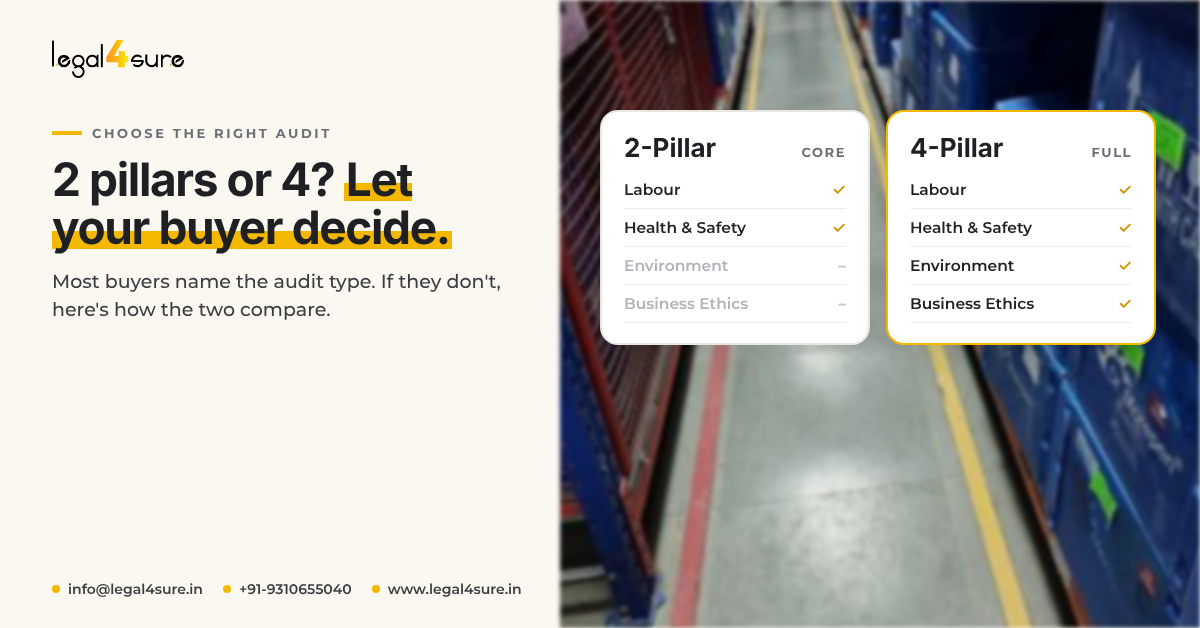
The short answer: A Sedex 2-Pillar audit includes labor standards and health and safety; whereas a Sedex 4-Pillar audit includes labor standards, health and safety, environment, and business ethics. Both 2-Pillar and 4-Pillar are done according to the SMETA framework. The choice between them is made by your buyer.
At Legal4sure, we help Indian manufacturers and exporters make this call before they book an auditor. This article lays out the differences, the cost drivers, and a simple way to decide.
Sedex 2-Pillar vs 4-Pillar: What Is the Difference?
It all boils down to scope. In a 2-pillar audit, the focus will be on how you take care of your workers and ensure their safety. With a 4-Pillar audit, aside from that, you will also be evaluated on how your site affects the environment and does business.
What a Sedex 2-Pillar Audit Covers
- Labour standards: free choice of employment, freedom of association, child labor, wages, working hours, discrimination, and regular employment.
- Health and safety: fire safety, guarding of machinery, chemicals, first aid, and health and safety in accommodation or canteens.
- Other components: management systems, right to work, sub-contracting, homework, and a brief environmental assessment.
What a Sedex 4-Pillar Audit Covers
A Sedex 4-Pillar audit includes everything above, then adds two full pillars.
- Environment: Energy & water consumption, waste disposal, emissions and permits.
- Ethics in business: Bribery and corruption, integrity of records and supply chain transparency.
Think of it as the same inspection with two more rooms to walk through. It isn’t a harder test on the first two pillars.
Are the Findings Graded Differently?
No. Both audits grade non-conformances as critical, major, or minor, and both end with a Corrective Action Plan Report. A 4-Pillar report simply has more sections, so there’s more room for findings. Neither format gives you a score or a pass mark.
2-Pillar vs 4-Pillar Audit Scope: Side-by-Side Comparison
| Feature | Sedex 2-Pillar audit | Sedex 4-Pillar audit |
|---|---|---|
| Core pillars | Labour standards; health and safety | Labour standards; health and safety; environment; business ethics |
| Environment | Shortened assessment only | Full environmental assessment |
| Business ethics | Not assessed | Assessed (bribery, integrity, transparency) |
| Additional elements | Management systems, entitlement to work, subcontracting, homeworking | Same elements, plus the two extra pillars |
| Auditor effort | Shorter | Longer, with a wider document review |
| Preparation load | Lighter | Heavier, especially environmental paperwork |
| Typical buyer use | Baseline social compliance | Fuller supply chain due diligence |
If your labour and safety records are shaky, adding pillars won’t hide that. Auditors assess every module the same way: documents, site observation, and worker interviews.
Pros and Cons at a Glance
- Advantages of 2-Pillars: Quick preparation, inexpensive auditing fees, and sufficient to meet buyers who have labor issues.
- Disadvantages of 2-Pillars: May not meet the needs of those buyers who are interested in getting information about environment and ethics and, therefore, need another audit.
- Advantages of 4-Pillars: One report is comprehensive and meets buyer needs, and it also indicates preparedness for due diligence.
- Disadvantages of 4-Pillars: It is expensive, takes longer auditing days, and more documents are required.
Sedex 2-Pillar vs 4-Pillar Audit Cost and Requirements
The 4-Pillar audit is always expensive since it requires additional work from the auditor and extensive documentation. The cost depends on many factors such as the size of the workforce, the number of locations, location, and auditing organization. You should get quotations for both types.
What Drives the Cost
- Number of auditors, who determine the number of auditor days.
- Audit scope because of two additional pillars which will require more time on-site.
- Type of audit and travel to your place.
- Verification of correction action, if requested by your buyer.
Sedex membership fees are separate from audit fees. The audit fee goes to your chosen audit firm.
Documents Each Scope Needs
- Audit for both:Licenses, Payroll, Attendance & Overtime records, Contracts, Age Verification, Provident Fund & ESI Payment records, Fire & Safety records.
- Audit for 4 Pillars Only: Consent to Operate Certificate from State Pollution Control Board, Hazardous Waste Authorization, Water & Energy records, Anti-Bribery Policy, and Whistleblower/Grievance Redressal Mechanism.
How the Audit Day Feels Different
The opening meeting, worker interviews, and closing meeting look similar in both. The difference shows up on the site walk and in the management interview.
- As a part of the 4-Pillar audit, the auditor will also examine effluent treatment, chemical storage, waste storage, and meters.
- Questions are raised regarding anti-bribery control, gift policy, and record integrity.
- The need for additional documents increases that day, so make sure to have an individual ready to bring the documents.
Difference Between Sedex 2-Pillar and 4-Pillar Audits in India
The four pillars are uniform all around the globe, except that in India, apart from the ETI Base Code, an audit in India is compared with Indian laws. The difference between the audit lies in the documentation. In a 4-Pillar Audit, documentation related to environment and ethics is brought in.
- These two audits ensure adherence to Factories Act, minimum wages laws, limitations on overtime work, and PF and ESI contributions.
- The 4-Pillar audit includes permission from pollution control boards, effluent/waste discharge, and permission for hazardous waste.
- The 4-Pillar audit is mostly required by exporters in the garments, food processing, leather and packaging industry.
- The records in regional language or on paper require translation or organizing before audit takes place.
Which Sedex Audit Should a Supplier Choose?
Select the audit that the buyer requires. In case he does not specify one, inquire from him in writing. If the decision rests with you, choose 4-Pillar Audit in case you have many customers, export to Europe, or encounter environment-related concerns. Select 2-Pillar Audit if the buyer wants basic labour compliance.
A Simple Decision Framework
- Ask each client which scope he or she will accept and what kind of audit is expected.
- See if there is any buyer code of conduct or retail program which mandates environmental or ethics information.
- Count your clients. In case they have different expectations, do the audit on a broader scope, so that one report would be acceptable for all of them.
- Ensure you are ready for the audit, that means permits and ethics policies are available.
- Receive quotes on both scopes from at least two auditing companies.
A Quick Example
Consider the case of an exporter of packages having two buyers. The UK-based retailer is accepting 2-Pillar, while the German-based company requires data on both environment and business ethics. In the case where the exporter gets 2-Pillar certification for one customer and a different 4-Pillar for the other, he is paying twice the cost of one 4-Pillar.
When 2-Pillar Makes Sense
- Your only buyer accepts it in writing.
- You’re building your first compliance baseline.
When 4-Pillar Makes Sense
- A number of purchasers require information on environmental and ethical matters.
- You provide sustainability objectives to European retail firms or brand companies.
- You require only one report, which will not require repetition should demands increase.
Common Mistakes to Avoid
- Booking for 2-Pillars, finding out that the buyer wants 4-Pillars, and spending twice as much.
- Assuming that it’s your decision when it’s not.
- Thinking it won’t take long to get the environmental permits.
- Not closing the old corrective action from an earlier audit.
Impact on Ethical Trade and Sedex Ethical Trade Requirements
Sedex ethical trade criteria are not determined only by Sedex itself. It is the buyers who set the expectations, typically grounded on the ETI Base Code, local legislation, and buyer codes themselves. Sedex simply provides the tool and the methodology SMETA that gathers and exchanges the information.
SMETA 7.0, introduced at the end of 2024, left both 2-Pillar and 4-Pillar approaches as they were but also updated the reporting procedure and brought in the gender-disaggregated worker data. Buyers that have to comply with due diligence legislation in Europe, such as the German supply chain law, now prefer to have more information from the suppliers.
For the suppliers, the consequence of that is quite simple: ethical trade is not a once-a-year exercise anymore.
- Buyers find reports easy to compare among suppliers.
- Environmental and ethics information goes from being nice to having to become necessary.
- Action plans change audits from isolated events to ongoing improvement processes.
Can You Upgrade From 2-Pillar to 4-Pillar?
Yes, but a finished report can’t be stretched after the fact. You’ll usually need a new audit at the wider scope, so confirm SMETA 7.0 requirements before booking.
Best Practices for Either Audit
- Conduct an internal audit exercise based on the chosen scope.
- First, address statutory deficiencies as this will lead to most of your findings.
- Maintain organized payroll records for one year along with overtime records.
- Inform managers about responding to interviews honestly.
- Conclude corrective actions with proof within the stipulated time frame.
Key Takeaways
- The two-pillar audit encompasses labor practices and health & safety; the four-pillar audit, on the other hand, includes the environment and business ethics.
- It is your buyer that will determine which scope to go for, thus put that in writing.
- The four-pillar audit is costlier due to additional auditor’s time and documentation for the environment and ethics.
- Where you have many buyers, then auditing at the higher scope will save you the effort of re-auditing.
- None of the audits will give you a certificate but a report and a corrective action plan.
Conclusion
Choosing between 2-Pillar and 4-Pillar audit through Sedex is not an issue of which one is a more appropriate audit process. It is a matter of which one your buyers are currently accepting. Get the scope confirmed, set aside money for documentation, and prepare the records before the auditor shows up.
Legal4sure is a Sedex Consultant India and can help you to determine which scope suits your buyers if you are in any doubt and get your site ready for any audit.
Choose the Right Sedex Audit Scope for Your Business
Not sure whether your factory needs a 2-Pillar or 4-Pillar Sedex audit? Legal4Sure can help assess your buyer requirements, review labour and safety records, check environmental and business ethics documentation, and prepare your facility for a SMETA audit.
Frequently Asked Questions
What is the difference between Sedex 2-Pillar and 4-Pillar audits?
2-Pillar audit consists of two pillars – Labour standards and Health & Safety. 4-Pillar audit additionally includes Environment and Business Ethics.
What is the difference between Sedex 2-Pillar and 4-Pillar audits in India?
Pillars are the same, but in India, compliance with Indian legislation (Factories Act, PF, ESI, pollution control consents) is also verified.
Sedex 2-Pillar vs 4-Pillar audit cost and requirements: what should I expect?
Expect 4-Pillar to be more expensive due to additional effort and environmental documents. Price depends on the number of employees and the audit agency.
Which Sedex audit should a supplier choose?
You should choose an audit based on the buyer’s requirements. In absence of such a requirement, you should consider a 4-Pillar audit (multiple buyers, especially from Europe); 2-Pillar is better for basic needs.
Is a Sedex 4-Pillar audit a certification?
No. Like all other SMETA audits, it results in a report and corrective action plan, not a certificate.
Can one SMETA report be shared with several buyers?
Yes, through the Sedex platform, as long as each buyer accepts the scope and how recent the report is.
Does SMETA 7.0 change the 2-Pillar and 4-Pillar options?
No. Both remain available, though reporting has changed, including gender-differentiated worker data.