
SMETA 7.0 requirements have altered the parameters that auditors consider in your factory. In addition to looking into what an auditor observes during the day of the audit, the audit now checks whether the internal management systems are able to identify any issue prior to its manifestation at the shop floor level.
Sedex released SMETA 7.0 on 10 September 2024, and all SMETA audits conducted after 1 January 2025 are according to SMETA 7.0, except for 6.1 follow-up audits. If a buyer asks your unit to conduct a SMETA audit, then this will be the version you’ll be subjected to.
This guide from Legal4sure highlights the SMETA 7.0 changes, compares SMETA 7.0 vs 6.1, and provides a step-by-step approach to conducting a SMETA 7.0 audit in India.
What Are SMETA 7.0 Requirements?
The criteria of SMETA 7.0 Audit are the guidelines that are contained within the existing ethical trade model of Sedex. This comprises the Workplace Requirements that are detailed on the basis of ETI Base Code along with Management System Assessment, which has been added with “Collaborative Action Required”.
SMETA means Sedex Members Ethical Trade Audit. The SMETA audit is a method but not a certification; thus, there is no SMETA certificate that you can have. The buyers go through the report in order to assess your site according to the ETI Base Code, which is based on ILO conventions.
The 2-pillar audit includes labor conditions and health and safety, while the 4-pillar audit also includes environment and business ethics.
SMETA 7.0 Changes: What’s New
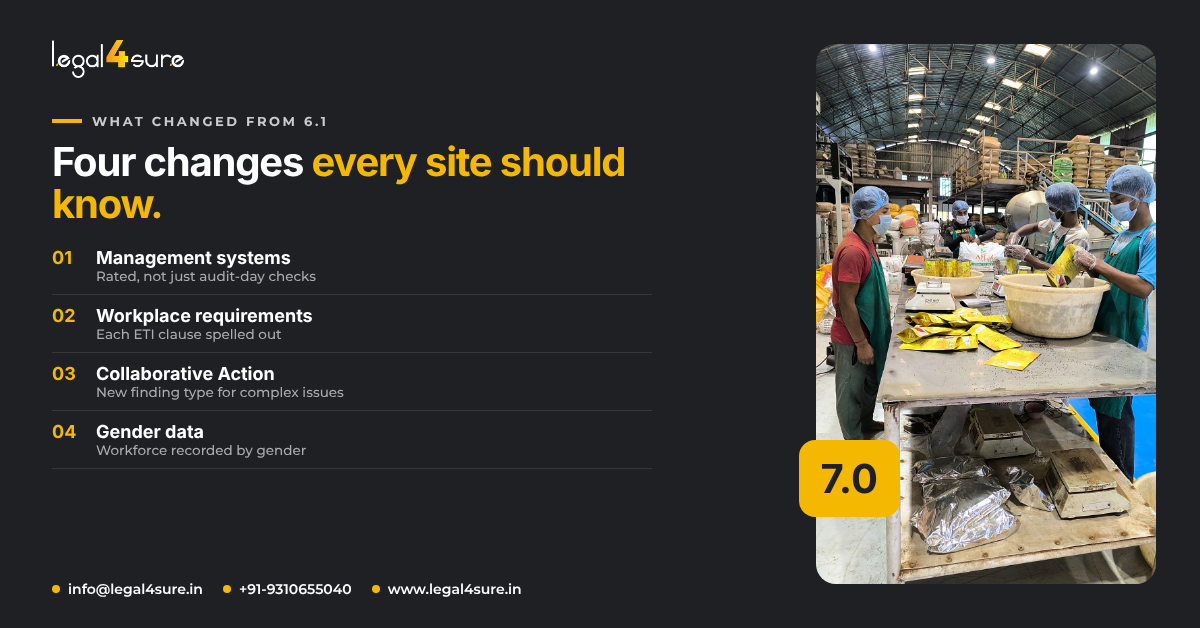
Sedex built this update after consulting more than 2,000 members and over 60 experts. Six changes matter most to suppliers:
- Workplace Requirements: ETI Base Code expressed as discrete, auditable requirements.
- Management Systems Assessment (MSA): An assessment of the performance of your facility on compliance over time.
- Collaborative Action Required (CAR): A new finding category for complicated situations.
- Gender differentiated data: Workforce data going further than the usual break-down between males and females.
- Reporting update: Results presented in Workplace Requirements categories and CAPR with instructions for next steps.
- Auditor Training: 16 hours of face-to-face training which is a mandatory prerequisite for a 7.0 audit.
SMETA 7.0 vs 6.1: What Changed
The key distinction in the SMETA 6.1 vs SMETA 7.0 is the shift from an audit-day snapshot to a systems-based approach. Version 7.0 includes workplace requirements, which are evidence-based, MSA scoring as opposed to observations, CAR findings, gender, and reporting.
| Area | SMETA 6.1 | SMETA 7.0 |
|---|---|---|
| Audit focus | Mostly conditions seen on the audit day | Conditions on the day, plus how management systems sustain them |
| Audit standard | Measurement Criteria for each Base Code area | Workplace Requirements, with the evidence reviewed recorded for each |
| Systems review | An “observations” category | A graded Management Systems Assessment (four elements, four grades) |
| Complex issues | Treated as ordinary non-conformances | Collaborative Action Required finding for four areas, with no fixed deadline |
| Gender data | Not a feature of the methodology | Gender-differentiated workforce data |
| Reporting | Earlier report and CAPR format | Results summarised by Workplace Requirement area; CAPR includes next-step guidance |
| Auditor readiness | Trained on 6.1 | Mandatory 16-hour live training before conducting 7.0 audits |
What Stayed the Same
- ETI Base Code is still the base.
- Audit formats of two pillars and four pillars are still in use.
- Announced, semi-announced, and unannounced audit types are still available.
- The methodology is still applicable to various industries.
There is one advantage for suppliers in this respect. Expectations are stated in advance, thus there are no surprises during the audit process. The drawback is an increased volume of documentation to be collected and maintained, particularly by those suppliers which have a large contract workforce.
SMETA 7.0 Workplace Requirements Explained
How They Work
The SMETA 7.0 Workplace Requirements divide the ETI Base Code and Sedex additions into verifiable criteria. In respect of each criterion, the auditor documents the evidence considered and determines if it is satisfied or not.
In case of discrepancy between the local law and the Base Code, the more stringent standard should be applied. This means that compliance with Indian law is the minimum requirement.
The requirements are detailed. Some examples are allowing employees to exit the workplace freely and the provided accommodation; verifying legal recruitment of the employees; and protection of children and young workers.
What Auditors Typically Ask to See
- Payslip, wage book, and attendance record compared to legal minimums.
- Working hours, overtime records, and days off.
- Labor agency agreements and recruiting records for contract or immigrant laborers.
- Age proof records and child labor prevention.
- Risk assessment, fire safety, and health and safety training records.
- Complaint log indicating resolution of the complaint.
SMETA Management Systems Assessment (MSA): The Biggest Shift
The SMETA Management Systems Assessment is an evaluation process where auditors assess the systems in place at a facility in order to ensure compliance with the standard. Each of four components of each Base Code category is evaluated as either “Not addressed,” or “Robust management system.”
This is the change suppliers feel most. An auditor can now see a clean factory floor and still grade your systems poorly if nothing would keep it clean next month.
The Four Elements Auditors Assess
- Policies and Procedures: Formal documents with clearly defined roles and a mechanism for reviewing them.
- Resource Allocation: A designated person with proper authorization and budget to manage the policies.
- Training and Communication: Proper training and communication of the policies with evidence of understanding by the employees.
- Reviewing and Monitoring: Timely detection of any issue with proper documentation of changes made to them.
The Four Grades
- Not covered
- Basic changes needed
- Changes suggested
- Effective management system
Let us consider work timing. A company can have well-maintained overtime records, but if there is no owner to check them or any system of action upon the unusual increase, it will fail in the monitoring aspect.
In case of non-compliances arising from the weak system, the grade would be worse. Attendance registers are not sufficient to prove the training aspect.
Collaborative Action Required Findings
CAR refers to situations where an organization is unable to address an issue internally. CAR pertains to only four issues: living wages, responsible recruitment, child labor and discrimination, and it does not have a predetermined closure period.
The parties involved might include the buyer, labour providers, local NGOs, and even trade unions. For instance, a recruitment fee charged through an overseas labour agent is a good example as this cannot be sorted out at the factory level alone.
The role of the auditor here is to demonstrate due diligence. You have to document activities undertaken like agency audits, fee repayment verification, and benchmarking of wages, and make the buyer aware of these documents.
CAR is not a tool for avoiding the normal process. In case the site can sort out the issue by itself, it becomes a standard non-conformance.
When SMETA 7.0 Applies to Your Audit
- 10 September 2024: Release of SMETA 7.0 by Sedex.
- 1 January 2025: All audits done against 7.0 version, except 6.1 follow ups.
- Previous audits: No need to do re-audits immediately but next audit will be done against 7.0.
- From 2025 guidance: Sedex does not consider any SMETA audit over 24 months as a strong reflection of the current situation.
Sedex also steers users toward semi-announced and unannounced audits, so plan to be audit-ready year-round, not just near a booked date. Your buyer may set its own frequency on top of this.
How to Prepare for SMETA 7.0 Requirements in India
SMETA audit Preparation works best when you treat the MSA as the spine and the Workplace Requirements as the checklist. Here’s a practical sequence:
- Clarify scope with your buyer. Inquire if they require a 2-pillar or a 4-pillar audit and what kind of audit is acceptable to them.
- Conduct a gap analysis. The Sedex has Workplace Requirements published in the Annex of the Auditor Manual. Compare them against your internal systems.
- Designate a responsible manager. Delegate written authority to him along with a budget, as the MSA audits resource allocation.
- Update the policies and processes. Make sure these are aligned with Factories Act, wage legislations, PF & ESI, contract labour laws, POSH guidelines, and also the stricter one between the two for Base Code.
- Train and check comprehension. Inform your employees in their native language and retain records showing comprehension, not mere presence.
- Set up a monitoring process. Conduct internal audits, grievance audits and minutes of management review in order to demonstrate continuous improvement.
- Conduct a practice audit. It should include interviews of employees, agency workers and night shift records.
Common Mistakes to Avoid
- Policies written just before the audit and no training on them.
- Agency and contract employees not included in documents and interviews.
- Documents contradicting what employees say happened.
- Not taking into account zero tolerance issues until the audit comes up.
When to Bring In Outside Help
A first audit, a 4-pillar scope or a buyer deadline usually justifies expert support. A readiness review of the kind Legal4sure supports can surface gaps while there’s still time to close them. If your systems are mature and internally audited, you may only need a light mock audit.
SMETA 7.0 and Your Other Compliance Programmes
The C-TPAT is a different US Customs supply chain security program and will not be affected by the new SMETA 7.0. There may be documents, like training, which are required for both.
The buyers are tightening their due diligence based on requirements such as the EU CSDDD and forced labor regulation. They will pay closer attention to your SMETA audit report.
Key Takeaways
- Since January 2025, SMETA 7.0 has been used in all audits, except 6.1 follow-up audits.
- Workplace Requirements make the ETI Base Code into checklist points that the auditor evaluates against the evidence.
- The Management Systems Assessment assesses four areas, which means that documentation without action fails badly.
- CARs include living wage, responsible recruitment, child labour and discrimination, but there is no fixed deadline.
- Begin by assessing your gaps, appoint an accountable manager and train staff before the audit date.
Conclusion
Requirements of SMETA 7.0 encourage those systems to work which have been built for the purpose, not those that prepare hurriedly at the last minute. The audit now queries about ownership of compliance, awareness of workers about it, and also about how to detect compliance failures promptly.
Begin from Workplace Requirements, construct four MSA pillars around it and maintain updated records. This way, a SMETA 7.0 audit will only be a confirmation of what you already do.
Prepare Your Business for SMETA 7.0 Audit with Expert Guidance
Get ready for SMETA 7.0 requirements with Legal4sure. Our experts help you conduct gap assessments, review workplace requirements, strengthen management systems, and prepare your facility for a successful SMETA audit.
Frequently Asked Questions
What are the new requirements in SMETA 7.0?
Workplace Requirements, Graded Management Systems Assessment, CAR findings, gender disaggregated data, and the revised reporting are new additions in SMETA 7.0.
What is the difference between SMETA 6.1 and 7.0?
The version 6.1 depended on conditions prevailing during audit day. SMETA 7.0 includes systems review, evidence-based requirements, and CAR findings.
How to prepare for a SMETA 7.0 audit in India?
Clarify the scope, conduct gap analysis against Workplace Requirements, appoint accountable manager, train the workforce, and have monitoring records ready.
C-TPAT what changed from SMETA 6.1 to SMETA 7.0?
There were no changes for C-TPAT as it is a US security programme and is independent of SMETA 7.0 and 6.1.
Is SMETA 7.0 a certification?
No, it is an auditing methodology and therefore you would get a report and corrective action plan, not a certificate.
Do I need a fresh audit if my last one was SMETA 6.1?
Yes, eventually, you will have the audit done according to SMETA 7.0. Sedex does not consider any audit older than 24 months.
Does SMETA 7.0 apply to both 2-pillar and 4-pillar audits?
Yes. Both formats remain, and each includes the Workplace Requirements and the Management Systems Assessment.