What is Sedex SAQ vs ESAQ? This is a question that pops up right away on an exporter’s desk when a client requests information about their suppliers. The Sedex Self-Assessment Questionnaire may appear easy to fill in on the computer screen; however, it is not.
The most common errors that our lawyers find in Legal4sure are not related to poor working practices on the production line, but rather to hastily filled forms with numbers that do not add up and policies that exist only in imagination.
This manual will walk you through the contents of the SAQ and ESAQ and will tell you how to complete them properly before your SMETA audit.
Sedex SAQ vs ESAQ: The Quick Answer
The Sedex SAQ, a wide-ranging self-assessment related to labor issues, health and safety, environment, and business ethics, serves as an evaluation tool. On the other hand, the ESAQ, which stands for the Environment Self-Assessment Questionnaire, provides more in-depth assessment of environmental performance like energy use, water consumption, and waste.
| Feature | Sedex SAQ | Sedex ESAQ |
| Full name | Self-Assessment Questionnaire | Environment Self-Assessment Questionnaire |
| Focus | Broad ethical self-check across labour standards, health and safety, environment and business ethics | Environmental practices and performance in more detail |
| Typical content | Site details, worker numbers, hours, wages, safety controls, policies | Energy, water, waste, emissions and chemical management |
| Shared with | Linked buyers through the Sedex platform | Buyers who ask for environmental data |
| Link to audit | Auditors compare answers with what they see on site | Supports the environment checks in a 4-Pillar audit |
| Best for | Every supplier site on Sedex | Sites with environmental exposure or buyer requests |
Sedex updates its platform and questionnaires from time to time, so check the current versions inside your account before you start.
What Is the Sedex Self-Assessment Questionnaire?
The Sedex Self-Assessment Questionnaire is a questionnaire completed by the supplier and includes the description of how a particular site complies with labour standards, health and safety, environmental protection, and ethics. You complete it through the Sedex system and connected buyers have access to the results.
What the SAQ covers
- Site profile: address, product lines, number of employees and the percentage of migrant, contract and agency employees.
- Labor standards: working hours, wage payments, child labor, young worker protection, measures against forced labor, right to freedom of association.
- Health and Safety: fire safety measures, machine safety, chemicals, accident reporting, emergency procedures.
- Environment and Business Ethics: waste management, energy conservation, licensing, anti-bribery practices, grievance handling procedures.
Reasons for the buyer’s close reading
Buyers consider a supplier’s risk level based on their responses to the SAQ long before sending an auditor to visit the facility. Information provided in the SAQ is used by Sedex as well to perform the risk assessment for the buying organizations. Inadequate or ambiguous answers to the SAQ can result in more questions by your buyer or earlier audits.
Relation of SAQ to SMETA audit
The SAQ is reviewed by the SMETA auditor prior to and during the audit. Discrepancies between your answers in the SAQ and what really happens at your facility will be considered as findings, sometimes even as issues of integrity. To understand in what way SAQ relates to Sedex Certification (as it is informally called), see our article.
What Is the Environment Self-Assessment Questionnaire (ESAQ)?
The Environment Self-Assessment Questionnaire is an environment-specific questionnaire that requires the site to provide more information than what is needed in the environment section of the SAQ.
Information required by the ESAQ
- Use of energy and the sources of the energy being consumed, which could be grid power, diesel generator/boilers.
- Source of water, consumption of water and management of effluents.
- Generation of waste, segregation and disposal of the waste.
- Emission of air and any information on the greenhouse gas emissions, if any.
- Storage of chemicals and the environmental clearances like the clearance from the State Pollution Control Board.
Applicability
Food processing units, textile units, packaging units and many other types of factories having visible footprint of energy, water or waste can derive the maximum benefit from this questionnaire.
What Is the Difference Between Sedex SAQ and ESAQ for Indian Exporters?
The practical difference is in scope and depth. The SAQ is the starting point that all supplier sites complete. The ESAQ comes in as an additional layer with more details on the environmental side, and it becomes important when buyers, regulators, or a 4-Pillar audit put environmental performance into question.
- Scope: The SAQ covers four aspects; the ESAQ focuses on one of them.
- Evidence: SAQ answers are based on payroll, contracts, and safety records; ESAQ answers on utility bills, waste manifest, and permits.
- Owners: HR and compliance departments handle the SAQ; plant, maintenance, or EHS department handles the ESAQ.
- Pressure point: SAQ problems become obvious in worker interviews; ESAQ problems become obvious when the auditor requests bills and permits.
Consider a spice exporter from Gujarat that supplies a European retail chain. The SAQ questions include information about seasonal workers and overtime; the ESAQ questions include information about wastewater and packaging waste management at the unit level.
How Do I Complete the Sedex SAQ and ESAQ?
Login to your Sedex account, complete the questionnaire for your site, give answers to each section on evidence basis, have it reviewed by another person, and share it with linked buyers. Do not assume answers and leave questions unanswered unless you verify the answer.
- Verify the information about the site and ensure that the name and address of the site match your documents.
- Gather evidence prior to filling up the questionnaire: payroll records, attendance register, licenses, fire certificate, utility bills and waste bills.
- Assign sections to the right people rather than making a guess about them by one person.
- Answer on evidence basis and keep a folder with references for each answer.
- Conduct an internal review with the HR, production and management team before submission of the questionnaire.
- Share the filled questionnaire with your buyers and remind yourself to review it.
How to Complete Sedex SAQ and ESAQ Accurately: Best Practices
Create an evidence checklist
- Headcount divided into permanent, contract, agency and migrant workers.
- Wages records for the last three months, attendance and overtime.
- Fire safety approvals, fire drill and accident records.
- Pollution control approvals, waste disposal records and chemicals inventory.
- Written policies related to complaints procedure, anti-bribery and child labour.
Common errors to watch out for
- Counting round worker numbers or omitting contract labor.
- Replying “yes” to the policies which are not written and communicated.
- Having the same person answer both questionnaires.
- Copying answers from the previous year without reviewing changes.
- Making an exaggerated statement about performance and contradicting it in the course of the audit.
Why honesty works better than polish
A straightforward “no, and this is how we will fix that” goes down much better with customers than an answer which is proven wrong by an auditor. This should be stated on the form with a dated plan.
Which Questionnaire Should You Prioritise First?
Let’s start from the SAQ. It is the base level of questionnaire that any buyer expects, and incomplete SAQ stops the process of onboarding. Switch to the ESAQ once you submit your SAQ, or even earlier if a buyer requested for environmental information.
Submit SAQ when
- You register a new factory on Sedex and link your first buyer.
- A buyer needs a rapid insight into your labour and safety risks prior to scheduling an audit.
- You need to get ready for 2-Pillars or 4-Pillars SMETA audit.
Submit ESAQ when
- A buyer requires energy, water, or waste metrics.
- You have an environment pillar included in your audit.
- You operate a process-intensive plant, such as food processing, dyeing, or printing.
When a questionnaire does not work on its own
Both questionnaires do not serve as the proof of compliance. They provide information about your facility; an audit will verify this information. If your documentation is weak, improve it first and complete the questionnaire second.
The realistic timeframe for your first-time facility is several weeks of documentation preparation, several days of writing, and a short review period. To rush the process in one afternoon is the main reason for mistakes.
What Happens When SAQ Answers Don’t Match the Audit?
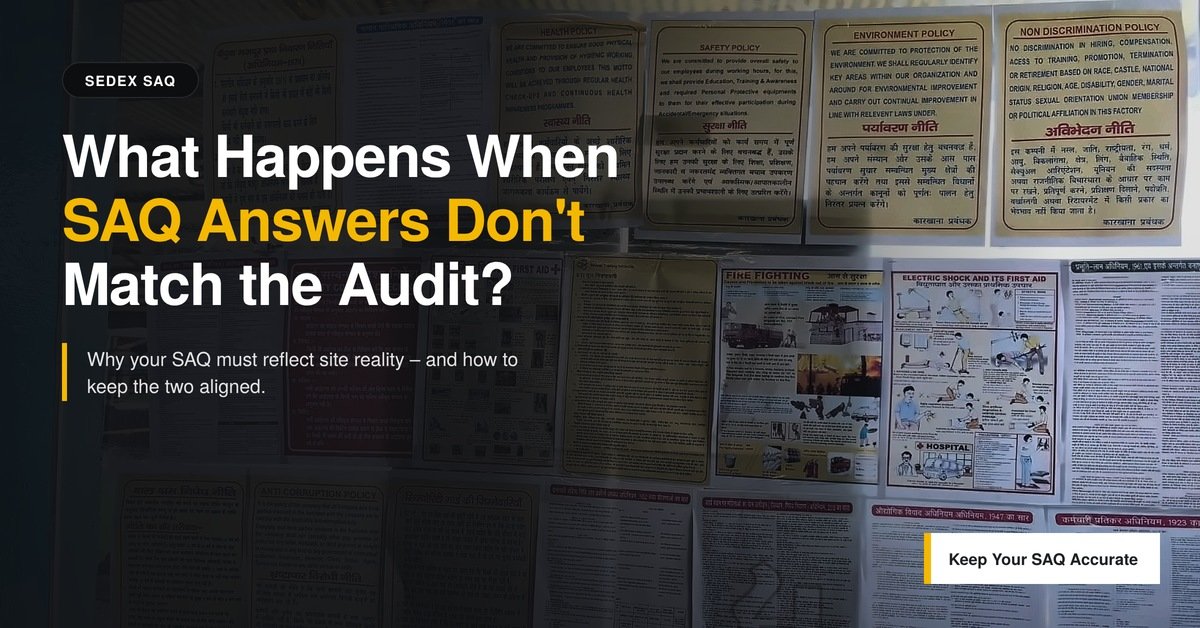
Non-conformity results from mismatches, which if big enough can erode confidence of buyers in the organization. Auditors match up hours and attendance, headcount with payroll, and permits with site conditions.
Rectification of the SAQ before an audit is always simpler than explaining it after an audit. Check the SAQ just before the date of the audit to see if you need to make any changes.
Where the SAQ Fits in Your Wider Compliance Plan
SAQ and ESAQ are just the beginning of a Sedex audit journey, where further SMETA audit, corrective measures, and monitoring follow. Many food exporters perform these audits in conjunction with food safety requirements, and their comparison in Sedex, SA8000, BRC, and FSSC 22000 is presented.
One team planning both audits will be able to use one set of documents for all procedures involved. This is how we work at Legal4sure with food exporters who need to satisfy all buyer requirements with one evidence system.
Sedex vs SA8000 vs BRCGS vs FSSC 22000
Choosing the right compliance standard is essential for businesses aiming to work with global buyers and expand into international markets. Understanding Sedex vs SA8000 vs BRC vs FSSC 22000 helps businesses identify the differences in audit requirements, worker welfare, food safety and supply chain compliance. While each standard serves a different purpose, the right choice depends on your industry, buyer expectations and business goals.
| Comparison Factor | Sedex / SMETA | SA8000 | BRCGS | FSSC 22000 |
| Primary Focus | Ethical trade, labour practices and responsible sourcing | Social accountability and workers’ rights | Food safety, quality and product safety | Food safety management systems |
| Industry Applicability | Food, textiles, garments, toys, packaging, pharma and manufacturing | Manufacturing, textiles, food, apparel and other industries | Food manufacturing, packaging, storage and distribution | Food manufacturing, packaging, processing and related supply chains |
| Key Requirements | Labour standards, health and safety, environment and business ethics | Fair wages, working hours, workplace safety, child labour prevention and workers’ rights | HACCP, hygiene, product safety, quality management and process control | ISO 22000, HACCP, prerequisite programmes and additional FSSC requirements |
| Assessment Type | SMETA 2-Pillar or 4-Pillar audit | Independent certification audit | Third-party certification audit | Third-party certification audit |
| Certification Status | Not a certification; SMETA is an audit methodology | Certification standard | Certification standard | Certification scheme |
| Buyer Recognition | Widely used by global retailers and responsible sourcing programmes | Recognised internationally for social accountability | Recognised by global food retailers and brands | Recognised internationally by food manufacturers and buyers |
| Main Objective | Improve supply chain transparency and ethical business practices | Ensure fair treatment and protection of workers | Maintain food safety, quality and product integrity | Establish and maintain an effective food safety management system |
| Best Suited For | Businesses supplying global buyers who require ethical trade audits | Businesses seeking formal social accountability certification | Food businesses supplying retailers and international markets | Food businesses seeking internationally recognised food safety certification |
Key Takeaways
- SAQ stands for the general background, while ESAQ provides more details about environmental performance.
- They are both filled by suppliers, given to buyers and audited according to what is happening in practice on site.
- Answers should be taken from supporting documentation like payrolls, invoices, permits and policies, but never from memory.
- Distribute the questions among the responsible parties and get them reviewed before submission.
- Make sure your answers are updated before each audit.
Conclusion
The difference between Sedex SAQ and ESAQ depends on the breadth of inquiry. SAQ allows buyers to have a broad perspective on your facility, whereas ESAQ will give a broader perspective on the environment as well. Exports who prepare their documentation in advance and provide accurate responses will be rewarded.
The questionnaire should be treated as an exercise prior to the audit process. If you want a second opinion on your responses, Legal4sure is here to help you out.
Complete Your Sedex SAQ & ESAQ with Expert Guidance
Get professional support with Sedex SAQ and ESAQ questionnaires, compliance documentation, environmental assessments, and SMETA audit preparation. Ensure accurate responses and stay ready for buyer requirements.
Frequently Asked Questions
What is the difference between Sedex SAQ and ESAQ?
SAQ is a general self-assessment in four categories. ESAQ concentrates on environmental details such as energy, water, and waste.
Does the difference between Sedex SAQ and ESAQ for Indian exporters affect audit scope?
No. Scope is determined by audit type. But ESAQ provides information which is used during the environment audit in 4-Pillar Audit.
How do I complete the Sedex SAQ and ESAQ?
Collect documents, distribute sections among section owners, respond based on documents, internal approval, and submit to the Sedex system.
Any tips on how to complete Sedex SAQ and ESAQ accurately?
Use payroll, invoices and permits as the source for your answers. Include temporary workers and update your previous answers.
What is the Sedex Self-Assessment Questionnaire?
Self-Assessment Questionnaire is the self-reporting of supplier in four categories prepared for buyers via Sedex platform.
How often should I update my SAQ?
Review it annually and prior to each audit or upon changes in your workforce/operations.
What happens if my SAQ answers don’t match the audit findings?
Auditors may raise non-conformities, and buyers may question your data. Correct answers before the audit.