
There is an accelerated growth in the business of exporting food products from India. As the demand for such food items from Europe and the UK increases, attaining the standards set by BRCGS (Brand Reputation Compliance Global Standards) assumes a great deal of importance for Indian producers. At the core of such an approach lies effective BRC audit preparation.
Our BRC audit guide will show you what needs to be done in order to achieve certification in 2026 by providing a checklist for India’s manufacturing facilities. We will remove any vagueness and give you instructions on how to transform your HACCP processes and ensure your supply chain’s traceability.
BRC Audit Preparation: Understanding the BRCGS Standard
BRCGS Food Safety Standard, previously known as BRC Global Standards, is a universally acknowledged standard that has been established to facilitate food safety, quality, and legality. This food safety standard is well-accepted among retailers and food service organizations operating within the United Kingdom, Europe, North America, as well as in the Gulf and Southeast Asia regions.
The BRCGS Food Safety Standard certification is important for Indian food organizations in particular because it indicates their commitment toward food safety practices that are more rigorous than the national standards such as FSSAI.
Who Needs BRC Audit Preparation?
Any Indian company that:
- Sells products through exports to UK retail chain
- Sells products through exports to Europe retail chain
- Sells products to the food services or FMCG organizations internationally
- Desires improvements in their food safety management system
needs to put in the effort to get ready for their BRC audit ahead of schedule.
>Helpful Guide:- Emergency BRC Certification: How to Get Approved When Audit Is Due in 15–30 Days?
BRC Audit Preparation: Step-by-Step Process in India
It is important to understand what the BRC audit process in India entails in practical terms. This will be very helpful in planning how best to go about BRC certification. Below is a detailed explanation of all BRC certification meaning and process in India.
Step 1: Determine the Right BRCGS Standard
There are several BRCGS standards. In India, the most popular ones are
- Food Safety (Issue 9)
- Packaging Materials (Issue 6)
- Storage and Distribution (Issue 4)
Before you start your BRCGS certification in India, you need to determine which of these applies to your business.
Step 2: Undertake a Gap Analysis
The gap analysis is a diagnostic audit. In this audit, your current processes are compared to all BRCGS clauses. This analysis will identify all gaps in your processes. In India, most businesses seek a BRCGS-certified consultant to undertake a gap analysis audit.
Step 3: Establish and Implement Your Quality Management System
Based on your gap analysis report, you will need to develop or enhance your food safety plan (HACCP), standard operating procedures, supplier approval records, hygiene monitoring records, and corrective actions. Once you develop your quality management system, you will need to implement it in your business.
Step 4: Train Your Team
BRCGS places significant emphasis on staff competency. All staff participating in production, quality control, hygiene practices, and food safety must be trained in their responsibility to the BRCGS Standard. Training records must be maintained as part of the audit documentation.
Step 5: Run Internal Audits and a Management Review
Before you allow an external auditor to examine your facility, you must undertake comprehensive internal audits to identify any outstanding non-conformities that must be cleared. A formal management review must be done to validate the readiness of your QMS.
Step 6: Schedule and Complete the Third-Party Audit
You must engage an accredited BRCGS certification body: SGS, Bureau Veritas, Intertek, BSI, or DNV is the most used in India. The auditor will inspect your facility, documents, processes, and interview key staff. Audits can be announced or unannounced based on your chosen program.
Step 7: Receive Your Grade and Certificate
BRCGS will give you a grade based on the number of non-conformities identified during the audit: AA+, AA, A, B, C, or D. AA+ to A is for performing organizations. The certificate is valid for 12 months. Every year, you must undertake a recertification audit to renew your certificate.
>Helpful Guide:- Top 5 Mistakes Indian Export Houses Make During BRCGS Audits
BRC Audit Preparation: The Complete BRC Audit Checklist for Indian Businesses
An effective BRC audit checklist is the most effective way for you to prepare. The checklist provided below is based on the BRCGS Food Safety Issue 9 and is prepared keeping the operating environment of food manufacturers in India in mind.
- Senior Management Commitment Documents
- Signed food safety and quality policy statement
- Minutes of the management review meeting (at least once a year)
- Organisation chart showing the responsibilities related to food safety
- Records of involvement of senior management in food safety culture activities
- Food Safety Plan (HACCP) Documents
This is arguably the most important part of the BRC audit documentation requirements of interest to the food industry.
- Documented study of the HACCP system with the team’s details and scope of the study and product descriptions
- Hazard analysis records on biological, chemical, physical, and allergen hazards
- Determination of CCPs with decision tree records
- Critical limits and monitoring procedures of CCPs
- HACCP verification and validation records
- Product flow diagrams with confirmation of the site map
- Supplier and Raw Material Management Documents
- Approved supplier list with risk assessment records
- Supplier audit reports or questionnaire responses
- Certificates of conformance or analysis from suppliers
- Raw material specifications signed and dated
- Incoming goods inspection and testing records
- Site Standards and GMP Documentation
The BRC checklist puts a lot of weight on the documentation of Good Manufacturing Practice (GMP).
- Site map and facility layout plan
- Pest control contracts, inspection reports, and activity logs
- Cleaning and disinfection schedules with verification records
- Maintenance schedules and records of food contact equipment
- Waste management procedures and disposal records
- Water quality testing records (potability records)
- Environmental monitoring programme records
- Product Control Documents
One of the key aspects of BRC certification document list india auditors review is product-specific controls.
- Product specification for all finished products
- Shelf-life and challenge test records
- Allergen management plan with risk assessment
- Packaging specification and approval records
- Label approval records, including nutritional information and allergen statements
- Product development and reformulation records
- Process Control Documents
- Process flow charts for all products
- Process parameters, monitoring logs, and out-of-tolerance records
- Calibration records for measuring and monitoring equipment
- Statistical process control data (where applicable)
- Weight, fill, and inspection records
- Personnel Hygiene and Training Documents
One of the most neglected areas in the BRC audit documentation requirements food industry companies need to fulfill.
- Training matrix and competency records for all staff
- Induction training records for new employees
- Food hygiene training certificates
- Allergen awareness training records
- Hygiene policy acknowledgement forms signed by the employees
- Medical screening and illness reporting records
- Visitor and contractor hygiene rules and sign-in records
- Internal Audit and Non-Conformance Documents
- Internal audit schedule and completed internal audit reports
- Non-conformance reports with root cause analysis
- Corrective and preventive action records
- Trend analysis of non-conformances and complaints
- Traceability and Recall Documents
- Traceability system description and procedure
- Mock recall test records (at least annual)
- Customer complaint records and investigation outcomes
- Product withdrawal and recall procedure
- Records of traceability exercises with mass balance
- Food Fraud and Food Defence Documents
- Vulnerability Assessment (VACCP) data for raw materials
- Threat Assessment (TACCP) data for food defense
- Approved site access process
- Food fraud mitigation plan
>Helpful Guide:- BRC Certification Without a Consultant: Why 80% Companies Fail?
BRC Audit Preparation: A 16-Week Preparation Timeline for Indian Companies
A lot of Indian businesses do not take into account how long it takes to prepare well for BRC audit preparation. Below is the most feasible time schedule, depending on the preparation methods used by successful Indian exporters.
Weeks 1-2: Gap Analysis – Perform a gap analysis against BRCGS requirements.
Weeks 3-5: Document Revisions – Revise your HACCP plan and SOP according to Issue 9.
Weeks 6-8: Infrastructural Improvements – Take care of the infrastructural non-conformities in the facility. For example, pest control, drainage, glass register, and segregation.
Weeks 9-11: Training – Conduct awareness sessions and role-based training.
Weeks 12-13: Internal Audit and Mock Assessment – Conduct an internal audit. If you can afford it, engage an external auditor to perform a mock assessment.
Weeks 14-15: Non-Conformity Closure – Implement all corrective actions taken and provide documentation for verification.
Week 16: Pre-Audit Readiness – Brief senior management on the audit process and ensure everything else is ready.
BRC Audit Preparation: Common Pitfalls Indian Companies Must Avoid
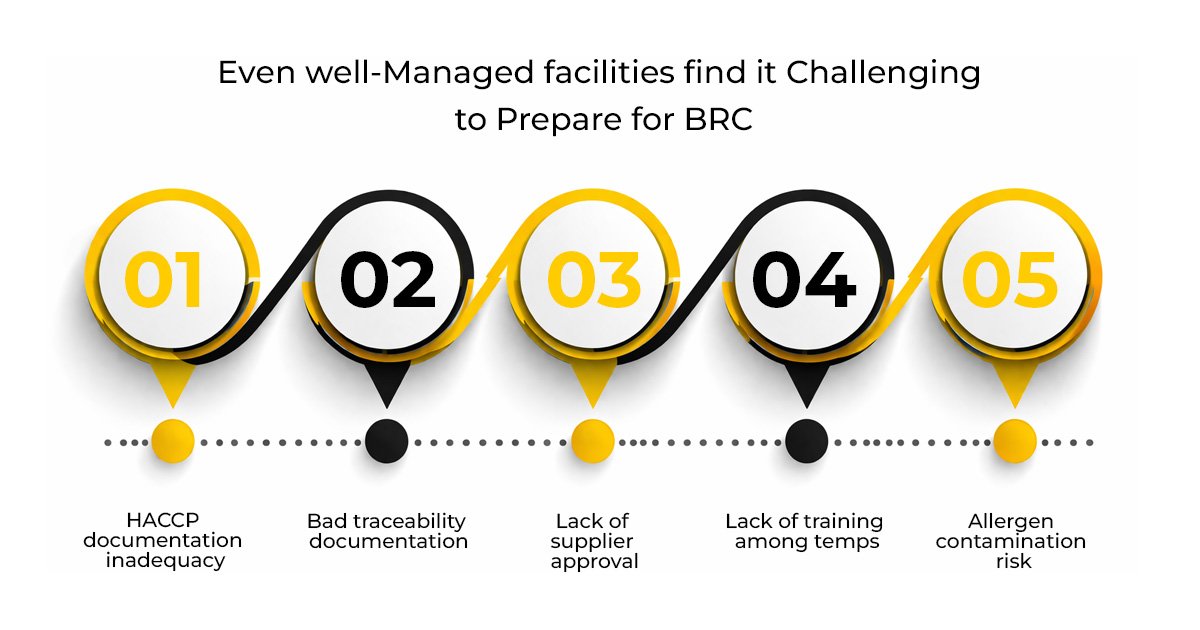
Even well-managed facilities find it challenging to prepare for BRC audit when some common pitfalls are overlooked. Some of the common mistakes that are seen to be made by Indian food firms include:
- HACCP documentation inadequacy – HACCP plan is documented but lacks validation documentation or has not been updated after changes to product or process.
- Bad traceability documentation – There are batch codes used inconsistently among incoming material and outgoing products resulting in traceability tests failing.
- Lack of supplier approval – No risk assessment and questionnaire have been done before suppliers were approved.
- Lack of training among temps – Temporary employees lack any proof that they have completed training and medical examinations for food handling.
- Allergen contamination risk – Documentation for allergen control program is present but not visible in the processing areas.
By overcoming these shortcomings while preparing for your BRC audit, you stand a great chance of scoring highly.
>Helpful Guide:- BRCGS Certification Cost | Apply With Trusted Experts Today
BRC Audit Preparation: How to Pass BRC Audit Successfully
Successfully passing the BRC audit is always the end objective of the preparation process. Here are some tips that work for food manufacturers in India:
- Treat the Audit as a Business Improvement Exercise
Businesses that receive AA grades approach the BRCGS system as means to improve their practices and not just as a preparation process to pass. Such businesses always make it evident in auditor discussions.
- Conduct at Least Two Internal Audits Before the Certification Audit
The two internal audits should be considered your safety cushion. With each of the internal audits, you discover some weaknesses. The second audit ensures that the issues raised during the first internal audit have been resolved.
- Engage Your Entire Workforce
All employees of the facility will be reviewed by the auditors including warehouse and production staff. Train everyone in the organization and not only your management team. The primary cause of non-conformities is the inconsistency between practice and documentation.
- Get Your Traceability Right
Perform a traceability check of at least one complete lot of a final product from the time of the raw material receiving to despatch to the customer, within four hours. Document the process.
- Prepare Your Documentation Pack in Advance
Ensure that all necessary documents are readily available on the day of the audit. These include HACCP documentation, internal audit report, supplier approval forms, training documentation, equipment calibration certificates, pest control reports, and management review documents.
Key Takeaways
- The planning phase for conducting a BRC audit takes at least 12-16 weeks for Indian food companies.
- The full BRC audit checklist includes documentation, suppliers, traceability, and hygiene issues.
- The process behind a BRC audit will allow people to better distribute their resources and fill possible gaps.
- BRCGS accreditation is internationally recognized, and could result in entry into leading supermarket chains of the United Kingdom and EU.
- Frequent internal audits and simulations are the best way to be ready for any audit.
>Top Trending Guide:- BRC Full Form: All 3 Meanings Explained – Food, Export and Education (2026 Guide)
Frequently Asked Questions
What does a BRC audit preparation checklist food companies india typically include?
A BRC audit preparation checklist should include HACCP documentation, supplier approval documentation, allergen control management, employee training records, internal audit results, pest control documentation, and traceability testing according to BRCGS Issue 9.
How long does it take to prepare for a BRCGS certification audit?
Indian food manufacturers usually take between 12 to 16 weeks to prepare for their initial BRC audit.
How to pass BRC audit successfully on the first attempt?
If you want to find out how to pass a BRC audit effectively, conduct at least two internal audits, correct all required measures, conduct full-scale training for your employees, and test your traceability system.
What are the key BRC audit requirements and preparation guide steps for HACCP?
According to the BRC audit requirements, preparation of the HACCP plan must include hazard analysis document, verification of CCPs, monitoring documentation, and documentation proving review by HACCP team members within the last year.
Which is better BRC or iso for Indian food exporters?
The choice between BRC and ISO comes down to your target market, BRCGS is required for retailers in the UK and EU, whereas ISO 22000 is more appropriate for international markets or internal quality system development.
What is the BRC iso difference in terms of audit frequency?
BRCGS demands that you undergo an annual audit (which could include an additional unannounced audit schedule), whereas ISO 22000 is based on a three-year certification period with annual surveillance audits.
Can iso vs BRC certifications be held simultaneously by an Indian company?
Yes, ISO and BRC certificates can complement each other. In India, many top exporters have both certifications; they use BRCGS for retailer certification purposes and ISO 22000 as their internal food safety management system.