
In today’s highly competitive global food and product safety landscape, BRC certification for exporters is more than just a badge of honor. It is a gateway to international trade. For Indian exporters aiming to enter markets in the UK, Europe, North America, and beyond, the BRCGS (Brand Reputation Compliance Global Standards) certification has become an essential credential. This blog walks you through everything you need to know about BRC certification for exporters, covering its meaning, purpose, benefits, process, and how it specifically helps Indian businesses break into global markets in 2026.
What Is BRC Certification for Exporters
The BRC certification meaning, in its simplest form, is a food safety and quality management standard that is awarded by the British Retail Consortium. The BRC standard was originally developed to assist food manufacturers in the UK in meeting the needs of the UK’s supermarkets. However, over the years, the BRC standard has developed into a truly international benchmark with over 130 countries across the globe.
The BRC certification for exporters is a symbol of assurance that your manufacturing facility, processes, and products are at the highest level of food safety and quality. Therefore, when international buyers see the BRCGS symbol on the certificate, they understand that your company has been independently audited and verified against the most rigorous international standards.
The BRC’s purpose is built on the principles of providing protection for the end-consumer while providing the retail industry with the confidence to source from BRCGS-certified suppliers without the need for performing the same audit on the supplier themselves. This is particularly significant for Indian exporters because it removes the barriers that exist with international buyers while providing a stronger position at the negotiating table.
>Helpful Guide:- Emergency BRC Certification: How to Get Approved When Audit Is Due in 15–30 Days?
Why BRC Export Certification Matters for Indian Exporters in 2026
India ranks amongst the top countries in terms of exports of food products, agricultural products, spices, processed foods, and consumer goods. Yet, Indian exporters often struggle to comply with the ever-changing food safety and quality regulations of importing countries. This is where BRC Export Certification acts as a game changer for Indian exporters.
The year 2026 will be a landmark in terms of supply chain integrity. After the pandemic, regulatory bodies in the EU, UK, and USA have tightened regulations in terms of importing products. In order to get registered as a supplier, supermarkets and other large-scale retailers now demand BRC Export Certification. In absence of BRC Export Certification, Indian exporters would miss out on lucrative business opportunities.
Many of the importing countries are now adopting international standards in terms of importing products. BRC Export Certification would not only prove compliance with British standards but also international food safety regulations.
Requirements Of BRC Certification for Exporters
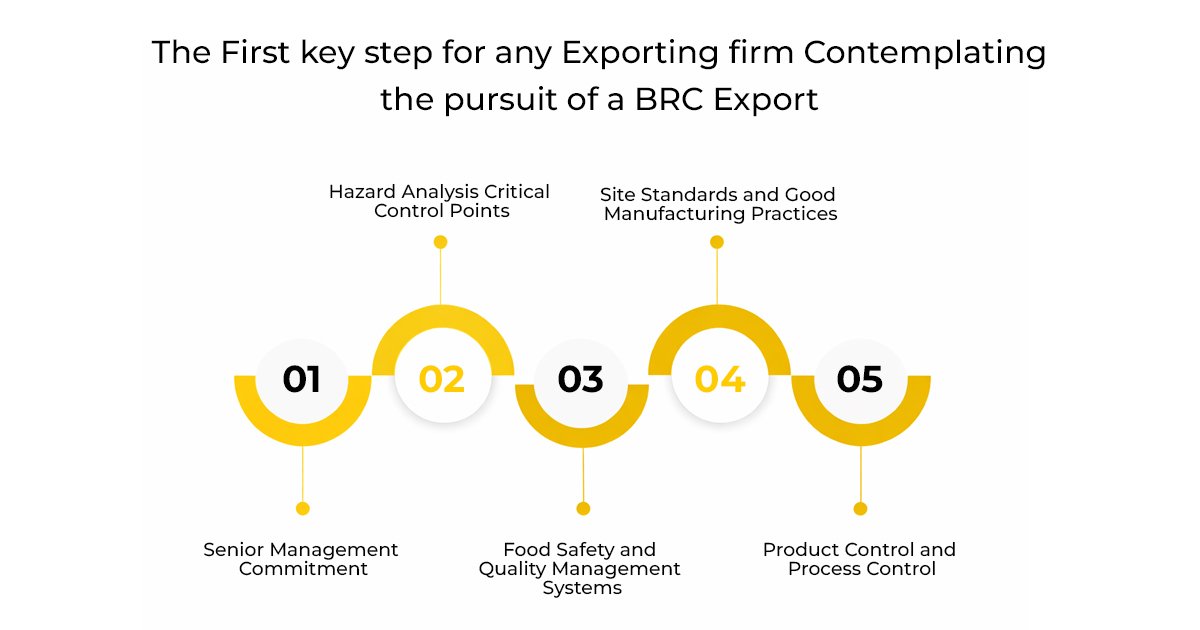
The first key step for any exporting firm contemplating the pursuit of a BRC export certificate is to understand the requirements. The BRCGS Global Standard for Food Safety, which is the most common standard for food exporters, deals with the following areas:
- Senior Management Commitment
BRC export requirements start with senior management. Senior management is required to be fully involved in food safety culture, resource allocation, and improvement activities. Auditors check whether food safety is part of the organisation’s core values or just a box-ticking exercise.
- Hazard Analysis Critical Control Points (HACCP)
A fully implemented HACCP plan is a key requirement for BRC export requirements. Exporters are required to have documented all potential hazards, identify critical control points, set criteria, and describe their control procedures. These are reviewed regularly, updated, and changed when there are changes in the process or product.
- Food Safety and Quality Management Systems
BRCGS has a requirement for exporters to have a quality management system. The quality management system is required to be documented, covering product specifications, approval of suppliers, internal audit, and corrective action. All documentation is required to be up-to-date, available, and verifiable during the BRC audit for exporters.
- Site Standards and Good Manufacturing Practices
Infrastructure, hygiene, pest control, waste disposal, and welfare facilities are part of BRC export requirements. Exporters are required to demonstrate their manufacturing environment is under control.
- Product Control and Process Control
The BRC audit for exporters covers the examination of the methods used in the design, testing, labelling, and controlling of the products in the manufacturing process. The management of allergens, foreign body controls, and the calibration of measuring equipment are also checked.
>Helpful Guide:- Top 5 Mistakes Indian Export Houses Make During BRCGS Audits
Step-by-Step Process To Get BRC Certification for Exporters
The BRC certification for export companies India process is a well-structured one that generally takes between three and six months depending on the readiness of the facility and the chosen certification body.
Step 1: Select the Appropriate BRCGS Standard
Indian exporters must first select the appropriate BRCGS standard for their business. The most sought-after BRCGS standards include the Global Standard for Food Safety, Storage and Distribution, Packaging Materials, and Consumer Products. The majority of food exporters seek the Food Safety standard; however, the rest are categorized based on the nature of the products.
Step 2: Conduct a Gap Assessment
Before starting the BRCGS standard procedure, it is highly recommended that the exporters conduct a gap assessment based on the selected BRCGS standard. The gap assessment is a detailed review of the differences between the BRC export certification standard and the company’s current system.
Step 3: Implement the Required Systems and Improvements
Based on the gaps identified in Step 2, you will need to develop or enhance your food safety management systems, documentation, training programmes, and infrastructure. This will be the most time-consuming phase of the BRC certification for export companies India process, especially for smaller companies starting from scratch.
Step 4: Select a BRCGS-Approved Certification Body
BRCGS maintains a directory of approved certification bodies around the world. Export companies India will need to select an accredited body to undertake the formal BRC audit for exporters. The certification body will be responsible for scheduling, conducting, and reporting on the audit.
Step 5: Undergo the BRC Audit for Exporters
The formal BRC audit for exporters will be an announced or unannounced audit conducted by your chosen certification body. During the audit, documentation will be reviewed, a site audit will be conducted, and staff will be interviewed to ensure all BRC export requirements are being met in practice. The audit will be conducted in one or two days depending on the scope and size of your operation.
Step 6: Receive Your Certificate and Grade
Upon the successful completion of an audit at your facility, you will be issued a BRCGS certificate with a grade of AA+, AA, A, B, C, or D based on the number of non-conformances identified. Higher grades imply greater compliance with the BRCGS standards. Global retailers require higher grades for their suppliers. The certificate is valid for twelve months after which a surveillance or re-certification audit is required for BRC certification exporter status.
>Helpful Guide:- BRC Certification Without a Consultant: Why 80% Companies Fail?
Benefits Of BRC Certification for Exporters
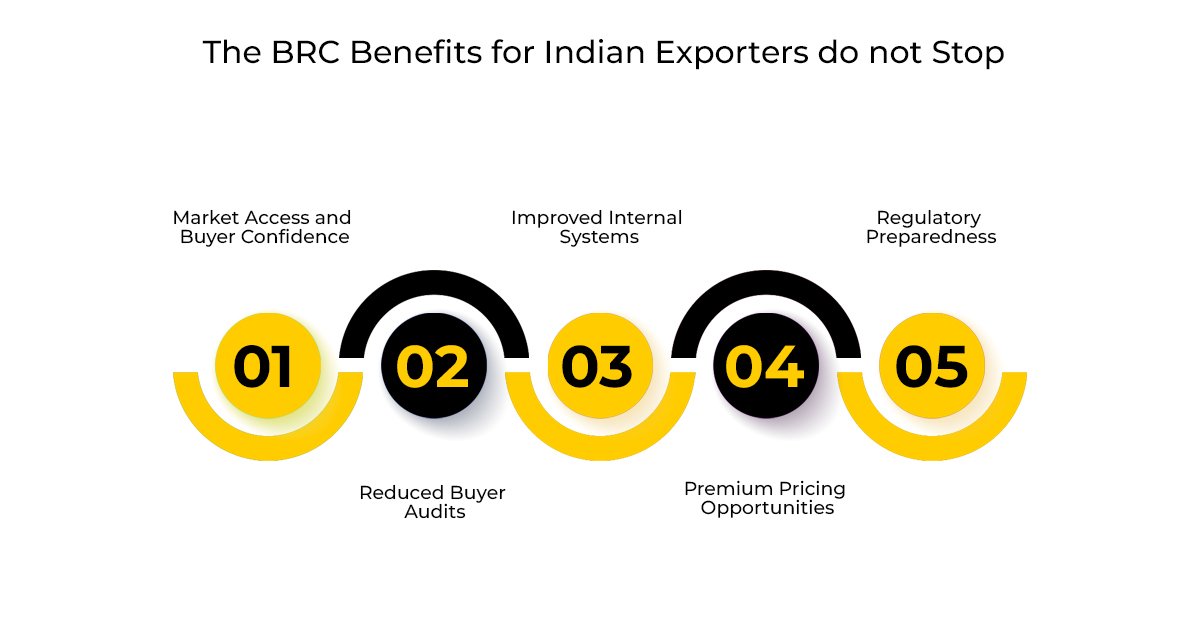
The BRC benefits for Indian exporters do not stop at the satisfaction of buyer requirements. In fact, certified exporters have reported a significant improvement in internal efficiency, employee awareness, product quality, and customer satisfaction.
- Market Access and Buyer Confidence
The first of the many BRC benefits is the market access provided. Many of the biggest UK retailers, including Tesco, Sainsbury’s, and Marks & Spencer, as well as many retailers in Europe and the US, require their suppliers to be certified under the BRC standard as a prerequisite for approval. Therefore, for Indian exporters, the BRC benefits will be the ability to gain access to the retail market.
- Reduced Buyer Audits
The first of the many practical BRC benefits is the reduction in the actual number of buyer audits that the exporting facility will have to undergo. In fact, since many retailers recognize the BRCGS standard, a single BRC audit for exporters will enable the facility to pass many buyer audits at once.
- Improved Internal Systems
The process of attaining and maintaining BRC certification for exporters creates internal improvements that are advantageous to the business irrespective of international trade. Documented systems, responsibility, traceability, and a stronger approach to supplier management all contribute to a reduction in defect rates and waste.
- Premium Pricing Opportunities
Exporters with BRC certification are able to achieve premium pricing, especially when supplying own-label products to retailers. BRC certification reduces the perceived risk for retailers, which enables exporters to achieve higher price premiums during tender exercises.
- Regulatory Preparedness
As India enhances its own food safety regulations under FSSAI, mirroring Codex Alimentarius standards, the BRC certification process ensures that exporters remain at the forefront of regulatory developments within their own country. The BRC benefits are cumulative.
Key Takeaways
- BRC certification for exporters is recognized worldwide by retailers as well as international authorities. Hence, it has become a necessity for exporters to get certified with BRC to have access to international markets.
- Indian exporters who are certified with BRCGS have a competitive advantage over others who are not certified with BRC.
- The audit process for exporters who seek BRC certification includes food safety systems, manufacturing processes, quality management systems, and hygiene standards.
- The BRC certification for exporters meets international food law requirements, thereby helping exporters avoid risks in terms of international food laws.
- The BRC certification process for export companies in India, with proper preparation, usually takes between three to six months.
>Helpful Guide:- BRCGS Certification Cost | Apply With Trusted Experts Today
Frequently Asked Questions
What is the BRC certification meaning and why is it important for exporters?
BRC certification is a quality and food safety standard recognised globally. It is significant for exporters as it signifies compliance with international buyer needs and provides access to regulated global markets.
What are the BRC export certification requirements india exporters must meet?
The requirements include a documented HACCP plan, quality management systems, good manufacturing practices, commitment to food safety at the highest level of the organisation, and passing a third-party audit with an approved certification body.
How does the BRC certification for export companies india process work from start to finish?
The process includes performing a gap analysis, implementing the necessary systems, choosing an approved certification body, undergoing a formal audit, and obtaining a graded certificate with a twelve-month validity period.
How do exporters get BRC certification if they are a small or medium enterprise?
The way in which exporters obtain BRC certification is the same for all companies, irrespective of their size. SMEs can use BRCGS-approved consultants, undertake training courses, and work in association with a certification body to audit and certify their facility according to their own resources.
What are the main BRC benefits for Indian food exporters?
The main benefits lie in gaining market access to international retailers, minimizing buyer audit requirements, developing internal quality management systems, and preparing themselves for regulatory requirements in domestic and international markets.
What happens during a BRC audit for which exporters should be prepared for?
During a BRC audit, exporters can expect their documents to be reviewed, their facilities to be inspected, and their employees to be interviewed, in addition to verifying their food safety processes
What is the BRC purpose and does it align with Indian export regulations?
The BRC purpose is to ensure food safety, quality, and product protection. It is largely aligned with FSSAI regulations in India, which means that when exporters aim for BRC certification, they are at the same time strengthening their compliance with local regulations.