The BRCGS certification process marks an achievement, but keeping its validity is another matter. Within the international chain of food production, having an outdated certificate is not just about being inefficient; it means losing all chances at export opportunities, distribution contracts, and sales markets.
Consistent compliance is a must for any business that wants to keep its operations smooth. Below you can see all necessary details about BRCGS certification validity and a complete procedure of renewing it in 2026.
What Is BRC Certification Validity?
The validity of a BRC Certification is how long the validity of your certificate will last as an accredited certificate by BRCGS. After the expiry of this period, the validity of your certificate becomes null and void, meaning that your entry in the BRCGS directory also ceases to exist.
The standard period for validity of the BRC certification is 12 months from the time you were audited. However, it can be influenced by a number of factors, such as:
- The rating achieved from the previous audit (AA, A, B, C, or D)
- If you choose announced or unannounced audits
- The type of BRCGS standard under which you are certified (e.g. food safety, packaging, agents & brokers, etc.)
Organisations that continually achieve AA or A ratings might get into an unannounced audit programme, allowing you to have more control over the audit intervals. Nonetheless, the maximum period for BRC certification validity is 12 months.
>Helpful Guide:- Emergency BRC Certification: How to Get Approved When Audit Is Due in 15–30 Days?
BRC Certification Validity Period: Grade-Wise Breakdown
It is vital to know the impact that the score in your audit will have on your validity period of the BRC certification. Here is an easy way to understand this issue:
| Audit Grade | BRC Certification Validity | Audit Type Option |
| AA | 12 months | Announced or Unannounced |
| A | 12 months | Announced or Unannounced |
| B | 12 months | Announced only |
| C | 6 months (re-audit required) | Announced only |
| D | Certificate not issued / Re-audit | N/A |
If you get a C grade, then your BRC validity period becomes only six months, which requires an audit to be performed to verify whether the correct actions were taken.
BRC Renewal: When Should You Start the Process?
The typical mistake made by most companies is to think that BRC certification can be planned for only a couple of weeks before the expiry date of the existing certificate.
Following are some of the reasons behind planning BRC certification renewal well in advance:
- The audit calendars of certification bodies are usually full, particularly during the peak season for food exports.
- Gap analysis and corrective actions following pre-audit assessments require 4-8 weeks.
- Reviewing documents and training personnel on existing guidelines add to the list of tasks that need to be completed.
- In India, BRC certification renewal needs to be coordinated with export documentation and compliance with FSSAI requirements.
It helps in ensuring that your BRC certificate remains valid without any gap once your existing certificate expires.
>Helpful Guide:- Top 5 Mistakes Indian Export Houses Make During BRCGS Audits
How to Renew BRC Certification Step by Step
If you have been searching for a step-by-step guide to extend your BRC certification, you are in luck because we have got you covered. Here is what you need to do:
Step 1: Verify Your Current BRC Certification Expiry Date
Login to the BRCGS Directory to verify the expiry date of your current certification, its grade, and the audit program type. It is important to know when you can renew your BRC certification.
Step 2: Communicate With Your Approved Certification Body
It is now time to get in touch with your CB to schedule the renewal audit. Remember that your CB must be accredited by BRCGS for the particular standard that you wish to renew. Indian firms usually contact SGS, Bureau Veritas, Intertek, or LRQA for this purpose.
Step 3: Conduct an Internal Pre-Audit
Prior to conducting the actual audit, perform an internal audit based on the current version of the BRCGS standard (Issue 9 for Food Safety up to 2026).
Step 4: Ensure Updated Documentation
Make sure that all HACCP, SOPs, supplier approvals, pest control, and training records are updated. The most frequent causes of non-conformances during BRC renewal audits include outdated records and documents.
Step 5: Provide Training for Staff
Remind your staff about the requirements under the BRCGS Standard, including allergens, hygiene, and traceability. Staff members, especially those working at frontline level, are normally interviewed during BRC audits.
Step 6: Take the BRC Renewal Audit
The auditors from the certifying body will perform a complete site visit, which entails a review of documents, interviews with employees, and an inspection of facilities and systems. This audit will cover all the clauses within the specific BRCGS standard.
Step 7: Correct Non-Conformances and Get the Certificate
Following the audit, any non-conformances will have to be addressed according to the period specified by the CB (usually 28 days for majors and 90 days for minors). Upon acceptance of such corrections, a certificate will be issued and posted in the BRCGS Directory.
>Helpful Guide:- BRC Certification Without a Consultant: Why 80% Companies Fail?
BRC Certificate Renewal Process in India: Special Considerations
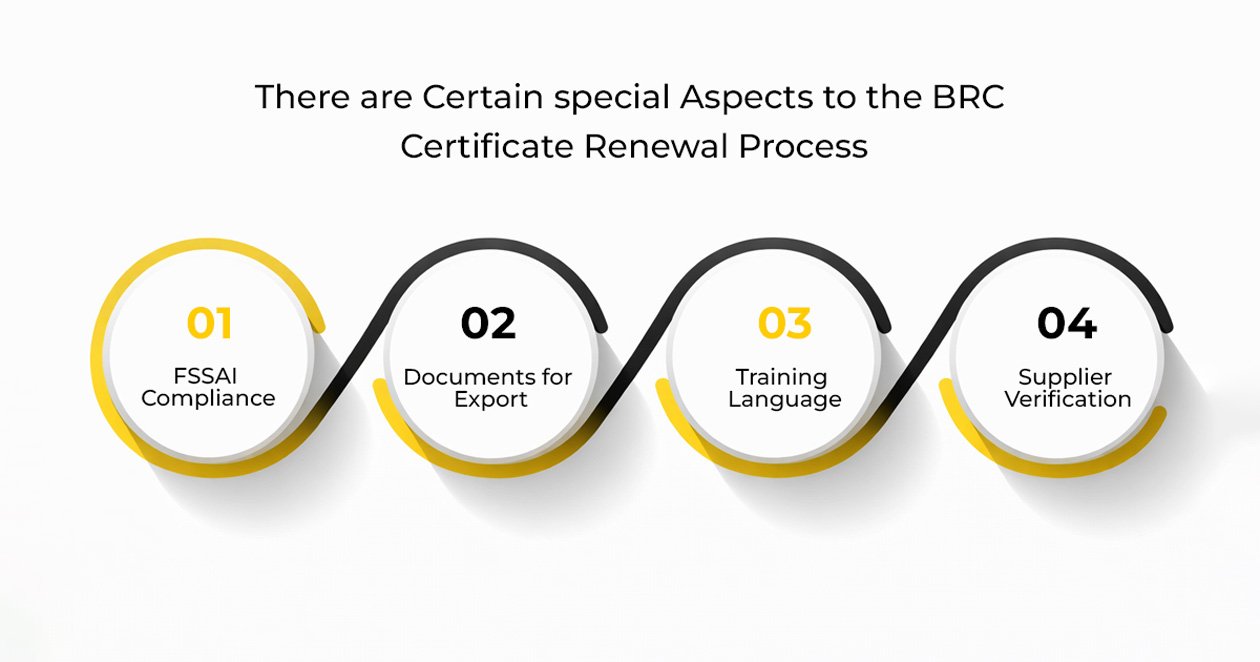
There are certain special aspects to the BRC certificate renewal process in India that companies should consider:
- FSSAI Compliance
FSSAI certified Indian food manufacturers should ensure alignment of their food safety management system with FSSAI Schedule 4 requirements and BRCGS. BRC renewal audit can help enhance compliance with FSSAI guidelines.
- Documents for Export
Indian exporters who ship food products to UK, EU, and Middle East countries usually require BRC certification as per buyer requirement in export contracts. Lack of BRC certification validity may result in rejection of consignment and removal from approved supplier list.
- Training Language
Most Indian food factories are multi-lingual, and CB auditor will verify whether food safety and hygiene training is provided in native language of employees. It is a common BRC audit checklist point, which Indian factories tend to ignore while renewing BRC certification.
- Supplier Verification
Indian food factories sourcing raw material from local farmers and cooperatives need to have a supplier verification program active. The auditor will review supplier verification documents at time of BRC renewal audit.
How to Prepare for a BRC Audit: The BRC Audit Checklist
Preparation on how to do a BRC audit will determine whether you will have an easy renewal process or not. Below is a concise BRC audit checklist that can help you during preparation.
- Senior Management Commitment
-
-
- Evaluate and update the food safety policy
- Ensure the management review was performed in the past year
- Conduct checks to ensure there is a designated leader for food safety training
-
- HACCP and Food Safety Plans
-
-
- Make sure that the HACCP investigation is up-to-date and applicable to all products and procedures
- Assess whether there are limits set on CCPs and documented monitoring of CCPs
- Check PRPs for any deficiencies
-
- Site Standards and Hygiene
-
-
- Check facility for signs of pest infestation, drainage and structural soundness
- Maintain schedules and records of site cleaning activities
- Evaluate the observance of hygiene practices by staff
-
- Tracing and Recall
-
-
- Conduct a tracing exercise simulation a minimum of a month prior to the audit
- Demonstrate that tracing and recall have been well-documented and tested
-
- Allergen Management
-
- Examine all product risk assessment concerning allergens
- Conduct testing to ensure labelling is accurate and segregation practices are being performed
The above points are critical during the BRC audit for a company to pass and renew its license. Companies that view the checklist as dynamic and always update it have higher chances of passing.
>Helpful Guide:- BRCGS Certification Cost | Apply With Trusted Experts Today
Common Mistakes That Jeopardise BRC Certification Validity
In some cases, even seasoned certified organizations might still err and jeopardize their BRC validity:
- Allowing expiry of supplier approvals without renewing them
- Lack of formal documentation of management review
- Omitting to update HACCP plans upon the introduction of new products/processes
- Failing to account for staff turnover – new staff members lack BRC training
- Skipping internal audits – BRCGS requires an annual internal audit of your organization
All these challenges can be easily avoided by having a systematic process for sustaining your BRC validity all year round, not only months before the audit takes place.
Key Takeaways
- The validity of BRC certification is for 12 months, and thereafter a renewal audit becomes mandatory.
- Graded certifications AA, A, B, C have an impact on the audit schedule; higher grades allow you unannounced audit exemptions.
- BRC Renewal has to be done well in advance before the expiry date in order to avoid any gap in certification.
- BRC renewal should be coordinated in India by food organizations along with their FSSAI and export requirements.
- Failure in renewal audits leads to suspension of certification and contract losses.
>Top Trending Guide:- BRC Full Form: All 3 Meanings Explained – Food, Export and Education (2026 Guide)
Frequently Asked Questions
What is the BRC certification validity period and renewal India?
The validity period for BRC certification is one year from the date of your audit. The process of renewal includes scheduling an audit from your CB, conducting internal audits, and meeting the FSSAI criteria prior to the expiry date.
How to renew BRC certification step by step if I’m doing it for the first time?
Begin with determining your expiry date, scheduling a renewal audit through your CB, conducting a gap analysis, updating all documents, training your staff, and completing the audit process in accordance with the steps mentioned above for the BRC certification renewal process in India.
Can you explain the BRC certificate renewal process in India for food exporters?
Yes, the BRC certification renewal process in India entails auditing with respect to the export deadlines and meeting FSSAI criteria, in addition to language criteria for suppliers and training.
How prepare BRC audit before renewal?
In order to be ready for a BRC audit, carry out an internal audit according to the BRCGS criteria, perform a mock exercise in traceability, update HACCP plans, and train the staff at least 6–8 weeks before the expiry date.
What are the key BRC audit steps I should follow during the renewal process?
The major steps that are included in a standard BRC audit involve reviewing the documents, inspecting the facilities, interviewing staff members, verifying CCPs, checking traceability, and assessing allergen management, all done by the BRC auditor at the premises.
Is there a specific BRC audit checklist I should use before renewal?
Yes, the usual scope of a BRC audit includes items such as senior management commitment, HACCP plans, hygiene, allergen management, supplier approval, traceability, and internal audit documentation.
What happens if my BRC validity lapses before I complete the renewal?
If the validity of your BRC certificate expires, your certificate becomes suspended from the BRCGS Directory and your customers are informed, leading possibly to the activation of certain clauses in your contracts.