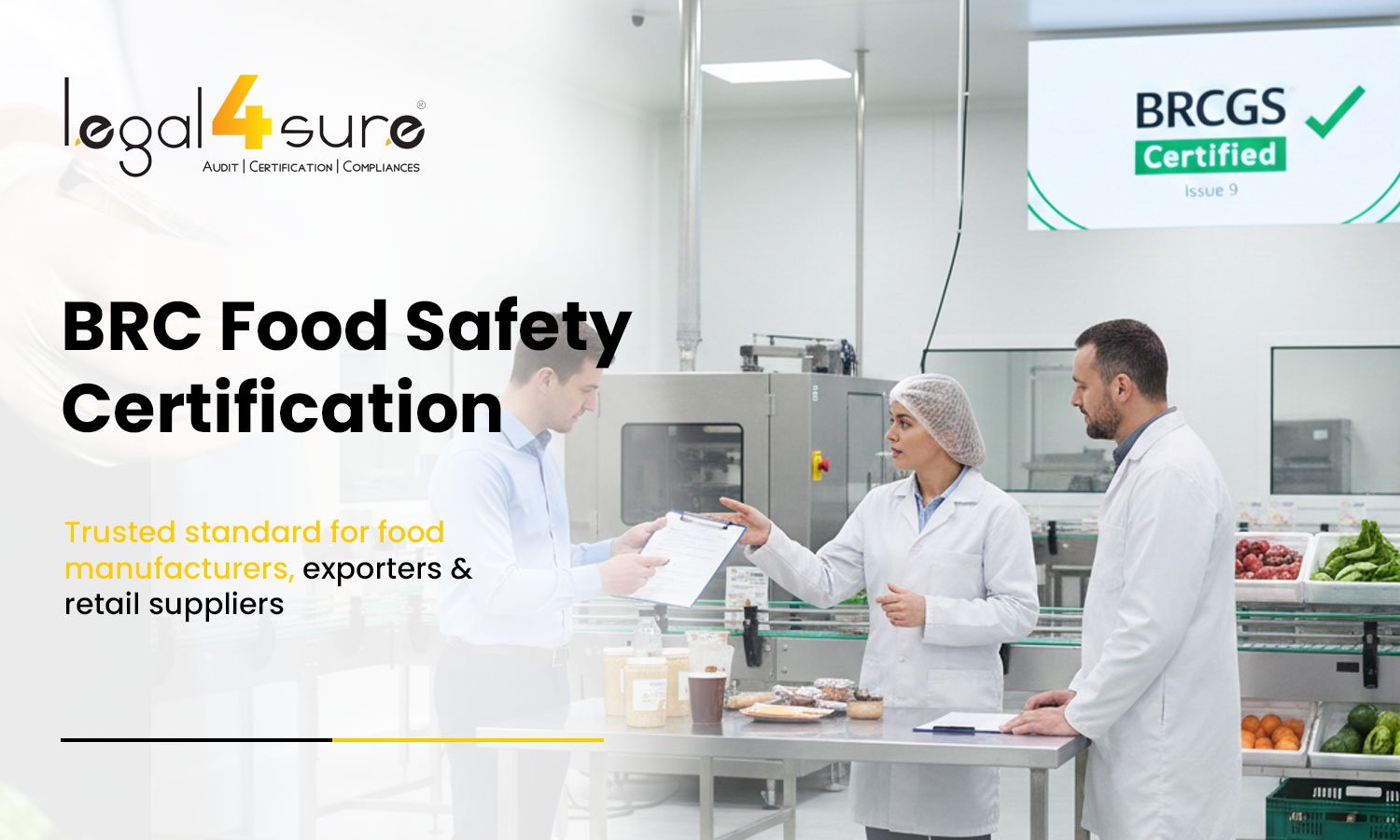
BRC Food Safety Certification is one of those standards buyers expect you to understand without much explanation. If you make, process, or pack food for export or modern retail, it often decides whether a buyer takes you seriously.
The focus is simple. Do your food safety systems actually work on the factory floor? Not just during audits, but every day. That’s why global retailers trust BRCGS certification.
For food manufacturers in India, this matters. Export opportunities are growing, but so are expectations. BRC food safety certification helps bridge that gap and puts Indian suppliers on equal footing with global players.
Need help with BRCGS Audit or Certification?
What is BRC Food Safety Certification?
Full Form of BRCGS
BRCGS stands for Brand Reputation through Compliance Global Standards. The food safety standard under BRCGS is built specifically for food manufacturing and processing sites.
Scope of BRC Certification
BRC food safety certification applies to food manufacturing, processing, packaging, and contract production. It covers both low-risk and high-risk food operations.
Businesses That Need BRC Certification
If you supply food to retailers, export markets, or private label brands, BRC certification is likely relevant. That includes manufacturers, exporters, FMCG brands, and contract manufacturers.
Why BRC Certification Matters for Food Businesses

Export and International Market Access
Many international buyers will not approve a supplier without BRC certification. It is often the first filter.
Approval from Global Retailers
BRC certification in India helps meet retailer expectations in markets like the UK, EU, and the Middle East. It removes friction during supplier approval.
Brand Credibility and Trust
BRCGS food safety certification shows that food safety is controlled, documented, and taken seriously. Buyers trust it because audits are thorough and consistent.
Reduced Food Safety Risks
Strong hygiene, clear procedures, and tested traceability systems reduce the chances of recalls and customer complaints.
BRC Food Safety Certification Requirements
Food Safety Management System
You need a food safety system that reflects how your factory actually runs. Auditors can tell when systems exist only on paper.
HACCP must be practical and understood by the team. Copy-paste hazard analyses rarely survive a BRC food safety audit.
Factory Hygiene and Infrastructure
The factory layout, zoning, pest control, cleaning, and maintenance activities are very closely inspected. Often, small gaps in these areas can lead to major problems.
Documentation and Traceability
Records should be very clear and accurate. Traceability should be capable of withstanding pressure, not just during scheduled tests.
Employee Training and Competence
Workers on the production line should understand the reasons for the controls, not only know what forms to fill in.
BRC Certification Process (Step-by-Step)

1. Gap Analysis
The gap analysis demonstrates your position in comparison with the BRC certification requirements. It is a time saver and keeps away the surprises that might occur later.
2. Documentation and Implementation
Procedures and records are aligned with actual operations. This step takes effort but sets the foundation.
3. Internal Audit
An internal audit checks whether systems hold up during real production, not just in theory.
4. BRC Food Safety Audit
The formal audit is done by an accredited certification body. Be prepared for in-depth questioning, a site inspection, and a review of records.
5. Corrective Actions and Closure
Any non-conformities should be corrected in the right manner and within the stipulated time. Closing it up quickly usually leads to repeat issues being created.
BRC Certification Cost and Timeline in India
Factors Affecting BRC Certification Cost
Costs vary depending on the size of the site, the range of products, the risk category, and the length of the audit. There is no flat-rate fee.
Typical Certification Timeline
Usually, a site can be certified within three to six months if it starts its preparations early.
Initial Certification vs Renewal Costs
Initial certification costs more due to setup and the first audits. Renewals are simpler but still demanding.
Common Mistakes During BRC Audits
Incomplete or Outdated Records
Auditors notice when documents are updated just before the audit.
Poor Hygiene Practices
Weak hygiene control, especially in high-risk areas, is a common reason for major non-conformities.
Lack of Trained Personnel
If staff cannot explain basic controls, auditors question the system itself.
Weak Traceability Systems
Traceability should be fast, accurate, and tested regularly.
BRC vs Other Food Safety Certifications
BRC vs FSSC 22000
FSSC 22000 focuses more on management systems. BRC is more detailed and site-focused.
BRC vs ISO 22000
ISO 22000 allows flexibility. BRC certification requirements are specific and retailer-driven.
When BRC is the Better Choice
If you supply private label retailers or UK and EU supermarkets, BRC is often the right choice.
Who Should Get BRC Food Safety Certification?

Food Manufacturers
Manufacturers supplying branded or retail products benefit directly.
Export-Oriented Food Units
Exporters targeting regulated markets often need BRC certification to qualify.
Private Label and Retail Suppliers
Many retailers require BRCGS certification from private label suppliers.
FMCG and Packaged Food Brands
FMCG brands use BRC food safety certification to build buyer confidence and control risk.
Related Blogs
Explore more insights on BRCGS certification & audit compliance
Conclusion
BRC Food Safety Certification is not about impressing an auditor. It is a business that sells food and can be checked every day without any problem.
BRC certification for Indian food companies is the way to go if they want to expand worldwide. It establishes the framework, trust, and consistency. If everything is properly prepared and carried out truthfully, it is a means to improve functioning rather than just another certificate on the wall.
Frequently Asked Questions
Which is better, BRC or FSSC 22000?
BRC is better for retail and private label supply, while FSSC 22000 suits broader management system integration.
How to get a BRC food certificate?
Implement BRC food safety standards and pass an audit conducted by an accredited certification body.
How to get BRC certified?
Prepare your food safety system, conduct internal audits, and successfully clear the BRC certification audit.
Is BRC certification mandatory?
No, it is not legally mandatory, but many retailers and export markets require it.
Is BRC the same as HACCP?
No, HACCP is a risk management system, while BRC includes HACCP plus operational and management requirements.
Is ISO 9001 the same as BRC?
No, ISO 9001 focuses on quality management, while BRC focuses on food safety and compliance.
Is BRC HACCP?
No, BRC incorporates HACCP as part of a broader food safety and quality management system.
What are the 5 C’s in food safety?
Clean, Cook, Chill, Cross-contamination prevention, and Correct storage.
What is BRC in food safety?
BRC is a global food safety standard ensuring consistent quality, hygiene, and traceability in food operations.
Which is better, SQF or BRC?
BRC is preferred for UK and EU retailers, while SQF is more common in North America.
What is the BRC certificate?
It is proof that a facility meets BRC food safety and quality standards after an independent audit.
What are the 7 most important food safety rules?
Clean, Separate, Cook, Chill, Personal hygiene, Safe sourcing, and Proper storage.