
Getting lost in the jargon jungle when talking about certification systems can be a little bit like ordering at a restaurant in a foreign language. If you are the owner of a food manufacturing company or its quality manager in 2026, you would probably focus on two sets of letters: HACCP and BRCGS (which is often still referred to as BRC).
Although their goal is almost identical, ensuring consumer safety and keeping the food uncontaminated, they are not competitors per se. The second one is built on the back of the first one, and that’s what makes all the difference in meeting the bare minimum of legal requirements and being able to enter the global market.
In this article, we will discuss the BRC vs HACCP, and help you make an informed choice about which way to go for your enterprise this year.
Understanding the BRC vs HACCP Debate
What Is HACCP
HACCP is a system which identifies, evaluates and controls hazards which are significant for food safety in all stages of the process from raw material to final consumption. Hazard Analysis and Critical Control Points are the initials for HACCP. It is a system developed jointly by NASA and Pillsbury in the 1960s for ensuring food safety during their missions in space. Over time it became a well-recognized standard for food safety.
The following are the seven principles of HACCP:
- Conduct a hazard analysis
- Determine the critical control points (CCPs)
- Establish critical limit(s) for each CCP
- Establish a system to monitor the CCPs
- Determine the corrective action
- Establish verification procedures
- Maintain records
FSSAI mandates HACCP based food safety management systems for food businesses of particular types under Schedule 4 of the Food Safety and Standards (Licensing and Registration of Food Businesses) Regulations, 2011. Thus, HACCP is a mandatory compliance in India for many food businesses.
It should be noted that HACCP is an internal standard. There is no provision within the HACCP standard to achieve a third party certification. That is one key difference while comparing HACCP and BRC.
What Is BRCGS (BRC)
BRCGS means British Retail Consortium Global Standards. It was initially developed in the UK and has since developed into one of the most popular international food safety certification standards. The latest BRCGS standard (BRCGS Food Safety Issue 9) outlines the criteria that food manufacturing businesses should fulfill to sell their products to large retail companies operating in the UK, EU, Middle East, and North America markets.
- BRCGS deals with a great variety of aspects such as:
- Senior management commitment and continual improvement
- Food safety plan (based on HACCP principles)
- Food safety and quality management system
- Site standards (facilities, equipment, maintenance)
- Product control and process control
- Hygiene and training of personnel
- High risk and high care production areas
The BRCGS standard represents a comprehensive management system, in which HACCP is integrated; however, it goes much further than just the hazard analysis. The key point to understand here is the BRC vs HACCP difference – HACCP is part of a bigger whole called BRCGS.
Third-party certification bodies accredited by UKAS or similar organizations audit BRCGS. Passing audits leads to obtaining BRCGS certification issued as proof that your food safety management system complies with BRCGS. Your buyers will find your food safety certificate in the official BRCGS database.
>Helpful Guide:- Not Sure What Is BRC Certification? Get Clarity In 5 Minutes
BRC vs HACCP: A Side-by-Side Comparison
The following table provides a structured food safety certification comparison BRC vs HACCP to help you understand where each system stands:
| Criteria | BRCGS (BRC) | HACCP |
| Nature | Third-party certification standard | Food safety management system |
| Origin | UK (British Retail Consortium) | USA (NASA/Pillsbury, 1960s) |
| Scope | Entire food safety & quality system | Hazard analysis & critical control points |
| Audit Required | Yes, third-party audit | No mandatory external audit |
| Certificate Issued | Yes | Not always, internal system |
| Retailer Accepted | Yes, globally recognised | Varies by buyer/country |
| India Relevance | Growing demand from exporters | FSSAI mandated for certain sectors |
| Cost | Higher (audit + certification fees) | Lower (mostly internal effort) |
This BRC comparison makes it clear that while both systems serve food safety, they operate at different levels and serve different commercial purposes.
BRC vs HACCP: Which Is Better for Your Food Business?
Your business model, the target market, and regulatory requirements will be key factors to consider when determining your approach. Let’s explore this further.
When HACCP Alone Is Sufficient
When your food enterprise works mainly within the local Indian market and doesn’t have exports to any retail chains in UK/EU or Middle East markets, then having only HACCP would be adequate enough for meeting FSSAI compliance norms. This way, you will get an organized way of dealing with food safety concerns without having to spend money on third party audit procedures.
Such scenarios are common for SMEs and caterers in the local market. The mere process of following HACCP alone is also an important aspect towards food safety management.
When BRCGS Is the Right Choice in the BRC vs HACCP Decision
If you are exporting your product line or planning to start exporting your goods in the near future, especially to UK grocery stores, European retail stores, or middle eastern suppliers, then BRCGS certification becomes a business necessity. Most major buyers would not include your products in their listings without a valid BRCGS certification that is at least of Grade C level.
BRCGS-certified suppliers are becoming popular even in India where organised retail and quick commerce are expanding. This makes you more competitive if you have BRCGS certification in comparison to food safety certifications.
Moreover, BRCGS includes HACCP within it, so by getting BRCGS certification, you automatically obtain HACCP certification too.
>Helpful Guide:- Emergency BRC Certification: How to Get Approved When Audit Is Due in 15–30 Days?
FSSC 22000: Where Does It Fit in the BRC vs HACCP Landscape?
Any discussion on BRC vs HACCP in 2026 would be incomplete if it fails to discuss FSSC 22000 (Food Safety System Certification 22000). FSSC 22000 is yet another internationally recognized food safety certification system, based on a combination of ISO 22000 and specific PRPs and FSS
Required FSSC Documents
If you want to obtain FSSC 22000 certification for your company, then it will be necessary to develop an extensive collection of FSSC required documents, which includes:
- Food safety policy and manual
- HACCP analysis and food safety plan
- Prerequisite program (PRP) documentation
- Documentation of internal audits and minutes of management review meetings
- Records of corrective actions taken and non-conformities detected
- Approval of suppliers and raw materials
- Maintenance and calibration records
- Records of training and competency
- Product traceability and recall information
>Helpful Guide:- Top 5 Mistakes Indian Export Houses Make During BRCGS Audits
BRC vs HACCP: Steps to Get Certified in India
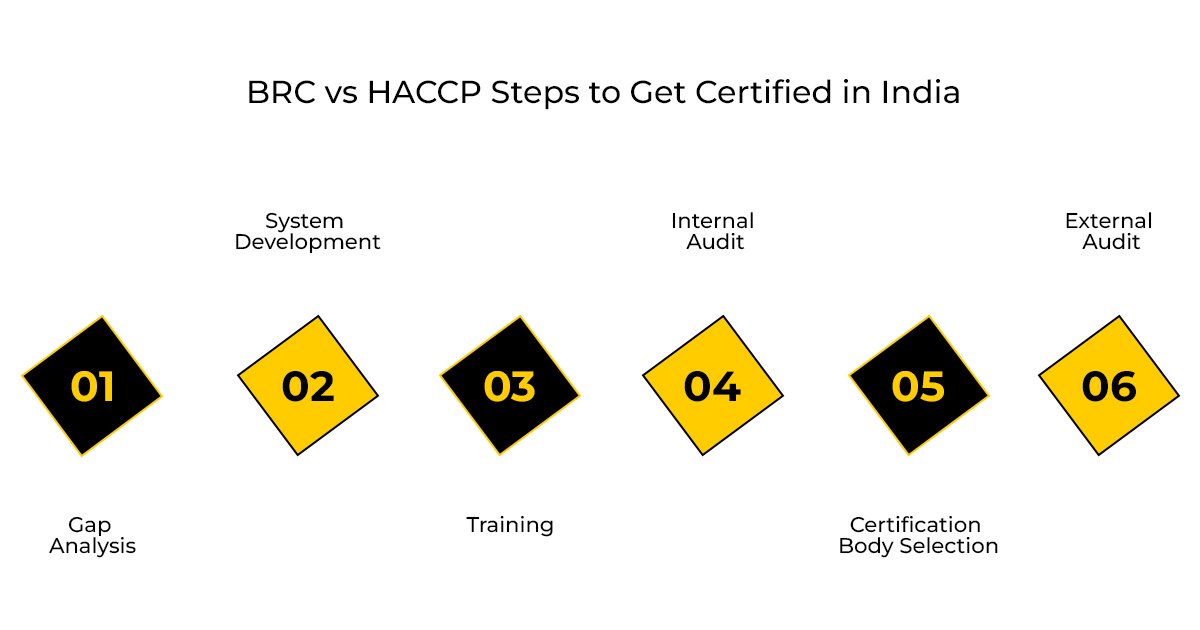
Regardless of whether you choose to go for HACCP compliance, BRCGS certification or FSSC 22000 certification, the route will be fairly similar. This is what it looks like:
- Gap Analysis: Gap analysis to identify areas that your food safety systems fall short in relation to the standards set out by the chosen standard.
- System Development: Designing or updating your food safety management system, including development of HACCP plan, setting up PRPs, setting up management systems etc.
- Training: Ensuring that your personnel are well-trained in the new system and in accordance with the chosen standard.
- Internal Audit: Conducting an internal audit, and ideally, also conducting management review to identify gaps.
- Certification Body Selection: Selecting an accreditation body (BRCGS / FSSC 22000) or choosing a recognised HACCP certification body.
- External Audit: Conducting the external audit and becoming compliant in accordance with the respective standard. In case of BRCGS, this involves receiving a grade (AA, A, B, C, D) as well as inclusion in the BRCGS Directory.
- Maintaining Compliance: Continuously improving your system and preparing yourself for annual surveillance audits.
Having a qualified food safety consultant India can drastically reduce the amount of time and effort required in this process.
>Helpful Guide:- BRCGS Certification Cost | Apply With Trusted Experts Today
Key Takeaways
- HACCP is a food safety certification programme which aims to control hazards through identification and management whereas the BRCGS (BRC) certification programme includes HACCP among other things.
- Thus, the major difference between the two is that the former is methodology, while the latter is a complete food safety certificate.
- In case of Indian exports which are intended for UK, Europe, and Middle East countries, the BRCGS certification programme gains more importance than HACCP.
- Furthermore, HACCP is an important certification requirement for some food businesses according to the Food Safety and Standards Act 2006 in India.
- There is no point in deciding whether HACCP is better than BRC as many companies go for HACCP certification initially and gradually switch over to BRCGS certification.
>Top Trending Guide:- BRC Full Form: All 3 Meanings Explained – Food, Export and Education (2026 Guide)
Frequently Asked Questions
What is the difference between BRC and HACCP certification India food businesses should know?
HACCP is a mandatory food safety management system by FSSAI for several food organizations in India, whereas BRC (BRCGS) is a worldwide third-party certification standard mainly applicable to export markets. Although BRC incorporates HACCP principles, it has a more comprehensive quality and safety management system than HACCP.
BRC vs HACCP which is better for an exporter targeting UK supermarkets?
The superior option for the supply chain is BRCGS, because almost all UK supermarkets have a requirement that BRCGS certification must be available from suppliers. A mere HACCP system would not satisfy the requirement.
How does the food safety certification comparison BRC vs HACCP play out in terms of cost?
Implementation of the HACCP system is less expensive because it is mostly an internally focused initiative. However, BRCGS certification requires payment of charges from a certification body, which depends on the size of the facility being audited.
What are the FSSC required documents for FSSC 22000 certification?
Some important FSSC certification documents that are needed are a food safety manual, a HACCP program, PRP documents, audit reports, approved suppliers documentation, calibration logs, corrective actions reports, and traceability and recall plans.
What are the FSSC requirements India businesses must fulfil for certification?
In India, companies are required to satisfy the ISO 22000:2018 standard, PRPs specific to each sector, and additional requirements of the FSSC standard such as food fraud assessments, all audited by an accredited third party.
Is there a standard FSSC checklist that Indian food manufacturers can follow?
Yes, An FSSC checklist in India would normally include requirements such as ISO 22000, sector specific PRP requirements, additional FSSC requirements, internal audit reports, and food safety objectives and performance indicators.
In the HACCP vs BRC debate, can a business hold both certifications?
Yes, Many food firms in India maintain FSSAI-approved HACCP documentation as part of their own requirements, but still hold a BRCGS certificate for exports, allowing for maximum coverage.