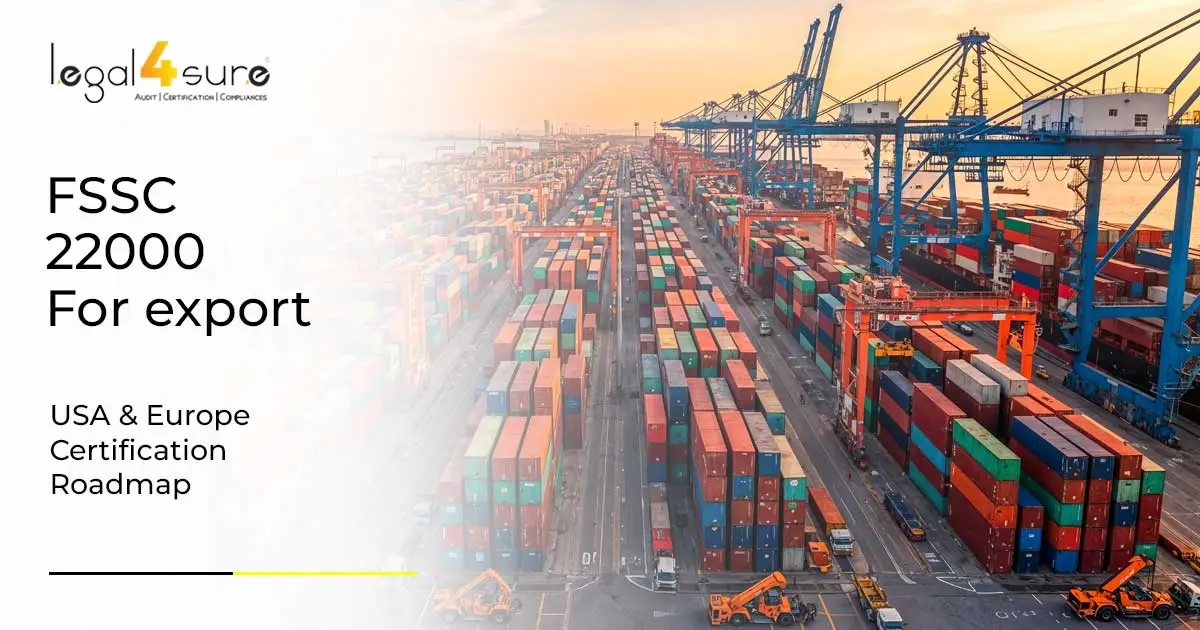
For food manufacturers in India, FSSC 22000 for export serves as a universal permit to high-value Western markets. Businesses can considerably reduce trade barriers, minimise product rejections, and comply with the FDA and EU’s stringent preventive control requirements by aligning operations with this rigorous framework.
The blog explains the strategic alignment between FSSC 22000 for exporters and international regulations like the US FSMA and EU Food Law. The certification process for Indian food enterprises requires a detailed certification roadmap, which shows all necessary steps. The essential FSSC 22000 Additional Requirements (Food Fraud Prevention and Food Defence) requirements, which exceed standard ISO 22000 procedures.
Problem Statement: Why FSSC 22000 for Exporters Matters for USA and EU Trade
The FSSAI license serves as a legal requirement for Indian businesses, but it fails to meet the advanced risk management needs of Walmart, Tesco, and Costco. FSSAI serves as a basic hygiene standard for Western consumers, while FSSC 22000 provides international safety certification.
- GFSI Benchmark: The Global Food Safety Initiative recognises GFSI Benchmark as a pre-approval system that enables you to skip costly individual audits required by international retail chains.
- Regulatory Bridge: The system connects directly to FSMA regulations set by the US FDA and EU Food Law standards, while it tackles critical areas that domestic licenses fail to address through their Food Defence (tampering) and Food Fraud (adulteration) regulations.
Why This Happens
Many food business owners assume:
- FSSAI approval is enough for export.
- HACCP certification alone will satisfy foreign buyers.
- Lab test reports can replace system certification.
- International buyers conduct product verification together with system verification.
They require evidence that your organisation maintains food safety throughout its operations, instead of testing it only at the conclusion. FSSC 22000 for export has become an essential requirement that global supply chains must fulfil.
Founder Pain Points
- Is FSSC 22000 required for export to the United States or Europe?
- Buyer says they only accept certification that GFSI or an equivalent auditor has given. What are they saying?
- We do maintain strict hygiene practices. When are we to certify for FSSC 22000 certification?
- How tough is the FSSC 22000 certification in order to export food from India?
- Would certification have real importance in bringing in international clients for us?
Simple Explanation: Is FSSC 22000 Accepted in the USA and EU?
The USA and EU markets consider FSSC 22000 as a highly regarded standard that receives broad recognition. Its acceptance stems from its status as a GFSI-recognised (Global Food Safety Initiative) standard.
- USA (FDA FSMA Compliance): The US FDA does not require private certifications, but organisations that follow FSSC 22000 requirements establish compliance with FSMA Preventive Controls Rule requirements. Indian manufacturers who achieve FSSC 22000 certification fulfil almost all HARPC requirements.
- European Union (EU Food Law): The European Union EU Food Law demands that traceability and safety protocols be established through procedures. FSSC 22000 contains ISO 22000 together with Prerequisite Programs (PRPs) that different sectors use to meet EU Regulation 852/2004 hygiene requirements.
FSSC 22000 for Exporters: Why It Matters
FSSC 22000 certification exists as a GFSI-recognised scheme that combines ISO 22000, HACCP, PRPs, and additional requirements to help exporters demonstrate their effective food safety systems.
- Global Benefits: The system provides retailers worldwide with acceptance while it decreases risks and enhances supply chain performance, which results in increased brand trust with access to new markets.
- EU Access: FSSC 22000 certification enables EU buyers to implement preventive controls together with traceability systems that comply with European regulations, thus simplifying the importer approval process.
- USA FSMA Fit: The system supports FSMA requirements because it conducts hazard analysis together with preventive measures, which help organisations demonstrate their U.S. compliance, but the system does not eliminate their legal obligations.
FSSC 22000 Certification for food export from India
The system enables Indian companies to follow international standards, which boosts their credibility during international business transactions.
- Market expansion: The system enables FSSC 22000 for EU market access and the US because it has achieved GFSI certification.
- Risk management: The system enables organisations to trace their products and conduct audits.
- Competitive edge: Retailers show a preference for the product because it provides them with greater value.
- Cost efficiency: The system decreases audit expenses while it establishes customer loyalty.
What Actually Works: FSSC 22000 Certification Roadmap
The process of establishing FSSC 22000 standards requires organisations to develop an enduring system that maintains its operational capabilities during evaluations by international port authorities. The main export control requirements of FSSC 22000 depend on ISO 22000.
The Strategic Pillars of the Roadmap
1. The Export-Ready Requirements (Food Fraud & Defence): Exporters often stumble here. FSSC 22000 requires a Vulnerability Assessment (VACCP) to prevent economically motivated adulteration and a Threat Assessment (TACCP) to prevent intentional sabotage.
2. The Strengthening of the PRPs Prerequisite Programs: The core components that establish food safety standards comprise this element. It involves:
- Hygienic Design: The design of equipment needs to provide proper cleaning procedures while preventing bacterial growth.
- Allergen Management: The process requires testing to confirm that Nut-Free contains no nuts through strict methods that stop cross-contact.
- Environmental Monitoring: The facility undergoes testing to identify pathogens, which include Listeria and Salmonella.
3. The Audit Cycle-Documentation vs. Reality: The certification body needs to see both a manual and proof that the system meets requirements.
- Stage 1: Your Food Safety Management System (FSMS) design will be evaluated at this stage.
- Stage 2: The system checks if staff members follow proper handwashing procedures according to existing instructions.
4. The Continuous Loop (Post-Certification): The FSSC 22000 standard mandates organisations to undergo annual surveillance audits, with complete recertification required every 3 years. The Traceability Exercise serves as the primary recurring responsibility for exporters.
Legal4sure Role as Your FSSC 22000 Certification Consultant in India
The presence of Legal4sure as an experienced FSSC 22000 certification consultant India enables exporters to achieve their goals faster while minimising their risk of making expensive compliance errors.
Legal4sure supports businesses by:
- Developing practical, factory-friendly documentation.
- Simplifying HACCP and prerequisite program implementation.
- Guiding Food Fraud and Food Defence assessments.
- Training staff for real-world compliance.
- Conducting mock audits before the final certification audit.
Founder Takeaway
Your exports need global food safety credibility because your business requires more than a high-quality product.
FSSC 22000 for exporters helps you:
- Gain trust with USA and EU buyers.
- Reduce repeated second-party audits.
- Improve your FSSC 22000 global market access.
The certificate serves as your international trade passport because it provides more than just official documentation.
> Helpful Guide:- FSSC 22000 Certification Cost in 2026
 Call Now
 WhatsApp Us
FAQ (Frequently Asked Questions)
What is FSSC 22000 for export?
The FSSC 22000 for export certification serves as a worldwide food safety certification that enables food manufacturers to fulfil both international buyer requirements and government regulations.
Is FSSC 22000 required for exporters?
Typically mandatory when required by export authorities, FSSC 22000 for exporters is often an expected norm for global retailers and importers for the approval of suppliers.
How does FSSC 22000 support global market entry?
Your food safety system certification process provides GFSI-benchmarked international standards certification through FSSC 22000 global market access, which establishes your business as certified.
Why is FSSC 22000 important for EU market access?
FSSC 22000 for EU market access helps companies show their European customers that they have established preventive controls and traceability systems and all necessary compliance requirements.
Can Indian companies get FSSC 22000 certification for food export?
In India, signing up for FSSC 22000 certification enables food makers to benchmark energy initiatives against global food safety and buyer requirements.
Who helps businesses implement FSSC 22000 in India?
The services offered by an FSSC 22000 certification consultant India include documentation training and internal audit training.
What are FSSC 22000 export compliance services?
FSSC 22000 export compliance services provide four main services, which include system implementation, Food Fraud and Defence planning, internal audits and certification support.