

So, with the changing dynamics of the market every year, in 2026, food safety standards have come out as the key component that would help companies to carve a niche for themselves in the international market. With India moving on to the path of becoming the food basket of the world, the FSSC 22000 certification for the food industry has come out as the standard that needs to be achieved by all the manufacturers, processors, and packagers to make a mark in the international market.
Given the emergence of the latest version of the standard, which is Version 6, along with the future version that is Version 7, it is no longer about being hygienic alone with the FSSC 22000. With advancements in terms of Food Safety Culture, minimizing food loss and food wastage and traceability with artificial intelligence, it is essential for anyone looking forward to entering organized retail chains or supplying to the EU market. This blog post will take us through those people who need the FSSC 22000 certification in India in 2026, important FSSC 22000 requirements for the food industry business under the 2026 update, and eight steps for certification.
What Is FSSC 22000 Certification For Food Industry
The FSSC 22000 stands for Food Safety System Certification 22000, which is an internationally recognized standard comprising the following three basic elements:
- ISO 22000:2018 – international food safety management system standard
- Sector specific PRPs – for instance, ISO/TS 22002-1 for food manufacturing sectors
- Additional requirements of FSSC – food fraud, food defense, allergens control, etc.
The combination of all these crucial elements into one system through hazard identification, risk management, traceability, and improvement within the food chain is achieved by FSSC 22000. That’s why FSSC 22000 certification of food industry companies has become a benchmark of reliable food safety management.
Who Needs FSSC 22000 Certification For Food Industry
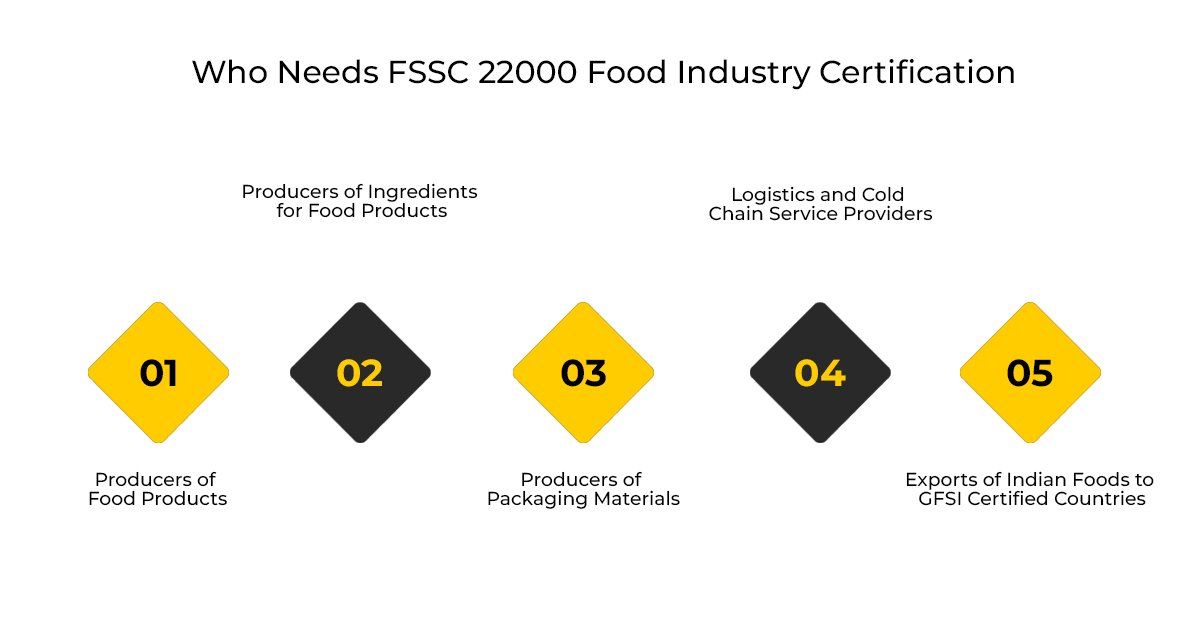
The FSSC 22000 certification can be obtained by different kinds of organizations involved in food production. The following types of organizations in India may either need or benefit from this certification:
Producers of Food Products
This category constitutes the core emphasis of the FSSC 22000 certification for food manufactures. Companies manufacturing food items such as beverages, food items, and snacks, whether to be sold wholesale or retail, will have much to gain through FSSC 22000, especially companies that manufacture food items for export purposes. FSSC 22000 in the food processing sector, including companies that process, cook, mix, and package food products in bulk, is increasingly being demanded by international buyers.
Producers of Ingredients for Food Products
Those companies that manufacture food ingredients and additives need to prove that they comply with food safety guidelines laid down by FSSC prior to using them as ingredients in multinational companies’ food products. It holds good for refiners and processors of oils and fats as well, and the implementation of FSSC 22000 for edible oil plants is becoming more and more important.
Producers of Packaging Materials
The FSSC 22000 standard is available for producers of packaging materials which are used in food production such as pouches and films depending on the requirements set forth by each specific industry sector.
Logistics and Cold Chain Service Providers
The companies providing service in the process of transportation of food products have the option to certify themselves by adopting the FSSC 22000 certification program. This is becoming all the more relevant due to the increasing trend of organized retailing of foods in India.
Exports of Indian Foods to GFSI Certified Countries
The exports of Indian food products to European Union, UK, US, Canada, Australia, and the nations of the Middle East need GFSI certification that can only be done through FSSC 22000; otherwise, it would not be possible for Indian food products to get to premium retail counters abroad.
>Helpful Guide:- FSSC 22000 Certification Documents Required: Complete Checklist for Food Businesses in India (2026)
Understanding the Difference Between ISO 22000 and FSSC 22000 Certification Food Industry
ISO 22000
The ISO 22000 standard has been developed by the International Organisation for Standardisation (ISO). This standard provides the requirements for a food safety management system that may be adopted by anyone in the food chain. The ISO 22000 standard is a certification standard but is not benchmarked by the Global Food Safety Initiative (GFSI).
FSSC 22000
FSSC 22000 is derived from the ISO 22000 system but has extra criteria such as PRPs, food frauds, and food defense. However, the uniqueness of FSSC 22000 lies in the fact that it is a GFSI benchmarked standard.
ISO 22000 vs FSSC 22000 – Key Differences
- Benchmarking GFSI: FSSC 22000 is benchmarked under GFSI; ISO 22000 is not
- Acceptance by the Market: FSSC 22000 has been acknowledged by the top retailers and food brands around the world; ISO 22000 might not be able to fulfill all buyer needs
- Supplementary Criteria: Food industry operators have supplementary criteria in FSSC 22000 in terms of food fraud, food defense, and allergen which are not included in ISO 22000
- Third Party Audit: FSSC 22000 is audited extensively through third parties via certification bodies
- Preparation and Investment: FSSC 22000 requires more preparation and investment
FSSC 22000 is the right certification for most food manufacturers in India seeking to enter the international market or retail chains. If the manufacturer is a small business operating exclusively in the local market, then ISO 22000 can be considered a suitable first step.
>Helpful Guide:- Most Common Non-Conformities Found in FSSC 22000 V6 Audits
Step by Step Process To Get FSSC 22000 Certification For Food Industry
Understanding how to get FSSC certification is essential before embarking on the journey. The FSSC 22000 certification process for food companies India typically follows these steps:
Step 1: Gap Analysis
In this step, a comprehensive gap analysis of your existing food safety management system against the FSSC 22000 V6 standard takes place. It helps you to identify gaps in terms of compliance and helps design the process of implementation. Many companies use the services of consultants who are well acquainted with FSSC 22000 requirements in India.
Step 2: Selection of a Certification Body
There are a number of accredited certification bodies (CB) that are accredited by the FSSC Foundation and can certify your organization under the FSSC 22000 scheme. There are a number of NABCB-accredited and IAF-affiliated CBs in India who provide auditing services against FSSC 22000 standards.
Step 3: Documentation of Your System
Food Safety Management System documentation needs to be done in accordance with the FSSC 22000 standard requirements for food industry and includes the following:
- Policy and objectives regarding food safety
- Your HACCP plan
- PRPs that relate to your industry
- An assessment of food fraud vulnerability
- Food defense plan and allergen control measures
- Recall and traceability procedures
Step 4: Training and Implementation
Training will be required for everyone who participates in the process on FSSC food safety management system requirements. The implementation of the written FSMS must be completed within a sufficient period (3-6 months usually).
Step 5: Internal Audit
Internal audit must be performed before the external one to make sure there are no gaps and non-conformities in your FSMS. These must be eliminated and verified.
Step 6: Stage 1 External Audit (Desk Review)
During the first stage of external audit, the certification body examines the documentation of your organization to evaluate its preparedness for further stage. It is a desk review.
Step 7: Stage 2 External Audit (On-Site Certification Audit)
This is the key on-site audit when the FSMS of your organization is audited for its proper implementation. Your factory will be inspected, personnel interviewed and non-conformances will be corrected before issuance of the certificate.
Step 8: Certification and Surveillance
After successful completion of the stage 2 audit and resolution of all non-conformances, the certificate of FSSC 22000 will be issued to you. The certificate is valid for 3 years; then annual surveillance audits are performed.
Timeline and Cost of FSSC 22000 Certification For Food Industry
The time period it will take for Indian food companies to get themselves certified under FSSC 22000 will vary between 6 months to 1 year, depending on the size of the company, the current state of food safety of the company and the type of food produced by the company.
The key cost parameters associated with FSSC 22000 certification for food industry units would be:
- Charges levied by certifying bodies
- Costs involved in consultancy/implementation services
- Costs linked to training of employees
- Amount needed for upgrading infrastructure in order to comply with PRPs
On an estimated basis, small and medium food firms in India generally incur costs ranging from 3 to 10 lakhs rupees for FSSC 22000 certification.
>Helpful Guide:- FSSC 22000 Certification Cost In India: Complete Process
Benefits of FSSC 22000 for the FSSC 22000 Food Industry in India
- Market access: The GFSI certificate helps gain access to the markets of more than 100 nations.
- Advantage as supplier: Most consumer goods producers in India would like the supplier to be FSSC 22000 certified, and FSSC 22000 certification in the food processing industry is undoubtedly an advantage.
- Audit waiver: With the help of the GFSI certificate, the buyer can conveniently waive the need for an audit, which saves a lot of time and money.
- Efficient operations: In fact, the process of certification ensures the efficient functioning of the company and traceability of its products and services.
- Compliance with government standards: The FSSC 22000 standard conforms reasonably to the FSSAI standard.
FSSC 22000 Certification for Food Industry
Get expert support for FSSC 22000 certification for food industry businesses in India, including gap analysis, FSMS documentation, sector-specific PRPs, food safety training, internal audits, and Stage 1 and Stage 2 audit preparation.
Frequently Asked Questions
What is the FSSC 22000 certification process for food companies India?
Certification process of food companies to FSSC 22000 in India requires gap analysis, documentation, training, internal audit, and an external audit performed in two stages by an accredited certification body and normally lasts from 6 to 12 months.
What are the food safety certification FSSC requirements India?
Requirements of Food Safety Certification FSSC 22000 in India include conformance of the company to ISO 22000:2018, sector-specific prerequisites (for example, ISO/TS 22002-1), and FSSC 22000 food fraud, food defense, allergens and food safety culture requirements.
How to get FSSC certification for my food business?
So, to respond to the question about how to get FSSC 22000 certification, gap analysis is necessary and then selecting the certification body, creation of FSMS documentation, training and performing Stages 1 and 2 audits. Consultation of an expert will be helpful.
Which is better FSSC or ISO for a food company?
FSSC 22000 is better suited for companies that are going to export products or sell it to big retail chains, but ISO 22000 can become a solid foundation for domestic businesses.
What is the FSSC ISO difference?
The key difference between FSSC and ISO is that FSSC 22000 meets GFSI requirements and is globally recognized by all major buyers, while ISO 22000 doesn’t meet GFSI requirements. In addition, FSSC 22000 has food fraud and defense provisions in addition to ISO.
Is ISO vs FSSC a choice or can a company have both?
In regard to the discussion on ISO vs FSSC, the FSSC 22000 is based on ISO 22000, which means that having an FSSC 22000 certificate would mean that the ISO 22000 standards are met, as it is impossible to choose these standards independently from one another.
Does FSSC 22000 cover all food businesses or only manufacturers?
The area of applicability of the FSSC 22000 is quite broad; it concerns not only manufacturing food products but also manufacturers of the ingredients and packaging materials and logisticians.