
Food manufacturers in Kolkata often face a common challenge when working with large retailers, international buyers and export customers: proving that their food safety practices meet recognised international requirements. Good manufacturing practices are important, but businesses also need a documented system to identify hazards, control risks and demonstrate that food safety procedures work consistently.
This is where FSSC 22000 certification in Kolkata becomes relevant. It helps food manufacturers, food packaging businesses and other eligible organisations establish a structured food safety management system that meets the applicable certification scheme requirements.
Legal4Sure supports businesses through gap assessments, documentation, staff training, internal audits and certification audit preparation. Whether you operate a food processing unit in Kolkata, a packaged food factory in Howrah or a manufacturing facility elsewhere in West Bengal, the right preparation can help you understand what needs to change before an external audit.
There is also an important update to consider. Foundation FSSC published Version 7 on 1 May 2026, introducing changes to prerequisite programmes, sector requirements and sustainability-related expectations. Businesses planning certification or upgrading an existing system should account for these changes when preparing their food safety management system. Read the official FSSC 22000 Version 7 update.
What Is FSSC 22000 Certification?
FSSC 22000 is an internationally recognised food safety management system certification scheme designed to help organisations manage food safety hazards throughout the food supply chain.
According to the official FSSC 22000 certification requirements, the scheme combines three main elements:
- ISO 22000 food safety management system requirements
- Applicable prerequisite programme standards from the ISO 22002 series
- Additional requirements specified by the FSSC 22000 scheme
Together, these requirements help organisations establish food safety controls, document procedures, train employees, monitor processes and respond to potential hazards.
For example, a packaged food manufacturer must do more than inspect finished products. It needs to control raw materials, prevent cross-contamination, maintain equipment, manage allergens where applicable and keep records showing that its controls are effective.
Businesses seeking FSSC 22000 certification in Kolkata can use this framework to improve their food safety management system and demonstrate conformity through an independent certification audit.
Why Do Businesses in Kolkata Need FSSC 22000 Certification?
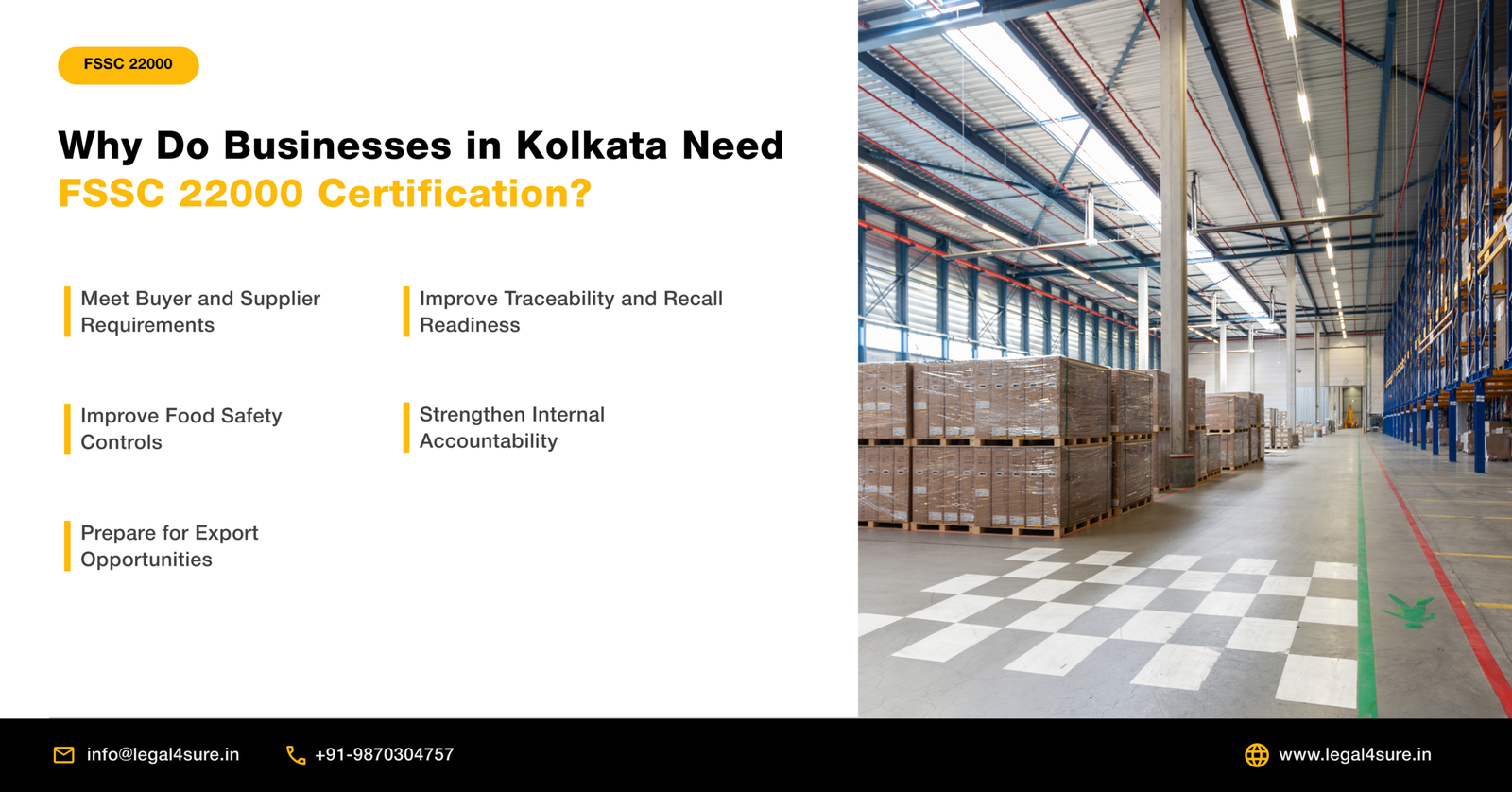
Kolkata and the wider West Bengal region have businesses involved in food processing, packaged foods, ingredient manufacturing, tea processing, warehousing and food packaging. Organisations serving larger buyers may need to demonstrate that their food safety management systems meet specific customer or supply-chain requirements.
FSSC 22000 can help businesses address these expectations, although certification is not automatically mandatory for every food business. Its importance depends on the products manufactured, customer contracts, export markets and applicable regulatory requirements.
1. Meet Buyer and Supplier Requirements
Large retailers, foodservice companies and international buyers may require suppliers to hold a recognised food safety certification.
Having an appropriate certification can help a business qualify for supplier assessments and respond to customer requirements. However, buyers may specify particular schemes, scopes or additional conditions, so businesses should confirm what each customer accepts.
2. Improve Food Safety Controls
FSSC 22000 requires organisations to establish and maintain controls based on food safety risks.
These may include raw material inspection, hygiene practices, cleaning schedules, pest management, temperature controls, allergen management, traceability and corrective action procedures.
A documented system makes it easier to identify gaps and ensure that employees follow consistent procedures.
3. Prepare for Export Opportunities
Export-oriented food manufacturers may need to demonstrate compliance with customer requirements in international markets.
FSSC 22000 can support supplier qualification where buyers accept the scheme. It does not replace country-specific food laws, import approvals, product registrations or other mandatory requirements.
4. Improve Traceability and Recall Readiness
A food safety management system should help an organisation trace relevant ingredients, production batches and finished products.
For example, if a supplier reports a contaminated ingredient, traceability records can help the manufacturer identify which batches may be affected and determine the appropriate response.
5. Strengthen Internal Accountability
Certification preparation encourages businesses to define responsibilities for production, quality assurance, maintenance, procurement and management.
This makes it easier to track corrective actions, review food safety performance and maintain records across departments.
Which Businesses Can Apply for FSSC 22000 Certification in Kolkata?
FSSC 22000 certification is available to eligible organisations within the food chain categories covered by the applicable scheme.
Depending on their activities and certification scope, businesses may include:
| Business type | Typical food safety focus |
| Food manufacturers | Processing controls, hygiene and hazard management |
| Packaged food companies | Product handling, contamination prevention and traceability |
| Beverage manufacturers | Water quality, process controls and packaging hygiene |
| Ingredient manufacturers | Raw material specifications, process controls and product safety |
| Food packaging manufacturers | Packaging safety and applicable prerequisite programmes |
| Food storage and distribution businesses | Handling, storage conditions and contamination prevention |
| Foodservice-related operations | Applicable food handling and safety management requirements |
Not every business category follows the same technical requirements. The correct scope and prerequisite programme standards must be determined from the organisation’s actual activities and the current FSSC scheme.
If your company is expanding into another city, you can also explore our FSSC 22000 certification in Bangalore resource for location-specific guidance.
FSSC 22000 Version 7: What Kolkata Businesses Should Know in 2026
Foundation FSSC published Version 7 on 1 May 2026. The new version incorporates the updated ISO 22002 prerequisite programme series, aligns with the Global Food Safety Initiative’s 2024 benchmarking requirements and strengthens elements linked to sustainability.
According to the official Version 7 update, the scheme introduces a revised structure for prerequisite programmes and clearer food chain categories. It also strengthens expectations relating to food loss and waste and sustainable packaging design where applicable.
Important Version 7 Transition Dates
| Milestone | Official timeline |
| Version 7 published | 1 May 2026 |
| Last date for audits against Version 6 | 30 April 2027 |
| Version 7 upgrade audit period begins | 1 May 2027 |
| End of the Version 7 upgrade audit period | 30 April 2028 |
For businesses seeking their first certification, the applicable scheme requirements should be confirmed with the certification body before the audit is scheduled. Existing certificate holders should review their transition plans and identify the changes needed for Version 7.
Working with experienced FSSC 22000 certification consultants in Kolkata can help businesses understand which requirements apply to their operations and organise the necessary implementation work.
How to Get FSSC 22000 Certification in Kolkata
The certification process involves more than preparing documents. The food safety management system must be implemented in practice, supported by records and assessed by an appropriately licensed certification body.
Here is the usual preparation process.
Step 1: Confirm the Certification Scope
Start by defining the activities, products, processes and locations that need certification.
For example, a company manufacturing ready-to-eat snacks may have different technical requirements from a business manufacturing food packaging materials.
The scope determines the applicable food chain category, prerequisite programme standards and audit requirements.
Step 2: Conduct a Gap Assessment
A gap assessment compares the company’s existing food safety practices against the applicable FSSC 22000 requirements.
The assessment may identify missing procedures, incomplete records, inadequate employee training, gaps in cleaning controls or weaknesses in hazard analysis.
The result should be a prioritised action plan showing what needs to be corrected before the certification audit.
Step 3: Develop the Food Safety Management System
The business must establish a food safety management system that reflects its actual operations.
Depending on the scope, this may include:
- Food safety policy and objectives
- Hazard analysis and HACCP-based controls
- Prerequisite programmes
- Supplier approval and raw material controls
- Cleaning and sanitation procedures
- Allergen management, where applicable
- Traceability and product recall procedures
- Corrective action and incident management
- Monitoring, verification and record keeping
Documentation should match what employees actually do. A procedure that exists only on paper will not demonstrate effective implementation during an audit.
Step 4: Train Employees
Employees need to understand their responsibilities under the food safety management system.
Production workers may require training in personal hygiene, contamination prevention and process controls. Quality assurance staff may need more detailed training in hazard analysis, monitoring, verification and corrective actions.
Training records should identify the topic covered, participants and relevant evidence of competence.
Step 5: Implement and Maintain the Controls
After documentation and training, the organisation must put the system into practice.
This means maintaining cleaning records, checking critical controls, monitoring relevant operating conditions, approving suppliers and recording corrective actions when problems occur.
The organisation should collect sufficient evidence to demonstrate that the system is operating as intended.
Step 6: Conduct an Internal Audit
An internal audit checks whether the food safety management system meets the applicable requirements and is being followed.
Auditors should examine both documents and actual workplace practices. Findings should be recorded, investigated and addressed through appropriate corrective actions.
Management should also review the system’s performance and ensure that the necessary resources are available.
Step 7: Complete the External Certification Audit
An appropriately licensed certification body conducts the formal certification audit.
The certification process normally includes a Stage 1 audit, which assesses readiness and the management system’s documented arrangements, followed by a Stage 2 audit that evaluates implementation and effectiveness.
The precise audit arrangements depend on the applicable scheme requirements and certification body’s procedures.
Step 8: Address Nonconformities and Certification Decisions
If the auditor identifies nonconformities, the organisation must address them through appropriate correction, root-cause analysis and corrective action.
The certification body reviews the audit evidence and corrective actions before making the certification decision.
A consultant can help the organisation prepare evidence and respond to findings, but the certification decision belongs to the independent certification body, not the consultant.
What Documents Are Required for FSSC 22000 Certification?
The documents required depend on the organisation’s activities, risks, scope and applicable scheme version.
Common documentation and records include:
| Document or record | Purpose |
| Food safety policy and objectives | Defines management’s commitments and priorities |
| Hazard analysis and HACCP plan | Identifies hazards and establishes appropriate controls |
| Prerequisite programme procedures | Covers hygiene, cleaning, pest control and other applicable operational controls |
| Supplier approval records | Supports the assessment and monitoring of suppliers |
| Raw material and finished product specifications | Defines product and ingredient requirements |
| Training records | Demonstrates employee training and competence |
| Traceability records | Connects ingredients, production batches and finished goods |
| Cleaning and sanitation records | Demonstrates implementation of hygiene controls |
| Monitoring and verification records | Shows whether food safety controls are working |
| Internal audit reports | Identifies system gaps and nonconformities |
| Corrective action records | Documents the investigation and resolution of problems |
| Food safety risk assessments | Supports relevant scheme-specific controls |
Additional documentation may be required for food fraud mitigation, food defence, allergen management, environmental monitoring, food loss and waste, or other applicable scheme requirements.
The official FSSC 22000 scheme documents should be used to confirm the requirements for the current version and certification scope.
What Is the Cost of FSSC 22000 Certification in Kolkata?
The cost of FSSC 22000 certification in Kolkata depends on the size of the business, number of sites, employee count, process complexity, certification scope and work required to prepare the management system.
There is no single price that applies to every organisation.
The total budget may include:
| Cost component | What it covers |
| Gap assessment | Identifying gaps in the existing system |
| Consultancy | Implementation guidance and project support |
| Documentation | Developing or revising procedures and records |
| Training | Preparing employees and internal auditors |
| Internal audit | Checking readiness and identifying outstanding issues |
| Certification audit | Fees charged by the certification body |
| Corrective actions | Resources required to address identified gaps |
| Ongoing certification | Surveillance audits and future recertification |
Legal4Sure’s published Kolkata certification guidance gives indicative cost ranges of ₹1 lakh to ₹5 lakh for audits, ₹2 lakh to ₹10 lakh for certification and ₹50,000 to ₹3 lakh for training. These are broad estimates from the provider’s published page, not a current binding quotation, and the categories may not represent the same costs for every project. See the published cost guidance.
Before comparing quotes, ask each provider to separate consultancy charges, certification body fees, training, travel, taxes and ongoing audit costs.
A small facility with an established food safety system may require less implementation work than a multi-site manufacturer with complex production processes. The best way to estimate the cost is to begin with a scope review and gap assessment.
How Long Does FSSC 22000 Certification Take?
The timeline depends on the organisation’s readiness, the complexity of its processes, the availability of records, the time required to implement corrective actions and the certification body’s audit schedule.
Businesses with an established management system may need less preparation than facilities starting from scratch.
A realistic project plan should include time for:
- Scope confirmation and gap assessment
- Documentation and implementation
- Employee training
- Collection of operating records
- Internal audit and management review
- External audit scheduling
- Corrective actions and certification review
The external audit itself is only one part of the process. The organisation must also demonstrate that the system is implemented and working effectively.
Be cautious of promises of guaranteed certification within a fixed number of days. A consultant can help organise preparation, but the certification outcome depends on the evidence and independent audit decision.
How to Choose FSSC 22000 Consultants in Kolkata
Choosing the right consultant can make the implementation process easier to manage, especially when the business does not have a dedicated food safety team.
Before hiring FSSC 22000 consultants in Kolkata, evaluate the following factors.
Relevant Industry Experience
Look for experience with your type of operation. A consultant familiar with packaged food manufacturing may understand different operational risks from one who mainly works with food storage or packaging materials.
Understanding of the Current Scheme
Ask how the consultant addresses the current FSSC 22000 Version 7 requirements and how the project will account for applicable prerequisite programme standards.
Practical Documentation Support
The consultant should develop documentation that reflects your actual operations rather than provide generic templates without implementation guidance.
Internal Audit and Training Support
Ask whether the service includes employee training, internal audit preparation, corrective action support and readiness reviews.
Transparent Pricing
Request a written scope of work with clearly listed deliverables, exclusions, additional charges and the responsibilities of both parties.
Independent Certification
Confirm which licensed certification body will conduct the formal audit. Consultancy and certification decisions must remain appropriately independent.
Why Choose Legal4Sure for FSSC 22000 Certification in Kolkata?
Legal4Sure helps businesses prepare for food safety and management system certification through structured compliance support.
Its published service information describes assistance with gap assessments, food safety documentation, HACCP implementation, employee training, internal audits and certification audit preparation.
For businesses pursuing FSSC 22000 certification in Kolkata, the service can be structured around the organisation’s current system, production processes and certification scope.
Legal4Sure’s support may include:
- Reviewing existing food safety practices
- Identifying gaps against applicable requirements
- Preparing or improving the food safety management system
- Supporting HACCP and prerequisite programme implementation
- Training relevant employees
- Conducting readiness assessments and internal audits
- Helping organise corrective action evidence
- Coordinating preparation for the external certification audit
The aim is to help businesses understand the requirements, prepare their documentation and implement the controls needed for the audit.
Legal4Sure does not replace the independent certification body. Certification is granted only after the required audit and certification decision.
Planning Certification for Multiple Locations?
If your organisation operates facilities in more than one city, its certification scope and site arrangements should be planned carefully. Requirements depend on the organisation’s activities, locations and the applicable scheme rules.
For businesses with operations in Karnataka, see our FSSC 22000 certification in Bangalore guide for additional location-specific information.
Maintaining FSSC 22000 Certification After Approval
Receiving a certificate is not the end of the process. Organisations must continue to operate and improve their food safety management system.
The ongoing responsibilities generally include:
- Maintaining procedures and operational records
- Conducting internal audits
- Reviewing food safety performance
- Monitoring corrective actions
- Updating hazard assessments when processes change
- Training new and existing employees
- Preparing for surveillance and recertification audits
- Keeping up with applicable scheme updates
FSSC 22000 Version 7 also makes it important for certified organisations to plan their transition in line with the official timeline.
The FSSC Version 7 upgrade requirements specify that Version 6 audits may be conducted through 30 April 2027, followed by the Version 7 upgrade audit period beginning on 1 May 2027. Existing certificate holders should confirm their specific transition arrangements with their certification body.
Get Expert Support for FSSC 22000 Certification in Kolkata
Preparing for FSSC 22000 certification requires a clear understanding of the applicable requirements, practical implementation and reliable evidence that the food safety management system works.
For food manufacturers and packaging businesses in Kolkata, the first step is to assess the current system, confirm the certification scope and identify the changes needed to meet the relevant scheme requirements.
Legal4Sure can help businesses organise the implementation process, prepare documentation, train employees and assess audit readiness.
Planning to get certified? Contact Legal4Sure to discuss your facility, certification scope, current food safety system and the support required before your external audit.
Frequently Asked Questions
What is FSSC 22000 certification in Kolkata?
FSSC 22000 certification in Kolkata is an internationally recognised food safety management system certification for eligible businesses operating in and around Kolkata. It demonstrates that an organisation meets the applicable FSSC 22000 scheme requirements through an independent certification audit.
Who needs FSSC 22000 certification?
Food manufacturers, beverage producers, ingredient suppliers, food packaging businesses and other eligible food chain organisations may seek FSSC 22000 certification. It is particularly relevant when customers or export markets require a recognised food safety management system.
How much does FSSC 22000 certification cost in Kolkata?
The cost depends on the facility size, certification scope, audit duration and implementation work required. Legal4Sure publishes broad indicative estimates for audit, certification and training fees, but businesses should request a project-specific quotation before budgeting.
How long does it take to get FSSC 22000 certification?
The timeline depends on the organisation’s readiness, documentation, implementation, audit availability and corrective actions. The preparation period should be assessed individually rather than relying on a guaranteed number of days.
What is the difference between ISO 22000 and FSSC 22000?
ISO 22000 is a food safety management system standard. FSSC 22000 builds on ISO 22000 by adding applicable prerequisite programme standards and scheme-specific requirements to form a broader certification scheme.
What is the latest version of FSSC 22000 in 2026?
FSSC 22000 Version 7 was published on 1 May 2026. According to Foundation FSSC, Version 6 audits may continue until 30 April 2027, and Version 7 upgrade audits begin on 1 May 2027.
What do FSSC 22000 certification consultants in Kolkata do?
FSSC 22000 certification consultants in Kolkata help businesses assess gaps, develop documentation, implement food safety controls, train employees and prepare for internal and external audits. The independent certification body makes the certification decision.
Which documents are required for FSSC 22000 certification?
Common documents include a food safety policy, hazard analysis, HACCP plan, prerequisite programme procedures, supplier records, training records, traceability records, internal audit reports and corrective action records. Additional requirements depend on the business’s activities and certification scope.
FSSC 22000 mandatory for food businesses in Kolkata?
FSSC 22000 is not universally mandatory for every food business in Kolkata. However, customers, retailers, supply chains or export contracts may require it. Applicable statutory food licensing and legal requirements must be assessed separately.
Can a small food manufacturing company apply for FSSC 22000 certification?
Yes, an eligible small food manufacturer can apply for FSSC 22000 certification. The organisation must meet the requirements applicable to its activities and demonstrate that its food safety management system is implemented effectively.
Does FSSC 22000 certification help with exports?
FSSC 22000 can support export supplier qualification when overseas buyers accept the scheme. It does not replace destination-country regulations, import permissions or product-specific compliance requirements.
What happens during an FSSC 22000 audit?
The certification audit assesses whether the organisation’s food safety management system meets the applicable requirements. Auditors review documentation, records, processes and workplace practices, and the organisation must address any nonconformities before certification can be granted.
Can a consultant guarantee FSSC 22000 certification?
No responsible consultant can guarantee an independent certification decision. A consultant can help prepare the system and address gaps, but certification depends on the applicable requirements, audit evidence and the certification body’s decision.
How often does FSSC 22000 certification need to be renewed?
FSSC 22000 certification follows a certification cycle that includes surveillance and recertification audits under the scheme’s rules. Organisations should confirm their specific audit schedule and certificate status with their certification body.
How can I choose the right FSSC 22000 consultant in Kolkata?
Choose a consultant with relevant industry experience, knowledge of the current scheme, practical documentation and training support, transparent pricing and a clear approach to audit preparation. Confirm that the external certification audit will be conducted by an appropriately licensed certification body.