
Eventually, the question will be raised if a food business is operated:
Do we really need to have the FSSC 22000 certification?
One buyer gives a little hint. An exporter makes a request. An auditor, in his/her own way, refers to it.
And suddenly, it becomes a very confusing and urgent feeling simultaneously.
FSSC 22000 is not an enigma. It is structured. It is logical. And it is very doable, even for FPOs and small-scale manufacturers,
if you take a look at what it really requires.
We don’t want to keep you guessing. Let’s break it down.
Chat with us directly on WhatsApp for a free review:
Why Food Businesses Struggle With Food Safety Compliance
Most food businesses that fail are not those that purposely neglect safety, but rather those that the system is too heavy for.
The paperwork seems never-ending. Prices appear unclear. Suggestions are usually very technical and do not help anyone on the shop floor.
In the case of FPOs and small units, the problem is much more serious. Teams are small. Owners act as managers.
Documentation feels like a distraction from real work.
What it basically comes down to is this: good practices exist, but they are not written down, reviewed, or verified.
That is where certification gaps come from.
What Is FSSC 22000 Certification, Really?
“FSSC 22000 Certification” is essentially a demonstration that your food production is hygienic and safe.
It is a combination of three elements:
| Element | What It Covers |
|---|---|
ISO 22000 System |
Food safety management system |
PRPs |
Standard hygiene and operational practices |
Additional Controls |
Food fraud prevention, food defense, traceability |
When you have this certification, it means that a third party has done a thorough check of your process
and confirmed that risks have been recognized and taken care of.
This is the main reason why this certificate is welcomed—not because of the logo, but because of the order behind it.
Who Needs FSSC 22000 Certification
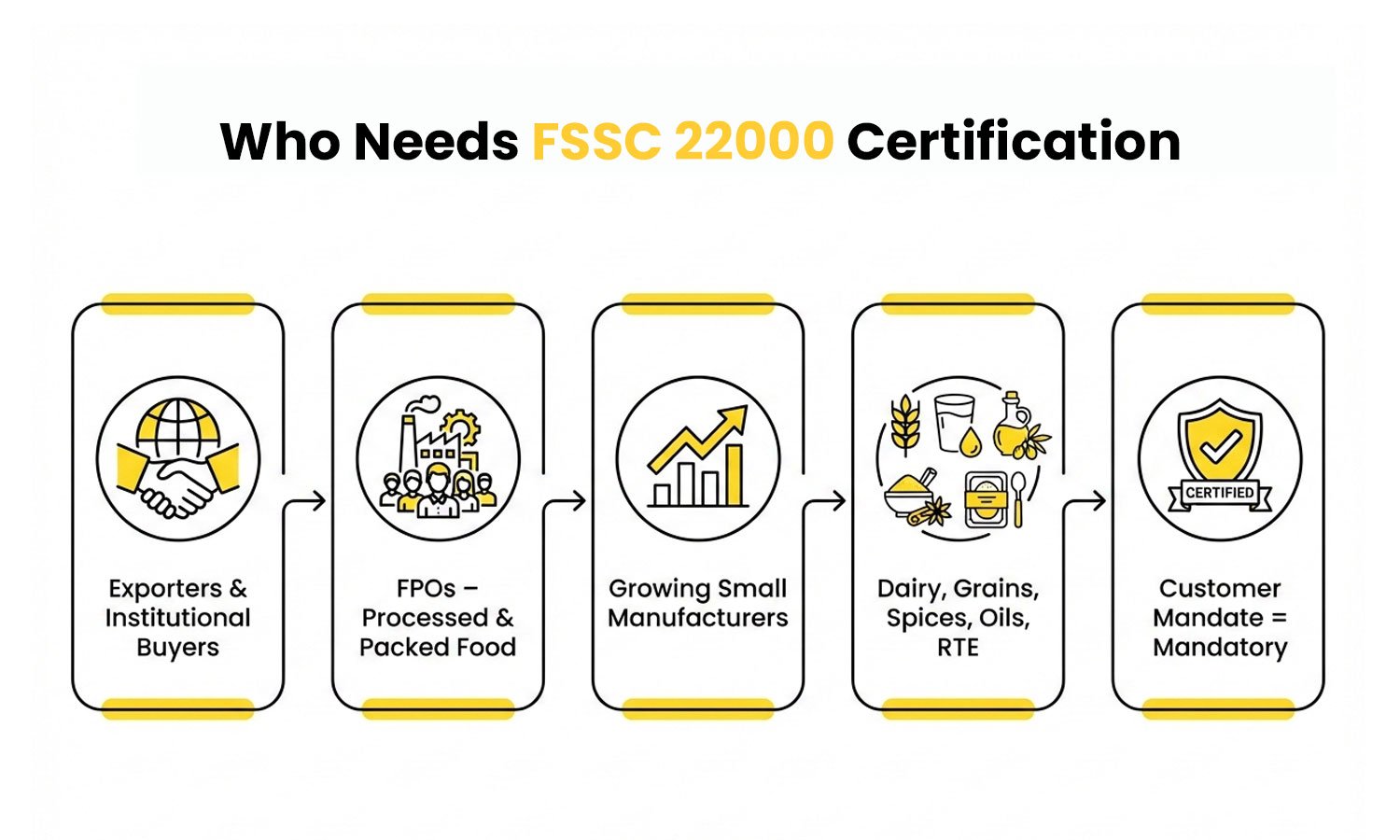
Here’s a List:
- FPOs providing processed or packed food
- Small manufacturers expanding beyond local markets
- Units dealing with dairy, grains, spices, oils, and ready-to-eat products
If your customer demands FSSC 22000, then it is not an option. It is a must.
FSSC 22000 Certification Requirements Explained Simply
Essentially, you need a food safety management system that identifies hazards, controls them,
and verifies results.
You also need basic factory discipline—cleanliness, pest control, equipment maintenance, and storage practices.
Nothing fancy. Just consistency.
Finally, you must address inherent risks such as food fraud, food defense, traceability, and supplier control.
Everything is documented and followed.
The key point is this: the system must reflect reality. Auditors look for truth, not the number of files.
The FSSC 22000 Certification Process Step by Step

Here are FSSC 22000 Certification Process Steps:
- Gap analysis to assess current practices
- Documentation aligned with actual operations
- Implementation through training and records
- Internal audit by the organization
- Certification audit by an accredited body
There are no shortcuts. Only preparation and follow-through.
FSSC 22000 Registration Checklist
Before applying for FSSC 22000 certification, ensure the following readiness points are covered:
| Checklist Item | Purpose | Status |
|---|---|---|
Defined product scope & processes |
Clarifies certification boundaries |
☐ Yes / ☐ No |
ISO 22000-based FSMS documented |
Core food safety framework |
☐ Yes / ☐ No |
PRPs implemented (GMP, GHP) |
Ensures hygiene discipline |
☐ Yes / ☐ No |
Food fraud & food defense plan |
Buyer-driven risk control |
☐ Yes / ☐ No |
Traceability & recall procedure |
Rapid issue containment |
☐ Yes / ☐ No |
Internal audit completed |
Confirms system readiness |
☐ Yes / ☐ No |
Want Help in FSSC 22000 Certification? Request a free Call!
Get Registered - Click Here
How Much Does FSSC 22000 Certification Cost
Cost depends on size, complexity, and readiness. It includes preparation support,
certification body audit fees, and annual surveillance audits.
For FPOs and small manufacturers, realistic planning keeps costs reasonable.
Failed audits always cost more than good preparation.
Is FSSC 22000 Worth It for Small Manufacturers
If you want stable buyers, better pricing, or export opportunities, it becomes worth it quickly.
Certification reduces buyer friction and builds trust.
How We Help FPOs and Small Units Get Certified Faster
We focus on clarity—systems sized to your operation, documentation that reflects reality,
and audit readiness without surprises.
Ready to Move Forward

If FSSC 22000 certification is part of your plan, understand it first instead of feeling pressured.
Clear gap assessment, realistic pricing, and defined timelines make the process manageable.
Work With Us for FSSC 22000 Registration
FSSC 22000 Registration requires more than documents. It demands a food safety system that reflects
actual operations and meets international audit expectations. Legal4sure helps food businesses
prepare, implement, and complete FSSC 22000 Registration with clarity and confidence.
How Legal4sure Helps With FSSC 22000 Registration
- Gap assessment for FSSC 22000 Registration readiness
- ISO 22000–based food safety system documentation
- Implementation of PRPs, food fraud, and food defense controls
- Internal audit preparation before certification audit
- Support during certification body audit and closure of gaps
Who Should Apply for FSSC 22000 Registration
- FPOs and small manufacturers supplying organized buyers
- Food processing units planning export or institutional sales
- Businesses upgrading from basic food safety compliance
- Manufacturers required by buyers to complete FSSC 22000 Registration
Start Your FSSC 22000 Registration
Get expert guidance on documentation, timelines, cost expectations, and audit preparation.
Legal4sure helps you complete FSSC 22000 Registration smoothly without disrupting daily operations.
Frequently Asked Questions
What is the FSSC 22000 certification course?
It is a food safety management system course based on ISO 22000, sector-specific PRPs, and additional FSSC requirements.
What is the difference between ISO 22000 and FSSC?
ISO 22000 is a standard, while FSSC 22000 includes ISO 22000 plus PRPs and extra certification requirements.
How much does it cost to become FSSC 22000 certified in India?
The cost typically ranges from ₹1.5 lakh to ₹4 lakh, depending on organization size and certification body.
How long is the FSSC 22000 certification valid?
FSSC 22000 certification is valid for three years with annual surveillance audits.
Which 3-month course is best?
A 3-month Food Safety Management or Lead Auditor course is considered one of the best options.
What is the salary of a food auditor in India?
A food auditor in India earns approximately ₹4–10 LPA depending on experience and certifications.
Is there any 6-month course in India?
Yes, several institutes offer 6-month diploma courses in food safety and quality management.
Who is eligible for a food safety officer?
Candidates with a degree in food technology, dairy technology, biotechnology, or related sciences are eligible.
Which is better, CIA or CFA?
CIA is better for internal auditing careers, while CFA is better for finance and investment careers.
What is FSSC full form?
FSSC stands for Food Safety System Certification.
Is FSSC 22000 the same as HACCP?
No, FSSC 22000 includes HACCP principles but is a more comprehensive food safety system.
Who is eligible for CSP course?
Graduates or professionals in safety, engineering, or science fields are generally eligible for the CSP course.