
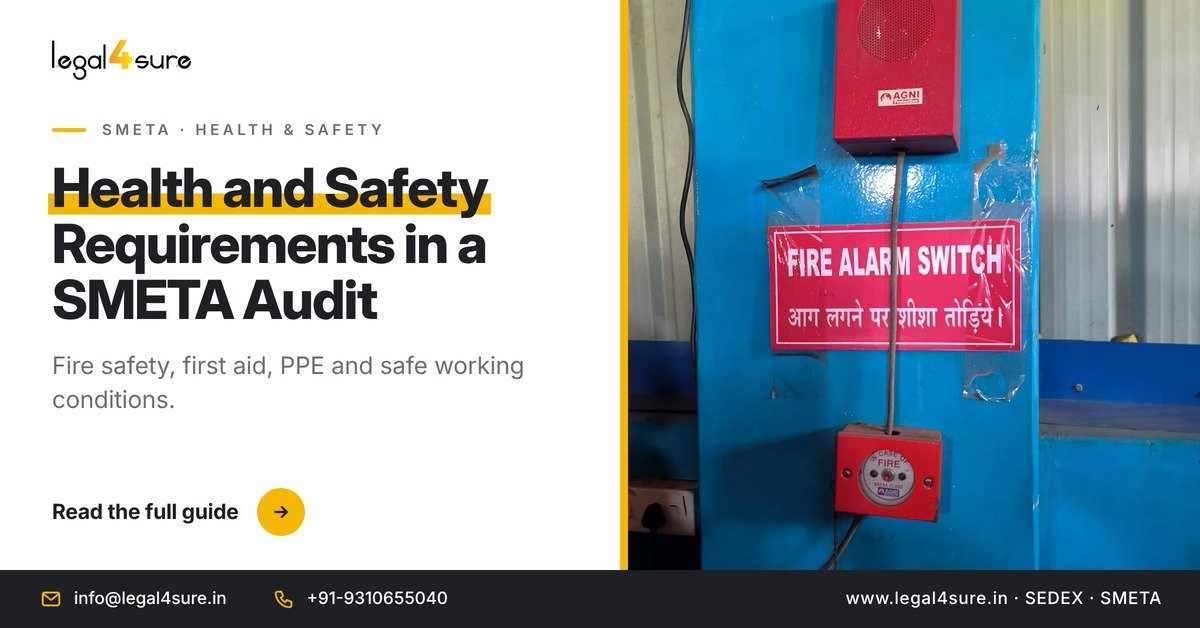
The procurement team of a UK retailer emails your export manager on a Monday. They need a SMETA audit done before placing the next order, but have included an interesting question in the email: could you provide us with fire drill records, accidents log and risk assessment?
If this sounds familiar to you, there is a reason for that. Buyers use this information to assess supplier ethical compliance, and health and safety is one of the key criteria no SMETA audit can overlook. This guide will walk you through health and safety criteria in a SMETA audit, tell you about the documentation typically required from Indian factories, and give you preparation tips.
What are the health and safety requirements in a SMETA audit?
These are the working conditions that the auditor evaluates during Workplace Requirement 3, which states that “Working conditions are safe and hygienic”. The evaluation is done for risk assessment, a responsible manager, training, preparedness for fires, machines and equipment, chemicals, first aid and welfare provisions.
Is Sedex a certification? Clearing up the terms
No. Sedex is a membership platform, and SMETA (Sedex Members Ethical Trade Audit) is an audit methodology. Neither is a certificate or a legal licence.
- Membership in Sedex is not mandatory. You will be provided with an account where you can upload information about your site and audit reports for the buyers. According to the Sedex website, there are members of Sedex from 180 different countries.
- SMETA audit is carried out by a Sedex-approved auditing agency, either 2-pillars or 4-pillars audit. They both cover health and safety issues.
- Sedex says that more than 540,000 audits have already been carried out in their system, hence the familiarization of buyers with the format.
- The outcome is an audit report with recommendations and action plan for improvement but not a passing grade. This does not ensure your orders.
A 2-pillar audit covers labour standards, health and safety and a basic environment assessment. A 4-pillar audit adds extended environment and business ethics checks. Health and safety sits inside both, so everything below applies either way.
What will the auditor check on your factory floor?
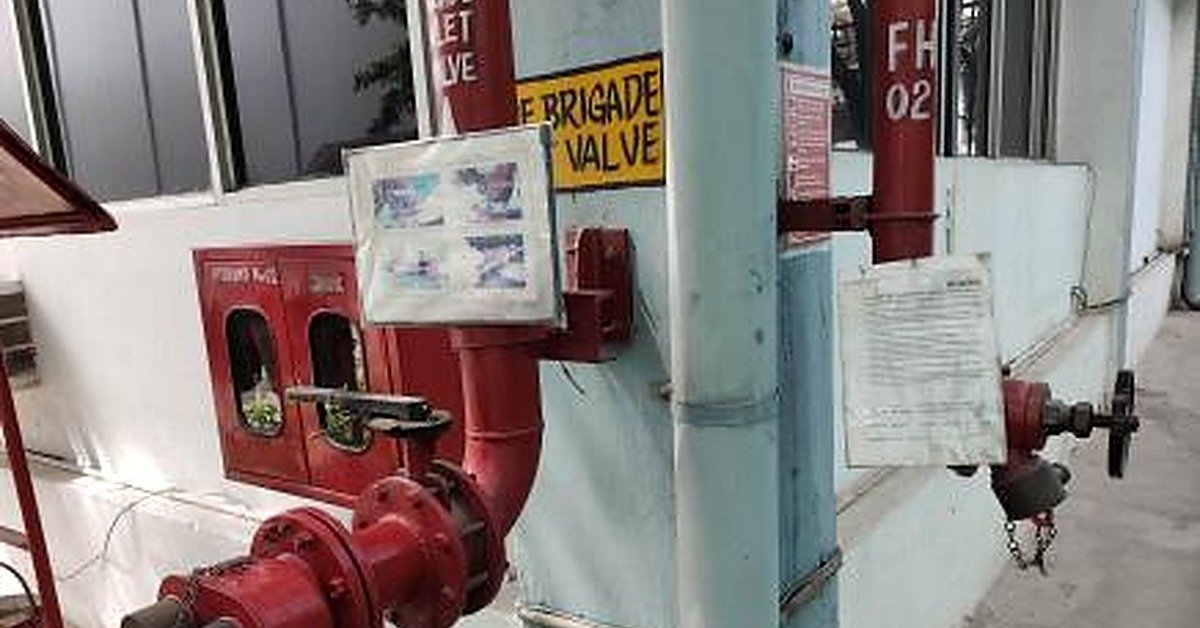
Sedex’s SMETA 7.0 Auditor Manual (Annex 4) sets out the checks. Here’s how they translate into daily factory practice.
| Area | What the auditor looks for | Records to keep |
|---|---|---|
| Risk and responsibility | Risk assessments updated after process changes; a qualified health and safety manager; a committee including workers | Risk register, appointment letter, committee minutes |
| Training and first aid | Training before exposure to hazards, with a check that it worked; first-aid supplies and trained staff on every shift | Training matrix, attendance sheets, first-aid roster |
| PPE and incidents | Free PPE where needed; accidents and near misses logged and investigated; workers can stop work in imminent danger | PPE issue register, incident log, investigation reports |
| Fire and emergencies | Clear exits, detection, extinguishers, emergency plans, and drills covering all shifts | Drill reports, equipment inspection tags |
| Buildings, machinery, electrics | Safety certificates valid for the current layout; machinery safely installed and maintained; qualified electrical oversight | Building and fire certificates, maintenance logs |
| Chemicals | Hazardous substances registered where possible, safety data sheets in use, safe storage and disposal | Chemical inventory, safety data sheets, disposal records |
| Welfare and living | Clean toilets, drinking water, heat-stress controls; safe accommodation and transport where provided | Cleaning schedules, accommodation checks |
Which extra checks apply to higher-risk sub-sectors?
Auditors give extra attention to your specific hazards. Four examples from Indian manufacturing:
| Sub-sector and cluster | Typical extra checks |
|---|---|
| Textiles and garments (Tiruppur, Ludhiana, Surat) | Unobstructed exits on crowded floors, lint and dust control, boiler safety, hostel fire safety |
| Food processing | Refrigeration or ammonia leaks, cleaning chemical handling, wet-floor slips, conveyor guarding |
| Chemicals and pharma (Ankleshwar, Vapi, Baddi) | Spill response, ventilation, labelling, emergency drills built around chemical scenarios |
| Engineering and auto parts (Pune-Chakan, Manesar, Coimbatore) | Press and machine guarding, lockout procedures, forklift and crane safety, electrical panels |
For hot work, confined spaces or work at height, expect questions on permits and rescue arrangements too.
How do auditors verify what you tell them?
Auditors do not solely base themselves on paperwork. They match up documentation with what is seen in the field as well as what is told in a confidential interview. A drill that does not have any sign-in sheet and an expired extinguisher tag will certainly be a cause for concern.
A confidential interview also helps to check whether employees are aware of the way out during a disaster and whether they feel comfortable to speak out against unsafe activities without having to face repercussions, according to Workplace Requirement 3.J.
What has changed recently, and how does SMETA differ from Indian law?
As per the auditing firm DQS, Sedex launched SMETA 7.0 on 10th September 2024, succeeding SMETA 6.1. With the inclusion of Workplace Requirements and Management Systems Assessment, auditors would be asking you how you sustain your safety, not if you have any record for it. Sedex had also mentioned that it will stop considering SMETA audit as an adequate assessment of present status after 24 months.
The Indian Ministry of Labour and Employment issued the notification S.O. 5321(E) making the Occupational Safety, Health and Working Conditions Code, 2020 effective from 21st November 2025, superseding the Factories Act, 1948. Central Rules were notified on 8th May 2026, while state-level rules have been enacted in various stages.
SMETA audit is not a legal compliance audit. As per Annex 4, sites must comply with stricter local legislation or the ETI Base Code which protects worker’s rights more. Passing of SMETA audit does not assure statutory compliance, and satisfying minimum statutory requirement may not suffice to address all findings.
How does the process work, step by step?
- Check with your buyer on whether you need 2-pillars or 4-pillars audit and which Sedex ID should be used. See our article on Sedex 2-Pillar vs 4-Pillar.
- Register your company in Sedex, create your profile and complete the self-assessment questionnaire. See our article on Sedex registration.
- Perform the gap analysis based on the table above.
- Close the gaps: obtain certificates, conduct drills, provide training, install guards and signs.
- Choose a Sedex approved audit company and arrange the date of audit and number of man-days.
- Arrange the audit process: opening meeting, document check, site inspection, employee interview, closing meeting.
- Develop the corrective action plan and submit the report into Sedex. See our article on SMETA audit India.
Preparation checklist
- Risk assessment for all processes
- Safety manager nomination and minutes of meetings
- Training files for new and old employees
- Report on fire drill for all shifts
- Building, fire, and electrical licenses
- Chemical inventory with safety data sheets
- Accident and near-miss records, PPE
- Observation reports for all contractor managed hostels/transport
Unsure where your gaps are? Legal4sure can review these records against Workplace Requirement 3 before the auditor does.
What does it cost, and how long does it take?
Costs split into several parts, and none is a single fixed figure. Ask for written quotations in INR with taxes shown. According to QIMA, most on-site SMETA audits take one to two days.
| Component | What drives it | Rupee and timing context |
|---|---|---|
| Audit company fee | Auditor man-days, set by workforce and site size; a 4-pillar audit adds half a day, per Sedex’s Supplier Manual | Quoted in INR by the audit company |
| Sedex audit fee | Sedex lists £199 per SMETA audit for members from 1 July 2026 | Paid in pounds, so the rupee cost moves with exchange rates |
| Corrective works | Size of gaps: extinguishers, guarding, signage, training | Paperwork takes weeks; certificates and equipment depend on vendors and authorities |
| Consultant support | Gap review only, or full preparation support | Compare written scopes and quotations |
Timelines are dependent on how large your gaps are. A site that has current documentation can take weeks to become compliant, whereas sites that require new fire detectors and building certifications may take months, as vendors and authorities determine the speed. Once the audit is complete, the corrective action plan provides deadlines for each gap found.
What happens if the auditor finds a gap?
The gap becomes a non-conformity in the report, and your team develops a plan of action for each one with a timeline. Most of the gaps, such as drill logs not being maintained and exit doors being blocked, can be corrected by your team. Some will require external intervention.
Which mistakes cause the most health and safety findings?
- Drills done for the general shift only, while drills need to be done for all shifts.
- Certification that does not fit the new layout because of an expansion.
- Training provided but not verified for its efficiency.
- Charging employees for PPE, when the site should give it for free.
- Not taking into account contractor’s accommodation or transport facilities as well as Workplace Requirements 3.S and 3.T do.
- Considering the audit process a one-day job rather than an ongoing process throughout the year.
- Incident logs without any follow-up action being taken. Learn about SMETA audit errors from our article.
The fix is simple: review records monthly, not the week before the audit.
Should you do this now?
- This is logical because when your customers ask for SMETA, you sell to UK or European retailers, or you need just one report.
- It can be optional because your customers will accept other well-recognised audit or did not ask for it at all.
- Size also counts. A smaller company with just one customer can do a 2-pillars audit, while an exporter dealing with several customers prefers a 4-pillars audit, so one report serves more customers.
- First of all, check: which pillar they want, whether they accept the already existing report, and how recent it should be.
How can a consultant help, and how do you choose one?
The consultant saves time on preparation. The consultant will not replace the auditor and will not be able to guarantee anything. Watch out for any guarantees of passing the audit, fast tracking or backroom dealings; only the approved audit company can make conclusions.
Legal4sure assists manufacturers in conducting a gap analysis according to SMETA workplace standard requirements, document review, and actions to correct shortcomings, while the audit remains with an approved audit company. Select a partner that will explain conclusions clearly and let your team operate the system on its own. Before selecting any partner, you need to ask:
- Are you not willing to commit to results?
- Have you handled my sub-sector before?
- Are you willing to provide a scope and an INR quote in writing?
- Who visits my site, and how frequently?
- How do you facilitate corrective measures following the report?
Planning an audit in the next few months? Speak to Legal4sure about a health and safety readiness review.
Key Takeaways
- Sedex is an organization that offers a membership service, while SMETA is an audit methodology. Neither can be considered as a form of certification.
- Workplace Requirement 3 involves risk assessment, training, fire, machinery, chemicals, and welfare.
- SMETA 7.0 focuses on management systems, hence always maintain updated documentation.
- SMETA audit does not override Indian legislation, including the OSH code.
- Request written quotations in Indian National Rupee (INR) and stay away from any promise of guaranteed outcomes.
Conclusion
Health and safety requirements of SMETA audit encourage the formation of good practices: current risk assessments, trained individuals, tested fire plans, and honest documentation. Do a gap analysis, rectify it, and get approval from your buyer before booking the audit. Such a strategy will facilitate responsible sourcing and smooth social compliance audit. Lastly, ask your buyer about its accepted audit report and plan ahead of the 24 months.
Strengthen Workplace Safety and Prepare Your Factory for SMETA Audit Requirements
Is your factory ready for SMETA health and safety checks? Legal4Sure helps manufacturers identify compliance gaps through workplace requirement reviews, risk assessment checks, safety documentation review and corrective action guidance. Strengthen your fire safety, employee training, machinery, chemical handling and welfare practices before the audit.
Frequently Asked Questions
What is a SMETA audit?
SMETA audit is a Sedex approved social compliance audit on labour, health and safety and possibly on environment and business ethics.
What is Sedex membership? Is Sedex a certification?
Sedex is a voluntary system for exchanging supplier information. Sedex is not a certification and no audit outcome is assured.
What does a SMETA audit assess?
It examines labour standards, health and safety and environmental management; 4 pillar SMETA audits examine all four pillars, including business ethics.
What are the health and safety requirements in a SMETA audit in India?
Workplace Requirement 3 is applicable to all SMETA audits in India and is measured on Indian laws, including OSH code and ETI Base Code.
What are the health and safety requirements in a SMETA audit requirements and documents?
Risk assessments, training, drills, certificates, chemicals and incidents are likely.
What are the health and safety requirements in a SMETA audit process step by step?
They include registration, gap analysis, correction of gaps, scheduling the audit, conducting the audit and creating the corrective action plan.
How to prepare for health and safety requirements in a SMETA audit?
Review records monthly, run drills on every shift, and confirm the pillar and report validity with your buyer.