
Trust building and quality assurance are two of the most crucial aspects in food industries and manufacturing. These are also key challenges faced by small and medium sized enterprises (SMEs). While it is difficult to compete with global giants, ISO 9001 Certification for small business provides a measure of excellence that offers great opportunities for growth and reputation. While some people believe ISO certification small company is too complicated and expensive one, but actually, it is actually about creating efficient and planned business operations.
This blog post is aimed at clarifying any doubts about ISO 9001 certification, making its great advantages known and leading India’s small enterprises to get this award of excellence through a simple and clear plan.
 Thinking about ISO Certification? Our experts make the process simple and fast.
Challenges Faced In ISO Certification Small Company
Small-scale industries in India face various challenges in the effective implementation of quality management. There is an overall perception that the implementation of the ISO 9001 standard is an expensive affair that is only suitable for large-scale industries. This has created:
- Problem in showing consistency in terms of quality: Without proper guidance, it is not easy to ensure that all operations within an organization show proper consistency in terms of product or service quality.
- Inability to penetrate markets: Many larger organizations, both domestic and international, now require that their suppliers hold an ISO 9001 certification. Without it, many small-scale industries would not even be considered in the tendering process.
- Inefficiencies in operations: Without proper documentation, many small-scale industries might face problems in terms of operations.
- Perception of irrelevance: Some small-scale industries might feel skepticism to the direct applicability of an international standard in terms of operations within an individual country.
>Helpful Guide:- ISO 9001 Certification Process: 7 Steps To Get Certified In India (2026)
The Root Causes Why Small Businesses Struggle
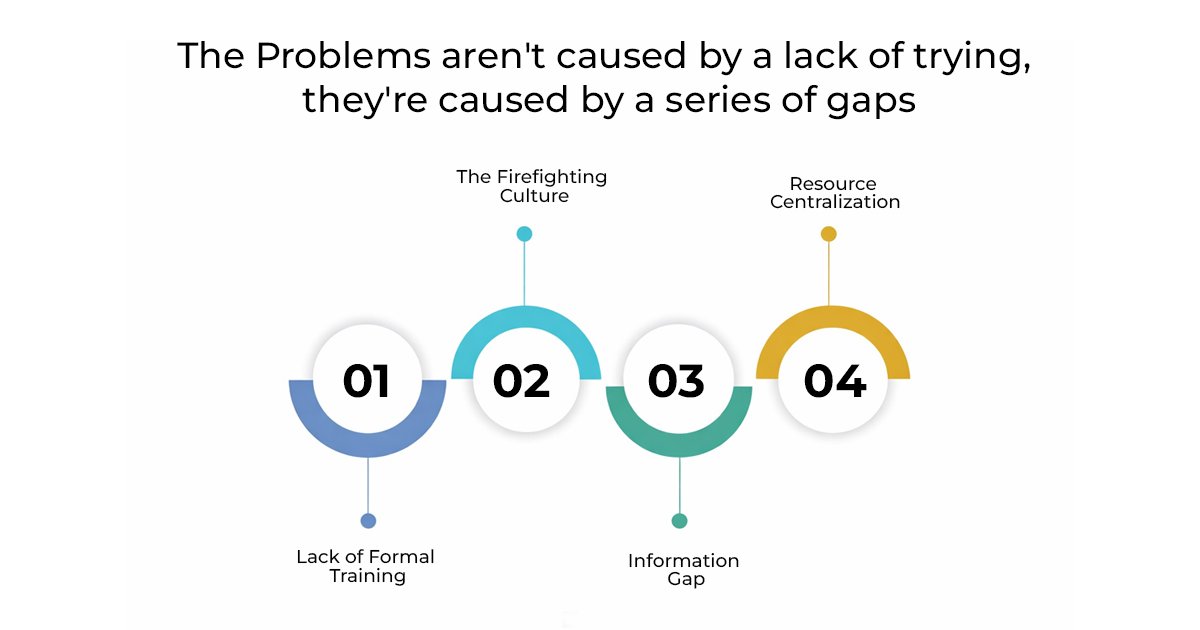
For most Indian SMEs, The problems aren’t caused by a lack of trying, they’re caused by a series of gaps:
- Lack of Formal Training: While the entrepreneur is a subject expert in the product they’re offering, they’ve never been formally taught the concept of Systems Thinking. Without a formal standard like ISO 9001 for small business, the quality is left to the memory of the staff rather than proper documentation.
- The Firefighting Culture: For a small business in the growth stage, the entrepreneur is too busy firefighting the problems that arise on a daily basis to think about the future or implement a Quality Management System (QMS) that will prevent these problems from arising in the first place.
- Information Gap: For most small business owners, ISO is all about thick manuals and expensive consultants because they’ve never seen a simple, digital solution to the problem.
- Resource Centralization: For most small businesses, all the technical expertise is confined to the minds of one or two key people in the company. This results in a decline in quality when these people leave the company. ISO 9001 for small business fixes this by decentralizing knowledge into standard operating procedures (SOPs).
Why You’re Losing Tenders: The ISO 9001 Gap
- Is ISO 9001 really mandatory?
- Is ISO 9001 for small business just going to add more paperwork for my already busy supervisors?
- We already maintain strict hygiene. Why do we need to certify now?
- Can we actually implement iso certification small company without stopping production for weeks?
- Will this actually bring in international clients?
Helpful Guide:- Top 10 Benefits of ISO 9001 Certification for Your Business
Who Can Apply? Eligibility for ISO 9001 for Small Business
To apply for iso certification, you simply need to meet these three foundational pillars:
- Legal Business Registration:
Your manufacturing unit must be a registered entity in India. You need to provide documents such as:
- Udyam (MSME) Registration (Highly recommended for small businesses)
- GST Registration Certificate
- Factory License/Trade License
- Defined Scope of Operations:
You need to be able to clearly explain what your business does. For manufacturing businesses, this is called your Scope. For example, Manufacturing and supply of precision automotive components.
- System Maturity:
You can’t apply for certification, the day you finish writing your SOPs. You need to have a minimum of 3 months of operation of your Quality Management System (QMS) to be eligible for the final audit. You need to prove to the auditors that you have:
- Records of production and quality checks.
- Evidence of at least one Internal Audit.
- Evidence of one Management Review Meeting (MRM).
>Helpful Guide:- Documents Required For ISO 9001 Certification: Complete Checklist India (2026)
ISO Benefits Small Business
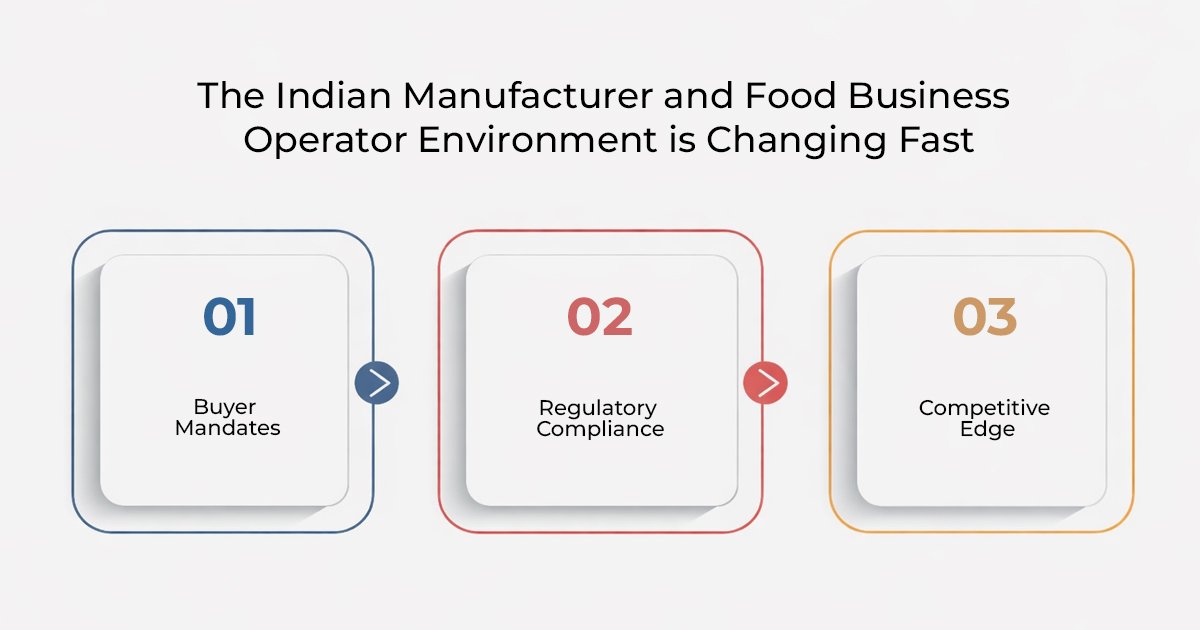
The Indian manufacturer and food business operator environment is changing fast. Not only must you produce goods or provide services, you must do so with quality and reliability.
Adopting ISO 9001 for small business is no longer just an option, it is a strategic necessity Some of the iso benefits small business are:
- Buyer Mandates: More and more, government contracts, large private sector contracts, and supply chains for large retailers require suppliers who are ISO 9001 certified. This is especially true for the iso in India export-oriented businesses, where international buyers are looking for certified suppliers.
- Regulatory Compliance: Though not always required by law, the adoption of the ISO 9001 standard for a Quality Management System (QMS) can help ensure regulatory compliance in the industry in which you operate, reducing the chances of penalties and fines.
- Competitive Edge: In a marketplace where competition is high, the adoption of the ISO 9001 standard can provide instant credibility for your business and differentiate you from the competition who have not obtained the standard.
Step by Step ISO 9001 Certification Process
Achieving ISO 9001 for small business can be a streamlined process with the right approach. Here’s how small companies get iso 9001 certification India:
- Get to Know ISO 9001 & Its Requirements: Start getting to know the ISO 9001:2015 standard, in particular the emphasis on a process approach and risk, based thinking. This will be the basis of your Quality Management System (QMS)and begin your process of iso registration.
- Gap Analysis: Carry out a baseline evaluation to spot the differences between your present methods and the ISO 9001 standards. This will help you prepare the changes you need.
- Documentation Development: Prepare the main QMS documents, such as:
- Quality Manual: Outlining the scope and objectives of your QMS.
- Quality Policy: A statement of your commitment to quality.
- Procedures: Detailed instructions for various processes (e.g., control of documents, internal audits, corrective actions).
- Work Instructions & Forms: Specific guides and templates for day-to-day tasks and record-keeping.
- Implementation: Use your written QMS. Here, you train your workers on the new methods, defining roles clearly, and keep proper records as proof of conformity.
- Internal Audit: Perform deep internal checks to make sure that your QMS is not only working well but also fulfilling ISO 9001 requirements. This is a self inspection tool to find and fix non, conformities before the external auditor arrives.
- Management Review: Senior management evaluates how the QMS is working and decides on the changes, allocation of resources, and policy changes.
- Select a Certification Body: Pick an officially recognized certification body (for example, in India, a body accredited by NABCB) to carry out the external audit.
- Stage 1 Audit (Document Review): The certification body will analyze your QMS documentation to verify if it aligns with the ISO 9001 standard requirements. Besides that, they will evaluate your preparation level for Stage 2.
- Stage 2 Audit (OnSite Assessment): The auditors go through your company location to assess the implementation and effectiveness of your QMS by conducting interviews, getting a glimpse of the running processes, and going through your records.
- Certification Grant: On the successful completion, your ISO 9001 certificate will be issued to you.
- Surveillance Audits: You can keep your certification effective with the help of annual surveillance audits performed by the certification body.
Key Points For Small Businesses Regarding ISO India
- Make changes one by one.
- Recognize ISO 9001 as a powerful tool for business improvement, not just a certificate to be displayed on the wall.
- Your commitment and participation are essential for a successful implementation.
- Your team members are the backbone of a successful implementation.
- Don’t be afraid to seek expert advice to make the journey easy and ensure a smooth certification process.
Conclusion
ISO 9001 is an investment for the future of your small business, securing your company’s place in the quality-focused world. This is not just a symbol for a young company; it is a shift from person based processes to system based processes. By embracing these global standards, you give your employees a guide to consistency, knowing that every product or service is of the highest caliber that your customers have come to expect from you.
>Helpful Guide:- ISO 9001 Certification Cost In India | Fees Breakdown & Expert Support
Ready to Get ISO Certified?
Free consultation · 4,500+ businesses certified · Pan India
FAQs
What are the iso 9001 certification for small business benefits india?
Certain advantages of iso certification include better access to the market, better operational efficiency, customer confidence, and a competitive advantage in the indian market.
How small companies get iso 9001 certification india?
Understand the SOPs, conduct a gap analysis, implement the changes, conduct internal audits, and then finally a certification body.
What are the iso certification requirements for startups india?
Startups have to develop their quality management system according to ISO 9001 principles and processes.
Why iso certification needed for a small business?
It is required for building credibility, accessing larger markets, standardizing business processes, showing commitment to quality, and meeting the growing needs of customers.
What are the key iso benefits company can expect?
Major benefits are lesser waste, greater productivity, quality service, and a robust structure for continuous improvement.
What is iso certification importance for businesses?
It is a sign of commitment to quality norms across the globe, generating confidence among stakeholders.
Is ISO 9001 certification too expensive for a small business in India?
Though there is a cost of investment, in the long term, the benefits of efficiency, access to markets, and reputation far outweigh the initial investment.