The ISO 9001 certification process is the internationally recognized standard for setting up an effective Quality Management System (QMS). Rooted in the ISO 9001:2015 standard, it emphasizes internal efficiency, risk management, and continual fulfillment of customer requirements.
Going through the ISO registration steps is really like changing your “informal habits” into written, well, functioning procedures. Besides that, if you are a new or established business, adhering to these ISO certification steps will result in your company not only earning international trust but also having a more sustainable operation and getting a leg up on competitors in worldwide markets.
Common Challenges for Indian Businesses
Indian Companies face several problems which pull down not only their growth but also the market they can get. Due to inconsistency in product quality, inefficiency in the getting work done and lack of written processes, there will be customer complaints, the resources will be wasted and the opportunities will pass. One cannot expand the operations without having a good quality management system (QMS). And only few will consider the company as the product can be entered in the supply chain worldwide. But one more thing that without the quality standard certificate it becomes almost impossible to win the bids or even to convince the prospective buyers about your reliability and commitment to excellence.
>Helpful Guide:- ISO 9001 Certification Cost In India | Fees Breakdown & Expert Support
Get Your ISO 9001 Certification — The Right Way
From document preparation and gap analysis to final audit support, our ISO 9001 certification experts help your business get certified faster, smoother, and without costly mistakes with legal4sure.
 Trusted by 500+ businesses across India | NABCB Accredited Consultants
Your Roadmap to Excellence: The ISO 9001 Certification Process Step-by-Step
It may feel intimidating at first when you decide to pursue ISO 9001 certification, but it is a well ordered process that eventually leads to operational excellence. The following are the essential ISO process steps that will assist you in the ISO registration process:
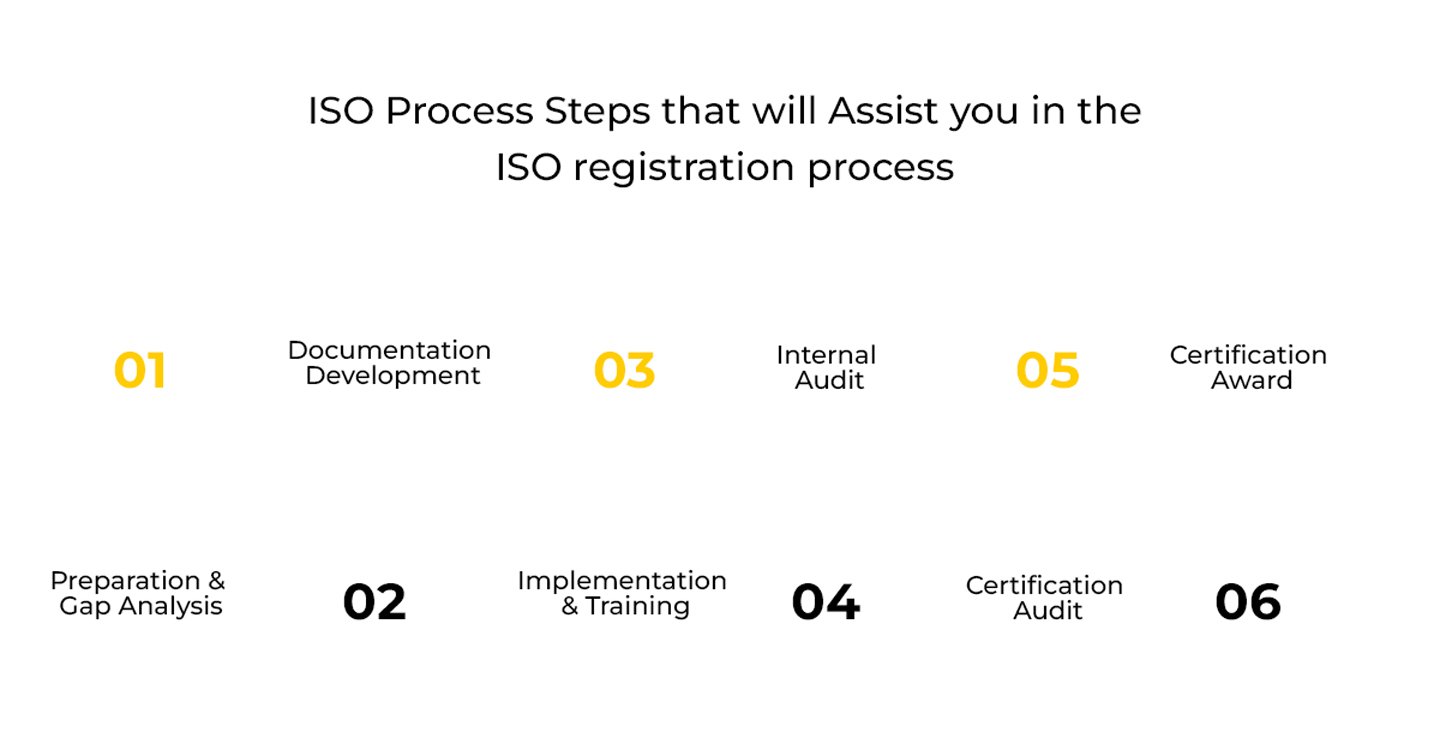
Step 1: Preparation & Gap Analysis
- Gap Analysis & Planning: Understanding the Standard: Get to know the ISO 9001:2015 standard and the requirements it entails.
- Current State Assessment: Perform a “Gap Analysis” to identify differences where your existing quality management practices either fall short or exceed ISO 9001 requirements. Make a list of the areas that require improvements or where new processes are needed.
- Scope Definition: Decide what parts of your organization will be covered by your QMS (i.e. particular products, services, or departments).
- Planning: Draw up a project plan, designate the persons responsible, and schedule the dates.
Step 2: Documentation Development
- Quality Manual: Prepare a Quality Manual describing your QMS and its compliance with ISO 9001 standards.
- Procedures: Write down the main procedures of your operational activities (e.g. production procurement sales quality control, corrective actions).
- Work Instructions & Forms: Create comprehensive work instructions and necessary forms/records to maintain uniformity.
Step 3: Implementation & Training
- Put QMS into Practice: Roll out the procedures that have been documented throughout your company.
- Employee Training: Make sure you educate all personnel involved on the new QMS, their tasks, and duties. Motivate them to comply by explaining the significance of adherence.
- Record Keeping: Start compiling detailed records as proof of your QMS implementation.
Step 4: Internal Audit
- Self Assessment: It is recommended that you perform the internal audit to check the degree of your QMS implementation and its compliance with ISO 9001 standards. In fact, it is one of the most crucial self checks before undergoing an external audit.
- Corrective Actions: You need to fix the nonconformities and/or potential areas for improvement you have noted during the internal audit.
Step 5: Management Review
- Leadership Oversight: It is the role of the top management to assess the QMS’s performance, appropriateness, and efficiency. This might entail the review of the audit findings, customer feedback, process performance, and opportunities for improvement.
Step 6: Certification Audit (by an external Certification Body)
- Stage 1 Audit (Document Review): A recognized external auditor goes through your QMS documentation to ensure it aligns with ISO 9001 standards. They will determine your readiness for Stage 2.
- Stage 2 Audit (On, site Assessment): The auditor comes to your location to check the impact of your implemented QMS through observations, interviews, and review of records. They will confirm that your processes are not only being followed but are also yielding the desired results.
- Non conformities: In the event of non conformities, you will be required to perform corrective actions within a given period.
Step 7: Certification Award
If you pass Stage 2 and after resolving any nonconformities, the ISO 9001 certification will be granted to you.
Unlocking Opportunities: Key Benefits of ISO 9001
Realizing the potential of ISO 9001 goes far beyond just a certificate. Here are some of the benefits you can enjoy:
- Publishing your dedication to quality will increase the faith of customers, partners, and other stakeholders in your organization.
- Standardization of the operations results in minimizing waste turning into a more productive and efficient approach.
- ISO 9001 certification will allow you entry to new markets, including international tenders and supply chains that require the certification. Besides, having it will set you apart from other competitors.
- Understanding of the employees and their performance is dramatically uplifted as they would have more fixed and clear roles, responsibilities and procedures.
>Helpful Guide:- How To Get ISO 9001 Certification 2026 – Easy Process & Trusted Experts
Key Takeaways
- The QMS implementation will hardly be successful if leadership is not actively involved.
- Make sure everyone knows not only their tasks but also why it is important to follow quality procedures.
- The main aim of ISO 9001 is to achieve a state of ongoing improvement, rather than merely obtaining a certificate the first time.
- A knowledgeable consultant can make a big difference in ensuring that the process is not only simplified but also compliant.
Frequently Asked Questions
What is the iso 9001 certification process step by step guide India?
The process comprises Gap Analysis Documentation Implementation, Internal Audit, Management Review, and ultimately, a two, stage Certification Audit by an external body.
What is the iso certification process and audit procedure India?
It starts with creating a QMS, conducting internal audits, followed by an external audit with Stage 1 and Stage 2 by an accredited certification body.
How to get iso 9001 certification easily?
Hiring a consultant who understands the standards well is the best way to make the process smooth.
What are the iso certification requirements?
Meeting ISO 9001 requires putting together a Quality Management System (QMS) which is based on seven quality management principles.
How long does the ISO 9001 certification process typically take for an Indian SME?
Usually, the whole process of gaining ISO 9001 certification can last anything from 3 to 6 months.
What documents needed iso?
You must maintain a Quality Policy, Quality Objectives, and a Scope of the QMS. Additionally, you need operational records like internal audit results, training logs, and corrective action reports.
Is there an iso checklist for preparation?
Yes. A standard iso checklist ensures you have conducted a gap analysis, completed a full internal audit, and held a management review meeting, before the final audit.