
The field of organic farming in India is expanding at an incredible speed, with customers and exporters requiring certified and reliable goods. And at the basis of certification is none other than organic certification in India, which confirms if the producer has met the organic standards set by authorities. Whatever may be your occupation as either a farmer, a food processor or a distributor, learning how to obtain an organic certification India will take you places.
In this guide, we will show you everything about the requirements, procedures, documents, costs, and certification authorities behind organic product certification in India.
What Is Organic Certification India and Why Does It Matter
An organic certification India is officially given to producers, processors, and traders who can prove that their products have been grown, handled, and processed according to certain standards of organic production. The main regulator of the process in India is the NPOP or National Programme for Organic Production that operates under the aegis of APEDA or the Agricultural and Processed Food Products Export Development Authority, which is a department of the Ministry of Commerce of the country.
For the producers, certification means access to the foreign market and higher prices. For the consumers, this will be a guarantee that their food is absolutely natural without any artificial pesticides or fertilizers or genetically modified ingredients. For the companies it will mean being trusted in today’s health-conscious society.
The Indian market also has the Participatory Guarantee System called PGS-India, that serves to provide small and marginal farmers with a tool to enter local markets without certification from independent certifying organizations.
Organic Certification Eligibility Criteria India: Who Needs It
Understanding the organic certification eligibility criteria in India will help you ascertain your suitability for the certification and which one best meets your needs.
Who Should Apply
- Individual farmers and agricultural businesses operating on lands that are managed organically
- Producer companies for farmers (FPOs) and farmer collectives
- Organic food processing, handling, packaging firms
- Organic products exporters
- Organic products traders and importers
If you’re a farmer marketing your produce as organic in any market, including retail, wholesale, online, or export markets, then you have to be certified by an agency recognized by the government. Trading un-certified goods as organic is illegal according to FSSAI laws.
Small farmers marketing their goods locally within their community and registered under the PGS-India system are exempted from going through the entire NPOP certification procedure but have to abide by the PGS criteria and documentation procedures.
Which Body Gives Organic Certification India
There are several recognized institutions in India that issue certifications of organic produce. These institutions are accredited by the National Accreditation Board (NAB), APEDA and have to adhere to strict standards for inspection and auditing.
The recognized certification organizations for organic certification in India are as follows:
- APOF Organic Certification Agency (AOCA)
- Bureau Veritas Certification India Pvt. Ltd.
- Control Union Certifications
- IMO Control Pvt. Ltd.
- Lacon Quality Certification Pvt. Ltd.
- OneCert Asia Agri Certification Pvt. Ltd.
- SGS India Pvt. Ltd.
The process of PGS certification is decentralized and conducted by local group councils. It is coordinated by the National Center of Organic and Natural Farming (NCONF).
Organic Certification Process Step by Step India
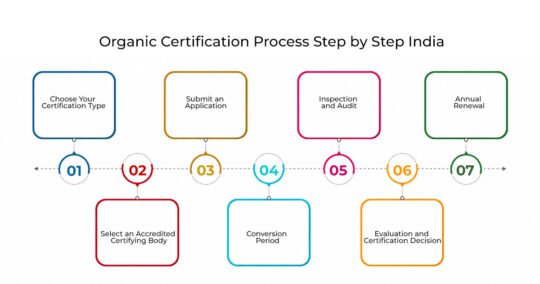
The steps involved in obtaining an organic certification India include many processes and normally take one to three years, depending on previous land use and preparedness of your documents.
Step 1: Choose Your Certification Type
Depending on whether you require NPOP certification for exporting or selling organically certified products in the domestic market or need PGS India certification for purely domestic trade within your community, you will determine the certification required and hence the certifying organization you will approach.
Step 2: Select an Accredited Certifying Body
Select an accredited certifying organization for organic products. Reach out to these organizations to familiarize yourself with their pricing structures, inspection dates, and requirements. The requirements vary with different organizations and thus comparisons are recommended.
Step 3: Submit an Application
Complete the application form provided by the certification body. The application form requires information related to your farm/operation, crop cultivated, acreage, and production process
The above information along with other documents (mentioned in the following step) must accompany the application form.
Step 4: Conversion Period
One of the most significant parts of learning how to get organic certification India is understanding that a mandatory conversion period needs to be undertaken before certifying any crop as organic. In order to obtain organic certification for crops, no prohibition substances such as synthetic fertilizers and pesticides can be used on the farm. According to NPOP, the conversion period ranges from 24 months for annual crops and 36 months for perennial crops.
Step 5: Inspection and Audit
Upon receipt of your application, an inspector from the certifying agency inspects your farm/facility with regard to soil condition, source of irrigation water, inputs used, record maintenance, storage, and conformance with the organic system plan. Inspections could either be announced or unannounced, occurring at least once every year.
Step 6: Evaluation and Certification Decision
Following the inspection, the inspector’s report and other relevant documents are evaluated. Provided that all requirements have been met, a certification decision will be issued to you. An organic certificate will be issued to you that lasts for one year, renewable on an annual basis.
Step 7: Annual Renewal
Certification of your farm as organic in India is not a one-off event but something that needs to be done on an annual basis.
Documents Required for Organic Certification India
Correct documentation plays an important part. The following are the most important documents needed for obtaining organic certification India:
- Proof of land ownership or lease
- A history of the last three years of your farm, including a list of all the inputs that you use
- Your Organic System Plan (OSP), a detailed document that describes your farming methods, including crop rotations, pest control, and soil fertility programs
- Farm map or sketch indicating the boundary, buffer areas, and water sources of the farm
- Test report for soil and water samples obtained from NABL-accredited laboratories
- Information about what kind of crops you grow and expected yields
- Relevant invoices for all the certified organic input materials that you have purchased
- Harvesting, handling, and sales records
- Details about the neighboring farms, along with their methods of farming (to determine buffer requirements)
- Identity proof of the farmer or his authorized representative
The following documents will be required by processors and handlers for obtaining organic product certification India:
Cost of Organic Certification India: What to Expect
Obtaining organic certification costs will depend on the organization certifying the farm as well as the size of the business and number of produce items for which certification is sought. The following table summarizes these costs:
| Expense Category | Price Range (INR) | Key Determining Factors |
|---|---|---|
| Application Fee | ₹2,000 – ₹10,000 | Choice of certifying agency (NPOP/NOP) |
| Inspection Fee | ₹10,000 – ₹50,000 | Farm size, location, and travel for inspectors |
| Certification Fee | ₹15,000 – ₹1,00,000+ | Annual renewal; scale of the operation |
| Laboratory Testing | ₹3,000 – ₹15,000 | Number of soil, water, and residue tests required |
Financial help from the government of India is provided to small and marginal farmers under schemes such as Paramparagat Krishi Vikas Yojana (PKVY) and Mission Organic Value Chain Development for North East Region (MOVCDNER). According to PKVY scheme, groups of farmers are entitled to get help amounting to Rs. 50,000 per hectare in three years, including the cost of certification.
It is comparatively much cheaper, being community-based and without the costs of third-party inspections.
Is Organic Certification Mandatory in India?
It really hinges on the circumstances involved. In case of export of organic crops, having one’s produce certified through NPOP or any international benchmarking equivalent becomes extremely important. When it comes to exports of organic produce from India, these need to conform to the standards set by the destination countries, be it the EU’s EC 834/2007, the USDA’s NOP or any other system that has equivalence with NPOP.
In the case of the domestic market, regulations from FSSAI mandate that all products carrying organic labels must necessarily be certified in accordance with the same. Any violation amounts to deception in addition to being against the provisions of the Indian food safety laws.
That said, an organic farmer who does not use labels such as ‘organic’ for his produce may not really have the need to certify the produce at all. But then, that would imply foregoing lucrative returns available in the form of certification.
Benefits of Organic Farming Certification India
Organic Farming Certification India not only meets compliance but provides practical advantages such as:
- International markets and premium pricing opportunities
- Government schemes and subsidies through organic farming schemes
- Increased consumer confidence
- Improved economics in the long run because of reduced input costs
- Soil health and sustainability
Key Takeaways
- Organic certification India is provided by NPOP (National Programme for Organic Production) for exports and PGS-India for domestic markets.
- Certification normally takes anywhere between 12 to 36 months and includes the conversion period of farms.
- Certification India organic farming can be applied by individual farmers or farmer organizations, processors, handlers, and exporters.
- Some important documentation required includes the land records, farm history, report on soil and water testing, and organic system plan.
- It is not necessary to undergo organic certification for every product sold domestically. However, organic certification becomes mandatory for those products that have the claim of being ‘organic’ in nature.
>Top Trending Guide:- Top Organic Certifying Agents in India and How to Choose
Frequently Asked Questions
How to get organic certification in India?
To get organic certification in India, choose an APEDA-accredited certifying body, complete the conversion period (usually 24–36 months), submit your application with required documents, and pass an on-site inspection. After approval, you receive a certificate that must be renewed annually.
What is the organic certification process step by step in India?
The process includes selecting certification type (NPOP or PGS), choosing a certifying body, submitting an application, completing the conversion period, undergoing inspection, receiving certification, and renewing it annually.
What documents are required for organic certification in India?
Required documents include land ownership records, 3-year farm history, Organic System Plan, soil and water test reports, farm map, input purchase records, and harvest and sales logs.
What is the organic certification eligibility criteria in India?
Eligibility includes individual farmers, farmer groups, FPOs, processors, handlers, and exporters involved in organic production, processing, or trade for domestic or export markets.
Is organic certification mandatory in India?
Yes, certification is mandatory for export and for products labeled as “organic” under FSSAI regulations. However, farmers selling without organic claims in local markets do not require certification.
Which body gives organic certification in India?
APEDA-accredited bodies such as Control Union, IMO Control, OneCert Asia, and Bureau Veritas issue NPOP certification, while PGS-India certification is managed through local group councils under NCONF.
How long does it take to get organic certification in India?
The process usually takes 12 to 36 months due to the required conversion period. After successful inspection, certification is typically granted within a few weeks.