
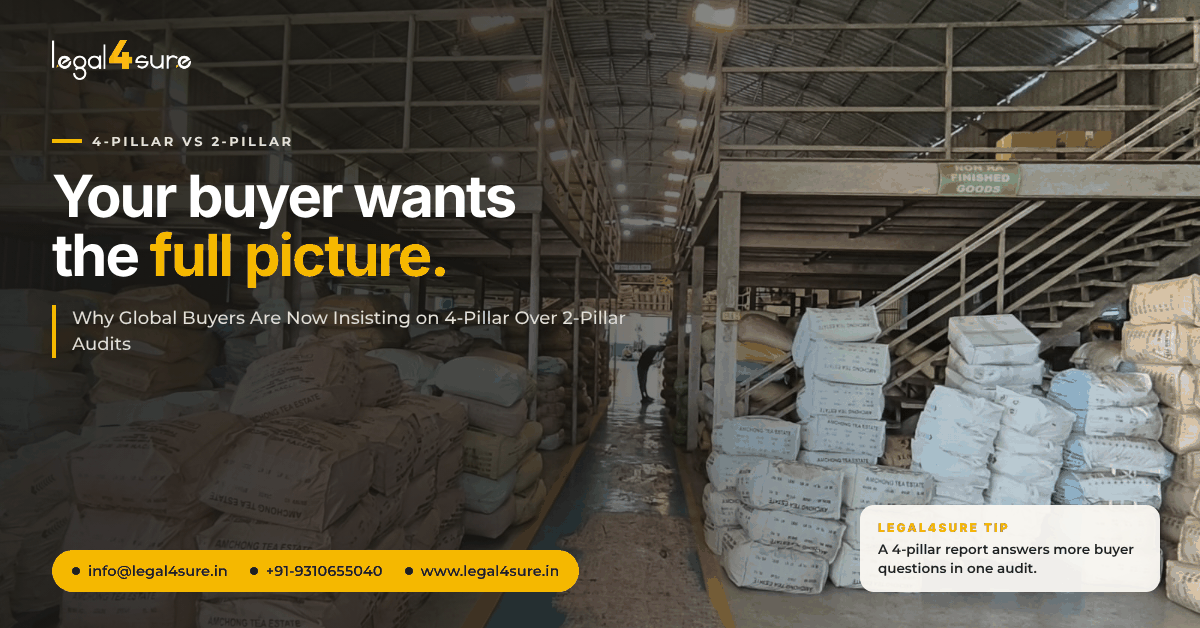
More and more global buyers are asking suppliers to complete a Sedex 4-Pillar Audit instead of a 2-Pillar Audit. The 4-Pillar Audit covers four areas: labour practices, health and safety, the environment, and business ethics. As ESG becomes more important and global supply chains face closer checks, buyers need a better understanding of the risks linked to their suppliers.
If the retailer or brand simply asks you to upgrade to 4-Pillar Audit from 2-Pillar, there is definitely a trend. Buyers in the apparel, food, packaging, and houseware industries tighten their requirements towards their suppliers.
In this article, we describe what the audit includes, what the difference is between 4-Pillar and 2-Pillar audits, buyer expectations, and the preparation process. We help suppliers pass this stage of their development with Legal4sure and that’s why we have included common mistakes.
What Is a Sedex 4-Pillar Audit?
Definition: Sedex 4-pillar audit refers to SMETA (Sedex Members Ethical Trade Audit) which looks into the following 4 aspects of audit – labour practice, health & safety, environment, and business ethics. The audit is based on ETI Base code and shared with the buyers through Sedex.
Sedex is a membership organization globally that assists companies with managing their responsible sourcing data. SMETA is the auditing methodology and according to industry sources, more than 60,000 organizations use this methodology.
The auditors use the ETI Base Code which covers issues like freely chosen employment, no child labour, living wages, safe working condition and many more. Only one audit report can be shared with different buyers.
Sedex 2-Pillar vs 4-Pillar Audit: What’s the Difference?
While a Sedex 2-Pillar audit assesses labor standards and health and safety, a 4-Pillar audit will involve environment and business ethics as well, thus offering buyers the total picture of social, environmental and integrity risk. However, both assessments use SMETA approach, while a 4-Pillar audit offers more depth.
Nevertheless, a 2-Pillar audit is far from shallow either, as it evaluates management systems, entitlement to work, subcontracting, homeworking and abbreviated environmental assessment.
| Aspect | 2-Pillar audit | 4-Pillar audit |
|---|---|---|
| Pillars covered | Labour standards; health and safety | Labour standards; health and safety; environment; business ethics |
| Environmental assessment | Shortened | Full assessment |
| Business ethics | Not assessed | Assessed |
| Typical buyer use | Entry-level or lower-risk suppliers | Strategic, higher-risk or long-term suppliers |
| Preparation effort | Moderate | Higher, with more documents and policies |
| What the buyer learns | Workplace conditions | Workplace, environmental and integrity risks |
Why Global Buyers Now Require a Sedex 4-Pillar Audit
Buyers aren’t adding paperwork for its own sake. Several pressures push them toward the wider audit.
- Due diligence pressure. In Europe and other regions, regulators require brands to assess human rights and environmental impact throughout their supply chains. Limited audit results in blind spots.
- ESG disclosure. The brands disclose information about their supply chains to the investors and consumers. ESG results become part of the reports.
- Environmental risk. Incorrect waste disposal, storage of effluents and chemicals can affect supply or cause penalties at a supplier’s facility.
- Exposure to corruption and fraud. Corruption, document falsification and covert subcontracting undermine a buyer’s brand even if it occurs several steps down the supply chain.
- One audit, many buyers. A comprehensive audit report published on Sedex saves buyers from carrying out numerous audits.
- SMETA 7.0. A new methodology that became mandatory since January 2025 included the Management System assessment as well as improved environmental and business ethics audits.
Sedex Buyer Requirements: What Retailers and Brands Typically Ask For
Requirements differ by buyer, so check your supplier manual first. Most follow a similar pattern:
- Profile of Sedex with the link to your website as per the buyer’s demand
- SMETA Audit conducted by the audit firm accredited by Sedex and not internal audit
- Type of audit as per the buyer’s demand, 2-Pillar audit or 4-Pillar audit
- Corrective Action Plan Report (CAPR) with all findings closed as per the agreed timeline
- Repeat audits as per the frequency of audits as per the buyer’s demand
Sedex 4-Pillar Requirements: What Auditors Check
Labour Standards
Audits will be carried out with regard to pay, hours of work, age verification, contracts, freedom of association, and grievances according to ETI Base Code.
Health and Safety
The health and safety audit will involve inspections concerning fire exits, machine guards, personal protective equipment (PPE), first aid facilities, chemicals, and living quarters (dormitories) if you have housing for your employees.
Environment
Environmental audit will include inspections for permits, waste and effluent management, emissions, water use, energy use, and hazardous substances management.
Business Ethics
Audits will cover anti-corruption measures, document integrity, sub-contractor issues, and handling of reports.
It is important to note that SMETA 7.0 has also added the Management Systems Audit which will be an audit for the implementation of policies. Therefore, it will not help just to have the policy in writing.
Sedex 4-Pillar Audit Requirements for Suppliers: Document Checklist
Most Indian suppliers should have these ready before the auditor arrives:
- Factory licensing
- PF and ESI registration, and licensing for contract labour, wherever applicable
- Attendance and payroll records
- Records of age verification and employment agreement
- Fire safety records and training records of fire drills and fire safety
- Consent to Operate license issued by the State Pollution Control Board and disposal records of waste
- Safety and worker’s rights training records
- Anti-corruption policy, code of conduct, and grievance policy and evidence of communication of such policies
- List of subcontractors and labor agencies
2-Pillar or 4-Pillar? A Simple Decision Framework
Ask your buyer first. If they haven’t specified, these pointers help.
Use a 4-pillars audit where:
- Your buyer mandates you to have one through their supplier manual
- You process any chemical, dyeing, plating or other activities that generate effluent
- You need a single audit report to meet more than one buyer’s requirements
- You wish to be a strategic and lasting supplier
You will use a 2-pillars audit where:
- Your buyer has accepted your audit
- You have minimal environmental impact
- It is your first audit
Example: How the Decision Plays Out
Imagine an audited dyeing and printing unit under 2-Pillar certification last year. This year, there is a request by a new European buyer for 4-Pillar certification. The unit is doing well on labor and safety documentation, but poor on effluent treatment log and lack of anti-bribery policy.
These two areas will definitely be mentioned as observations. It makes sense to sort out these problems before the audit, not afterwards, as to keep the CAPR brief and relations good.
Pros and Cons of a 4-Pillar Audit
Benefits
- Greater buyer confidence because of comprehensive risk assessment
- Single report used by multiple buyers
- Early identification of environmental and compliance risks
Drawbacks
- More paperwork and increased time to prepare
- Increased scope may reveal weaknesses that have not been identified before
- More auditing and consulting work than a 2-pillar audit
Supplier Mistakes in Audits
- Approaching it as paperwork rather than an entire operation audit
- Getting environmental permits only during the audit week
- No written policy on business ethics or anti-bribery policies
- Inconsistency between payroll and attendance
- Preparation of answers for workers’ interviews
- Failure to close out CAPR issues
How to Prepare for a Sedex 4-Pillar Audit
- Verify the type of audit. Inquire in writing from your buyer whether you require either a 2-Pillar or 4-Pillar audit.
- Perform a gap assessment. Evaluate your facility in comparison to ETI Base Code, environmental and business ethics requirements.
- Close the gaps. Start with safety risks, wage/hour violations and missing permits.
- Create your documentation folder. Gather all licenses, records, policies and training verification into one folder.
- Train your staff. Supervisors, managers and security personnel need to know what an auditor is looking for and why.
- Conduct a dry-run audit. A mock-audit helps you identify areas of improvement while there is still time to improve them.
- Close the CAPR and proceed. Think of CAPR as a starting point rather than an end in itself. Read our article on SMETA 7.0 continuous compliance.
What Happens on Audit Day?
The order can vary by auditor, but a SMETA audit usually follows this flow:
- Initial meeting for confirmation of the audit’s scope, schedule and contacts at the site
- Documentation review including payroll records, licenses, permits and policies
- On-site walk through of production facilities, storage, canteens and dormitories
- Confidential interviews of employees away from management
- Conclusion of audit where the auditor presents their results
The audit company then uploads the report and CAPR to Sedex, and your buyers can view them once you share access.
Do You Need a Sedex Consultant in India?
A Sedex Consultant in India will conduct the gap analysis, bridge the documentation gap and prepare your team before the audit commences. This is most beneficial when you are making a transition from 2-Pillars to 4-Pillars for the very first time.
Legal4sure collaborates with suppliers in conducting gap analysis, mock audits and CAPR closure. If you have a team that efficiently manages environmental and ethical compliance, you may conduct preparation yourself.
Key Takeaways
- The Sedex 4-Pillar audit involves labor, health & safety, environment, and business ethics, whereas a 2-Pillar audit entails only the former two pillars.
- The buyers need it due to the requirements of due diligence, ESG reporting, and enhanced risk visibility.
- SMETA 7.0 set new standards by incorporating the assessment of the management systems along with enhanced checks on environmental and ethical considerations.
- Payroll, licenses, environmental permissions, and ethics policies are the key documents that would determine the results of the audit.
- Make sure that you confirm the type of audit and conduct a gap analysis prior to the audit date.
Conclusion
The Sedex 4-Pillar audit has set the standard for buyers who want a single report on workers, safety, environment and integrity. The move from 2-Pillar is here to stay, and suppliers who get ready ahead of time will have less to fix and less repeat auditing.
First, find out from your buyer what audit they require, and then fill those gaps before the auditor does. Legal4sure can help you organize that process, step by step.
Meet Global Buyer Requirements with Sedex 4-Pillar
Prepare your business for Sedex 4-Pillar audits with Legal4Sure’s gap assessments, environmental and business ethics documentation, mock audits, and corrective action support. Strengthen compliance and build buyer confidence with a structured audit readiness plan.
Frequently Asked Questions
What is the difference between Sedex 2-Pillar and 4-Pillar audits?
The 2-Pillar audit includes labor and health & safety issues. The 4-Pillar audit includes environment and business ethics.
Why do buyers require a Sedex 4-Pillar audit?
They get all social, environmental and integrity risks into a single report to facilitate due diligence and ESG requirements.
What are the Sedex 4-Pillar audit requirements for suppliers?
Supplier requires a Sedex account, auditor approval, legal licenses, employee record, health & safety record, environment permits, and ethics policy.
Can you explain why global buyers require Sedex 4-Pillar audits for strategic suppliers?
Strategic suppliers have high risk and more branding and hence buyers demand better proof beyond the 2-Pillar audit.
Can I upgrade from a 2-Pillar to a 4-Pillar audit?
Yes. Inform the buyer and audit company at an early stage, because the expanded scope will need additional environment and business ethics evidence.
Does SMETA 7.0 change the 4-Pillar audit?
Yes. It included Management Systems assessment and enhanced environment and business ethics assessment.
Is a Sedex Consultant in India worth it?
For new and upgrading suppliers, yes. Gap analysis and mock audit will usually decrease audit findings.