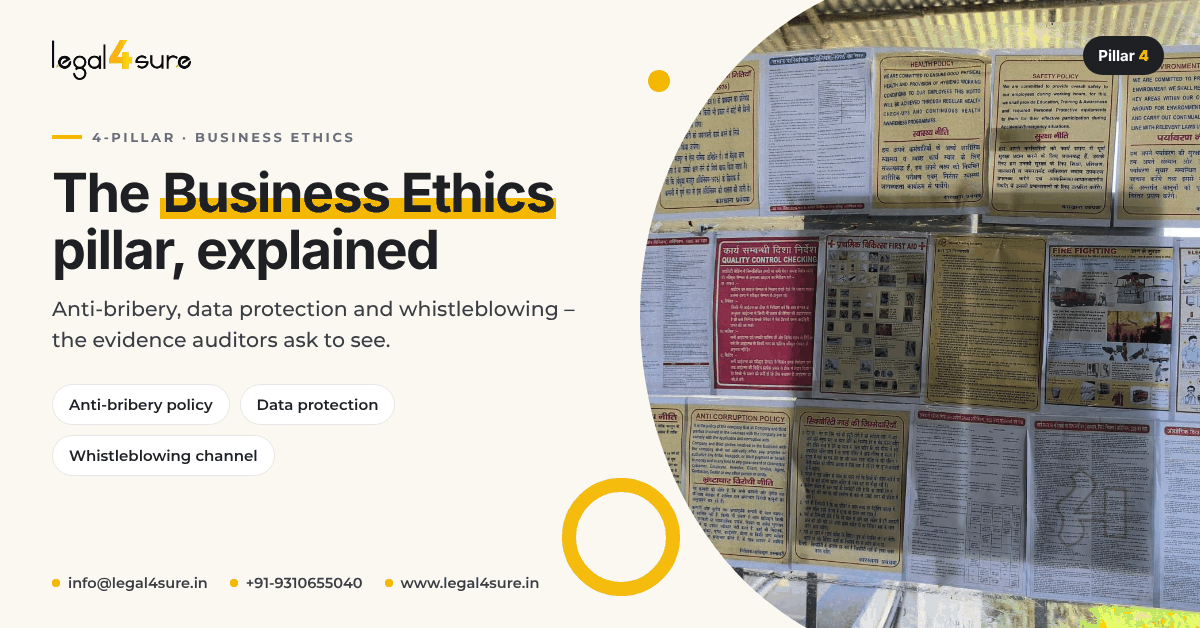
Most companies prepare well for the labour, health and safety, and environment sections of a Sedex audit. However, business ethics often gets little attention beyond a policy kept in a folder. Then the auditor asks the HR assistant what would happen if an employee reported a bribe, and nobody knows what to say.
Business ethics in the Sedex 4-Pillar SMETA audit is the section of the SMETA 4-Pillar audit process to evaluate the integrity of the site under assessment. In other words, there will be no bribery, responsible handling of personal information and safe whistle blowing. This guide explains what the auditor will be looking for and what documentation needs to be produced by the company, based on the audit readiness projects done by Legal4sure with the Indian manufacturers/exporters.
What Is the Business Ethics Pillar in a Sedex 4-Pillar Audit?
The pillar of business ethics in a Sedex 4-pillar audit assesses integrity risk management such as bribery and corruption, transparency, data protection, and whistleblower. The four pillars include labour standards, health and safety, and environment. The pillar is assessed by the auditor using documentation, site visit, and interviews of managers and staff members.
Quick Definition: In SMETA language, business ethics is evidence that the policies at your facility regarding integrity have been documented, communicated, and implemented.
A 2-Pillar audit covers labour standards and health and safety. The 4-Pillar version adds environment and business ethics, which is why many global buyers now ask for it. Here’s the difference at a glance.
| Aspect | 2-Pillar audit | 4-Pillar audit |
|---|---|---|
| Pillars covered | Labour standards, health and safety | Labour, health and safety, environment, business ethics |
| Ethics evidence reviewed | Not assessed as a pillar | Policies, registers, logs, training, interviews |
| Typical effort | Lower | Higher, with more documents and more interview topics |
People often search for “Sedex Certification,” but SMETA is an audit methodology and Sedex is the platform where you share the report.
Sedex Business Ethics Requirements: What Auditors Check
Exact wording shifts between SMETA versions and buyer expectations, so always check the current SMETA Best Practice Guidance. In practice, auditors work through the same core areas:
- Business ethics policy that has been adopted by management and communicated to employees
- Controls for anti-bribery and anti-corruption, including gifts and hospitality
- Proper bookkeeping without parallel bookkeeping for salaries and production
- Personal data protection of employees and other people
- A reliable whistleblower channel and a reliable process
- Training and communication to raise awareness of policies
The auditor isn’t hunting for a perfect document set. They want to see that what’s written matches what people say and do on the floor.
Anti-Bribery Sedex Audit: Evidence Auditors Want
A Sedex anti-bribery audit poses only one question: is your facility able to demonstrate that you do not offer, make or accept bribes? A policy does not answer this question. The auditors expect controls and evidence that this policy works.
Commitment to policy and management
A written policy for your organization needs to include prohibited behavior such as facilitation payments. It must cover employees, contract labor and agents, and contain signatures from a senior manager and the date of the review.
Gift and hospitality log
The auditor may require evidence of how your firm manages gifts from buyers, suppliers or inspectors. This can be accomplished using a simple log that records date, donor, value and authorization. The lack of a log when there is heavy activity in an exporting company will pose some serious questions.
Third party and officials
The potential for bribery exists with customs brokers, freight forwarders, liaison agents and license consultants. Maintain basic due diligence for each and have an anti-bribery clause in the contract/purchase terms.
Evidence checklist
- Anti-Bribery signed policy
- Gifts and hospitality registry with approvals
- List of third parties with risk assessments and signed commitment letters
- Training attendance register and test/feedback forms
- Past incidents, investigations, and results (if any)
Such behaviors as trying to bribe an auditor or falsification are taken quite seriously by Sedex. For more information about Sedex zero tolerance issues, please see our article.
Data Protection Sedex Audit: What Counts as Evidence
When undertaking the Sedex data protection audit, the auditor will examine whether the site is collecting only what data is necessary, storing this data in a secure manner, and limiting access to it. This becomes important for worker information, biometrics for attendance purposes, CCTV and recruitment process records.
India introduced its own law on that matter – Digital Personal Data Protection Act, 2023. A treatise on legal issues may not be necessary, but basic considerations must be taken into account.
What auditors usually look at
- Privacy Policy for Worker Data
- Simple listing of the type of information collected – photocopies of identification documents, financial information, health information, biometric information
- Locked filing cabinets or systems access for employees based on their roles
- Data retention policies to make sure outdated records are not stored indefinitely
- Worker’s knowledge of how their data is being used through notifications or consent forms
A typical weakness
Sites may be locked to the HR department but keep identification copies in the security station or in a common computer. The auditors will know. Conduct a tour of the facility the same way as the auditors will and see where employee documents are located.
Requirements for Whistleblowing in Sedex Audits
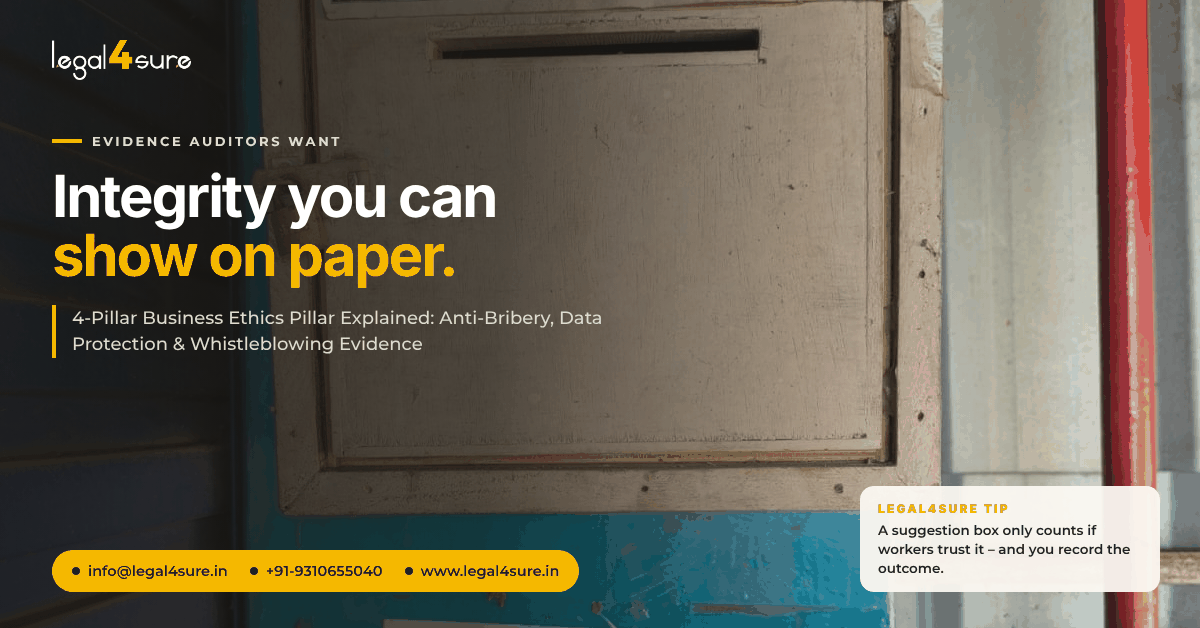
Whistleblowing in Sedex means three things: whistleblowing channel, protection from retribution, and evidence of the investigation of complaints. If workers do not know about the whistleblowing channel, the auditor will learn that through interviews.
What a working whistleblowing system looks like
- Explanation of how to make a report, including confidentially
- A means of making complaints that is not through direct supervisors, for example, through a locked box or hot line
- A no-reprisals policy, displayed in local languages
- A record kept of all complaints made, who reviewed them, and what action was taken
- Regular communications to the workers about the existence of the system
Make workers aware, not just compliant
Hold short toolbox talks in the local language and show them the channel for reporting concerns. When auditors ask two or three employees how they would report a concern, consistent answers are very convincing.
A complaint box without anyone who can open it and without any record is one of the least convincing evidence an auditor finds. Even a small and honest log of three or four complaints is better than an immaculate book.
Documents Required for Sedex Business Ethics Audit
These are the documents required for a Sedex business ethics audit. Keep them in one folder, with the latest versions, so you aren’t hunting for them on audit day.
| Document | What it proves | Usual owner |
|---|---|---|
| Business ethics and anti-bribery policy | Management commitment and scope | Top management |
| Gifts and hospitality register | Controls on giving and receiving | HR or compliance |
| Third-party due diligence file | Risk managed beyond your own staff | Purchase or compliance |
| Training records | People know the rules | HR |
| Data protection policy and inventory | You know what personal data you hold | HR or IT |
| Access control records | Personnel data is restricted | HR or IT |
| Whistleblowing procedure and log | Concerns can be raised and acted on | HR or worker committee |
| Investigation and disciplinary records | Follow-through exists | HR |
| Management review minutes | Ethics is reviewed at leadership level | Top management |
Sedex 4-Pillar Business Ethics Audit Requirements and Evidence: How Auditors Test Them
They don’t just stick to the paperwork. They compare three things: what’s on paper, what they see, and what they hear. If they’re all the same, you’re off the hook. But if not, then the difference is the finding.
- Paperwork check – policies, register, logs and training sheets
- Observation of site – notices posted, locked cabinets, visible channels
- Interviews – managers and staff members tell the policy in their own words
That’s why the question is always not only “Do you have a policy?” but “Does your gate guard know what he should do when a visitor offers him money?” Often, short refreshers do that better than creating a document.
Common Mistakes That Cause Findings
- Policy documentation based on templates without the names of sites, date and signature
- Register available without entries for any period
- Whistleblower facilities that workers cannot mention during the interviews
- Worker information stored in different places such as offices, cabin rooms and even personal cellphones
- Not considering the agents and brokers while calculating the risks associated with bribery
- Preparation of documentation a week prior to the audit and doing nothing else
Who Needs a 4-Pillar Ethics Review, and When It Can Wait
Not every supplier needs the full 4-Pillar scope today. The choice usually comes from your buyer, not from Sedex.
- Use 4-Pillar if the buyer, retailer, or brand asks for it or if you operate in a market that has regulated ethical sourcing requirements.
- Use 4-Pillar if you are using any third-party, such as agents, brokers, or subcontractors, because of the high risks of bribery.
- If buyers just require labor and safety audits and don’t ask for upgrades, then a 2-Pillar audit may suffice.
Ask your buyer in writing which scope they accept. That one email can save you a costly re-audit later.
A Simple Readiness Framework
Start six to eight weeks before your audit if you can. Here’s a workable order:
- Check gaps in relation to pillars’ core competencies
- Formulate and implement policies, assigning policy owners and signatures
- Kick off the registration and logging process for historical record purposes
- Train management, security, and HR on how to act and respond
- Carry out a simulation walk-through and conduct mock interviews
- Address any gaps and file all information in one document folder
If you’d rather not do this alone, a Sedex audit consultant can run the gap check and mock interviews. That’s the kind of support Legal4sure offers suppliers preparing for a first 4-Pillar audit.
Key Takeaways
- The Sedex 4-Pillar business ethics test assesses integrity in practice, rather than in theory alone.
- There should be a signed anti-bribery policy, a gift registry and third party checks for evidence of anti-bribery.
- For data protection there is a requirement to understand personal data that is held and restrict access.
- Evidence of whistleblowing includes a reporting channel, no retaliation, and documentation.
- The auditor looks at documentation, inspection of the site and interviews, so they have to be consistent.
Conclusion
The Sedex 4-Pillar ethics module rewards those businesses that behave responsibly on a daily basis and can prove it. Start building the case early on, prepare your interviewees for their questioning, and conduct a walkthrough of your facility as a proper auditor would. If you do all of that, the ethics module is no longer a mystery.
Prepare Your Business for Sedex 4-Pillar Audit Requirements
Strengthen your business ethics compliance with Legal4Sure’s Sedex audit readiness support. Get help with anti-bribery policies, data protection documentation, whistleblowing procedures, gap assessments, mock audits, and corrective actions to build buyer confidence and prepare for your SMETA 4-Pillar audit.
Frequently Asked Questions
What is the business ethics pillar in a Sedex 4-Pillar audit?
It involves checking controls on bribery, transparency, data protection, and whistleblowing in your site, which are done using documents, observations, and interviews.
What evidence is required for the Sedex 4-Pillar business ethics pillar?
The evidence should include signed policies, registers, training evidence, a whistleblowing register and evidence of workers’ understanding of the same.
What are the documents required for Sedex business ethics audit?
The main ones are ethics policy, gifts register, third party document, data protection policy, training evidence, and whistleblowing procedure including the register.
What are Sedex 4-Pillar business ethics audit requirements and evidence?
It includes written controls, evidence of their implementation and consistency in answers from management and employees.
Do Sedex business ethics requirements include data protection?
Yes. It covers collection, storage, access and retention of data relating to your workers but with different wording depending on SMETA version.
Does a whistleblowing box satisfy Sedex whistleblowing requirements?
No. Non-retaliation, investigative process, log of investigations and worker awareness are included too.
Can a supplier fail on anti-bribery in a Sedex audit?
Sedex audits report findings and don’t pass or fail, but bribery issues can create serious findings buyers will act on.