
An email comes in from the buyer requesting a “Sedex certificate.” You look for such a thing and come up with absolutely nothing, because there is no such thing as a Sedex certificate. It is this disconnect that leads to greater misunderstandings of Sedex and ethical sourcing than anything else in this process. The Sedex audit Complete Guide explains all: what Sedex is, what SMETA is, the audit process itself, and why you will not get a certificate at the end.
A Sedex audit is a form of social compliance audit that is almost exclusively carried out following the SMETA approach. It assesses the labour practices and health & safety aspects of a company, and occasionally environmental and ethical considerations as well. The results are included in an audit report, which is made available to the purchasing party via the Sedex system.
This very situation arises at Legal4sure when dealing with manufacturers and exporters in respect of inclusion into the retailer’s or brand’s supplier programme. The short story: Sedex – the platform; SMETA – the audit procedure; buyer – the one who determines what the outcome means. Here is how everything else follows.
What Is a Sedex Audit and How Does SMETA Work?
SMETA is known as Sedex Members Ethical Trade Audit, and it is a methodology, implying that it is a process that you use to conduct and document an ethical audit. The audit uses an internationally accepted format; hence approved audit firms all over the world use the same format, allowing buyers to compare audit reports from different locations around the world without the need for translation.
Your site is assessed according to the ETI Base Code which is based on conventions of the International Labor Organization and also the legal requirements of the countries you operate within. In India, this includes Factories Act, minimum wage law, and provident fund/ESI contributions.
The Four Pillars of the SMETA Methodology
- Labour practices: freedom to choose employment, freedom of association, absence of child labor, fair wages, reasonable working hours, no discrimination, regular employment, and no undue pressure.
- Occupational safety and health: fire prevention, machine safeguarding, first aid provisions, chemical safety and handling, and canteen/dormitory management.
- Environmental practices: waste management, emissions, water usage, and environmental licenses.
- Business ethics: bribery, accounting accuracy, and transparency in subcontracting.
A 2-pillar audit covers the first two. A 4-pillar audit covers all four. Your buyer decides which applies, and a growing number now ask for the wider scope.
What Auditors Do On Site
- Examine documents like payrolls, attendance slips, agreements, and age documentation.
- Inspection of the factory floor, stores, fire exits, canteen, and workers’ accommodations.
- Interview the workers privately, along with a separate interview with management.
- Closing session where findings are shared before report writing is finalized.
Audit length depends mostly on workforce size. A small unit might need one auditor-day; a large factory can need several.
Sedex vs SMETA: Understanding the Difference
Sedex is a not-for-profit membership organization with a website for exchanging supply chain information. SMETA is the audit protocol that members follow to evaluate a location. Sedex is the place where the outcomes reside; SMETA is the tool used to gather them.
- Sedex: formed in the United Kingdom in 2004, owns the platform, and does not do audits themselves.
- SMETA: audit method and reporting criteria done by an approved third-party auditor.
Think of Sedex as the filing cabinet and SMETA as the inspection form. The cabinet doesn’t judge what’s inside it. Your buyer does.
Sedex Membership: What It Is and Who Needs It
The Sedex membership requires annual fees to allow a firm to be a member of the Sedex database. In the process, they conduct their own assessment questionnaire, enter site data, and exchange audit reports with customers. Suppliers belong to B level while buyers to A level membership.
What You Get as a Supplier Member
- Site profile and Self-Assessment Questionnaire (SAQ).
- The capacity to post and share SMETA audit reports and any action plans.
- Risk assessment systems such as Sedex Radar.
- Receiving invitations from buyers to perform one audit for many companies.
Membership Is Not Audit Approval
The fact that you have joined does not imply that you have been reviewed or accepted. The membership fees go directly to Sedex and will differ depending on your category of membership and size of the company. The audit fees will go directly to your selected auditing firm.
Why SMETA Is Not a Certification
This means that SMETA does not have a certification since there is no accreditation authority or pass or fail for that matter. The auditor documents the findings and uploads them on Sedex and it is up to the buyer to determine if they are adequate.
This is how you could misunderstand Sedex Certification search. While it is used extensively, it is a misnomer since it is a process rather than a certification process. Let’s see the difference between Sedex Certification and Certification.
| Feature | SMETA / Sedex audit | Certification (ISO 9001, FSSC 22000, BRCGS) |
|---|---|---|
| Purpose | Share ethical trade data with buyers | Prove conformity to a defined standard |
| Who issues the result | Audit report from an approved audit firm | Certificate from an accredited certification body |
| Outcome | Findings plus a corrective action plan | Certificate after a successful audit |
| Pass or fail | No | Yes |
| Who judges the result | Your buyer | The certification body |
| Validity | No certificate; buyers set how recent a report must be | Fixed cycle with surveillance or recertification audits |
| Marketing claim | Shouldn’t be described as “certified” | Certification mark allowed under scheme rules |
Common Mistakes With the Word “Certified”
- Putting “Sedex certified” in your website or brochure.
- Asking the auditor for a certificate at the end of the audit.
- Thinking that having no non-conformances means you passed.
- Seeing membership as certification.
SMETA Audit Process: Step by Step
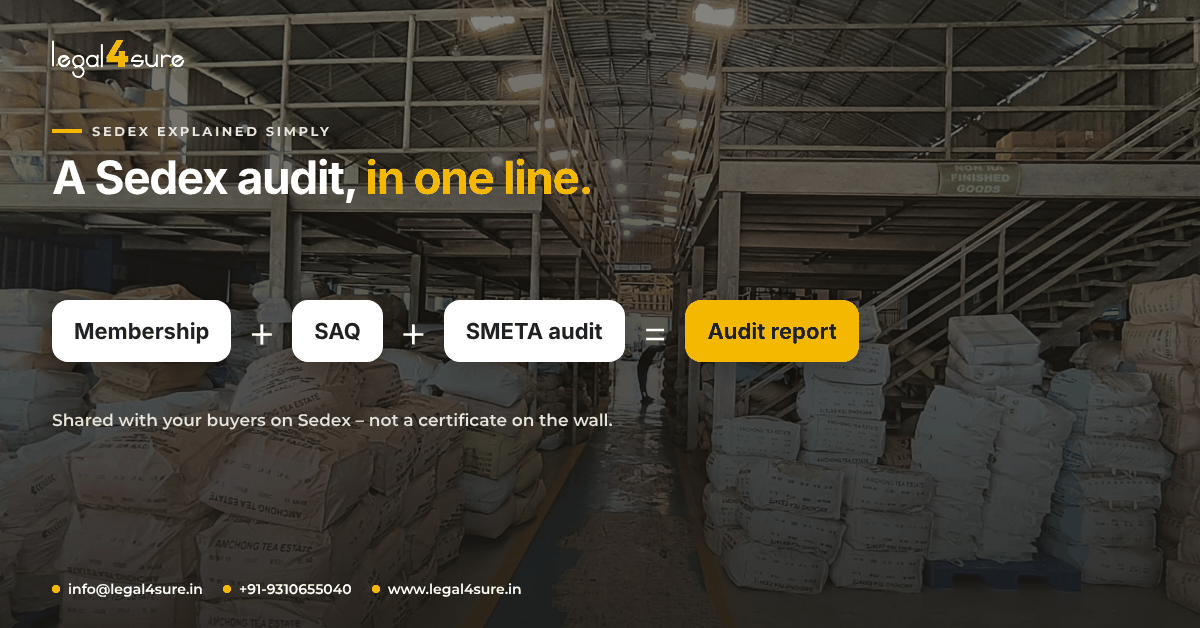
There are six steps to carrying out the SMETA audit process: join Sedex, undertake self-assessment, scope out the audit with your buyer, appoint the approved auditor, carry out the on-site audit, and finally, conclude the corrective action process. The schedule largely depends on the readiness of your documentation.
- Join the Sedex as a supplier member and register your organization and facility on Sedex.
- Fill out the Self-Assessment Questionnaire to give the auditor some context at the beginning.
- Find out from the customer if your organization requires a 2-Pillar Audit or 4-Pillar Audit.
- Book the Approved Affiliate Audit Company and set dates.
- Undergo the pre-audit, site visit, documentation, and worker interview processes.
- Receive the audit report and CAPR (Corrective Action Plan Report).
Announced, Semi-Announced and Unannounced Audits
- Announced: date is known beforehand by agreement with your site.
- Semi-announced: auditor provides a fixed period but not the actual date.
- Unannounced: no notice at all is provided to your site.
How Findings Are Graded
The non-conformances can be categorized as critical, major or minor, while at times there are observations or good practices. Some of the critical non-conformances include child labor and forced labor. Each non-conformance must be recorded in the CAPR along with the appropriate action plan and timeline.
Documents and Records to Prepare
- Statutory Licences & Registrations: Factory license, Fire Clearance, and Consent to Operate.
- Payroll, Attendance, and Overtime records for last 12 months.
- Proof of age and employment contract for all employees.
- Proof of Provident Fund, ESI, and Bonus Payment.
- Risk assessment, Safety Training and Fire Drill Records.
- Policies related to discrimination, Grievance Procedure, Disciplinary Action, and Subcontractor Management.
- Permits and Waste Disposal record for 4 Pillars Audit.
Auditors cross-check what they read against what workers say. If payroll shows eight-hour days and interviews describe twelve, expect a finding.
Is a Sedex Audit Right for You? Pros, Cons and When to Skip It
When It Makes Sense
- You cater to UK or European retailers or clothing and food brands that have Sedex programs.
- You have several clients that demand the same information on ethics, and you would prefer conducting one audit for multiple uses.
Pros and Cons
- Advantage: the same report can be shared by several interconnected buyers.
- Advantage: it is well-recognized, which means reports can easily be understood by buyers.
- Disadvantage: there is no certification; just a report.
- Disadvantage: the decision to accept depends on each individual buyer, and the audit is repeated at your own expense.
When to Skip It
If your buyer requires amfori BSCI, SA8000, or another scheme, a SMETA report may not count. Ask in writing before you book anything.
Practical Tips Before Your First Audit
- Fill statutory loopholes first, as non-compliance with the law is the most common basis for violations.
- Conduct a mock audit internally using a checklist.
- Educate your managers to respond to interview questions in truth and never train their employees.
- Store documentation in one organized file, not spread out across various departments.
- Get confirmation from your buyer in writing on the scope, pillars, and nature of the audit.
Key Takeaways
- Sedex is a membership system; SMETA is the audit technique that powers it.
- There is a report and a corrective action plan but no certification from a Sedex audit.
- It is the decision of your buyer whether you meet their needs, so check their requirements first.
- The 4-pillar audit includes labor standards, health & safety, environment and business ethics.
- Good documentation and truthful worker testimonies will get your audit further than any last minute fixes.
Conclusion
The Sedex Audit Complete Guide can be boiled down to just one thing. Sedex is the platform to share ethical information, SMETA is the process to gather it, and none of them gives you any certificate. What they give you is a reliable report.
Are you getting prepared for your first audit or shifting from a 2-pillar system to 4-pillar? Contact Legal4sure and we will get your documents, policies, and staff ready for your auditor.
Prepare for Your SMETA Audit with Confidence
Understand Sedex membership, the SMETA audit process, and the difference between Sedex and SMETA. Legal4Sure supports your business with compliance gap analysis, SAQ preparation, documentation reviews, audit readiness, and corrective action planning—helping manufacturers and exporters prepare for buyer requirements.
Frequently Asked Questions
What is a Sedex audit and how does SMETA work?
It is an ethics trade audit by a certified auditor via SMETA, which includes records review, facility walk-through, and employee interview, with outcome reported on Sedex.
Why is SMETA not a certification, and what do you get instead?
There is no certificate or pass/fail outcome given. Report and corrective action plans are provided and evaluated by your buyer.
What is the difference between Sedex and SMETA?
Sedex is the membership-based platform for supply chain information exchange. SMETA is an audit approach used to produce the information.
Is SMETA a certification or an audit?
SMETA is an audit approach. No certificate is provided, just a report and findings, along with agreed corrective actions.
Do I need Sedex membership before a SMETA audit?
Yes. Your facility needs to be registered on Sedex so that the report can be uploaded and shared with buyers.
How much does a SMETA audit cost?
It depends on workforce size, scope and auditor traveling. Sedex membership dues are charged separately.
How long is a SMETA audit report valid?
There is no validity period. The buyer expects a new audit once a year or two, depending on risks.