
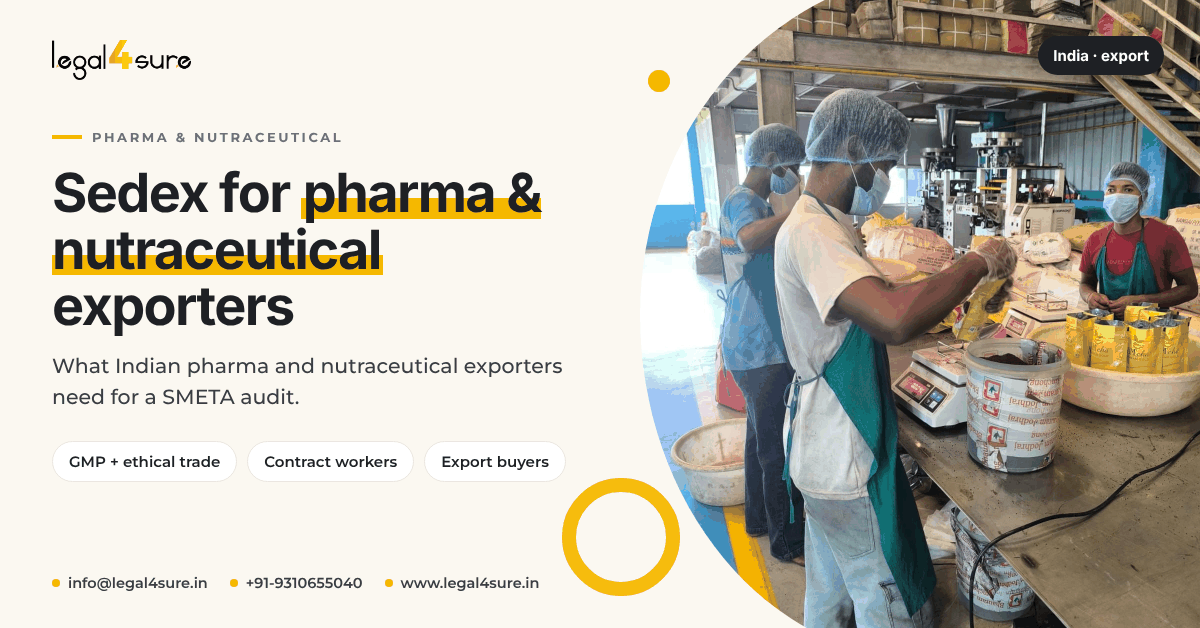
When a client emails an Indian pharmaceutical exporter saying, “Please share your Sedex audit report,” one of the first things the company may search for on Google is “Sedex Certification for Pharma.” However, this search phrase is not entirely accurate because Sedex does not issue certifications. It is a platform used to share supply chain and ethical business information. The audit itself is called SMETA.
This nuance becomes important in regard to pharmaceutical formulators, API manufacturers and nutraceutical manufacturers. These companies usually have WHO-GMP, ISO 9001 or FSSC 22000 certifications, believing that they fully satisfy the buyer’s request. This is not so because these standards audit product quality and safety. A Sedex audit audits people producing the product.
This issue came up during our first conversation about Sedex at Legal4sure. This article will discuss what the audit includes, who really needs it, and how to prepare for it without an emergency.
What Is Sedex Certification for Pharma?
Short answer: Sedex Certification for pharmaceuticals is a Social Audit of the SMETA kind that is done at the manufacturing site of the company producing pharmaceuticals or nutraceuticals and then shared via the Sedex platform with its buyers. Sedex is not an auditing organization and, hence, no certificate is issued and there should be no need for a “pass” or “fail”.
Sedex is a platform for members who upload information about their sites and share the audit findings with their buyers. The SMETA, or Sedex Members Ethical Trade Audit, is the standard followed by the auditors. SMETA 7.0 is the latest version which has incorporated Management System Assessment and a new Finding type called Collaborative Action Required which means issues that cannot be addressed by a particular site.
The audit is based on ETI Base Code which is based on ILO conventions. The audit can only be done by independent auditors approved by Affiliate Audit Companies. Remember that consultants cannot audit your company.
| Aspect | WHO-GMP / ISO / FSSC 22000 | Sedex SMETA audit |
|---|---|---|
| Focus | Product quality, safety and process control | Workers’ rights, health and safety, environment, business ethics |
| Outcome | Certificate issued by a certification body | Audit report, findings and corrective action plan; no pass or fail |
| Usually requested by | Regulators and quality teams | Procurement, sourcing and sustainability teams |
| Evidence needed | Batch records, validation, SOPs | Payroll, attendance, contracts, safety and permit records |
Is Sedex Certification Required for Pharmaceutical Exporters
Short answer: There is no statutory obligation anywhere in India or any of the importing nations to have Sedex. It is a commercial need. If your buyer’s purchasing policy requires SMETA Audit, you will have to have it to retain the account. If nobody has requested yet, you can go ahead without it.
In reality, such a request comes from the procurement or ESG teams, and not regulatory affairs. This is why such a requirement surprises quality heads. Common reasons could be:
- European/US brand has included your facility into their ethical sourcing program
- Your products are nutraceuticals/supplements for a retail/private label brand
- A tender or vendor onboarding form calls for social compliance audit
- Buyer requires supply chain due diligence as part of its own reporting requirements to stakeholders
Can you delay if you haven’t got any request yet? Yes, there is no urgency for a purely domestic company. However, once you get a request, you would likely see more coming soon. It is easier to prepare one report than to do multiple audits.
Sedex Audit for Pharmaceutical Companies: What Auditors Actually Check
A SMETA audit always covers labour standards and health and safety. The 4-pillar version adds environment and business ethics. Buyers decide which version they want, so confirm it before you book anything.
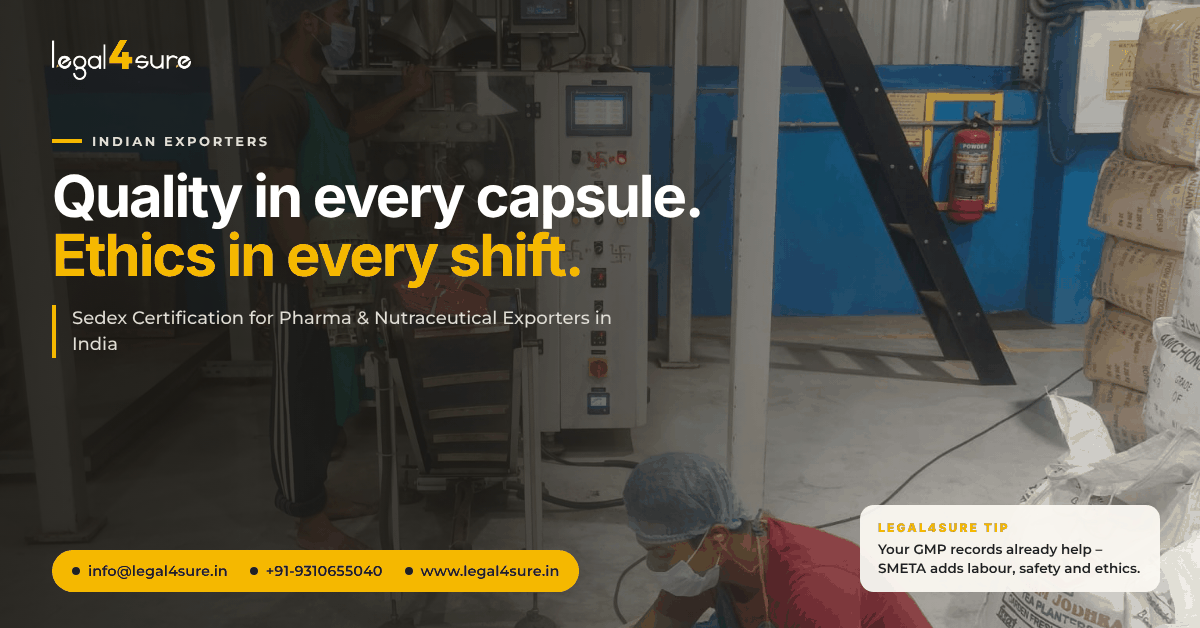
Where pharma sites get tested
- Working hours and overtime: working hours and shift systems may cause excess hours
- Contract and agency labor: salary, contracts and PF/ESI of workers employed via contractors
- Chemical and solvent safety: proper storage, personal protective equipment, emergency shower facilities and training
- Waste water and waste: effluent treatment and management of dangerous waste with pollution control approval
- Young employees, trainees and interns: age checks and restrictions on hazardous activities
- Grievance and ethics: mechanisms to handle grievances, anti-bribery policy and good accounting
What is not included in the checklist? Batch records and validation procedures. Auditing doesn’t mean judging your drugs’ quality. However, a GMP compliant facility normally has an easy time with the paperwork part of SMETA.
SMETA Audit for Pharma Exporters: Step-by-Step Process
- Join Sedex as a Supplier and pick the appropriate membership level.
- Take the Self-Assessment Questionnaire (SAQ) that describes your site, staff and policies.
- Define scope with your buyer: 2 pillars or 4 pillars, announced or unannounced.
- Schedule an independent auditor via an approved Affiliate Audit Company.
- Do a gap analysis of documents, policies and site conditions.
- Conduct the audit: opening session, documents verification, site visit, worker interviews, closing session.
- Submit your Corrective Action Plan Report (CAPR) and close findings with proof.
- Send your audit report to your connected buyers on the platform.
Serious violations like forced labor or child labor should not go through the regular procedure and can be reported directly to the buyer. Study our article about what triggers the de-listing by buyers.
Sedex Audit for Nutraceutical Companies: What’s Different
Nutraceutical production lines differ from those in the factory floor. There is greater reliance on manual blending, packaging, and labeling, as well as temporary staff during peaks in order volumes. The auditors know this.
Also, many nutraceutical factories produce goods on a private-label basis. Private-label clients typically connect to your Sedex account, and hence are aware of the reports and rectifications carried out.
Sedex Requirements for Private-Label Manufacturers
Sedex requirements for private-label manufacturers often depend on the brand owner’s supplier code of conduct and ethical sourcing policy. Buyers may ask manufacturers to register their production site on Sedex, complete the Self-Assessment Questionnaire (SAQ), and share a valid SMETA audit report through the platform. Requirements can also cover working hours, wages, contract labour, workplace safety, environmental practices, and business ethics, depending on the audit scope. Manufacturers should confirm the buyer’s required audit pillars, site coverage, and reporting deadline before beginning the process.
What does a Sedex audit cover for nutraceutical manufacturers?
Short answer: For nutraceutical manufacturers, a Sedex audit consists of the audit of labor practices, health and safety, and under four pillars, environmental and business ethics. The auditor checks payroll, contracts and licenses and permits, conducts a walk through the factory, and interviews employees and management separately.
Documentary Evidence required by auditors:
- Payroll, attendance, and overtime sheets of the audit period
- Labor contracts, identity proof, age proof, even agency labor proof
- Proof of registration of PF and ESI payments
- Factory license, fire NOC, safety certificate of the factory building
- Permission to work and authorization to handle hazardous waste from SPCC
- Child labor, discrimination, grievance, and anti-bribery policies
- Fire, first aid, and chemical handling training records
Sedex compliance requirements for nutraceutical manufacturers in India
They work in two layers: Indian labour, safety and environmental law, and the ETI Base Code. Where the two differ, the stricter standard applies. So meeting the statutory minimum isn’t always enough.
Sedex Compliance for Indian Exporters: Preparation Checklist
- Identify all types of employees: permanent, contract, trainee and agency workers.
- Make sure that your attendance, payroll and payslip reports match up.
- Review how many overtime hours, rest days and vacation days people have.
- Inspect the facility for fire escapes, solvent storage, machine guarding and PPE.
- Ensure all permits are current and posted.
- Give an owner for grievances and see how the system works.
- Inform your managers not to coach workers before the interview; it’s easy to spot.
Should you get audited now?
- An actual question from the buyer: get in writing the requested version and deadline, then proceed with the SAQ.
- An indication from the buyer: become a member of Sedex, do the SAQ, and clean up the record before.
- No one is asking for it: keep your records ready for audit and address it when the customer mentions it.
Common Mistakes Pharma and Nutraceutical Exporters Make
- Regarding it as a GMP audit and deploying only quality personnel. The HR, administration, and EHS should be present in the meeting.
- Maintaining separate wage or attendance sheets. Any fake documents are taken as an issue of integrity.
- Ignoring the agency laborers, who constitute a large portion of the packaging and loading workforce.
- Making a booking without confirming the scope of work and finding out that the buyer is interested in 4-pillar audit.
- Completing the corrective action without any proof. Learn about our Corrective Action Plan Report (CAPR) After a Failed Sedex Audit: Template + Timeline.
When a Sedex Registration Consultant Makes Sense
If the time is available and the person in charge of Human Resources/EHS has audit knowledge, then Sedex can be managed in-house. However, most pharma and nutraceutical companies lack both.
A Sedex Registration Consultant assists with registration, SAQ, Gap Assessment, and CAPR. The process at Legal4sure starts with the Gap Assessment against SMETA workplace standards, so that the probable results will be known to you even before the auditor finds out.
One thing to be cautious about. You should be very careful about people who promise to provide a “Sedex Certificate.” Such a certificate does not exist.
Key Takeaways
- Sedex pharma certification consists of SMETA audit along with data sharing on Sedex. There is no certificate and no pass or failure.
- It is not mandated by any law. It is mandated by the buyers, therefore enquire from the beginning if you need a 2-pillar or a 4-pillar audit.
- GMP, ISO, and FSSC 22000 do not supersede it. The auditors verify the salaries, working hours, health and safety, environment and ethics.
- Contract workers, overtime, chemicals handling and disposal of effluents are common issues faced during certification.
- Registration, SAQ, GAP and closing every item through CAPR comes next.
Conclusion
Sedex certification is yet another regulation for the pharma industry, but actually, it is merely a buyer’s tool to understand how well the labor conditions at the manufacturing plant are maintained. Exporters that see it as a mere piece of documentation tend to have hard times.
Those that prepare their payroll, contractors, and safety reports beforehand can cope with the audit without difficulty, and this report will be reusable in other companies as well. If you’d like a second pair of eyes before the auditor arrives, Legal4sure can run that gap check with you.
Prepare Your Pharma Facility for a Successful SMETA Audit
Get ready for buyer requirements with expert support for Sedex registration, SAQ completion, gap assessment, audit documentation, and corrective action closure. Legal4Sure helps pharmaceutical and nutraceutical exporters strengthen their compliance readiness and prepare for buyer audits.
Frequently Asked Questions
Is Sedex certification required for pharmaceutical exporters?
Not mandatory. Buyers impose it as a condition of supply.
What are the Sedex audit requirements for pharma exporters in India?
Membership with Sedex, SAQ completion, and SMETA audit from independent auditor along with supporting labour, safety, environment and ethics documentation.
What does a Sedex audit cover for nutraceutical manufacturers?
Labour standards, health and safety and, with 4-pillars, environment and ethics in terms of documentation, plant visit, and interview of workers.
What are the Sedex compliance requirements for nutraceutical manufacturers in India?
Compliance with Indian labour, safety and environmental laws and ETI Base Code. In case of difference between them, the more stringent one applies.
Does a SMETA audit for pharma exporters replace a GMP audit?
No. SMETA audit evaluates working conditions, not the quality of products. Both audits may be needed if buyers require them.
What happens after the audit under Sedex compliance for Indian exporters?
Submission of report, CAPR and closing of findings with evidence. Associated buyers can monitor the process via the platform.
Can a consultant conduct my Sedex audit?
No. Only independent auditors from approved Affiliate Audit Companies can. A consultant helps you prepare.