
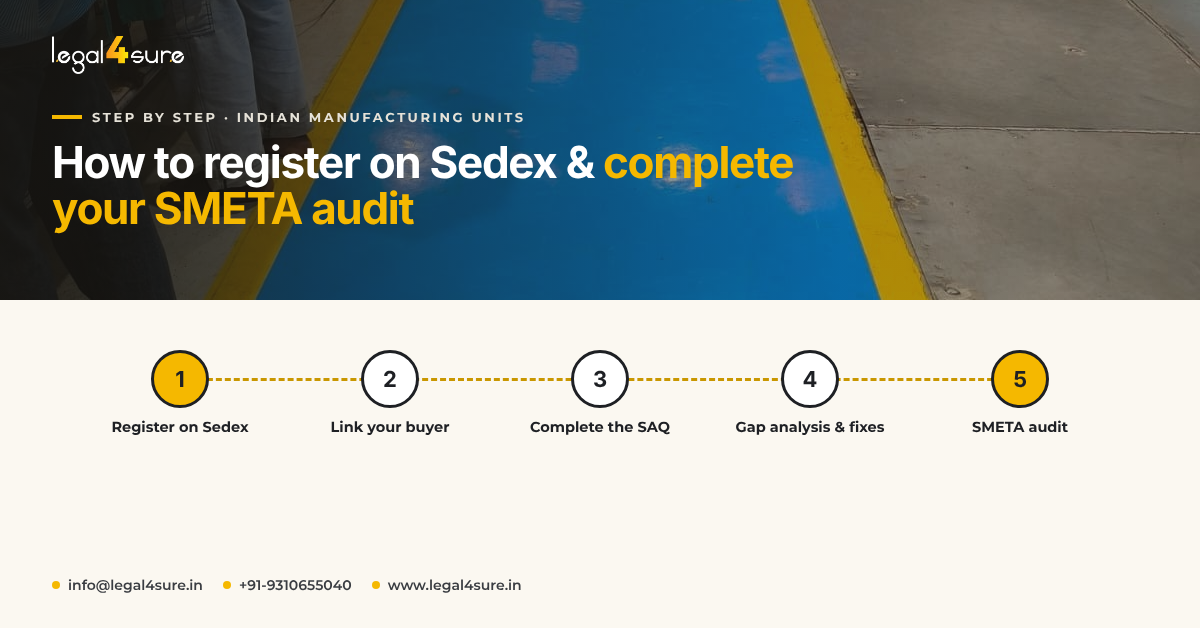
Getting your manufacturing company registered in Sedex is the process that will allow you to join the platform which customers use to monitor your compliance with their requirements. Without that, there is no possibility to submit your audit report, questionnaire or contact your customer.
This issue affects numerous Indian suppliers as a simple e-mail from a customer requesting one to “register in Sedex and pass SMETA audit” confuses everyone in the team.
In this article by Legal4sure, we will discuss Sedex membership in India, Sedex SAQ, Sedex audit requirements and SMETA audit procedure in the correct sequence.
What Is Sedex Registration?
Short answer: Sedex registration is the initial stage of becoming a member of the Sedex network. You register, enter company and site information, submit the Self-Assessment Questionnaire and connect with your customers. Sedex registration is not an audit and does not result in certification. Audit SMETA comes next.
Sedex is both a membership body and a data sharing platform. SMETA auditing methodology belongs to Sedex but is performed independently. Neither membership nor audit results in any certification or pass/fail grades by Sedex.
It can be viewed in two stages. One is about getting your site information onto the website. The other is about testing it in the field.
Sedex Registration vs SMETA Audit
| Aspect | Sedex registration | SMETA audit |
|---|---|---|
| What it is | An account on the Sedex platform with your site data and SAQ | An on-site ethical trade audit of one site |
| Who does it | You, on sedex.com | A Sedex Approved Audit Company (AAC) auditor |
| Output | A profile buyers can view once you link and share | An audit report and a Corrective Action Plan Report (CAPR) |
| Certificate? | No | No, and there is no pass or fail |
| Renewal | Membership renews annually | Sedex treats audit data as current for about 24 months |
| Order | Comes first | Comes after registration |
You don’t need a SMETA audit to join Sedex. You do need an account before an auditor can upload your report.
Who Is Eligible? Sedex Eligibility for Manufacturers
In reality, manufacturers enter into Sedex when asked by the buyer. In principle, any organization that hires employees and provides products to Sedex customers can join, regardless of its size or products.
Sedex eligibility for manufacturers are easily accessible as India is one of the busiest markets for Sedex. According to Sedex, India has more than 9,500 active Indian members, over 11,000 registered organizations, and more than 2.4 million employees. Worldwide, it claims that suppliers are connected with 4 to 7 customers on an average.
Should You Register Now or Wait?
- Please register now if a buyer has requested it, or if you supply to retailers in Europe or North America.
- Please register now if you want one single profile that can be used with several clients.
- Please don’t register now if no buyer has requested it and you cannot yet complete the SAQ.
How Do I Register My Company on Sedex?
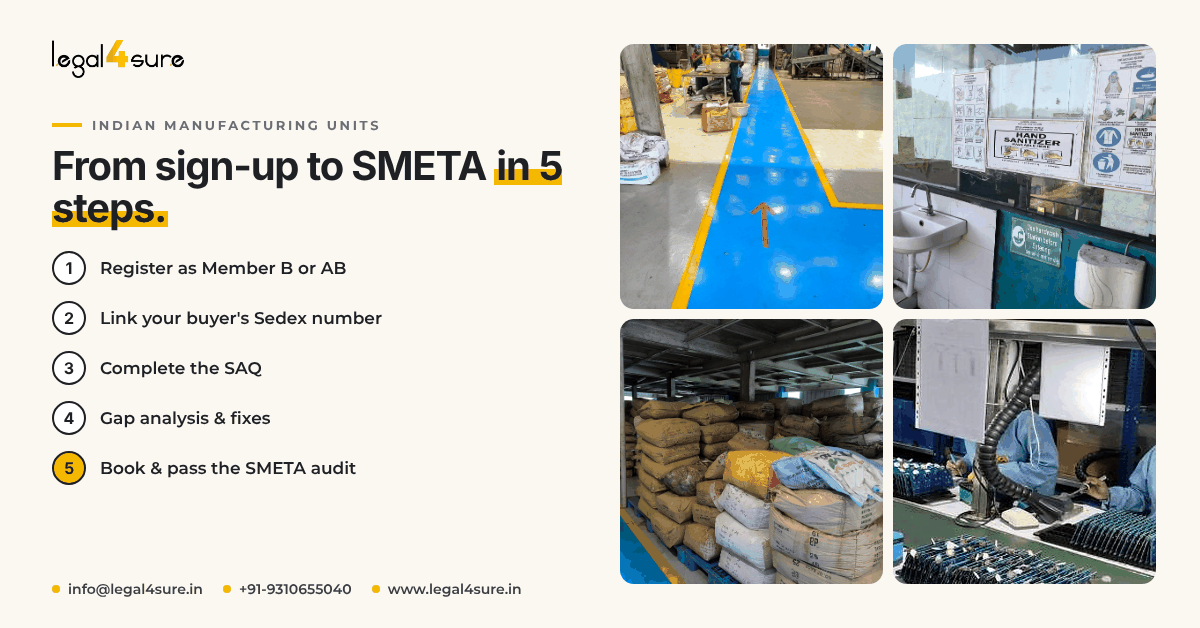
Registration takes six steps. Most of the effort goes into gathering accurate data, not filling in forms.
- Clarify the type of audit that your buyer requires. Find out whether he needs a 2-pillar or 4-pillar audit, and get his Sedex username for linking.
- Get all the necessary information about yourself. It will include the legal entity details, site addresses, contacts, and information about your workforce.
- Register at sedex.com. Select the supplier option and register your Sedex account.
- Procure membership in Sedex. The supplier membership program by Sedex includes annual membership, which means that you have to pay annually.
- Enter all the information about your company, sites, and your workforce at each location.
- Link to your buyers. Send the link request with the help of the Sedex username of your buyer. After acceptance, you can determine what they will see.
Sedex SAQ: What to Prepare
The Sedex SAQ is a questionnaire that assesses the following aspects: labour practices, health & safety, ethical business practice, and environmental management. It is to be filled out separately for each of your sites and then sent to several buyers at once.
Gather these before you start:
- Employee count by classification, comprising contractual, agency, and migrant employees.
- Work schedule, including overtime policy.
- Health and safety reports, for instance, fire safety and training reports.
- Anti-bribery, grievance, and whistleblowing policies.
- Waste management, energy use, and effluent management policies.
Be accurate. Auditors compare your SAQ with what they find on site, and a mismatch with payroll or attendance records raises questions fast.
Sedex Membership India: What You Actually Get
Membership at Sedex means having all your site information, SAQ responses, and audits in one place which will then be shared with the buyers you select rather than sending out documents individually via email.
- Access to the platform to manage your sites and your workforce profile.
- A repeatable SAQ that is sent to multiple customers.
- One click sharing of your SMETA audit report and corrective actions.
- Help and training for new suppliers.
The downside is that it needs maintenance. Your membership needs renewal on a yearly basis and your information must be updated as there will be changes to your headcount, contracts, and processes.
Sedex Audit Requirements: What Your Site Needs Ready
A SMETA audit measures your site against the ETI Base Code. Under SMETA 7.0, auditors check specific Workplace Requirements and grade your management systems.
For an Indian factory, auditors typically expect:
- Factory license, statutory registers and PF and ESI registration.
- Payslips, salary registers, attendance and OT registers.
- Agreements and registers of agency workers.
- Certificates of fire safety, risk assessments and records of emergency drills.
- Policy documentation with training registers and policy ownership by a manager.
2-Pillar or 4-Pillar?
- The 2-pillar consists of labor standards and occupational health & safety.
- The 4-pillar includes environmental and business ethics, and thus covers pollution permits, hazardous waste management and anti-corruption.
- Select whichever one your client demands. If not specified, ask before booking your inspection.
How Do I Complete a SMETA Audit in India?
In order to conduct a SMETA audit in India, one needs to create an account in Sedex, complete the SAQ, arrange for a Sedex Approved Audit Company, set up the audit date, have the audit done, sign off the CAPR at the closing meeting, and upload the evidence.
- Register for the SAQ and fill it in first. The audit report has to reach you via your Sedex account.
- Pick an audit firm. It has to be a Sedex Approved Audit Company, and according to Sedex, the company has to be an APSCA full member firm.
- Discuss the scope, type and date of the audit. There are three types of audits: announced, semi-announced, and unannounced. Sedex recommends semi-announced audits, but if you decide on announced, a reason is required.
- Holding the opening meeting. The auditor will verify the scope and process, arrange employee interviews.
- Inspection of documents and premises. The production process takes place as normal while the auditor checks your documents and inspections take place.
- Employee and management interviews. Employee interviews are confidential.
- Closing meeting. The auditor will present his findings and the CAPR. You can dispute his findings at this point if you have any questions.
- Uploading and closing actions. The report will be uploaded to the platform and the decision is made as to whom the report will be made available to you.
How Long Does It Take?
It depends on your headcount, site size and whether you’re doing 2-pillar or 4-pillar. Your audit company sets the audit duration in its quote, so ask for it up front.
What Happens After the Audit?
There is a report and the CAPR but not the certificate. The follow up could involve checking your submitted corrective actions on the desktop.
A Simple Planning Checklist
Work backwards from your buyer’s deadline. Sedex doesn’t publish a fixed registration timeline, so build in slack for each stage:
- Registration and payment: allow time for approvals within the organization and for the fee to be confirmed.
- SAQ and employee demographic: allow time to collect relevant HR/payroll data.
- Audit scheduling: request the earliest dates available from your auditing firm along with the audit period.
- Corrective action plan: assign an internal owner and date once the CAPR has been signed.
Treat the audit as the midpoint, not the finish line. Buyers watch how quickly you close findings.
Common Mistakes Indian Suppliers Make
- Mistaking the registration of the entity/site, only for it to require correction later on.
- Completing the SAQ from recollection rather than from the payroll and human resources files.
- Neglecting to include any agency or contracted employees in the headcount.
- Thinking of the audit as a one day process without ongoing controls.
- Missed upload deadlines for corrective actions post-audit.
Do It Yourself or Hire a Sedex Consultant in India?
Sedex registration when done alone is suitable for a facility with effective HR and compliance personnel. Professional assistance is beneficial for new suppliers, multi-site facilities, 4-Pillar Audit and strict buyer deadlines.
Legal4sure, a Sedex consultant India, usually provides assistance with Sedex registration, SAQ review, and mock audit services. However, it cannot substitute the audit process that only an authorized auditing firm can conduct.
Key Takeaways
- Step one is Sedex membership, followed by the SMETA audit, which does not result in certification.
- Sign up for sedex.com, fill out your site information and workforce profile, then connect to your buyers.
- The Sedex SAQ addresses four areas and needs to tally with your payroll and HR.
- The SMETA audit is conducted only by a Sedex Approved Audit Company.
- Upload your corrective actions right away after the closing meeting.
Conclusion
Although Sedex registration is all about documentation, it is the starting point for everything to follow. A good profile, a reliable SAQ, and well-kept records will help to ease the process of the audit.
Firstly, find out your customer’s needs, register, complete your SAQ, and schedule your auditor company ahead of time. However, if you do not feel comfortable doing it on your own, you may always rely on a consultant.
Get Your Business Ready for Sedex Registration and SMETA Audit
Need help with Sedex registration or preparing for a SMETA audit? Legal4Sure can assist with supplier membership, SAQ completion, buyer linking, compliance documentation, and mock audit preparation to help your facility get ready for the audit process.
Frequently Asked Questions
How do I register my company on Sedex?
I have to visit sedex.com, select the option of supplier membership, create an account, and provide details about my business and sites.
How do I complete a SMETA audit in India?
I have to complete my SAQ, book a Sedex Approved Audit Company, conduct the audit and close any nonconformities on the website.
How to register for Sedex and complete a SMETA audit in India?
First, I have to register, complete my SAQ, link buyers and then book an audit company to conduct the audit.
What is the step-by-step Sedex registration and SMETA audit process for Indian manufacturers?
Registration, completion of SAQ, linking buyers, booking of audit company, conducting the audit and signing of CAPR with the provision of fixes.
Do I need a SMETA audit to join Sedex?
No, I can become a member and complete my SAQ first and then only conduct the audit.
Is Sedex registration the same as Sedex certification?
No, Sedex membership and SMETA audits do not lead to any certificate or pass/fail results.
Who conducts a SMETA audit?
A Sedex Approved Audit Company conducts it. Sedex owns the method but doesn’t audit sites itself.