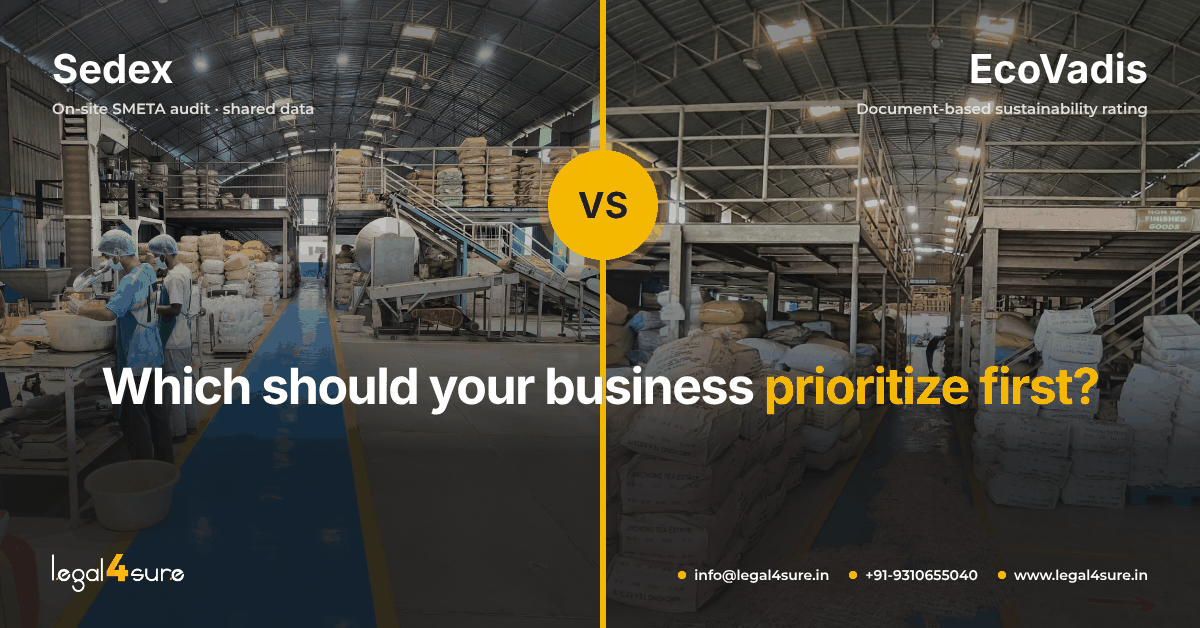
The vendor email of your buyer is sitting in your inbox, asking for your Sedex profile. A week later, a different buyer needs your EcoVadis scorecard. Now you are confused whether both are one and the same, which one to work on first, and whether one has replaced the other.
This is the Sedex vs EcoVadis issue and one that Indian manufacturing and export businesses face frequently. The brief answer to that is Sedex is the platform for information exchange for ethical trade, usually done with the help of SMETA audit on-site, whereas EcoVadis is the sustainability rating that can be obtained using a document assessment.
The article below will explain the differences between the two in terms of their functioning, purpose of buyers, and decision-making process. It is published by Legal4sure, the company that assists the suppliers in being Sedex and SMETA ready.
What Is the Difference Between Sedex and EcoVadis?
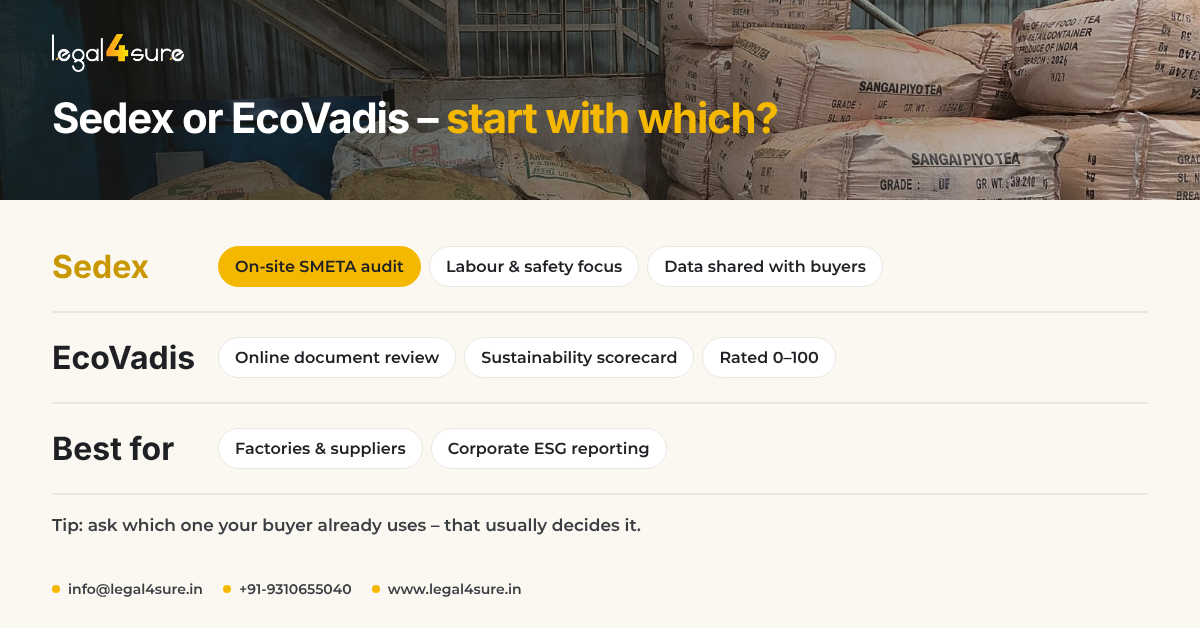
Sedex is a membership platform, in which suppliers provide ethical trade information to buyers using mainly a questionnaire and SMETA audit reports. EcoVadis is a rating platform, which assesses sustainability management of the company on a scorecard. Sedex illustrates how the site runs. EcoVadis illustrates how a company manages and proves its sustainability.
Supplier sustainability assessment is any systematic assessment that a buyer conducts in order to evaluate supplier’s labor, ethics, health and safety, and environment practices. There are several ways of conducting such assessments. Two most commonly used methods are Sedex and EcoVadis. The differences between Sedex and EcoVadis assessments can be found in their approaches.
The main difference between Sedex and EcoVadis assessments can be found in their methodologies. A Sedex assessment is based on a Self-Assessment Questionnaire (SAQ), and besides, a buyer requests an SMETA audit report from a supplier. An EcoVadis assessment is a desk-based assessment, which involves answering a customized questionnaire and providing documentation.
How the Sedex Assessment Works
- Register with Sedex and submit the SAQ of your site.
- Associate your account with the buyers requesting the information.
- Schedule SMETA audit with 2 Pillar or 4 Pillar as specified by the buyer.
- Correct any non-conformances using the Corrective Action Plan Report (CAPR).
- Submit the report to the buyers using the platform.
Sedex does not certify or give you scores. All you have is an audit report containing observations, and hence “Sedex certification” is a relative term. The article we wrote on What Is a Sedex Audit (SMETA) explains this difference.
How the EcoVadis Assessment Works
- Register your organization and pick those customers requesting your rating.
- Fill out the questionnaires specific to your industry sector, size, and geographical region.
- Submit documentation to support your responses, such as policies and certifications.
- Once your answers and documentation have been evaluated, you will get your scorecard.
- Your scorecard will show areas for improvement in the next cycle.
Scoring is done in categories like environment, labor and human rights, ethics and sustainable procurement. You will then be assigned a level of medal based on your position. There will be no site audit, and hence this is a paper-based rating system.
Sedex vs EcoVadis Comparison: Side by Side
A Sedex vs EcoVadis comparison is easiest to read in a table. Here’s how they line up on the points buyers care about.
| Factor | Sedex | EcoVadis |
|---|---|---|
| What it is | Data-sharing platform plus SMETA audit methodology | Sustainability rating and scorecard |
| Method | SAQ and on-site audit with worker interviews | Desk-based document review |
| Output | Audit report with non-conformities and CAPR | Scorecard with theme scores and improvement areas |
| Focus | Site-level labour, health and safety, and (in 4-Pillar) environment and ethics | Company-level sustainability management and policies |
| Typical requesters | Retailers and brands with factory-based supply chains | Large corporates, often across goods and services |
| Pass or fail | No grade, but critical findings can trigger buyer action | No pass or fail, but buyers may set minimum scores |
Practical differences can be seen from the fact that while Sedex audits the reality on the ground during the audit week, EcoVadis audits whether your policies and procedures work on paper.
Is Sedex or EcoVadis Better for Supplier Compliance?
Neither is better overall. Sedex is better at validating labor and safety practices at the site level since an auditor comes in and talks to employees. EcoVadis is better at providing corporate-wide sustainability management. It all depends on what your buyer is trying to prove.
Where Sedex Has the Edge
- Field verification, which will include interviewing workers and inspecting floors.
- Best suited to factory-based supply chains, specifically garments, food, packaging, and consumer goods.
- Clear action plan to correct issues using the CAPR.
Where EcoVadis Has the Edge
- Scores to monitor and continuously better year-on-year.
- Addresses corporate issues such as procurement policies and carbon management.
- Suitable for non-factory organizations for which on-the-ground SMETA audit makes no sense.
Where Each One Falls Short
Sedex will not assess the maturity of your sustainability program beyond the audited pillars. EcoVadis cannot verify what is happening at your shop floor. This is why some buyers require both.
Sedex vs EcoVadis: Which Is Right for Suppliers?
Always start with what your biggest or toughest buyer demands in writing. In case no buyer is demanding anything in writing, suppliers based out of factories typically begin with Sedex, whereas suppliers of services and companies typically begin with EcoVadis. The right sequence really depends upon the buyers and their demands.
A Simple Decision Framework
- Focus on Sedex if you are a manufacturing or processing plant and sell to retailers, brands or exporters who keep a check on labor conditions.
- Focus on EcoVadis if you are dealing with large companies which assess all their suppliers or if you are a service organization and do not have any production unit.
- Do both if the buyers from different countries require each of them.
- Hold on if none of your customers has asked for it and your budget is limited.
When Neither Should Be Your First Move
Should the most serious gap be related to the issue of legal compliance such as lack of licenses or unsafe machinery, then address that problem first before any bookings. Sedex and EcoVadis both presume you have a good standing in terms of legality. Spending money on audit or assessment without addressing these gaps will just lead to a long report.
Why the Order Matters
Sedex requires physical fitness: security, exit doors, payroll, working hours. This will take some time to correct. EcoVadis requires documented policies and proof, which can be assembled faster. When both are on your agenda, start with the one that has the closer buyer deadline and use the same documents for both.
What Carries Over
There is no duplication between the two; however, there is a lot of paperwork in common. Good policies double dividends for an organization.
- Code of conduct and bribery prevention policy.
- Health and safety protocols and training documentation.
- Environmental information on energy, waste and emissions when available.
- Grievance and non-discrimination policies.
A Typical Scenario
Imagine an exporter of food processing products from Gujarat. While the UK retailer demands the SMETA report through Sedex, the international buyer of raw material requires a scorecard from EcoVadis. The exporter makes changes in floor safety and pays attention to documentation regarding wages in order to conduct the audit, using the same safety protocols, training, and anti-bribery policy as evidence for EcoVadis.
What Buyers Do With the Results
These two outputs are used by buyers in different ways, and being aware of that will help you get ready to provide the appropriate proof.
- Sedex audit results are for risk assessments, where buyers analyze the results, their severity and speed of closure.
- EcoVadis scorecards serve for scoring suppliers, comparing their results and setting thresholds.
- Both can affect onboarding, contract renewal and, possibly, business volume offered.
Do not think that good results in one platform will compensate for bad results in the other one. The buyers who request both audits usually require separate answers.
Readiness Checklist Before Starting Either One
Whichever you pick first, these basics make the process smoother.
- Make sure you document which assessment needs to be carried out for each client and how far.
- Choose someone to take responsibility for the process, instead of dividing it between HR, EHS and management.
- Create a file that contains all your main policies; code of conduct, safety, grievance, environmental and anti-bribery policies.
- Make sure your records for attendance, pay, and overtime agree.
- Make sure your site and business information is consistent on both sites.
- Plan a schedule for reassessment as both need regular renewal.
How Much Effort Should You Expect?
The effort involved depends on where you start from. A company that maintains proper records and an existing SMETA report would consider the process of obtaining an EcoVadis to be mainly administrative. A new Sedex audit often takes longer since there will be real problems to deal with. None has a definite time frame, so check with your buyer first.
Common Mistakes When Choosing Between Them
- Taking each one in place of the other. The majority of consumers regard each one independently from the other.
- Selecting one depending on its cost or convenience instead of according to what the consumer is asking for.
- Answering the EcoVadis questions without proof and doing poorly as a result.
- Consider the Sedex SAQ as a questionnaire to fill once and forget about.
- Failure to follow up after a SMETA audit.
How Sedex Compares With Other Schemes
Sometimes, the apparel or footwear buyer would prefer to go for WRAP instead of Sedex. This gives a third choice for consideration. In our article on Sedex vs WRAP Certification, we cover when either would be required. But if you are undecided as to where to start, a Sedex consultant in India can analyze your buyer’s requirement and create a sequence for you.
Key Takeaways
- Sedex is a database that involves SMETA audits, while EcoVadis is a document-based sustainability evaluation tool.
- The Sedex database confirms the state of affairs on-site, whereas EcoVadis evaluates the state of sustainability management within an entire organization.
- Neither can replace the other, and some buyers require both.
- Prioritize based on your customer’s written requirements first and then on the factory or service-based status second.
- This allows for consistent policies and documents for both.
Conclusion
There is no right answer to the Sedex vs EcoVadis dilemma, but there definitely is a practical one. Start by analyzing what you are actually asked to do by your customers, then analyze your own company – if it’s a manufacturing company, the starting point will likely be Sedex, if it’s a service company, EcoVadis.
Then work on your policies and documents only once, but apply them twice. We at Legal4sure will assist you in planning the order in which to conduct assessments.
Choose the Right Sustainability Assessment for Your Business
Not sure whether to prioritize Sedex or EcoVadis? Legal4Sure can help you understand buyer requirements, identify documentation gaps, prepare for SMETA audits, and organize sustainability evidence so your business can approach supplier assessments with greater confidence.
Frequently Asked Questions
What is the difference between Sedex and EcoVadis?
Sedex is a tool for exchanging ethical trade information with SMETA audits. EcoVadis is a sustainability management assessment.
Can you explain the difference between Sedex and EcoVadis assessments?
Sedex includes a visit to your factory with worker interviews. EcoVadis assesses documents and generates a scorecard without a visit.
Is Sedex or EcoVadis better for supplier compliance?
Neither is better in general. Sedex is good for factory-level labour and safety audit, EcoVadis is good for company-level sustainability evidence.
Sedex vs EcoVadis: which is right for suppliers?
Adhere to the written instructions of your major buyer. Factory-based suppliers tend to begin with Sedex, service providers with EcoVadis.
Can a supplier hold both Sedex and EcoVadis?
Yes, many suppliers do so. Common policies, training documents and environmental information can be used for both certifications.
Does EcoVadis replace a SMETA audit?
No. EcoVadis does not conduct a site visit, so buyers requiring floor-level information will ask for a SMETA report anyway.
How long is an EcoVadis rating valid?
Ratings are valid for 12 months, therefore suppliers must reassess annually. Consult EcoVadis and your buyer for current terms.