
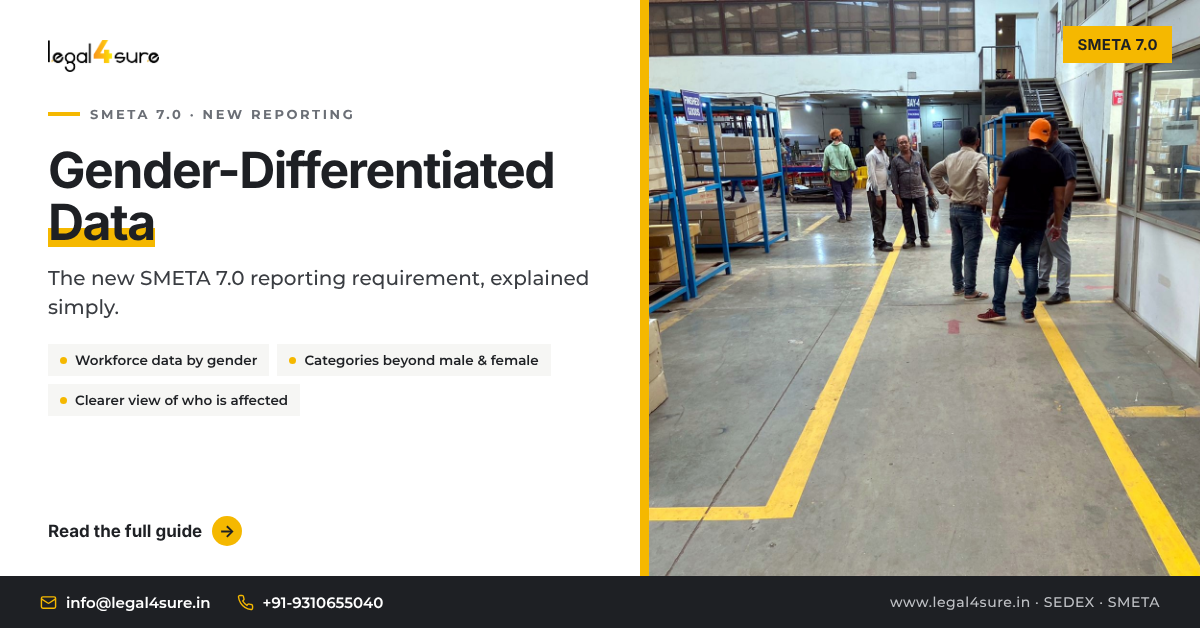
One of the most important changes in SMETA 7.0 related to gender is the new workforce data that companies need to collect. This can surprise many factories because their HR systems may not have collected this type of information before. As opposed to the previous version of the audit, which only needed the total number of males versus females in the factory, there is now a need for workforce data based on gender.
What Is Gender-Differentiated Data Under SMETA 7.0?
Gender-segregated information refers to labor force statistics segregated based on gender. In an ordinary SMETA Audit, it now concerns wages, grievances, leaves, training, and promotions in addition to headcount.
The older versions of the SMETA Audit required a simple segregation of the labor force by gender. The current version of SMETA 7.0 considers such segregation as just the beginning, but requires the consideration of whether there is any difference in the results achieved by each gender beyond headcount.
Why SMETA 7.0 Introduced Gender-Differentiated Data Reporting
Even a balanced 50-50 ratio of men and women in the production facility may not reflect true inequalities: women occupying predominantly low-paid positions, being underrepresented among supervisors, or unwilling to report grievances. Sedex made this requirement in order to reveal the actual picture of inequality that was being concealed by the general statistics for member facilities.
The next important update of the new SMETA 7.0 version is the inclusion of gender-specific statistics as a regular reporting practice instead of a supplementary one. This change corresponds to the overall trend of the protocol towards continuous monitoring based on factual data, including interviews with workers conducted by the auditor.
What Gender Data Points Auditors Now Expect
At minimum, expect auditors to ask for gender-disaggregated figures across five areas. Each one needs to be pulled from existing HR records rather than estimated on the spot.
- Employee composition: number of employees per gender, and further segmented by job, level, and department.
- Compensation information: the average compensation per gender in equivalent jobs, enabling the auditor to identify any disparity in remuneration.
- Use of the grievance procedure: number of grievances, and how each was handled, categorized according to the gender of the employee that lodged the grievance.
- Use of leaves: use of maternity/paternity leaves and return to their original job after such leaves.
- Access to training and promotions: employees nominated for training and promotions into supervisorial positions, categorized according to gender.
SMETA 7.0 Gender Data Requirements vs the Old Protocol
The table below shows what changed. It’s a useful reference if you’re updating an existing HR reporting template rather than building one from scratch.
| Data Area | Pre-SMETA 7.0 | SMETA 7.0 Requirement |
|---|---|---|
| Workforce headcount | Total male/female split only | Split by role, grade, and department |
| Wages | Not gender-disaggregated | Average pay compared by gender within the same role |
| Grievances | Logged in aggregate | Logged and reviewed by gender to spot reporting gaps |
| Leave utilisation | Not tracked | Maternity/paternity leave uptake tracked by gender |
| Promotions & training | Not tracked | Access to training and promotion tracked by gender |
How to Prepare Gender Data for a SMETA 7.0 Audit
Most of the work in preparing gender data for a SMETA 7.0 audit happens in the HR system, not on audit day. Factories that start early usually need one to two payroll cycles to get clean, gender-tagged records in place.
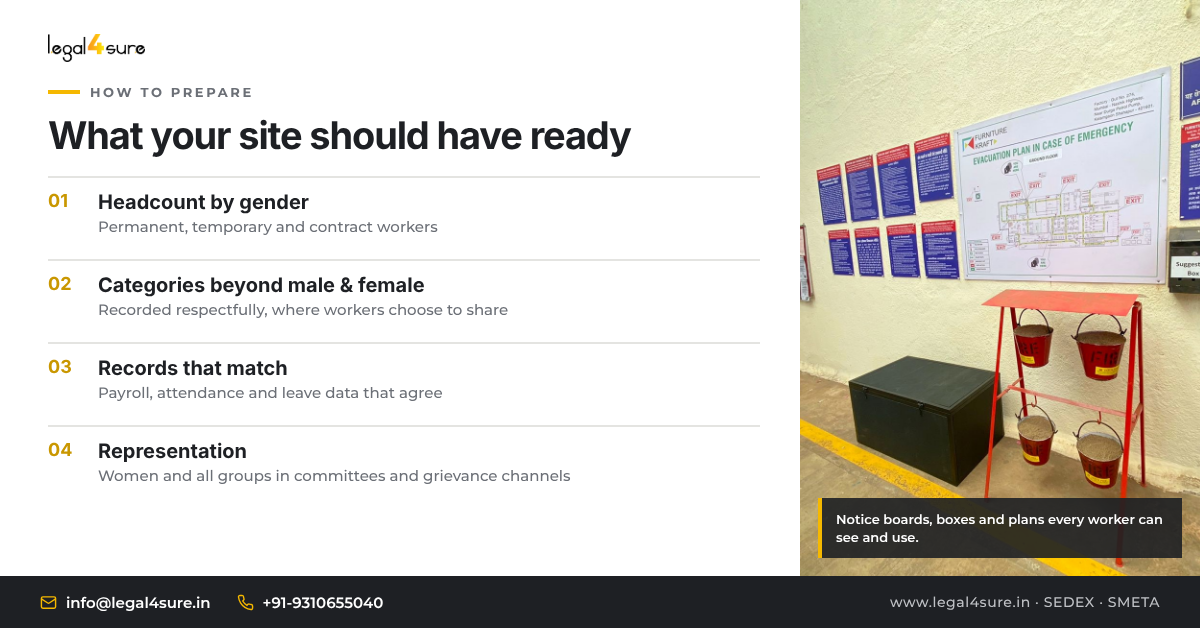
- Conduct an audit on the HR and payroll systems to check whether gender is registered as a searchable attribute, not only in personnel files.
- Retrieve information about wages based on the type of the role and see how the averages differ between genders within the same level of hierarchy; report any discrepancies that have no logical explanation.
- Mark grievances by the gender of the person who filed them from now on; go back and fill in the missing information where applicable.
- Collect information on maternity/paternity leave and reintegration into their positions after taking such leaves.
- Gather information on training programs and promotions within the last year based on the gender of the employee.
- Inform the HR and line managers about this to ensure that their statistics are the same as those reported by the workers.
Common Mistakes Factories Make With Gender Data Reporting
- Headcount reporting alone: The reporting of gender numbers without the inclusion of any wage disparity, grievances, or promotion statistics is no longer sufficient.
- Estimation rather than obtaining data: Auditors verify the figures from the payroll and human resource databases, making estimations quite noticeable.
- Lack of reintegration data: Recording of leaves of absence without knowledge of whether the employees have been reassigned creates an incomplete picture.
- Inconsistent figures with employee interviews: A situation where human resources do not report any pay discrepancy while employees report differently carries more weight than the pay discrepancy.
How Gender Data Fits Into the Broader SMETA 7.0 Audit
Gender-differentiated data does not exist in a bubble since auditors use the information against what they heard in the SMETA 7.0 interviews of the employees of the factory, meaning that the HR data and employees’ information have to match.
This ties into the larger issue of how SMETA 7.0 has revamped the whole system for evaluating factories since SMETA 7.0 has shifted the evaluation of factory compliance from being a one-time deal to continuous monitoring, with audits older than 24 months not being considered “robust” anymore. This also includes gender data which should be continuously kept rather than compiled prior to the audit.
Legal4sure helps companies make this exact protocol transition by assisting their HR departments in creating reporting templates which can pass the test of document analysis and worker interviews alike.
Key Takeaways
- The SMETA 7.0 Gender Data includes information on the gender-wise wage level, number of grievances, take-up of leave and access to promotions.
- Sedex made the change since the aggregate gender ratios were masking the actual difference in pay and promotions.
- Generating gender data for SMETA 7.0 is the process that begins at HR/ Payroll System, generally one to two cycles prior to the audit date.
- The auditors cross-verify the gender data against what workers say about it during their interviews; thus, the numbers and workers’ testimonies must be consistent.
- Gender differentiated reporting of data is a part of SMETA 7.0’s overall move towards compliance through continuous assessment.
Conclusion
Gender data in SMETA 7.0 requires that the factories go beyond the proportion of headcount ratio and explain what really happens to men and women after they join the company payroll in the terms of salary, complaints, leaves, and promotions. Reporting such data as part of normal human resource management, instead of compiling it just before the audit, is the way to ensure the consistency of the data with the information obtained during auditing on the shop floor. This is the type of preparation which Legal4sure can help the factories make before the date of the audit.
Frequently Asked Questions
What are the SMETA 7.0 gender-differentiated data reporting requirements?
Wages, grievances, leave utilization, training, and promotion statistics that are segregated by gender, not just a total number per gender category.
How do I prepare gender data for a SMETA 7.0 audit?
Check that gender is a searchable field in HR system, and then extract wage, grievance, leave, and promotion data on a gender-wise basis at least one payroll period in advance.
What changed in factory readiness under SMETA 7.0?
SMETA 7.0 made changes to factory readiness and made it continuously assessed, not just a point-in-time assessment. Therefore, recordkeeping has become more important than preparation for an audit.
Are older SMETA audit reports still valid under SMETA 7.0?
No, audit reports more than 24 months old are no longer considered to be “robust”.
Does gender data reporting apply to every SMETA audit?
Yes – This is applicable in all instances where a SMETA 7.0 protocol audit is conducted irrespective of site size or industry.
Do auditors verify gender data through worker interviews?
Yes – The information provided by HR is verified from the interviewees and then compared.
What’s the biggest mistake factories make with SMETA 7.0 gender data?
Reporting only the basic headcount ratio without mentioning the information related to wages, grievances, and promotions.