

For any company dealing in medical devices, the U.S. market is the pinnacle of opportunities because of its well-developed healthcare sector. However, getting access to this market requires not only innovative goods but also the conformity with the requirements of the U.S. Food and Drug Administration (USFDA). And for Indian companies and food operators willing to enter the market successfully, it is crucial not just useful to learn about fda device india and obtain fda medical registration since the certification of medical devices by USFDA is the most significant goal for most manufacturers in India.
In this article, we try to give a general idea of what the process of USFDA Certification for medical devices is, what mistakes may be made during this process, how compliance can be achieved and what the huge benefits of obtaining USFDA medical device certification are for Indian companies wishing to gain worldwide recognition.
Key Benefits of USFDA Certification for Medical Devices
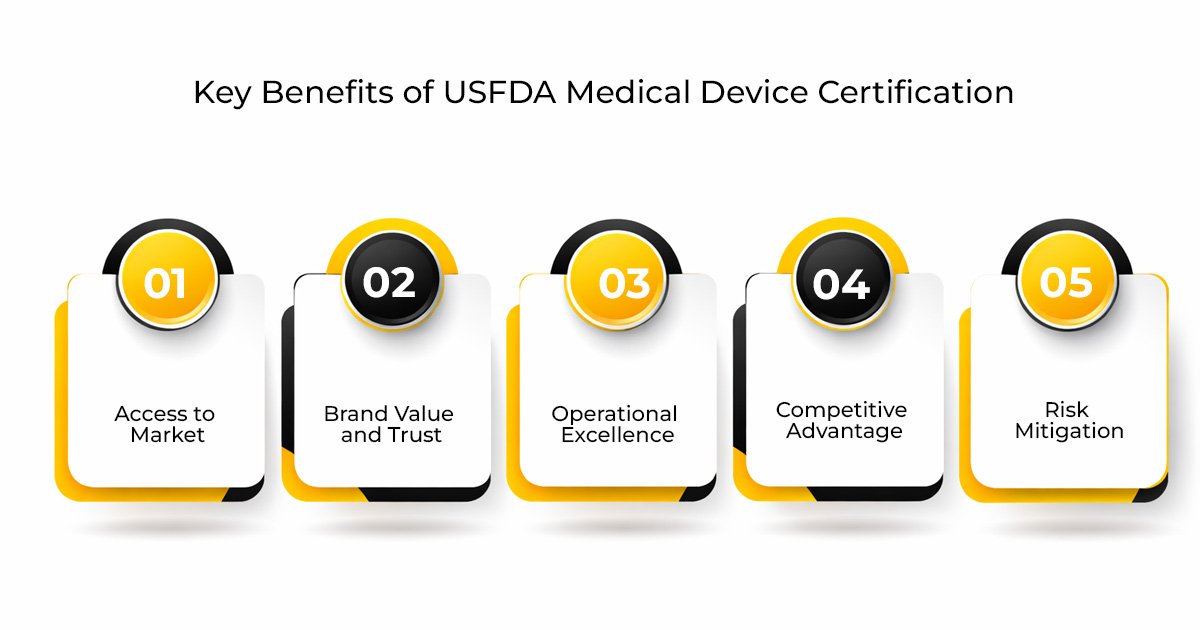
The hard work put into obtaining USFDA medical device certification brings immense returns to Indian companies:
- Market Access: Obtain direct market access to the immensely profitable U.S. pharmaceutical industry, hence increasing the pool of customers and the possibility of earning more money.
- Brand Image & Credibility: Immediately improve the image of your brand internationally. United States FDA Pharma Certification is an internationally recognized symbol of quality and safety that earns trust from all your buyers, partners, and even healthcare professionals around the world.
- Increased Efficiency: The procedure of being compliant with cGMP itself ensures increased efficiency, standardization, and high quality of production process, hence minimizing waste.
- Differentiation: Distinguish your company from other similar companies through this important certification, which will make you the most preferred partner for demanding buyers worldwide.
- Risk Reduction: Minimize the risk of expensive product recall procedures, legal proceedings, and restriction of imports through the compliance with top standards. Companies dealing with both devices and drug products usually acquire the USFDA certification for pharmaceutical production along with their device certification due to the overlapping product portfolio of most exporters.
Questions on USFDA Certification for Medical Devices
Indian entrepreneurs face certain concerns while thinking about USFDA medical device certification:
- USFDA certification for medical devices, yet another form of bureaucracy, which would consume all of our energy without even providing us any value?
- Would the FDA registration of medical devices be too complex and time-consuming, and thus halt the ongoing manufacturing process?
- Are we able to meet all the stringent USFDA medical device approval process standards in India without a complete change in our business?
- Is it possible to obtain USFDA device approval for our new product, or is it only applicable to the big corporations?
- What if we spend a lot but are unable to get USFDA device approval process compliance?
>Helpful Guide:- Everything You Need to Know About US FDA Certificate
Step by Step Process to Get USFDA Certification for Medical Devices
The process of obtaining USFDA registration for medical devices and, where applicable, full USFDA device approval requires a systematic and meticulous approach. Below is a simplified explanation of the fda device India registration: Here is an overview of fda device India registration:
1. Classification & Product Code Identification
FDA Product Code and FDA Regulation Number have to be provided for each of your products.
Class Identification: Determine into which class category the device belongs – Class I, Class II, or Class III.
| Device Class | Risk Level | Example | Pathway |
|---|---|---|---|
| Class I | Low Risk | Bandages, Handheld Scalpels | General Controls |
| Class II | Moderate Risk | Syringes, Powered Wheelchairs | 510(k) Premarket Notification |
| Class III | High Risk | Heart Valves, Pacemakers | Premarket Approval (PMA) |
Verify Exemption Status: Check to see whether your product is exempt from 510(k). Most Class I products require only registration and not a submission.
2. Appoint a US Agent
Since you are exporting from India, the next step would be the appointment of a US Agent, which is very important when complying with USFDA medical device standards.
- They will serve as your link to the FDA.
- They will assist in answering their queries as well as the possibility of facility inspections.
3. Build a QMSR Compliant Quality System
Before you submit anything, your manufacturing process needs to be audit-ready.
- ISO 13485: Make sure your quality system complies with the new QMSR regulations.
- Document Controls: Keep your Design History File (DHF) and your Device Master Record (DMR) up to date. This area causes gap issues for Indian firms.
4. Pre-Submission (Q-Sub) Meeting
However, for novel and complicated Class II devices, you have the liberty to request a Pre-Sub meeting with the FDA.
- This way, you can have the feedback about your testing protocol before you invest any money in the clinical trial or bench testing.
5. Prepare & Submit the Pre-Market Application
For a Class II or Class III device, you need to provide your technical file which is one of the main USFDA medical device requirements:
- 510(k) (Premarket Notification): Evidence of Substantial Equivalence to a predicate device.
- PMA (Premarket Approval): Provide evidence on safety and effectiveness (Class III).
- eSTAR Template: The FDA will require that beginning in 2026, the eSTAR electronic template is used for these applications to ensure their completeness.
6. Pay the FDA User Fee & Register Your Establishment
Once you have received FDA approval for medical devices (or if you are exempt), you need to pay the annual fee.
- The registration fee per year is approximately ₹10 Lacs.
- FURLS account: For facility registration, you have to log in to the FDA Unified Registration and Listing System.
7. Device Listing & UDI
The last administrative hurdle before you can ship your device:
- Identify the Device: Your next step is to tie your specific device models with your facility within the FDA.
- Unique Device Identifier (UDI): It will be required for you to provide a Unique Device Identifier on the packaging so that your product can be traceable across the US supply chain.
Why Manufacturers Struggle with USFDA Certification for Medical Devices
- Lack of Specialized Knowledge: While there is good knowledge of the products, the lack of knowledge on the USFDA process for approving medical devices in India (device types, 510(k) or PMA, etc.) is significant. It is not only an issue of good quality but one of specific knowledge.
- Lack of Proactive Attitude: Instead of trying to achieve compliance with the regulations after the product design phase, Indian manufacturers try to incorporate compliance into the product design phase. It leads to delays and inefficiencies.
- Information Overload and Misinformation: The amount of information on the USFDA website can be intimidating. In addition, it is hard to determine which information is relevant to their specific device or to use the obsolete information.
- Underestimating Documentation: The USFDA requires very detailed documentation of all processes in its regulation from product design to manufacturing to testing and post-market surveillance. The amount of documentation seems insufficient to many companies.
>Helpful Guide:- Documents Required For USFDA Certification In India 2026 | Complete Checklist
Key Takeaways
- Practice the tenets of QMS during the designing of the products and not after the manufacturing process.
- Seek consultation from consulting experts who have expertise in certifying USFDA medical devices for Indian manufacturers.
- Quality and compliance should be part of the DNA of the company.
- Your detailed and traceable documentation will be your greatest advantage in the USFDA device process.
- USFDA compliance is not only a goal but also a process.
>Helpful Guide:- USFDA Certification Cost 2026 – Full Fee Breakdown & What You Must Know
Frequently Asked Questions
What is USFDA certification for medical devices exported to usa india?
This is the compulsory process that the Indian medical device manufacturers need to follow in order to get permission to legally export and sell the devices to the US markets.
What is the fda medical device registration process in India for manufacturers?
The main requirements are implementing a QMS, preparing a pre-market submission (510k, PMA), facility registration, and device listing.
What are the USFDA approval requirements for medical devices india requirements?
Quality System Regulation (QSR) compliance, device classification, preparation of a pre-market submission and facility inspection.
Can you explain the USFDA device process in simple terms?
The procedure would involve the device risk assessment, development of a quality system and validating the safety and efficacy of the device through submission (like 510(k).
Is fssai enough to export usa for medical devices?
No, the Food Safety and Standards Authority of India (FSSAI) is responsible for regulating food products in India. The medical devices intended for the US market need to be in compliance with FDA regulations which are distinct from FSSAI regulations.
What is the difference between fda vs fssai india regarding medical devices?
FDA regulates medical devices and food in the US market and FSSAI is responsible for food safety and standards in India.
Is USFDA mandatory in India for selling medical devices in the US?
Yes, FDA approval is mandatory for any medical device to be sold in the United States market.