

Given the ever-changing dynamics of the international food sector, the concept of compliance can now be considered a significant advantage to go along with being mandatory in the present market scenario. According to 2026, FSSC 22000 Food Safety Certification (Food Safety System Certification) has made itself a favorite among Indian food processors and packagers in their quest for global expansion. Unlike compliance, the GFSI-certified program tackles the issue between domestic FSSAI regulations and international regulations by combining ISO 22000 and related PRP effectively, along with other requirements of Version 6.
This comprehensive blog helps answer the query “what is FSSC 22000 certification?” and discusses the components of the system along with the important changes, which includes food safety culture and waste management system, among others. The blog highlights FSSC 22000 certification requirements and the advantages of FSSC 22000 certification in India. The blog also describes the step-by-step process of certification in India from gap analysis to the final step of audit process. Furthermore, the blog provides information about the cost structure in 2026, including the cost of auditing and consulting fees.
What is FSSC 22000 Certification
FSSC 22000 stands for Food Safety System Certification 22000. One can deduce that this type of certification has nothing to do with products just from knowing the FSSC full form. Then, what does FSSC 22000 certification mean in simple words? It means FSSC 22000 Food Safety Certification that guarantees the operation of a documented, audited and continuously improved food safety management system. FSSC 22000 was designed by the non-governmental organisation Foundation FSSC registered in the Netherlands, first published in 2009 and awarded GFSI recognition later on. The most recent version of FSSC 22000 is FSSC 22000 Version 6 released in 2023.
There are three pillars on which FSSC 22000 is based:
- ISO 22000:2018: International standard for food safety management system
- ISO/TS 22002-series: Prerequisites programme standards for different industries like food manufacture, catering, retail, packaging, etc.
- FSSC Additional Requirements: Food safety culture requirements, Food fraud vulnerability assessment, Food Defense, and Allergens control.
Put simply, FSSC 22000 consists of three parts: ISO 22000, the sector-specific ISO/TS 22002 series, and FSSC Additional Requirements. Together, these three components define the FSSC 22000 certification requirements.
What Does FSSC 22000 Certification Mean for Your Business
FSSC certification is the highest level of endorsement possible by an impartial auditor. It shows that your food safety management systems are globally accredited, effectively designed, and implemented.
For an Indian firm wanting to export its goods, it is a great competitive advantage as follows:
- Access to International Markets: It serves as your key to being able to serve the big retailers in the international market.
- Time and Cost Savings: As this certification is recognized internationally, you will not have to go through several audits from several clients.
- Safer Products: There are lesser cases of food safety problems, complaints, and product recalls.
- Regulation Compliance: You will have met all the food safety requirements in the destination country of the exported goods.
Basically, it tells the rest of the world that your company does not just claim food safety but ensures it.
>Helpful Guide:- FSSC 22000 Certification Documents Required: Complete Checklist for Food Businesses in India (2026)
What is FSSC 22000 Certification Worth
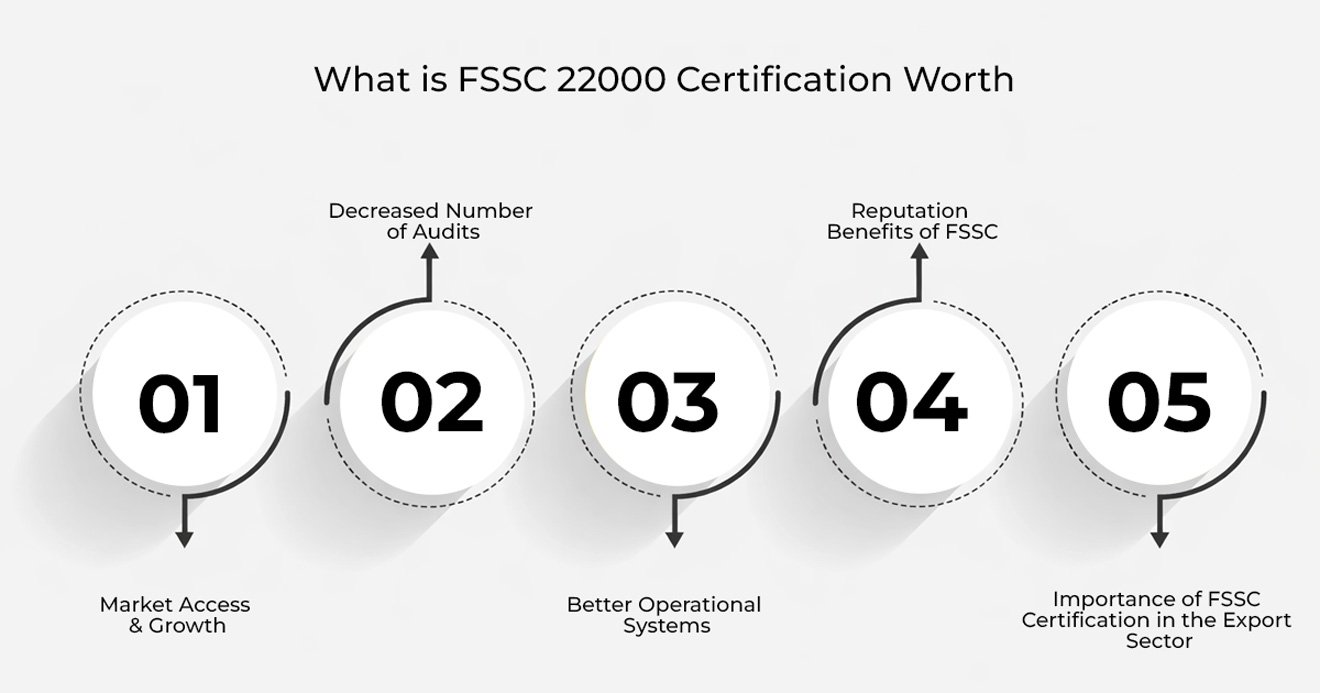
The benefits of FSSC 22000 certification for Indian food manufacturers are both strategic as well as operational. Some of the major benefits include the following:
Market Access & Growth
One of the major business advantages of attaining FSSC in India is the opportunity to get approved by the GFSI. Some of the top international purchasers, in particular those from the UK, European, US, and Middle Eastern markets, demand that their suppliers should have at least one GFSI-approved certification in possession. Otherwise, despite the tempting terms of the offer of the Indian exporter (both in terms of cost and product quality), the Indian supplier would not be considered a viable option.
Decreased Number of Audits
One of the least known FSSC India benefits is that it allows reducing the number of duplicate audits performed for specific customers.
Better Operational Systems
Even the act of certifying itself, which involves systematic hazards assessment, PRPs identification, and corrections, forces companies to improve their operational procedures. This way, there are some advantages such as more efficient production, less waste creation, and increased compliance with hygiene practices by the staff members.
Reputation Benefits of FSSC
With the current world of social media and instant news, one single misstep could be your downfall. An FSSC certification is an excellent way to get the message out that your business is credible.
Importance of FSSC Certification in the Export Sector
The importance of FSSC certification in India can never be ignored for food exports. With India planning to export more food items every year, the significance of FSSC certification keeps on growing day by day. The Indian government sponsors various agencies for export promotion, including APEDA, which views the FSSC 22000 certificate as a value addition certification.
What is FSSC 22000 Certification Process: A Step-by-Step Overview
The steps for FSSC certification process in India have been laid out below:
Step 1: Gap Analysis
Gap analysis forms the initial phase of this whole process. A gap analysis can be understood as an examination of the current food safety management system of the organization and then comparing it with the requirements of the FSSC 22000 certification under Version 6. It will help organizations find out what they need to establish and how. Normally, organizations in India hire consultants or certification bodies to carry out this task.
Step 2: Development and Implementation of System
The second step will consist of the development and implementation of the complete food safety management system based on the results of the gap analysis. This will include policies and procedures such as the food safety policy, HACCP, PRPs, food fraud vulnerability assessment, food defence, allergen management program, and food safety culture activities.
Step 3: Internal Audit
Before approaching any external agency for certification, it is necessary for the organization to conduct an internal audit against all the requirements of the FSSC 22000 standard. This process will help in identifying and solving any problems before the certification process. The internal auditor should be trained and unbiased towards the process he/she is auditing.
Step 4: Stage 1 Audit (Document Review)
This certified auditing organization performs the stage 1 audit procedure which mostly involves reviewing the documentation of your food safety management system from your desk. The auditor determines whether your food safety management system is well documented enough to allow the second stage audit.
Step 5: Stage 2 Audit (On-Site Verification)
In stage 2 audit, the process of on-site verification is completed. The auditors visit your premises and spend from one to several days assessing the implementation of documented procedures. Auditors investigate your manufacturing plant, interview your staff at all levels, review monitoring documents, and carry out traceability activities. Any nonconformities that the auditors discover have to be corrected.
Step 6: Certification Outcome
The completion of stage 2 audit together with the successful addressing of non-conformances marks the end of the certification process and an approval is done by the technical reviewer from the certification body. An FSSC certification for a period of three years will be issued to you.
Step 7: Surveillance Audits and Re-certification
The annual surveillance audits keep the compliance running continuously. After three years of certification, it becomes necessary to have a re-certification audit to prolong the certification. The maintenance of the food safety management system and internal audit will be helpful in the re-certification process.
>Helpful Guide:- Most Common Non-Conformities Found in FSSC 22000 V6 Audits
What is FSSC 22000 Certification Cost in India
Cost of FSSC certification in India depends on a few factors including company size, number of employees, complexity of the company, scope of certification and the certification body chosen. Below is an example of how the approximate cost can be arrived at:
| Cost Component | Estimated Cost (INR) | Notes |
|---|---|---|
| Gap Analysis and Consultancy | ₹50,000 – ₹2,50,000 | Varies by scope and consultant experience |
| Documentation Development | ₹30,000 – ₹1,00,000 | May be included in consultancy; lower if done in-house |
| Training Costs | ₹20,000 – ₹80,000 | Per programme; covers internal auditor and food safety team training |
| Stage 1 and Stage 2 Audit Fees | ₹1,50,000 – ₹5,00,000 | Depends on certification body chosen and facility complexity |
| Annual Surveillance Audit | ₹80,000 – ₹2,50,000 | Per audit; conducted annually to maintain certificate validity |
Despite this being a rather large expense, companies based in India that have obtained the FSSC certification in India have indicated that it makes up for itself through gaining additional business and the reduced need to undergo audits by customers within just two years.
Key Takeaways
- FSSC 22000 Food Safety Certification is a food safety system certification that combines ISO 22000, sector-specific PRPs and further FSSC specifications.
- Any food company in India aiming to operate in export markets or high-class retail must have knowledge about FSSC certification definition and FSSC 22000 certification requirements.
- Increasing number of food companies in India is getting the FSSC certification in India as a result of increasing demand on their part from the foreign buyers, which proves the increasing advantages of FSSC 22000 certification.
- The FSSC certification involves certain preparation at the internal level for documentation, double audit and surveillance.
Top Trending Guide:- BRC Full Form: All 3 Meanings Explained – Food, Export and Education (2026 Guide)
FSSC 22000 Certification
Get expert support for FSSC 22000 certification in India, including gap analysis, FSMS documentation, HACCP and PRP implementation, food safety training, internal audits, and Stage 1 and Stage 2 certification audit preparation.
Frequently Asked Questions
FSSC 22000 certification definition and its benefits in India can be put in simple words as follows: This is a globally acknowledged food safety management system standard that assists in developing export business opportunities, minimizes customer audits and facilitates food safety system development in India.
FSSC 22000 certification criteria encompass ISO 22000:2018, the prerequisite programs according to the sectors, and some FSSC 22000 requirements including food fraud vulnerability assessments, allergens management, food defense and food safety culture.
The duration needed for the food safety FSSC 22000 certification process ranges from 6 to 12 months from the gap analysis until certification. The time is dependent on the maturity of food safety management system within the company in question and the speed of implementing corrective actions.
In spite of FSSAI providing the national standards, FSSC 22000 certifies the international food safety standards required for the global buyers and retailers certification of the Indian manufacturers.
The basic FSSC 22000 benefits for India’s export industry include gaining access to the global retail chains, being accepted by the buyer companies that are the members of GFSI, preventing duplication of the buyer audits and the system itself minimizing the risk of product recalls.
The need of FSSC certification for SMEs is determined by the ability to distinguish themselves in the marketplace using FSSC 22000 certification recognized as reliable by their sophisticated domestic or international consumers.
The meaning of FSSC means Food Safety System Certification, which is gained from the certified bodies of FSSC and not from the organization itself upon completion of the two steps of the audit process.