
If you have your own food industry and you are trying to find out who needs BRC certification, do not worry. BRCGS (Brand Reputation Compliance Global Standards), often referred to as BRC certification, is now considered one of the most reputable food safety standards in the world. No matter if you are an owner of a food manufacturing company, food packaging company or a storage and logistic firm, knowing whether your enterprise requires a BRC can open doors for you to the international and local retail market.
The present blog article reveals the information on the BRC requirements, industries that require the said certification, criteria for the BRC eligibility, and other relevant information including the issue of BRC validity and the process of obtaining the same. The special attention will be paid to Indian companies.
What Is BRC Certification and Who Needs BRC Certification?
BRCGS (previously known as British Retail Consortium Global Standards) is a series of international standards aimed at providing safety, quality, and efficiency in the process of delivering products in the food supply chain. The standard originated in the UK and has since been embraced by more than 130 countries across the globe.
Which organizations need BRC certification? Well, quite simply, any organization that provides food items, food packing materials, or food services to major retail shops, food outlets, or even manufacturers requiring compliance with global standards.
While BRC certification is not obligatory under law in many parts of the world, including India, it is imperative from a business perspective for those companies seeking access to major retail chains such as Tesco and Walmart, among others.
>Helpful Guide:- Emergency BRC Certification: How to Get Approved When Audit Is Due in 15–30 Days?
Industries and Business Types: Who Needs BRC Certification
BRCGS Global Standards include several standards, with each one tailored to address a particular aspect of the food and consumer goods production chain. The following are some of the industries in which BRC compliance is required:
- Food Manufacturers (BRCGS Food Safety Standard)
This is the most commonly applied BRCGS standard. BRC food companies responsible for manufacturing, processing, and packaging food products have to comply with this standard should they supply their products to certified retailers and big brand-name food products.
These include:
- Processed food manufacturers (snacks, bakery, dairy, meat, seafood, beverages)
- Ready-meal producers
- Organic and natural food manufacturers
- Spice, condiments, and sauces makers
- Frozen food producers
If you are a BRC food business aiming at tapping the foreign export market or shelf space within the UK and European Union countries, you definitely require this certification.
- Packing Materials and Packaged Food Manufacturers (BRCGS Packing Standard)
Food packaging should conform to strict safety guidelines too. The BRCGS Packing and Packing Materials standard is targeted at firms manufacturing packing materials for food products, such as:
- Paper, cardboard and corrugated packaging
- Plastic films, containers and laminates
- Glass and metallic packagings
- Food contacting labels
Your firm may also have to meet the BRC requirement if you sell packagings to any BRC food firm.
- Storage and Distribution Organizations (BRCGS Storage & Distribution Standard)
Third party logistics companies, cold chains, and warehouses operating in food products will be included in the scope of organizations which require BRC certification. The following are covered under the BRCGS Storage & Distribution Standard:
- Warehousing services for ambient and chilled foods
- Cold stores
- Refrigerated transportation and distribution services
- Packaging and repackaging services
- Agents and Brokers (BRCGS Agents & Brokers Standard)
Not all organizations involved in the food trade actually have direct involvement in handling food products; rather, they work as agents for other entities. These could still require BRC certification for their role as follows:
- Import/export agents specializing in food products
- Food trading businesses with supplies from various sources
- Wholesalers as intermediaries
- Retailers & Wholesalers (BRCGS Consumer Products Standard)
The category of retailers which manufacture their own brand of products and wholesalers manufacturing private labels for supply to catering establishments could also come under the purview of getting certified for BRC in terms of the Consumer Products standard.
- Produce Businesses (BRCGS Produce Standard)
Businesses involved with fresh fruits, vegetables, and grains at the level of primary production or post-production could also be considered to require BRC certification for the Produce Standard. This would especially be pertinent to Indian export companies which export fresh produce to European markets.
>Helpful Guide:- Top 5 Mistakes Indian Export Houses Make During BRCGS Audits
Who Needs BRC Certification in India Food Industry
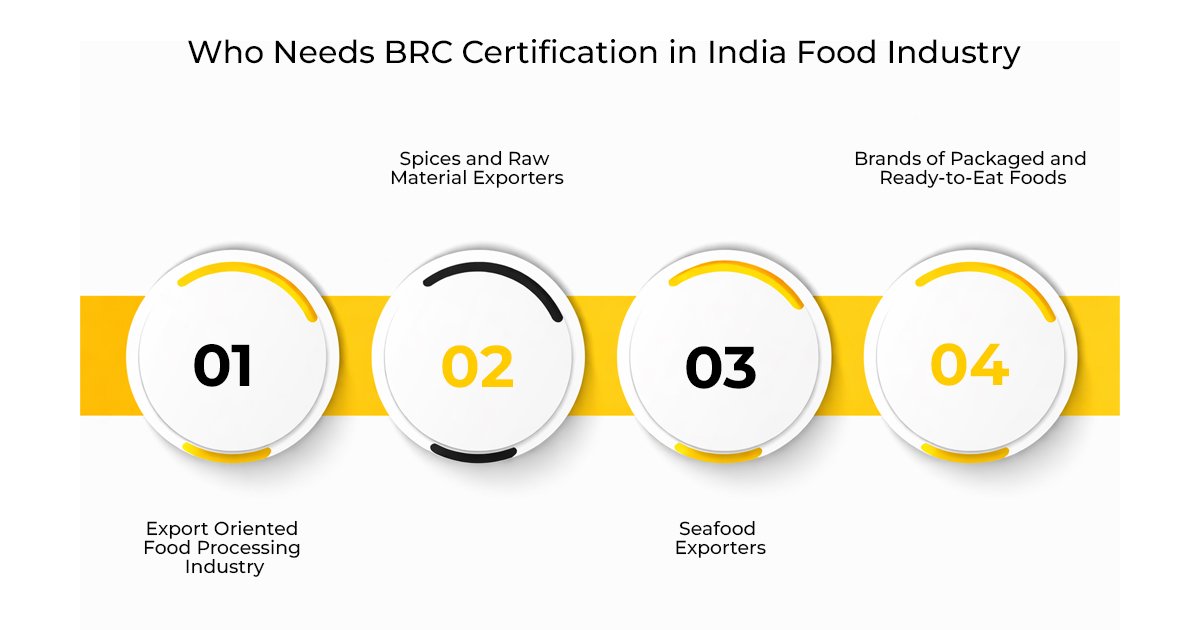
As Indian exporters gain more ground internationally, the issue of whether certification from the British Retail Consortium (BRC) is necessary for Indian food manufacturers becomes increasingly pertinent.
India is a major exporter of food products, exporting items such as rice, spices, sea foods, processed foods, dairy, and vegetables to foreign markets. Here are the cases where Indian companies may require BRC certification:
- Export Oriented Food Processing Industry
The food processors operating in India, who export to markets like the UK, EU, Middle East, and North America, are often mandated by their clients to have valid BRC certification. Otherwise, most of the retailers will not entertain any business discussion.
- Spices and Raw Material Exporters
India is one of the largest exporters of spices. The food companies that operate in various countries like Germany, France, and Australia would mandatorily require their Indian spice suppliers to have valid BRC certification.
- Seafood Exporters
The seafood industry comprises a wide range of products like shrimps, fish fillets, and cephalopods. Indian seafood exporters are subject to stringent BRC certification mandates from their clients in Europe and the UK.
- Brands of Packaged and Ready-to-Eat Foods
As Indian ethnic foods gain popularity worldwide, food companies that cater to the diaspora market or luxury overseas retailers need to prove their BRC conformity as one of their entry criteria.
>Helpful Guide:- BRC Certification Without a Consultant: Why 80% Companies Fail?
BRC Certification Eligibility Criteria India
The prerequisites for becoming eligible for BRC certification india need to be considered from two aspects: technical and practical. There are no limitations concerning the size, age, and geography of the organization – every enterprise meeting the necessary conditions is allowed to seek certification.
The general BRC certification requirements are:
- Existence of a food safety management system (based on HACCP principles)
- Appropriate facilities and resources sufficient for the nature of operations
- Knowledgeable staff involved in the management of food safety and quality
- Implementation of the principle of continuous improvement and system maintenance
- Readiness to be subjected to either announced or unannounced audit by an accredited BRCGS certification body
No minimal turnover or employee number is necessary. Enterprises of any size are equally entitled to obtain BRC certification; even small and medium-sized food organizations in India have managed to secure their certification.
Do You Need BRC Certification? A Quick Checklist
Answer these questions to know whether BRC requirement is applicable to your business:
- Do you deal in food items which are supplied to UK or European supermarkets/food companies?
- Has anyone from your clients or potential clients asked for BRC certification while considering dealing in your products?
- Are you involved in the manufacturing of packaging materials for certified food items?
- Do you provide services like cold chain, warehouse, and logistics for moving food products?
- Are you an exporter of Indian food items that can cater to premium market segments around the world?
In case you answered yes to any of the above questions, then the BRC requirement is certainly applicable to your business.
>Helpful Guide:- BRCGS Certification Cost | Apply With Trusted Experts Today
Key Takeaways
- BRC Certification is critical for food producers, packaging firms, storage providers, and retailers operating in either international or premium local markets.
- The need for BRC Certification results from major retailers, food chains, and food service organizations that make it a mandatory condition for their suppliers.
- BRC Certification is applicable to all firms engaged in the food chain business, from processors on the farm level to distributors.
- For India, the question arises who needs BRC Certification in India? The food industry in India is growing fast due to its export opportunities in the UK, European Union, and Middle East countries.
- BRC Certification is held for 12 months with one annual audit each year.
>Top Trending Guide:- BRC Full Form: All 3 Meanings Explained – Food, Export and Education (2026 Guide)
Frequently Asked Questions
Who needs BRC certification in India food industry specifically?
Any Indian food manufacturer, exporter, or packager selling in UK, EU, and Middle East markets would surely require BRC certification. This applies to all Indian food businesses exporting spices, seafood, dairy products, and packaged foods to international markets.
What is the BRC certification eligibility criteria india businesses must meet?
There are no size limitations; the company just needs to have a food safety management system based on HACCP principles, sufficient infrastructure, and skilled personnel to satisfy the mandatory requirements for BRC certification in India. The company should also be open to a third-party audit.
Are there specific companies required BRC certification by law?
While not legally binding in most nations, BRC certification was often a necessary prerequisite due to business reasons. Large UK and European retailers would refuse to stock suppliers lacking a valid BRCGS certification.
How long BRC valid certificate lasts?
Yes, the validity period of a BRC certificate is simple and clear. BRC Certificate is valid up to 12 months starting from the date of audit. You need to conduct your audit every year in order to renew your certificate.
What does the BRC renewal process involve for Indian businesses?
The process of renewing BRC certificates for companies based in India follows the same procedure worldwide. This involves conducting an audit annually, followed by issuing a new BRC certificate if necessary. Preparation for audit should start 6-8 weeks before expiration of your certificate.
What is BRC validity India, does it differ from the global standard?
No, the validity period for a BRC certificate in India is the same as that worldwide: 12 months. Indian companies that are accredited by agencies such as SGS, Bureau Veritas etc. adhere to the same renewal procedure as the companies in the UK and Europe.
Is BRC certification only for large food companies, or can SMEs apply?
Eligibility criteria of BRC is non-existent. Many small and medium sized food companies in India and other parts of the world hold the BRCGS certificate irrespective of their turnover and manpower strength.