
The FSSAI License represents the essential legal requirement for all food businesses operating within India. The 14-digit number issued by the Food Safety and Standards Authority of India serves to confirm compliance with national safety regulations. Online application submission through FoSCoS will begin in 2026. This blog covers current fees and eligibility requirements with a complete compliance procedure to support business growth.
What is FSSAI License?
An FSSAI License serves as a required food safety certification that provides a 14-digit identification number to businesses through the website of the Food Safety and Standards Authority of India (FSSAI). The first step to obtaining your food business license requires you to understand what an FSSAI License is and who needs it.
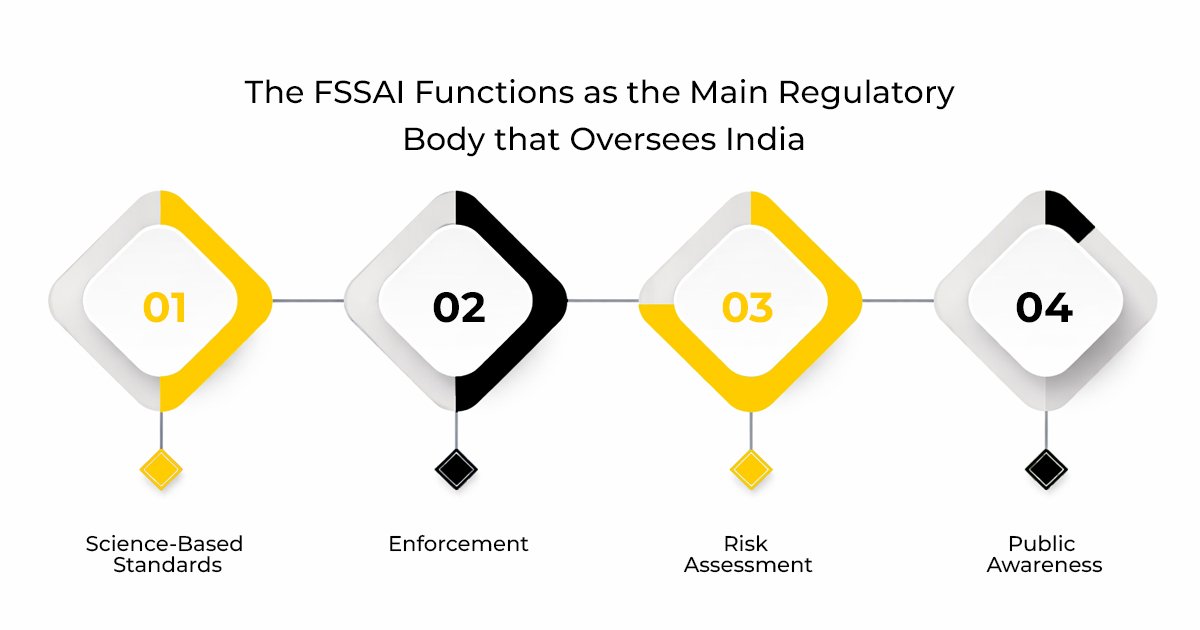
The FSSAI functions as the main regulatory body that oversees India’s entire food sector, which operates under the Ministry of Health and Family Welfare. Its core responsibilities include:
- Science-Based Standards: The organisation establishes fundamental standards that determine the accepted levels of ingredients, additives and contaminants.
- Enforcement: The program enables Food Safety Officers (FSOs) to perform inspections while they have the authority to issue improvement notices.
- Risk Assessment: The organisation tracks pesticide residues, heavy metals and food adulteration through its monitoring program, which observes food supply chains.
- Public Awareness: The organisation educates consumers through its “Eat Right India initiative (2018).
Who Must Obtain an FSSAI Food License?
According to Section 31(1) of the FSS Act, no person or organisation is permitted to start a food business without obtaining proper registration and an FSSAI Food License. The following business activities require information about FSSAI Food License requirements:
- Production: All manufacturers and processors need an FSSAI Food License for packaging activities.
- Logistics: All warehouses, cold storage facilities and dedicated food transportation companies need an FSSAI Food License.
- Retail & Hospitality: All restaurants, hotels, supermarkets and canteens require an FSSAI Food License.
- Modern Platforms: All cloud kitchens, home-based startups and e-commerce aggregators need an FSSAI Food License.
FSSAI Registration vs. FSSAI License: Comparison for 2026
Category is considered an important point to explain; obtaining a license upon need for a registration will instantly mean your application is denied, hence will lead to possible further complications due to legal sanctions.
| Feature | FSSAI Basic Registration | FSSAI State License | FSSAI Central License |
| Annual Turnover | Below ₹12 Lakhs | ₹12 Lakhs to ₹20 Crores | Above ₹20 Crores |
| Business Type | Petty retailers, hawkers, small home kitchens. | Mid-sized restaurants, local manufacturers. | Importers, Exporters, Railways, Airports, & Multi-state units. |
| E-commerce Rule | Not Eligible for online platforms. | Mandatory for local e-commerce sellers. | Required for the head offices of e-commerce giants. |
| Validity | 1 to 5 Years | 1 to 5 Years | 1 to 5 Years |
| Govt. Fee (Approx.) | ₹100 per year | ₹2,000 – ₹5,000 per year | ₹7,500 per year |
Types of FSSAI License in India (2026)
The process of choosing an appropriate FSSAI License stands as a vital organisational choice that defines your business’s legal framework and operational limits. The FSSAI will establish its licensing system in 2026 by using three factors, which include annual revenue, production capability and business type.
Comparison of FSSAI License Types (2026)
| License Type | Annual Turnover | Suitable For | Issuing Authority | Validity |
| Basic Registration | Up to ₹12 Lakhs | Petty retailers, hawkers, small home kitchens. | State/District Authority | 1–5 Years |
| State License | ₹12 Lakhs to ₹20 Crores | Mid-sized restaurants, local manufacturers, and caterers. | State Food Dept. | 1–5 Years |
| Central License | Above ₹20 Crores | Importers, large factories, multi-state operators. | Central FSSAI (HQ) | 1–5 Years |
Basic FSSAI Registration
The Basic FSSAI Registration serves as the foundation of FSSAI License that very small food businesses and micro-enterprises need to obtain. The system requires only basic paperwork from small vendors to achieve compliance with food safety regulations.
- Turnover Limit: The regulation applies only to food business operators whose annual revenue does not exceed ₹12 Lakhs.
- Suitable Businesses: Small-scale manufacturers who produce between 1-100 kg or litres of products each day.
- Petty retailers and temporary stall holders.
- Small dairy units that operate between 1-500 litres of milk processing capacity handle their daily operations.
- FSSAI License Eligibility: This category is only for businesses that operate at a local scale and have no plans to expand their operations beyond their home state.
FSSAI State License
The FSSAI State License applies to medium-sized businesses that operate in one state. This license serves as the primary certification for existing local businesses and their professional food service operations.
- Eligibility: The requirement applies to businesses whose yearly revenue falls between ₹12 Lakhs-₹20 Crores.
- Businesses Covered: All 3-star and 4-star hotels must apply for this requirement, which applies to restaurants and hotels.
- Manufacturers: Operations that process 101 kg-2 Metric Tonnes per day require this licensing.
- Storage: The facility operates at a maximum capacity of 10,000 Metric Tonnes.
- FSSAI State License Apply: Businesses must use Form B to apply through the FoSCoS portal by providing their complete facility plans and equipment specifications.
FSSAI Central License
The FSSAI Central License is essential for all food businesses that operate in multiple states or international markets, which require international trade. The FSSAI Central License Apply requires the highest level of certification, which the central government controls.
- Large Manufacturers: Mandatory for production units that exceed 2 Metric Tonnes per day.
- Import/Export Businesses: All importers and exporters must apply for an FSSAI Central License regardless of their business size.
- E-commerce Platforms: Aggregators and marketplaces that operate like Swiggy and Zomato must obtain a Central License for their main business locations.
- Special Jurisdictions: Food businesses that operate on Central Government properties at Airports, Seaports, Railways and Defence sites need to obtain a Central License.
2026 Strategy Tip: Mid-sized brands that plan to expand into their second state during this year should make their expansion plans immediately. The moment your business opens locations in two states, you must obtain a Central License to operate your Head Office.
Who Needs FSSAI License? (Eligibility Criteria)
The FSSAI License now includes all digital and physical locations that food supply chains use for their operations since its 2026 expansion. FSSAI License eligibility now requires an assessment of business operations because it needs to determine your actual activities, which affect food safety.
| Business Type | License Required | Key Condition |
| Small Home Kitchen | Basic Registration | Turnover below ₹12 Lakhs |
| Restaurants / Cloud Kitchen | State License | Selling via Swiggy/Zomato |
| Large Manufacturers | Central License | Production > 2 MT/day |
| Importers / Exporters | Central License | Mandatory regardless of turnover |
| Storage / Cold Chain | State or Central | Depends on capacity |
| Wholesalers / Distributors | State or Central | Above ₹30 Cr → Central |
Restaurants & Cloud Kitchens
All commercial kitchens need to obtain an FSSAI License that is currently valid to operate their restaurant.
- Restaurants that operate independently need to obtain a State License when their revenue exceeds ₹12 Lakhs.
- Cloud Kitchens need to obtain a State License when their business activities meet the requirements of listing on food aggregator apps in 2026.
- All 5-Star Hotels need to comply with Central License regulations because the law applies to them regardless of their financial performance.
Food Manufacturers & Startups
Food manufacturers must obtain their classification when they engage in activities that involve the processing, mixing, or repacking of food products.
- Startups and small units: They need to start their operations with basic registration when their production capacity remains under 100 kilograms per day and their revenue exceeds 12 lakhs Indian rupees.
- Large Scale Units: Any industrial operation that produces more than 2 Metric Tonnes of products needs to obtain a Central License according to the Large Scale Units requirement.
- Proprietary Food: Startups that develop proprietary foods must obtain product approval for their proprietary foods that do not have specific FSSAI standards, and their license type will depend on their business operations and product development abilities.
Home Kitchen Businesses & Tiffin Services
- Direct Sales: Businesses that operate within this revenue range can use Basic Registration to sell their products directly to local customers who spend less than ₹12 Lakhs.
- Digital Growth: Your business must obtain a State License when you start using e-commerce and delivery services.
Importers and Exporters
- Mandatory Central License: International trade operations require businesses to obtain a Central FSSAI License because the industry operates at high-risk levels.
- IEC Integration: During your application process, your Import Export Code needs to connect with your FSSAI profile.
Storage, Wholesalers & Distributors
- Cold Storage: Central License requirements apply to all facilities that achieve capacity levels beyond 10,000 MT.
- Wholesalers: If your business generates revenue that surpasses ₹30 Crores, you must switch to the Central category.
- Transporters: All logistics companies that operate more than 100 vehicles or across multiple states must obtain a Central License.
2026 Regulatory Insight: The FSSAI now uses Geo-tagging for manufacturing and large storage units. Your utility bills and rent agreement must match exactly to your premise address because any mismatch will lead to rejection at first sight on the FoSCoS portal.
FSSAI License Documents Required (2026 List)
The Food Safety Compliance System (FoSCoS) implemented stricter documentation requirements in 2026 to achieve better transparency and traceability. The FSSAI License documents you need are divided into two categories, which are Mandatory documents that all businesses must have and Specific documents that depend on your business type.
Mandatory Documents for All Categories
The Food Business Operator (FBO) needs to submit essential documents that apply to all business operations regardless of income level.
- Photo ID & Address Proof: The Proprietor, Partner, or Director must provide their Photo ID and Address Proof through either an Aadhaar Card or PAN Card, Voter ID ora Passport.
- Proof of Possession of Premises: The applicant must provide Proof of Possession of Premises through either a Valid Rent Agreement, Sale Deed or a recent Electricity/Water Bill.
- The List of Food Categories: It requires you to identify all food items that you plan to produce or sell according to the 2026 FSSAI Food Product Category FPC list.
Specific Documents for Manufacturers & Cloud Kitchens
The FSSAI license documentation contains advanced requirements because manufacturing operations involve dangerous processing activities.
- A Blueprint Layout Plan needs to show all dimensions through square meter measurements, which divide operational space into storage, processing and packaging areas.
- The Equipment List needs to include all machinery details, which show their complete operational capabilities through Horsepower HP specifications.
- The Water Analysis Report needs to deliver a chemical and bacteriological test report, which uses a NABL-accredited laboratory to confirm the water quality used as an ingredient.
- The Recall Plan functions as a formal document that describes your procedure for withdrawing products from stores when safety guidelines have been breached.
Specific Documents for Importers & Exporters
All international operations require you to include specific FSSAI license documentation in your FSSAI license documents.
- The Import Export Code IEC functions as a required document that must be obtained from DGFT for all Central License applications that involve trade activities.
- The Authority Letter needs to be written on the company letterhead to designate an authorised person who will manage all FSSAI inspection responsibilities.
- NOC from Manufacturer, the original producer must issue a No-Objection Certificate to all relabellers and repackers.
2026 Compliance Alert: The FSSAI now cross-checks your documents against the GST portal and MCA (Ministry of Corporate Affairs) records. Your electricity bill needs to contain the same name as your business registration because this requirement protects you from receiving a Document Mismatch query from authorities.
FSSAI License Fees & Cost in India (2026)
The process of determining FSSAI License expenses in India requires more than the assessment of government fees, which serve as the starting point. The 2026 investment total is distributed into three distinct categories, which include official government fees, mandatory compliance expenses and professional service fees.
Official FSSAI License Government Fees (Per Annum)
Note: State License fees differ according to particular activities because restaurants need to pay ₹2,000, while mid-sized manufacturers must pay between ₹3,000-₹5,000 according to their production capacity.
Breakdown of Indirect Compliance Costs
The business needs to calculate its operating expenses, which are needed for FSSAI License registration online beyond the application fee, to achieve cost savings.
- Food Testing Charges: Manufacturers and high-risk FBOs must conduct their food and water testing through NABL-accredited laboratories, which charge between ₹2,000 and ₹15,000 based on their testing needs.
- FSMS Documentation: The cost to develop a Food Safety Management System (FSMS) plan or ISO-style manual through outsourcing ranges from ₹1,000 to ₹5,000.
- Medical Fitness Certificates: Food handler health check-ups will undergo strict monitoring in 2026, which will cost about ₹500 to ₹1,000 per staff member.
Consultant Charges vs. DIY Application
Many entrepreneurs choose to hire experts because they want to avoid technical mistakes, which cause their applications to receive revert or rejection from the FoSCoS portal.
- Basic Registration: Consultants usually charge a flat fee of ₹500 – ₹1,500.
- State License: Professionals need to pay between ₹3,000 and ₹7,000 for their work, which requires them to prepare detailed documents that include site layouts and water reports.
- Central License: The costs range between ₹10,000 and ₹25,000 because the process includes both multi-state coordination and import/export requirements.
Penalties for Late Renewal (2026 Update)
You must renew your FSSAI License in India at least 30 days before your license expiration date to maintain a low FSSAI License Fees in India.
- The ₹100/Day Rule: If you miss the renewal window, a penalty of ₹100 per day is automatically added to your fee.
- Expiry Impact: The license becomes invalid after the expiration date if the renewal process does not occur. The late renewal process cannot be used; instead, you must obtain a new license, which will result in your business activities becoming legally restricted.
Pro-Tip: FSSAI will implement a Tatkal system in 2026, which provides service to selected groups of users across different states. The government fee who reduces The government fee needs to be paid together with the service charge.
How to Apply FSSAI License Online In India(Step-by-Step Process)
According to the Food Safety and Standards Authority of India (FSSAI), all Food Business Operators (FBOs) must obtain a valid registration before commencing operations. The FSSAI License acts as a legal permit that requires food establishments to maintain compliance with national health protection standards.
Step-by-Step Guide to Apply FSSAI License (2026)
To apply FSSAI License online successfully, follow this rigorous process designed for the updated 2026 digital infrastructure:
- Access the FoSCoS Portal: The official Food Safety Compliance System (FoSCoS) website functions as the required link to complete your payment and protect your business information.
- User Account Creation: You must register for an account using your valid email address and mobile phone number. In 2026, this account acts as your digital compliance dashboard for all future renewals and annual returns
- Identify Your Category: You should click on Apply for New License/Registration. The portal will prompt you to select your state and define your Kind of Business (KoB). Your choice here, whether as a manufacturer, trader, or restaurant, is the most critical factor for FSSAI License apply online success.
- Fill the Online Form:
- Form A: Used for Basic Registration.
- Form B: Used for State or Central Licenses. You must select your Food Category according to the exact items that appear on your menu or product offerings.
- Upload Digital Documents: You need to attach clear scanned PDF copies of your ID proof, address proof and business constitution document. Manufacturers must upload both a unit layout plan and a water analysis report.
- Online Fee Payment: The Food License online fee should be paid through the secure gateway, which has been integrated into the system. The system will issue you a 17-digit Application Reference Number (ARN), which you can use to track your application after your payment has been completed successfully.
- Inspection and Scrutiny: The licensing authority reviews your application. A Food Safety Officer (FSO) will conduct a physical or virtual inspection of your premises for high-risk categories that include meat processing and large-scale manufacturing.
- License Issuance: Your digital business license will become available after the approval process is completed. You can download the certificate directly from your dashboard; physical copies are no longer required.
Post-Application Status Tracking
After you Apply FSSAI License, you should monitor your dashboard for any Reverted status. The officer requires extra information with document modifications. The time limit for your response is set at 30 days, which you must complete to avoid application cancellation.
FSSAI License Registration Process (Timeline)
The FSSAI license registration process for 2026 establishes fixed time requirements which all organizations must follow. The Food Authority states that submitted applications through the FoSCoS portal undergo two examination processes which include automatic system checks and manual assessment.
Expected Approval Timelines
Inspection and Delays: A Food Safety Officer (FSO) conducts manufacturing and cloud kitchen inspections within 7 to 15 days after the application review process begins. The FSSAI License process experiences its longest delays because of two main reasons, which include:
- Incomplete Documentation: Missing water test reports or vague layout plans.
- Query Reversions: Failure to respond to portal queries within the 30-day window.
- Category Errors: Applying for Registration when production capacity requires a License.
The 2026 update enables most small food businesses to obtain Instant (Tatkal) Registration, which requires only 48 hours after they complete their payment and digital verification process.
FSSAI License for Different Businesses
Your FSSAI License needs to match your actual business operations for legal recognition. The FSSAI License that the restaurant requires operates as a compulsory requirement that all dining establishments must obtain. Mid-sized outlets require a State License, while 5-star hotels must hold a Central License.
- FSSAI License for Home Kitchen: Basic Registration suffices for small setups (under ₹12 Lakhs). Selling via apps like Swiggy requires an upgrade to a State License.
- FSSAI License for Food Manufacturing Unit: Based on production capacity. A Central License with FSMS Plan approval are required for units that exceed 2 MT of daily production capacity.
- FSSAI License for Cloud Kitchen: Online-only models need a State License for platform onboarding. The 2026 regulations establish Geo-tagged premises as the required method for digital verification.
- FSSAI License for Import Export: Strictly a Central License category. The Import Export Code (IEC) needs to be attached because this requirement exists for all business operations, regardless of their revenue level.
Benefits of Getting FSSAI License
The FSSAI License functions as a strategic business asset that extends beyond basic legal requirements in 2026. Your business benefits from this Safety Umbrella which protects it against legal claims while creating paths for business expansion.
- Legal & Financial Security: Valid registration prevents heavy penalties (up to ₹10 Lakhs) and business shutdowns. It is also a prerequisite for securing business loans and government subsidies.
- Platform & Market Access: Mandatory for onboarding on Swiggy, Zomato, and Amazon. Digital storefronts will suspend their operations and freeze their payments without this requirement.
- Consumer Trust & Retention: Displaying the 14-digit number and FSSAI logo on packaging acts as a hallmark of quality, which increases repeat purchase rates by up to 20%.
- Export Ready: A Central FSSAI License serves as the international buyers’ preferred standard because it simplifies customs processes and demonstrates your products meet worldwide safety requirements.
Penalty for Operating Without FSSAI License
The Food Safety and Standards Act 2006 considers operating a food business in India without a valid license as a serious crime. The authorities now use strictly digitised enforcement procedures in 2026 to detect businesses that do not comply with regulations through their e-commerce activities and their tax documentation.
- Fine Amount: A business that operates without an FSSAI License faces a maximum penalty of ₹5,00,000. The minimum fine amount for even small businesses reaches ₹25,000.
- Imprisonment: People who commit serious or repeated violations of the law face a maximum prison sentence of 6 months.
- Business Closure Risks: The Food Safety Officer (FSO) can impose fines on your business while also executing stock seizures and premises sealings with permanent closure orders.
- Platform De-listing: E-commerce platforms like Swiggy, Zomato and Amazon must suspend accounts that do not provide a verified 14-digit FSSAI License for Business according to legal requirements.
Common Mistakes While Applying FSSAI License
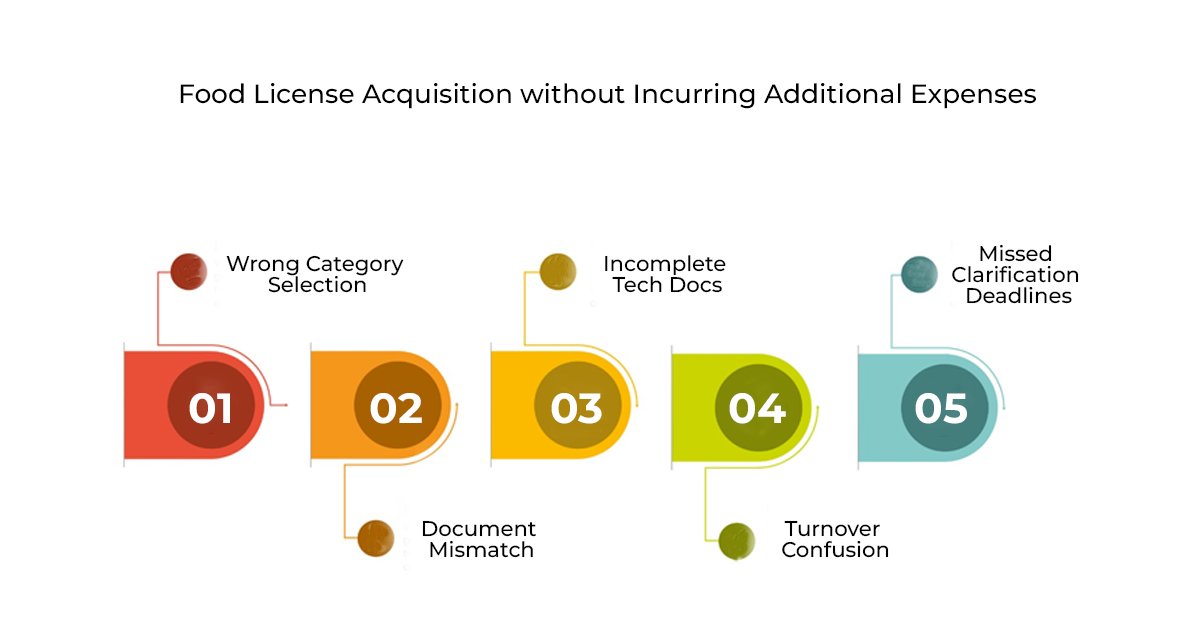
The 2026 data shows that more than 60% of FoSCoS portal applications experience processing issues because of mistakes that could have been prevented. The process requires you to avoid these common mistakes for successful online Food License acquisition without incurring additional expenses.
- Wrong Category Selection: This is the most common error. Businesses often apply for a Basic Registration to save money when their turnover or Kind of Business (like a cloud kitchen or importer) strictly requires a State or Central License.
- Document Mismatch: Your application details must exactly match your supporting documents. The application will be reverted if your Aadhaar or GST certificate contains any spelling errors or address differences with your utility bill.
- Incomplete Tech Docs: Manufacturers frequently omit required documentation, which includes the mandatory Layout Plan showing dimensions and machinery, and the Water Analysis Report from a NABL-accredited lab.
- Turnover Confusion: Businesses often fail to account for projected growth. Your Basic Registration will become invalid when your turnover reaches ₹12 Lakhs during the year, and you must submit a modification request.
- Missed Clarification Deadlines: You must provide an answer within 30 days after an officer raises a query. The application will automatically reject your request, and you will lose your government fees if you do not complete this task.
Why Apply FSSAI License Online Through Consultant?
The system requires multiple technical failures when users try to access the FoSCoS portal without assistance. We at Legal4sure provide complete support for your FSSAI License application process as your dedicated FSSAI License Consultant. Our team provides complete application support, which guarantees precise results that lead to your FSSAI License online application process through maximum efficiency and total ease.
Why Choose Legal4sure?
- Our Expertise: We’ve supported over 6,500+ clients in achieving 100% compliance.
- Error Reduction: We verify every document to prevent costly application reverts.
- Faster Approval: Our team accelerates your filing, ensuring you are Buyer Audit Ready.
- End-to-End Support: From initial filing to timely renewals, we handle it all.
Benifits Working With Us?
1 Lakh+ Happy Clients
Trusted by businesses across India for reliable legal & compliance services.
ISO Certified Company
Process-driven operations ensuring quality, accuracy, and consistency.
Complete Data Security
Your documents and information are handled with strict confidentiality.
Trained Legal Experts
Experienced professionals handling your case with accuracy and care.
On-Time Service Delivery
Fast execution with clear timelines and regular status updates.
Affordable & Transparent Pricing
No hidden charges — clear pricing with maximum value.
Our Promise: We make the FSSAI License registration cost an investment in your growth, keeping your business free from fines while you focus on scaling your brand.
Frequently Asked Questions
How to Apply FSSAI License online in India?
You can submit your application through the FoSCoS portal of the Food Safety and Standards Authority of India by choosing your business type, uploading the required documents and making your payment.
What is the FSSAI License Registration Process?
The process involves creating an account, submitting Form A/B, uploading documents, making a fee payment, getting an inspection (if required), and having certificates approved.
What is the FSSAI License Cost in India?
The government charges fees that start at ₹100 per year for Basic services and reach ₹7,500 per year for Central services, while customers must pay additional consultant fees, which depend on the project’s complexity.
Do restaurants need a separate FSSAI License for Business?
Yes, each restaurant and cloud kitchen needs to have at least a state license based on their annual turnover and the size of their operations.
How to do FSSAI License Certificate Download after approval?
Before you can download it, you need to log into your FoSCoS dashboard, go to issued licenses, and retrieve your certificate PDF.