

While obtaining ISO 22000 certification is a major milestone for any food business in India, it is a world-class commitment to food safety management systems. But for many business owners and quality professionals, the real question is not just how to get certified with ISO 22000, but how long it may take for their business to achieve this milestone.
While the ISO 22000:2018 certification journey may take anywhere from a few months to over a year for many food businesses in the Indian market, where supply chain complexity and FSSAI requirements may overlap, it is also true that the length of this journey depends on your current business infrastructure, the workforce strength you command, and the technical knowledge that your team may already possess.
This blog tries to outline the ISO 22000 certification journey based on business size, industry type, and your current level of readiness for obtaining ISO 22000 certification for your food business in India.
Why ISO 22000 Certification Time Varies So Much
ISO 22000 is an internationally recognised Food Safety Management System (FSMS) standard, developed based on HACCP principles and the ISO high-level structure. In India, ISO 22000 is sought after by food manufacturers, exporters, packaged food brands, catering services, and ISO food safety kitchen operators, among others.
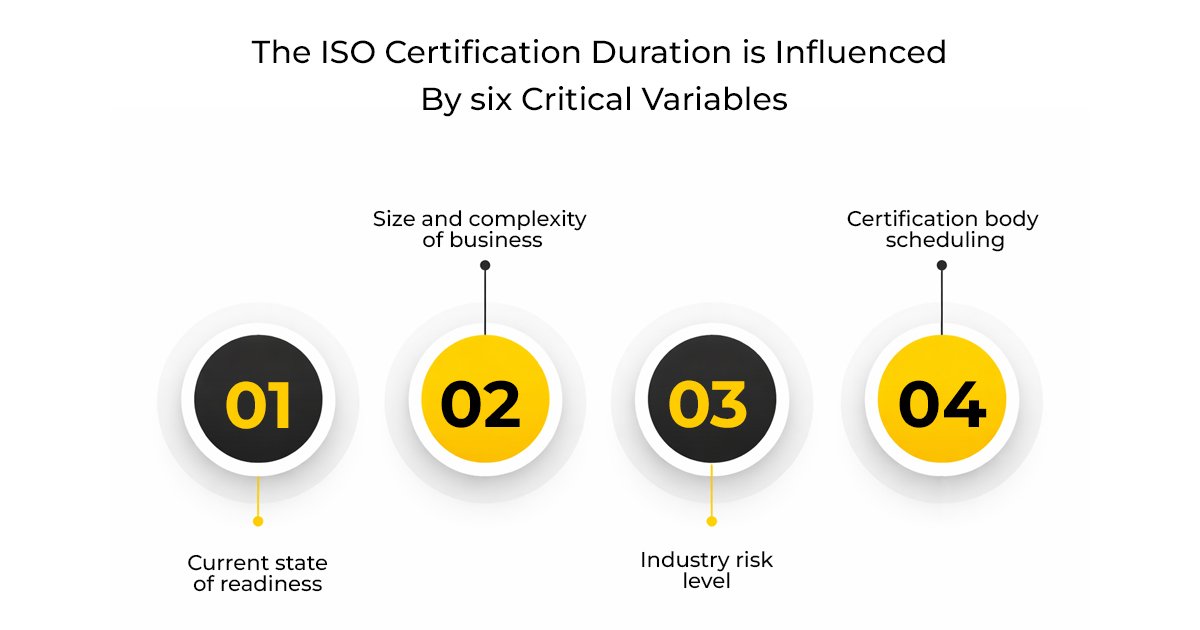
However, the duration for which ISO certification is sought is not fixed. A well-prepared cloud kitchen could get certified within 8 weeks, whereas a large dairy exporter could take as long as 12 months if they start from scratch. The ISO certification duration is influenced by six critical variables, namely:
- Current state of readiness – Do you already have documented food safety procedures in place?
- Size and complexity of business – A cloud kitchen will certify faster than a large food manufacturing business.
- Industry risk level – Higher risk sectors, such as dairy, meat, and baby food, will face tougher audit criteria.
- Certification body scheduling – Accredited certification bodies will have different audit scheduling criteria based on availability of audit slots.
- Internal team bandwidth – A well-prepared team will compress the duration for ISO certification considerably.
- Number of non-conformities – Every non-conformity will increase the duration for ISO certification.
>Helpful Guide:- ISO 22000 Validity in India , How Long It Lasts, Renewal Process & What Happens If It Lapses
ISO 22000 Certification Time by Business Size
The size of a business is one of the strongest predictors of ISO time required. More employees mean more processes to document, more departments to train, and a more complex supply chain to manage. This is a realistic breakdown:
| Business Size | ISO 22000 Certification Time | Primary Reason |
| Micro / Small (1–25 employees) | 2 – 4 months | Simple processes, fewer documents, faster audit cycle |
| Medium (26–200 employees) | 3 – 6 months | Multiple departments, cross-functional FSMS required |
| Large (200+ employees) | 6 – 12 months | Multi-site complexity, extensive documentation, longer audits |
| Export-focused units | 8 – 14 months | Stricter international body requirements, additional scrutiny |
ISO 22000 Certification Time by Industry – ISO timeline India Breakdown
Different sectors within the food industry have different risk profiles; this influences the level of documentation, hazard analysis, and audit required. This has a direct impact on the ISO timeline india for each business type.
| Industry | Typical ISO Certification Duration | Risk Level |
| Cloud Kitchens / Ghost Kitchens | 2 – 4 months | Low to Medium |
| Catering & Institutional Food | 3 – 5 months | Medium |
| Packaged Food Manufacturing | 4 – 7 months | Medium to High |
| Dairy & Dairy Products | 5 – 9 months | High |
| Meat, Poultry & Seafood | 6 – 10 months | Very High |
| Baby Food / Nutraceuticals | 7 – 12 months | Very High |
| Food Export Units | 8 – 14 months | Very High |
>Helpful Guide:- ISO 22000 Certification Mistakes: 10 Common Causes of Certification Failure in India and How to Avoid Them
ISO 22000 Certification Time for Cloud Kitchens in India
The food delivery business has also led to the increased importance of ISO cloud kitchen India certification. Aggregators, institutional clients, and corporate canteen operators are now seeking a food safety certification prior to engaging a cloud kitchen partner.
The good news for cloud kitchens is that their operations are relatively simpler with fewer supply chain variables. As a result, the ISO 22000 certification time for cloud kitchens is the least among all food business types.
| Phase | What Happens | Time Required |
| Gap Analysis | Current practices benchmarked against ISO 22000:2018 | 1 – 2 weeks |
| Documentation | FSMS manual, HACCP plan, SOPs, PRP records developed | 3 – 5 weeks |
| Training & Implementation | Staff trained, procedures put into daily practice | 2 – 4 weeks |
| Internal Audit | Internal check for non-conformities before external audit | 1 – 2 weeks |
| Stage 1 Audit | Certification body reviews your documentation | 3 – 5 days |
| Stage 2 Audit | On-site verification that systems are actually working | 1 – 2 days |
| Certificate Issuance | Audit findings reviewed, certificate issued | 2 – 4 weeks |
Total estimated time: 2 to 4 months for a well-prepared cloud kitchen. A kitchen already designed and implemented according to an ISO Food Safety standard and having existing records for temperature control, hygiene practices, supplier documentation, and handling of allergens can be ready for certification within 6 to 10 weeks.
ISO 22000 Certification Time by Readiness Level
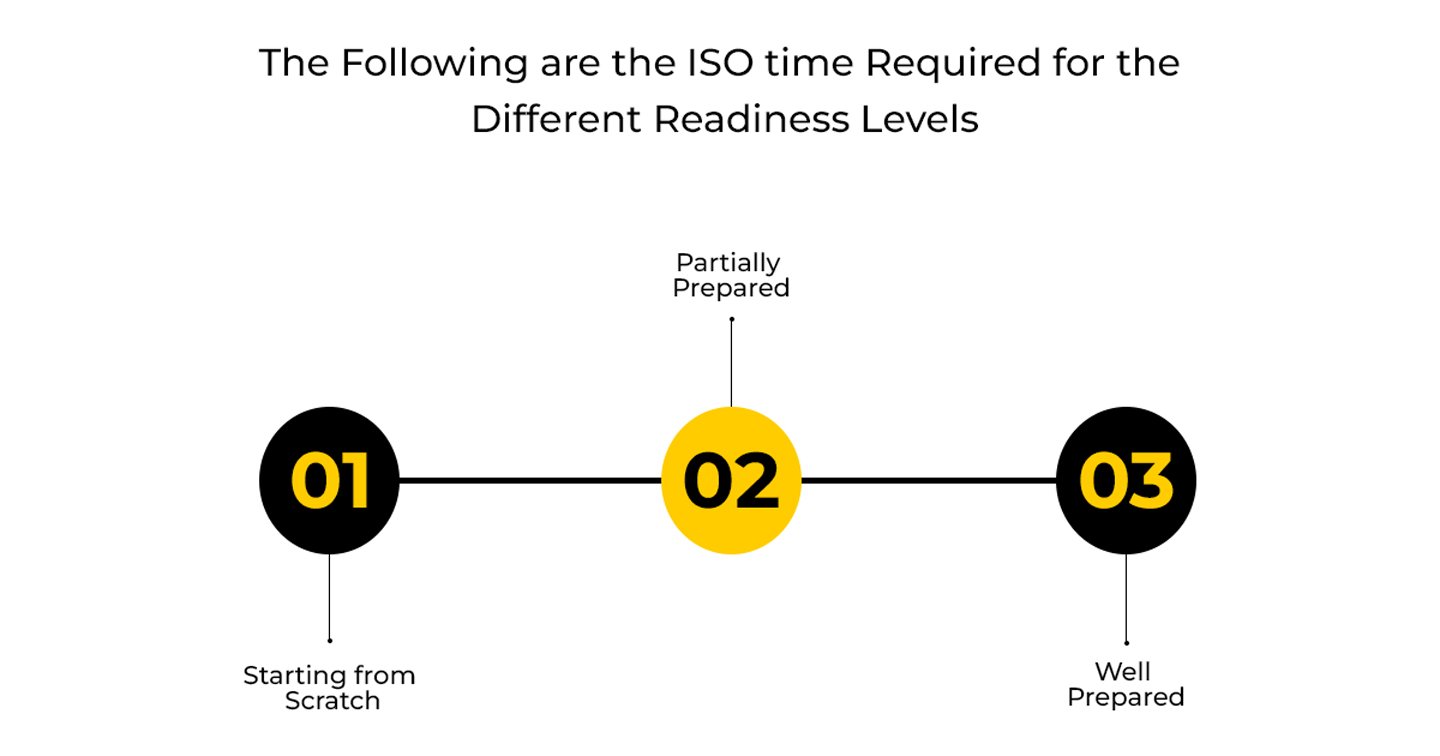
Your starting point is more important than any other single element. The following are the ISO time required for the different readiness levels:
Readiness Level 1 – Starting from Scratch
No food safety procedures have been implemented. No HACCP plan is in place, and no food safety team has been established. This is true of most small food businesses.
Estimated ISO 22000 Certification Time: 5 to 9 months
Most of the work will be developing the FSMS, as no food safety procedures have been implemented.
Readiness Level 2 – Partially Prepared
Has FSSAI license. Basic hygiene-related SOPs are in place, although some temperature and supplier records may be kept, but nothing has been formally documented.
Estimated ISO 22000 Certification Time: 3 to 5 months
Most food businesses in India are at this level, and the gap analysis will highlight the gaps, and the implementation work will be more focused rather than widespread.
Readiness Level 3 – Well Prepared
The organization is ISO 9001 and/or BRC-certified. A food safety team and internal audits are already in place.
Estimated ISO 22000 Certification Time: 2 to 3 months
Much of the documentation infrastructure is immediately transferable. Attention turns to unique elements of an FSMS: hazard analysis and food safety objectives.
>Helpful Guide:- FSSC 22000 vs ISO 22000: Why ISO 22000 Alone Is No Longer Enough for Serious Food Brands
ISO 22000 Certification Process
The certification process is not difficult at all, however, it is important for you to think about it as a system-building exercise rather than a paperwork exercise. Following a structured path is essential for success in the ISO food industry.
- Perform a gap analysis: Identify areas of your current food safety practices that do not meet the requirements of ISO 22000:2018. Be honest, this measure will prevent you from costly unexpected issues later on.
- Determine your scope: Select which products, sites, and processes you aim to have certified. Properly defining the scope helps to limit the audit time and expenses.
- Develop your FSMS manuals: This should consist of your food safety policy, hazard analysis, prerequisite programmes (PRPs), HACCP plans, and operational procedures.
- Educate the staff: The food safety team and production employees should know the standard well enough to be able to discuss with an auditor their control measures not just to show them a binder.
- Run at least one internal audit cycle: This reveals the non-conformities that you can rectify without an auditor’s observation. Besides, it shows the maturity of the system.
- Hold your management review: ISO 22000 underlines the need for top management commitment. A documented review meeting is a prime piece of evidence that auditors usually seek first.
- Stage 1 audit document review: The certification body you have selected will review your food safety management system (FSMS) documentation and identify any gaps before the on-site visit.
- Stage 2 audit on-site verification: The auditor will come to your facility to check if your documented system is indeed being implemented on the floor. Any non-conformities found at this stage must be resolved before certification can be granted.
- Get your certificate: This is valid for 3 years, with yearly audits to monitor compliance. Remember, the certificate reflects the degree of your commitment to continuing the system.
>Helpful Guide:- ISO 22000 Certification Cost In India – Expert Cost Breakdown
What Increases ISO 22000 Certification Time And How to Avoid It
Knowing what causes delays will help you plan around them. These are the most common reasons businesses take longer than their expected ISO certification duration
Incomplete documentation: Submitting your company’s FSMS manual with insufficient information on hazard analysis leads to revisions during Stage 1.
Undertrained staff: Auditors interview your staff members in the kitchen area, among other areas. If your staff members are unable to elaborate on your food safety measures, it is considered a non-conformity.
Delayed corrective actions: Deadlines are set for the resolution of non-conformities. Failure to meet deadlines may cause a delay in the Stage 2 audit.
Unavailable certification body: Some certification bodies in India have a scheduling queue that takes between 6 to 8 weeks for audit slots.
Scope creep: Creating a scope that is too broad may cause a delay in the ISO certification process if you have insufficient documentation for multiple sites and products.
Key Takeaways
- ISO 22000 certification time in India can take anywhere from 2-14 months, but it is agreed that your level of preparedness and business size are two major influences of how early or late you might be in this range.
- For cloud kitchens and other small food businesses, it is possible to obtain ISO 22000 within a matter of 2-4 months, making it one of the quickest and easiest certifications for food businesses.
- ISO approval time is based on a rigid framework of 7 stages, and skipping or rushing any of these, especially internal audits, is almost certain to cause delays at a later time.
- Insufficient documentation and insufficiently trained personnel are two major reasons for non-conformities, both of which can be avoided.
- ISO 22000 is now a requirement for food aggregators, exporters, and institutional buyers, making it a business need, not a want.
>Top Trending Guide:- BRC Full Form, Meaning, Certification Process & Cost in India (2026 Guide)
Frequently Asked Questions
What is the actual ISO 22000 certification time duration india for a small food business?
In a small food business in India with basic food safety practices in place, the ISO 22000 certification time duration in India typically takes between 2 to 4 months.
How long to get ISO certification india if I already have an active FSSAI license?
Having an active FSSAI license in place reduces the preparation time. Hence, THE certification time reduces by 3 to 6 weeks compared to those without basic food safety practices in place.
Can you walk me through the ISO approval timeline and process in simple terms?
It has six different stages: gap analysis, documentation, implementation, internal audit, Stage 1 document review, Stage 2 audit, and finally issuance of the certificate. This process takes between 2 to 14 months based on how complex your organization is.
Is ISO required cloud kitchen operations to have in India?
ISO 22000 is not legally mandatory. However, iso required cloud kitchen certification is becoming increasingly required by food delivery platforms, hospital caterers, and corporate clients.
What makes ISO cloud kitchen india certification faster than other food businesses?
The ISO cloud kitchen india certification process is quicker due to various factors like the location of operation being single, a simple supply chain model, and fewer staff to manage.
What does ISO food safety kitchen certification actually involve day to day?
The ISO food safety kitchen certification process involves implementing and documenting temperature control measures, hygiene practices, supplier control measures, handling of allergens, and training of staff.
Can ISO 22000 certification time be reduced by hiring a consultant?
Yes. An expert consultant who is conversant with the ISO timeline india process can reduce the overall ISO certification process by 4 to 8 weeks by avoiding common documentation errors and non-conformities.