
In the fast-paced world of India’s food technology industry, staying competitive on platforms like Zomato and Swiggy is no longer enough to succeed in the industry, as a high level of commitment to global food safety standards is the only answer to success. As the digital-first food industry becomes the new face of the industry, the only answer to establishing a world-class Food Safety Management System (FSMS) is the ISO cloud kitchen certification.
Although the FSSAI license is the minimum requirement for doing business in the food industry in India, the ISO food safety cloud kitchen certification offers a complete framework for implementing the Hazard Analysis Critical Control Points (HACCP) system along with high-level operational best practices for the food industry. For food businesses that are a part of the major aggregator platforms, the ISO kitchen offers a high level of institutional credibility to the stakeholders and the discerning customer base.
This guide offers a professional overview of the ISO 22000 cloud kitchen certification scenario for the year 2026, including the regulatory requirements, the process, and the investment required to achieve the internationally recognized standard for the food industry.
What Is ISO 22000 Cloud Kitchen Certification and Why Does It Matter?
ISO 22000 is a food safety management system standard that is recognized at a global level. The standard outlines requirements for organizations to manage food safety hazards along the entire food chain. For a cloud kitchen, which is not a dine-in model and only provides food through delivery channels, food safety is not only important but also a necessity.
Being ISO certified for food safety in a cloud kitchen ensures that your kitchen has been recognized for adhering to global standards for food safety. The standard is based on combining the principles of HACCP and management, which makes it more comprehensive than obtaining a basic FSSAI license.
Being an ISO kitchen ensures that you inform customers, aggregators, and corporate clients that you care for food safety and have documentation to support this claim.
>Helpful Guide:- ISO 22000 Validity in India , How Long It Lasts, Renewal Process & What Happens If It Lapses
Is ISO 22000 Cloud Kitchen Certification Mandatory in India?
No, the ISO 22000 cloud kitchen certification is not legally mandated in India. The FSSAI (Food Safety and Standards Authority of India) license remains the only legal requirement for all food businesses, including cloud kitchen businesses. However, the word “mandatory” should not be interpreted as “optional” in the competitive sense.
Here’s why the ISO cloud kitchen certification is fast turning out to be a logical necessity:
- More corporate and B2B clients, like offices and hospitals, are seeking ISO 22000 vendors.
- Some high-end aggregator programs and B2B delivery contracts include the need for FSMS documentation.
- The FSSAI Food Safety Management System (FSMS) audit framework is similar to the ISO 22000 framework, which means that the risks of regulatory surprises are low.
- Insurance companies and investors consider the ISO 22000 certification as a maturity indicator for businesses.
In other words, you might not be fined for not having it, but you might be missing out on a lot by not having it.
Step by Step Process to get ISO 22000 Cloud Kitchen Certification
Understand how the ISO 22000 process works in cloud kitchen operations to effectively plan your timeline. Here is how the journey of getting certified in ISO 22000 works:
Step 1: Gap Analysis
In this step, your present food safety procedures are compared with the ISO 22000 standard. The gaps are determined, which may include documentation, procedures, and infrastructure.
Step 2: Documentation and SOP Development
In this step, the development of the Food Safety Manual, HACCP plans, standard operating procedures, work instructions, and records for all critical processes, such as the receipt of raw materials and dispatch of orders, is required.
Step 3: Training and Implementation
In this step, all employees, including kitchen helpers, packaging staff, and dispatch personnel, must be trained on food safety. However, it is not just the initial training, as the ISO kitchen standard also requires evidence of periodic training and competency assessment.
Step 4: Internal Audit
Before seeking external certification, your kitchen must complete at least one internal audit.
Step 5: Management Review
Management must review the FSMS at planned intervals to demonstrate its leadership and commitment to food safety management. This is one of the major requirements of ISO 22000:2018.
Step 6: External Certification Audit
A certification body from NABCB and/or any international certification body conducts a two-stage certification audit. The first stage is a documentation study, and the second is an on-site evaluation of your processes. You are given a chance to take corrective actions in case of any non-conformities identified during the audit process.
Step 7: Certificate Issuance and Surveillance Audits
You are issued an ISO 22000 certificate for three years. Annual surveillance audits are performed to ensure continued compliance to the food safety management system. A recertification audit is performed after three years.
>Helpful Guide:- ISO 22000 Certification Mistakes: 10 Common Causes of Certification Failure in India and How to Avoid Them
Requirements for ISO 22000 Cloud Kitchen Certification
To fulfill all the iso certification requirements for cloud kitchen india, there are many areas to be covered. The basic iso 22000:2018 food safety management system requirements are:
| Focus Area | Requirement Details |
| System Foundation | A documented food safety management system including its scope, policy, and objectives. |
| Hazard Identification | Identify all food safety hazards (biological, chemical, and physical hazards and allergens) associated with your food products offered on the menu. |
| Operational Controls | Establish Prerequisite Programmes (PRPs) covering infrastructure, cleaning and sanitation, pest control, supply chain management, and personal hygiene. |
| Risk Management | A HACCP-based system of Hazard Analysis and Critical Control Points must be clearly established. |
| Validation & Monitoring | A system for monitoring, measurement, and verification must be established for all critical limits identified in the HACCP system. |
| Crisis Response | A documented emergency preparedness and recall procedure must be established. |
| Internal Leadership | A competent food safety team must be established with a designated food safety team leader. |
| Communication | A system for communication with suppliers, contractors, and consumers must be established. |
For cloud kitchens in particular, areas that must be addressed include packaging integrity, cold chain management for deliveries, cross-contamination prevention in shared kitchen spaces, and allergen management for multi-cuisine food offerings.
ISO 22000 Cloud Kitchen Certification Cost
The cost of iso cloud kitchen certification can vary depending on the size of your operations, the number of locations, and the state of your systems. Here’s a realistic estimate for a single location cloud kitchen in India:
| Category | Description | Estimated Cost |
| Consultant Fees | Development of documentation, staff training, and audit preparation. | ₹50,000 – ₹1,50,000 |
| Certification Body Fees | Initial audit and certificate for small to medium kitchens. | ₹40,000 – ₹1,20,000 |
| Annual Surveillance | Periodic audit fees to maintain the certificate. | ₹25,000 – ₹60,000 |
| Internal Resources | Staff training materials, infrastructure improvements, and time spent on documentation/audits. | Varies based on Gap Analysis |
| Total First-Year Investment | Combined total for a single location (includes consultant, certification, and internal resources). | ₹1,20,000 – ₹3,00,000 |
This may be a high cost for some operators, but one should consider the potential revenues generated by B2B contracts and premium platform programs that require this certification.
Benefits of ISO 22000 Cloud Kitchen Certification for Zomato and Swiggy Partners
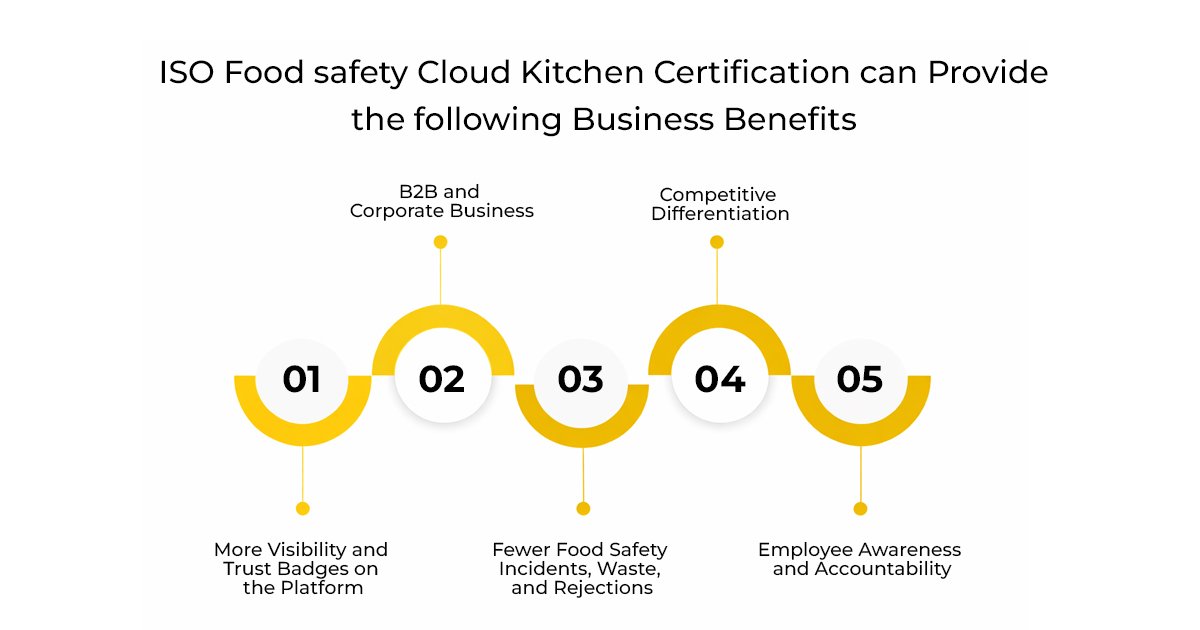
For cloud kitchen operators listed on Zomato and Swiggy platforms, ISO food safety cloud kitchen certification can provide the following business benefits:
- More Visibility and Trust Badges on the Platform
Zomato and Swiggy are now heavily promoting restaurants that have high food safety and hygiene. ISO certification for a cloud kitchen can result in special food safety and hygiene badges for the kitchen. This can result in more prominent listings and campaigns for the kitchen.
- B2B and Corporate Business
Corporate catering contracts, hospital food supply contracts, airline food supply contracts, and B2B food supply contracts to institutions always require a certified food safety management system. ISO 22000 certification can open up new revenue streams for the kitchen that were previously not available.
- Fewer Food Safety Incidents, Waste, and Rejections
The structured ISO kitchen system helps in the reduction of food safety incidents, batch rejections, and product recalls. This has a direct bearing on your food cost ratio and customer complaint ratio, which are vital for the profitability of your cloud kitchen.
- Competitive Differentiation
In the competitive landscape of hundreds of cloud kitchens competing on pricing and cuisine offerings, the ISO 22000 certification serves as a differentiator for your cloud kitchen business. This differentiates your business as one that can handle the dietary needs of your premium customers.
- Employee Awareness and Accountability
The process of attaining the ISO 22000 certification helps inculcate a food safety culture in your employees. This helps in the efficient running of your cloud kitchen business with minimal human error.
- Easier Expansion and Franchising of Cloud Kitchens
In the event of expanding your cloud kitchen business to other cities and locations, the ISO 22000 documentation serves as a template for the operations of your cloud kitchen business.
>Helpful Guide:- FSSC 22000 vs ISO 22000: Why ISO 22000 Alone Is No Longer Enough for Serious Food Brands
Key Takeaways
So, if you are new to this cloud kitchen business, here is a logical sequence of certifications for food safety that I would suggest:
- Start with FSSAI Registration or Licence (compulsory).
- Baseline hygiene practices and create your process documents.
- Work on obtaining ISO 22000 once your business is stable and targeting B2B segments.
- Add on top of that the SMETA certification for targeting global brands.
It is totally counterproductive to attempt all this without first building your business and then attempting to certify your systems.
>Top Trending Guide:- BRC Full Form, Meaning, Certification Process & Cost in India (2026 Guide)
Frequently Asked Questions
What are the ISO certification requirements for cloud kitchen India?
You need to have a documented food safety management system that includes HACCP plans, PRPs, employee training records, internal audits, and management reviews. This has to be done by an accredited certification body.
Is food safety certification for cloud kitchen business the same as an FSSAI licence?
No. FSSAI is a legal requirement by the government, while ISO 22000 is a voluntary international certification by an accredited third-party body after a detailed audit.
What is the ISO 22000 process for cloud kitchen certification?
This involves gap analysis, documentation, employee training, implementation, internal audit, management review, and finally a two-stage audit by a certified body.
What is SMETA audit and why should a cloud kitchen care about it?
A SMETA audit is to check your business for its labour standards, health and safety, environment, and ethics. This is a requirement by many food brands and institutions before they onboard you as a supplier.
What is the SMETA audit cost for a cloud kitchen in India?
Generally, it costs between ₹60,000 and ₹2,00,000 depending on the facility size, number of workers, and whether you choose to do a 2-pillar or 4-pillar audit.
What does a SMETA audit checklist cover for a food business?
It includes employment contracts, working hours, wages, fire safety, PPE, discrimination policies, environmental compliance, and anti-bribery management systems.
How long does ISO 22000 certification take for a cloud kitchen?
It generally takes three to six months from gap analysis to certificate issuance depending on your current state and ability to address non-conformities.