
As an entrepreneur in the food sector in India or an exporter who wants to know about the BRC vs ISO 22000 certification, you are definitely not alone. Both BRC and ISO 22000 are globally accepted standards that are recognized by numerous countries, but both have their own merits and are suited for specific business types. It is important to understand the BRC vs ISO comparison before investing in the process.
Through this blog, we will discuss how they differ, which is more suitable for your business, and what you should know as an Indian exporter in 2026.
What is BRC Certification?
BRC stands for British Retail Consortium Global Standard for Food Safety which is a type of certification program that was designed originally for UK-based retail suppliers. Currently, it operates under BRCGS (Brand Reputation Compliance Global Standards).
The BRC certification process is carried out by an unannounced/announced audit performed by a BRCGS-approved certification organization. The BRC standard is very detailed, implying certain regulations on issues associated with food safety, quality management, product control, process control and personnel.
It includes several grades ranging from AA to D, where AA grade means the highest possible grade that can be given. Most UK/European retail chains tend to operate solely with BRC certified organizations, making it almost mandatory for international food exports.
>Helpful Guide:- Not Sure What Is BRC Certification? Get Clarity In 5 Minutes
What is ISO 22000 Certification?
The ISO 22000 standard is an international FSMS that was introduced by the International Organisation for Standardisation. The standard can be used by all organizations in the food chain industry, including farmers and processors, packaging manufacturers and logistics firms.
In the debate between ISO and BRC, it is the following aspect that is commonly used as a starting point for the discussion: ISO 22000 conforms to the high-level structure (HLS) shared by many other ISO standards such as ISO 9001. Moreover, ISO 22000 is principles-based rather than prescriptive, which means that companies are provided with the ability to tailor their FSMS according to the specifics of their business operations.
ISO 22000 certification is awarded by an external auditor after an accreditation process carried out once every three years.
>Helpful Guide:- What Is ISO 22000 Certification? – Meaning, Importance, Scope & Who Needs It in India
BRC vs ISO 22000: Side-by-Side Comparison
The following table shows the BRC ISO comparison
| Criteria | BRC | ISO 22000 |
| Origin | British Retail Consortium, UK | International Organisation for Standardisation |
| Type | Audit-based certification scheme | Management system standard |
| Approach | Prescriptive and product-focused | Flexible and system-focused |
| Audit Style | Announced / Unannounced | Announced (surveillance + recertification) |
| Grading | AA, A, B, C, D grades | Pass / Fail (no grading) |
| Scope | Food manufacturers & processors | Entire food supply chain |
| HACCP | Mandatory, prescriptive application | Integrated as a core component |
| Market Recognition | Strong in UK, Europe, and retail | Global, across all sectors |
| Integration | Standalone | Easily integrates with ISO 9001, 14001 |
| Cost | Generally higher | Moderate |
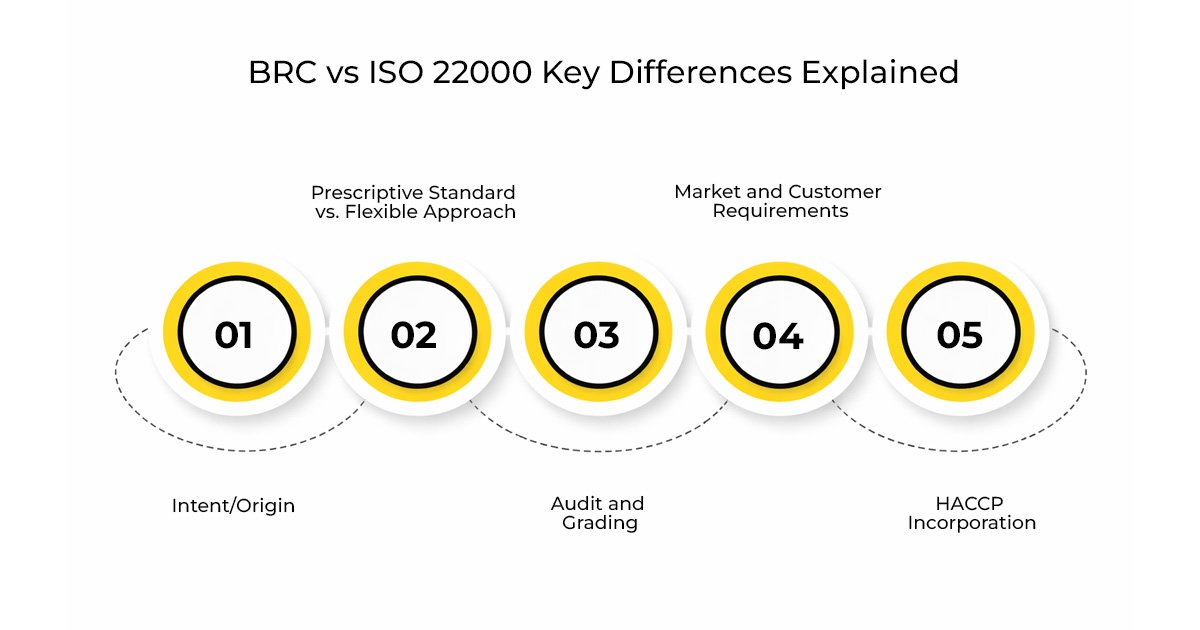
BRC vs ISO 22000: Key Differences Explained
- Intent/Origin
The BRC vs ISO 22000 must start with the intent behind each standard. BRC was developed in the UK by retailers to create consistent food safety and quality within their suppliers’ products. This standard is purely commercial in origin. ISO 22000 was developed as a standard to be used for the construction of sound food safety management systems by any company along the food chain, no matter the size or location.
- Prescriptive Standard vs. Flexible Approach
One of the biggest differences between BRC and ISO 22000 is that they take completely different approaches to requirements. While BRC states precisely what needs to happen in the form of clauses, facility requirements, labels, and document control, ISO 22000 tells organizations what needs to be done, leaving up to the organization how they will accomplish this. For a more mature business with an already established system, this can be quite beneficial.
- Audit and Grading
BRC audits are unannounced and lead to a graded certificate (from AA to D). Thus, the grading mechanism provides your customers with an insight into your supplier status. The ISO 22000 certification process ends up with a yes/no result, but not with the grades for your performance. The annual surveillance audit takes place according to the ISO 22000 standards. Every three years, there is also recertification.
- Market and Customer Requirements
For example, in case your suppliers are the British supermarkets such as Tesco and Sainsbury then BRC certification will most probably be required. For export companies dealing with foreign foodservice operators, ISO 22000 might be more appropriate. As regards the issue of whether to choose iso 22000 or brc in India, the answer will depend on the customers’ requirements.
- HACCP Incorporation
The two systems incorporate HACCP differently. While BRC specifies separate audit clauses for HACCP and evaluates compliance strictly according to these clauses, ISO 22000 incorporates HACCP as an integral part of the food safety management system. According to ISO 22000, companies are required to design pre-requisite programs (PRPs), operational pre-requisite programs, and HACCP plan. The latter is an important criterion while considering the brc vs haccp comparison or choosing between the two.
>Helpful Guide:- Emergency BRC Certification: How to Get Approved When Audit Is Due in 15–30 Days?
BRC vs HACCP: Where Does HACCP Fit In?
One of the most commonly asked questions by Indian food companies is regarding the difference between BRC and HACCP. HACCP is not a certification system; it is a food safety management system. While both BRC and ISO 22000 need the implementation of HACCP, HACCP itself cannot be called a third-party-certified food safety system.
If one is asked to provide proof of food safety certification, it means either BRC or ISO 22000 certification, not HACCP. In other words, HACCP forms the base, while BRC and ISO 22000 form the building blocks of the base. Asking about the differences between better BRC and HACCP can be misleading since they are two entirely different concepts.
BRC vs ISO 22000: Which Certification is Better for Indian Exporters?
It’s not possible to say whether brc or iso 22000 is better. You have to make the decision based on your target audience, client demands, and other factors specific to your situation.
Go with BRC If:
- Your clients are located in the UK or EU, or are UK/EU-based retailers.
- Your customers specifically request or mandate BRC certification.
- You want a graded certification that signals performance levels to buyers.
- Your company deals with processing/producing private brand foods.
Opt for ISO 22000 If:
- Your customers include food service, industrial, or business-to-business organizations across the world.
- You prefer to have a flexible system that could be easily combined with ISO 9001 or ISO 14001.
- Your activities span anywhere along the food chain, and you do not necessarily focus on food production.
- You are working towards establishing an organizational culture for food safety.
In fact, many major Indian exporters seek to obtain both these certifications. One of the key distinctions between brc and iso 22000 certification in India lies in the fact that BRC serves as a prerequisite for market entry, whereas ISO 22000 acts as an indicator of systems excellence.
>Helpful Guide:- BRCGS Certification Cost | Apply With Trusted Experts Today
Key Takeaways
- BRC is a retailer-led, audit-based certification system mainly mandated by UK and European buyers of supermarkets.
- ISO 22000 is an internationally approved standard for management systems appropriate for any organization involved in food.
- The key distinction between brc iso is that BRC is more specific and oriented to products whereas ISO 22000 is more flexible and system-oriented.
- Indian exporters seeking access to European and UK retail markets must opt for BRC, while those seeking international markets and B2B operations must opt for ISO 22000.
- Both standards include HACCP, but there are distinct differences in their implementation, scope, and certification from third-party sources.
>Top Trending Guide:- BRC Full Form: All 3 Meanings Explained – Food, Export and Education (2026 Guide)
Frequently Asked Questions
What is the difference between BRC and ISO 22000 certification India?
BRC is a mandatory system that focuses on auditing and is predominantly used by UK and European retail purchasers, whereas ISO 22000 is a more versatile international standard that can be applied throughout the whole food chain.
BRC vs ISO 22000 : which is better for the food industry?
It depends on your market and buyers.BRC is more suited to food manufacturers selling to UK and European retailers, but ISO 22000 works well with businesses operating along the whole food chain and wants an integrated food safety management system.
What is a comparison of BRC and ISO certification in terms of audit process?
BRC inspections may occur without notice and are awarded certificate ratings (AA to D), but ISO 22000 inspections follow a schedule and have a pass or fail verdict with annual surveillance inspections.
Which is better: BRC or HACCP?
Unlike BRC, which is a comprehensive standard with HACCP as an integral part of it, HACCP is merely a methodological approach to ensuring food safety. Third-party certification cannot be provided by HACCP, but only BRC or ISO 22000 will suffice for this purpose.
What is the BRC vs HACCP difference?
BRC is a certification process that includes food safety, quality, and conformity auditing, whereas HACCP is a food safety risk management approach. BRC mandates that HACCP be incorporated into its process.
Can an Indian exporter hold both BRC and ISO 22000?
Yes, there are many Indian exporters who seek both, BRC for compliance with the demands of a particular retailer buyer and ISO 22000 for creating an internal management system and entering the global market.
Is ISO 22000 vs BRC relevant for FSSAI-regulated businesses in India?
All food businesses must have compliance with FSSAI, but for exporting goods, buyers from abroad would demand additional certification in BRC or ISO 22000 standards. ISO 22000 is more relevant since the underlying philosophy is closely related to that of FSSAI.