

Now, as the market dynamics change with each passing year, in 2026, food safety standards have emerged as the factor that can help companies gain their ground in the international market. Given India’s progress in emerging as the food basket of the world, FSSC 22000 has emerged as the standard that manufacturers, processors, and packagers must achieve to make a name for themselves in the international market.
In the wake of the latest version of the standard, i.e., Version 6, and the future one, i.e., Version 7, FSSC 22000 is not simply about ensuring hygiene alone. With advanced aspects like Food Safety Culture, reduction in Food Loss and Food Wastage, and traceability with artificial intelligence, it has become vital for those who want to enter into organized retail chains or supply to the EU markets. This blog will take us through those who require FSSC 22000 in India in 2026, the key points from its latest 2026 requirements, and eight steps for certification.
What Is FSSC 22000 Certification For Food Industry
The Food Safety System Certification 22000 (FSSC 22000) is an internationally accepted certification scheme that incorporates the following three essential components:
- ISO 22000:2018 – international standard for food safety management system
- Sector-specific PRPs – for example, ISO/TS 22002-1 for food manufacturing sectors
- Supplementary requirements by FSSC – such as food fraud prevention, food defense, allergen control, etc.
FSSC 22000 combines all these vital components into one cohesive system involving hazard identification, risk management, traceability, and improvement in the food chain.
>Helpful Guide:- Think You Don’t Need FSSC 22000? Think Again
Who Needs FSSC 22000 Certification For Food Industry
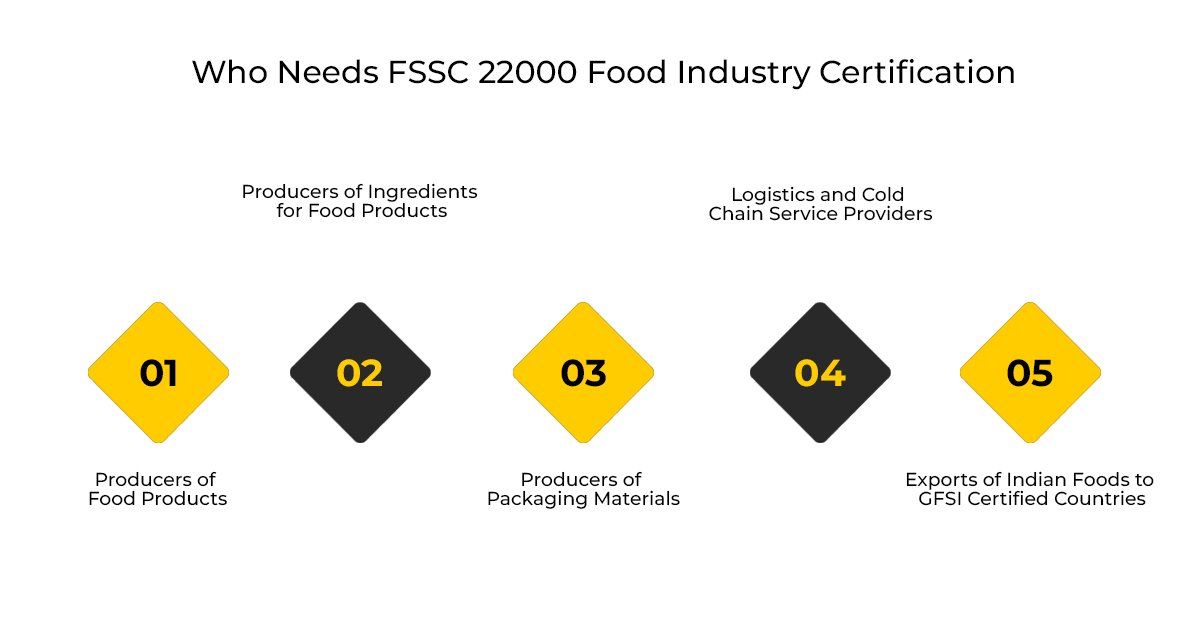
The FSSC 22000 certificate is available to many types of organizations within the food production chain. In India, the following types of businesses may require or greatly benefit from this certificate:
- Producers of Food Products
This category represents the main focus of the FSSC food manufacturing certification. Businesses producing food products such as beverages, food products, and snacks, for sale either wholesale or retail, will greatly benefit from FSSC 22000, particularly those who produce products intended for export.
- Producers of Ingredients for Food Products
Companies producing food ingredients or additives will have to demonstrate compliance with FSSC food safety guidelines before their products can be used in multinationals’ food products.
- Producers of Packaging Materials
Producers of packaging materials that are used in food manufacturing, like pouches and films, can apply for the FSSC 22000 certification according to the criteria of their respective industry sectors.
- Logistics and Cold Chain Service Providers
Service providers involved in the transportation of food products can get their businesses certified under the FSSC 22000 certification scheme. The rise in the trend of organized retail and delivery of foods in India makes this an increasingly relevant application segment.
- Exports of Indian Foods to GFSI Certified Countries
Exports of Indian food products to EU, UK, US, Canada, Australia, and countries of the Middle East require GFSI certification, which is provided by FSSC 22000. Otherwise, it will not be possible for Indian food products to reach premium retail counters abroad.
>Helpful Guide:- FSSC 22000 Certification Documents Required: Complete Checklist for Food Businesses in India (2026)
Understanding the Difference Between ISO 22000 and FSSC 22000 Certification Food Industry
ISO 22000
The ISO 22000 standard was developed by the International Organisation for Standardisation (ISO). The standard specifies the requirements for a food safety management system, which can be implemented by any party in the food chain. ISO 22000 is a certification-ready standard but it is not GFSI benchmarked.
FSSC 22000
FSSC 22000 is based on the ISO 22000 standard but includes additional requirements including the use of PRPs, food fraud, and food defense. But what makes FSSC 22000 unique is that it is GFSI benchmarked.
ISO 22000 vs FSSC 22000 – Key Differences
- GFSI Benchmarking: FSSC 22000 is benchmarked by GFSI; ISO 22000 is not
- Market Acceptability: FSSC 22000 is recognized by leading global retailers and food brands; ISO 22000 may not meet all buyer expectations
- Supplemental Criteria: FSSC 22000 mandates additional criteria for food fraud, food defense, and allergens not covered by ISO 22000
- Third-Party Audits: FSSC 22000 undergoes thorough third-party audits through accredited certification agencies
- Preparation & Investment: FSSC 22000 demands more effort and expense, but offers better market credibility
For the majority of food producers in India intending to access international markets or organized retail networks, FSSC 22000 is the recommended standard. For smaller enterprises concentrating only on the local market, ISO 22000 can serve as an appropriate initial step.
>Helpful Guide:- Most Common Non-Conformities Found in FSSC 22000 V6 Audits
Step by Step Process To Get FSSC 22000 Certification For Food Industry
Understanding how to get FSSC certification is essential before embarking on the journey. The FSSC 22000 certification process for food companies India typically follows these steps:
Step 1: Gap Analysis
In this step, there is an exhaustive gap analysis of your current food safety management system in relation to the requirements of the FSSC 22000 V6 standard. It allows you to determine areas where compliance is not achieved and will guide your implementation strategy. Many organizations hire consultants who have knowledge about FSSC requirements in India.
Step 2: Choosing a Certification Body
FSSC 22000 can be certified by accredited certification bodies (CBs) that are recognized by the FSSC Foundation. There are many NABCB-accredited or IAF-affiliated CBs in India that provide auditing services for FSSC 22000 standards.
Step 3: System Documentation
Documentation for your Food Safety Management System needs to be created and included in the following items:
- Policy and objectives regarding food safety
- Your HACCP plan
- PRPs that relate to your industry
- An assessment of food fraud vulnerability
- Food defense plan and allergen control measures
- Recall and traceability procedures
Step 4: Training and Implementation
All individuals involved in the process will require training about FSSC food safety requirements. Implementation of the documented system should take place within an adequate timeframe (typically three to six months).
Step 5: Internal Audit
An internal audit should be conducted prior to the external audit in order to ensure that there are no gaps or non-conformances with your FSMS. These gaps need to be fixed and confirmed.
Step 6: Stage 1 External Audit (Desk Review)
In the first stage of external audit, the certification body reviews the documentation of your company in order to assess its readiness for the next stage. At this point, a desk review is done.
Step 7: Stage 2 External Audit (On-Site Certification Audit)
This step constitutes the main on-site audit, during which time your FSMS is audited to determine whether it is effectively being implemented. Your plant will be inspected, personnel interviewed, and non-conformances fixed prior to issuing the certificate.
Step 8: Certification and Surveillance
Following the successful conclusion of Stage 2 audit and correction of all non-conformances, your FSSC 22000 certificate will be issued.Certificates remain valid for three years after which annual surveillance audits are done.
Timeline and Cost of FSSC 22000 Certification For Food Industry
The duration that would be required for Indian food companies to be certified with the FSSC 22000 would typically lie in the range of 6 months to 1 year, based on the size of the organization, food safety status of the organization, and type of products offered by the company.
The key cost parameters associated with FSSC 22000 certification for food Industry would be:
- Fees charged by certification bodies
- Fees associated with consulting/implementation services
- Fees related to training staff members
- Money required for improving infrastructure to satisfy PRPs
Based on rough estimates, small and medium food organizations in India typically spend anywhere between 3 to 10 lakhs rupees to get themselves FSSC 22000 certified.
>Helpful Guide:- FSSC 22000 Certification Cost In India: Complete Process
Benefits of FSSC 22000 for the FSSC 22000 Food Industry in India
- Global market access: The GFSI certified certificate allows entry into the markets of over 100 countries.
- Supplier advantage: Most major consumer goods manufacturers in India prefer that the suppliers be FSSC 22000 certified.
- Buyer audits waiver: With the GFSI certificate, the buyers can easily waive their audit procedure, saving considerable time and money.
- Internal efficiency: The certification process itself ensures efficient operations and traceability of the products and services offered by the company.
- Government compliance: The FSSC 22000 standard complies fairly well with FSSAI standards.
>Top Trending Guide:- BRC Full Form: All 3 Meanings Explained – Food, Export and Education (2026 Guide)
Frequently Asked Questions
What is the FSSC 22000 certification process for food companies India?
The process for FSSC 22000 certification of food companies in India includes gap analysis, documentation, training, internal audit, and an external audit conducted in two phases by an accredited certification body. It usually takes between six and twelve months.
What are the food safety certification FSSC requirements India?
Food Safety Certification FSSC requirements in India require the company to adhere to ISO 22000:2018, sector-specific prerequisites (such as ISO/TS 22002-1), and FSSC 22000’s requirements related to food fraud, food defense, allergens, and food safety culture.
How to get FSSC certification for my food business?
To answer the question about obtaining FSSC certification, a gap analysis is essential, followed by choosing an accredited certification body, developing FSMS documentation, training, and conducting Stages 1 and 2 audits. Consulting an expert will make everything easier.
Which is better FSSC or ISO for a food company?
FSSC 22000 should be considered superior for businesses seeking to export their products or sell them to big retail chains, whereas ISO 22000 can serve as a good basis for those planning to stay in the domestic market only.
What is the FSSC ISO difference?
The main FSSC vs ISO difference is that FSSC 22000 is benchmarked against the GFSI criteria, which makes it recognized globally by all big purchasers, while ISO 22000 is not GFSI-certified. FSSC 22000 includes additional food fraud and defense clauses on top of ISO.
Is ISO vs FSSC a choice or can a company have both?
In the ISO vs FSSC discussion, FSSC 22000 is built on ISO 22000, which means that having an FSSC 22000 certification will imply compliance with ISO 22000 standards, as the two cannot be chosen independently of each other.
Does FSSC 22000 cover all food businesses or only manufacturers?
The scope of application for FSSC 22000 is quite wide; it includes not only manufacturing food, but also manufacturers of ingredients and packaging materials and logistics operators.