

The food business needs an FSSC 22000 certificate in order to continue operations since it guarantees your clients and even the world that your food safety management is up to the mark. However, the certificate should always be renewed on time as well in order to maintain the credibility of the food organization.
Starting from the year 2026, the situation has become more stringent due to the launch of Version 7 of the standard. According to the new regulations, all businesses need to work on upgrading their management practices right away as failure to do so may result in loss of their sales opportunity.
All the information you should know regarding the FSSC 22000 Certification validity, the procedure for its renewal, the eligibility criteria, and compliance with the standard by companies in India till 2026 and further will be discussed in this blog post.
What Is FSSC 22000 Certification validity and Why Does It Matter
FSSC 22000 is a recognized food safety management system standard globally formulated by the Foundation for Food Safety Certification. This food safety system standard integrates ISO 22000 standards along with other prerequisites related to sectors and the FSSC organization.
It is important for businesses to know how valid their FSSC 22000 is as expired certification means loss of credibility among customers and retailers; you may even lose contract opportunities, especially with multinational food organizations or exporters who require active FSSC certification.
For Indian businesses dealing with food production, processing, and services, FSSC validity India is becoming an increasing challenge due to regulatory compliance demands from FSSAI and global trading organizations.
How Long Is FSSC 22000 validity
The validity period for the FSSC 22000 is three years. The certification cycle of three years operates as follows:
Year One: Initial Certification
Upon successful completion of the certification audits for both Stage 1 and Stage 2 carried out by an accredited certification body, your organization will receive its FSSC 22000 certificate. The validity period of this certificate is three years, starting from the issuance date. The first surveillance audit should be completed within one year from this date.
Year Two: First Surveillance Audit
In year two, an inspection audit is done to ensure that your food safety management system remains compliant with the FSSC criteria. The audit is usually less time-consuming than the initial audit but is used to check your corrective measures and compliance levels. If you fail to do the audit, your FSSC becomes invalid.
Year Three: Second Surveillance Audit and Renewal Preparation
The second surveillance audit occurs after three years. At about the same period, your company is supposed to start preparing for the FSSC certification renewal. This FSSC certification renewal process consists of a complete re-certification audit, which is basically the same process that occurred when you first applied for certification.
>Helpful Guide:- Think You Don’t Need FSSC 22000? Think Again
FSSC 22000 Certification Validity and Renewal: When and How to Start the Process
The ideal timing for FSSC renewal is six months prior to the expiration date of your certificate. This ensures that you have sufficient time to gather all required documentation, perform internal audits, rectify any non-conformances, and schedule the recertification audit.
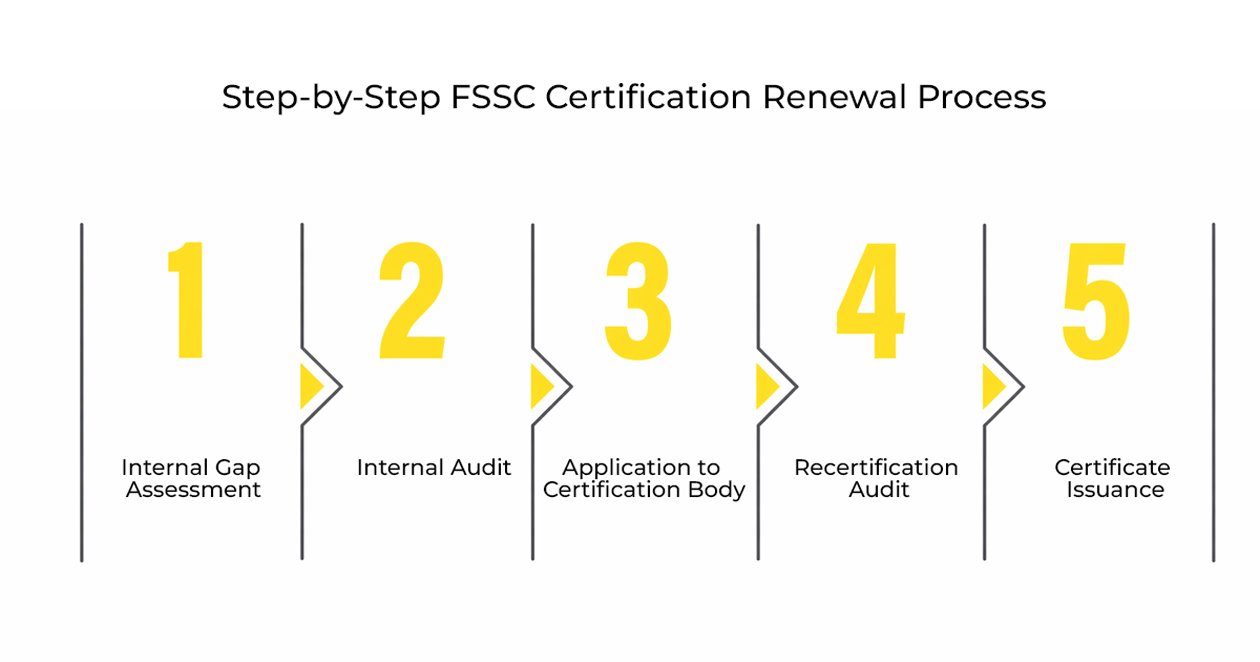
Step-by-Step FSSC Certification Renewal Process
- Internal Gap Assessment: Perform an internal assessment of your organization’s food safety management system based on the latest version of FSSC 22000 standard. Since version 6.0 of FSSC has been launched in 2024, you should check whether the internal system conforms to the latest requirements.
- Internal Audit: Complete an internal audit and management review of all applicable ISO 22000 and FSSC 22000 additional requirements.
- Application to Certification Body: Make a renewal application either to your current accredited certification body or find another one which is certified by FSSC.
- Recertification Audit: Your certification body will conduct a comprehensive recertification audit that will cover all your food safety management systems. Major findings of non-conformity should be addressed prior to the renewal.
- Certificate Issuance: If all findings have been rectified and the audit team is satisfied, a new certificate will be issued for three more years.
It is crucial to make sure that your certification body is certified by FSSC in case of FSSC validity india.
>Helpful Guide:- Most Common Non-Conformities Found in FSSC 22000 V6 Audits
Who Is Eligible for FSSC 22000 Certification
- Food Manufacturers
This is the most prevalent type. It involves food producers such as those of dairy products, meat products, seafood products, and ready-to-eat meal products, alongside non-perishable products such as candy products, snack foods, and beverages. Such food manufacturers represent the core of FSSC certified businesses globally.
- Feed and Pet Foods Manufacturers
Business entities that manufacture animal feeds as well as pet foods come into the purview of certain FSSC 22000 types of companies.
- Packaging Materials Manufacturers
Food packaging material manufacturers such as bottle manufactures, can manufacturers, pouches, and wrapper manufacturers can gain certification under FSSC 22000.
- Food Service and Catering
Food service providers such as full-service caterers, airline caterers, and even hospitals which have their own kitchens can also apply for FSSC eligibility india under the catering segment of the standard.
- Storage and Transport
Ambient and refrigerated logistics and transport operators can get covered under FSSC 22000 provided that they manage food products.
- Retail
Organizations operating within the retail segment which make their own private label foods can also apply for the certification under the retail sector.
The matter of FSSC eligibility in India arises quite often in regard to FSSAI recognized standards. It must be noted that although FSSC 22000 is a private standard and not directly required by the FSSAI, it is well recognized and mandatory in several export destinations and foreign multinationals.
FSSC 22000 validity: What Indian Businesses Must Know
For businesses operating in India, knowledge about FSSC 22000 validity in India entails not only meeting the requirements set by FSSC Foundation globally but also complying with local regulations. The Indian food sector has been witnessing increased FSSC 22000 implementation, especially by:
- Food manufacturers exporting products to EU, US, and Middle Eastern countries.
- Big food producers supplying quick-service restaurants worldwide.
- Suppliers and co-packers serving international food brands.
- Packaging manufacturers serving food-grade export businesses.
There are many accredited FSSC certification organizations in India’s market, which are even from international agencies with India branches. It is important for businesses to confirm the accreditation status of their certification organization before starting the certification/re-certification process.
Moreover, it is recommended for Indian companies to keep all records related to their FSSC certificate validity, such as surveillance audits, re-certification periods, and corrective actions register, as they could be required in an FSSAI inspection or customer audit.
>Helpful Guide:- FSSC 22000 Certification Documents Required: Complete Checklist for Food Businesses in India (2026)
Common Reasons FSSC 22000 validity Is Suspended or Withdrawn
Continued validity of your FSSC certification is more than just undergoing audit procedures; you need continuous compliance. Here are some factors that may lead to suspension or revocation of your FSSC certification:
- Inability to conduct surveillance audits within the set period of time.
- Unresolved major nonconformity after set deadlines.
- Voluntary withdrawal of the company.
- Use of the FSSC mark or certificate in a fraudulent manner.
- Non-payment of fees to the certification body.
The suspended certificate will be visible on the FSSC public register, which can be seen by customers, retailers, and authorities. It will definitely affect your business relations; therefore, you should not take your FSSC renewal process lightly.
>Helpful Guide:- FSSC 22000 Certification Cost In India: Complete Process
Tips for Maintaining FSSC 22000 Validity Between Audits
Being certified is just the start; keeping your FSSC valid for the next three years is another task altogether:
- Conduct internal audits quarterly and record any issues with their resolutions.
- Make sure your HACCP and prerequisite programme documents are up-to-date.
- Conduct training on food safety policy and FSSC standards for your staff.
- Monitor FSSC 22000 standards for any changes and adjust accordingly.
- Maintain regular communication with your certifying body between audits.
Key Takeaways
- The FSSC 22000 validity is for three years starting from the initial certification date, and there are annual surveillance audits that must take place within this period.
- The FSSC must be renewed at least six months prior to the expiration date of the existing certificate.
- Both food production companies as well as food services providers including packaging material firms can undergo the process of FSSC 22000 certification in India.
- The FSSC 22000 recertification procedure entails a complete recertification audit, which is done by an authorized certification body.
- The FSSC 22000 validity India requires continuous improvement and other activities throughout the validity period.
>Top Trending Guide:- BRC Full Form: All 3 Meanings Explained – Food, Export and Education (2026 Guide)
Frequently Asked Questions
What exactly is the FSSC 22000 certification validity and renewal india timeline?
FSSC 22000 certification is valid for three years in India, with annual surveillance audits in years one and two, followed by a full recertification audit before the three-year period ends.
How long FSSC certificate valid India before it expires?
The FSSC certificate is valid for three years from its date of issuance. Renewal must be completed before expiry to avoid suspension or lapse in certification.
What does the FSSC certification renewal process involve for Indian companies?
The FSSC certification renewal process involves an internal gap assessment, a formal internal audit, application to an accredited certification body, and a full recertification audit to issue a fresh three-year certificate.
Who eligible FSSC certification, can small businesses in India apply?
Yes, any organisation in the food chain including small manufacturers, caterers, and packaging suppliers can be eligible for FSSC 22000, provided they meet the applicable sector-specific requirements.
Which are the FSSC required companies in India?
Multinational food brands, global QSR chains, EU and US export-focused manufacturers, and large retail private label suppliers typically require their Indian vendors and partners to hold valid FSSC 22000 certification.
How do I determine FSSC eligibility India for my food business?
Review the FSSC 22000 scope categories on the FSSC Foundation website and consult an accredited certification body in India for a pre-assessment to confirm your category and eligibility.
What happens if I miss my FSSC renewal deadline?
Missing the FSSC renewal deadline leads to certificate suspension or lapse, which is publicly visible on the FSSC register and can result in immediate loss of customer contracts or export approvals until recertification is achieved.