
In the modern global marketplace, being an ethical company is not just a choice but a necessity. If you are a garment exporter, a manufacturing plant, or a supplier for overseas companies, showing that you adhere to ethical labour standards can be crucial for maintaining healthy business relations. That’s why getting certified by SA 8000 in India is important.
Social Accountability 8000 (SA 8000) is one of the most popular social accountability certifications around the world. As many labour-intensive sectors such as garments, leather, and electronic products are part of India’s export industry, this certification holds great significance. Here is a complete guide on all things related to SA 8000 India, including its meaning, requirements, process, and fees.
What Is SA 8000 Certification: Understanding the SA 8000 Standard India
SA 8000 is an international standard that has been devised by Social Accountability International (SAI). This standard offers a structure for organisations to handle social performance in their supply chains and guarantees the consumers/buyers that the products have been produced under humane working environments.
The SA 8000 standard in India is derived from the international human rights norms, which are enunciated in the Universal Declaration of Human Rights, the UN Convention on the Rights of the Child, and many conventions of International Labour Organisation (ILO).
The standard deals with nine significant aspects, which include:
- Child Labour
- Forced or Compulsory Labour
- Health and Safety
- Freedom of Association & Right to Collective Bargaining
- Discrimination
- Disciplinary Practices
- Working Hours
- Remuneration
- Management Systems
For Indian companies, meeting these standards via social accountability certification in India is a message to their international partners that their supply chain is open, ethical, and meets all criteria.
>Helpful Guide:- Factory Audit Standards For Global Compliance Success | Legal4sure
Who Needs SA 8000 Certification in India
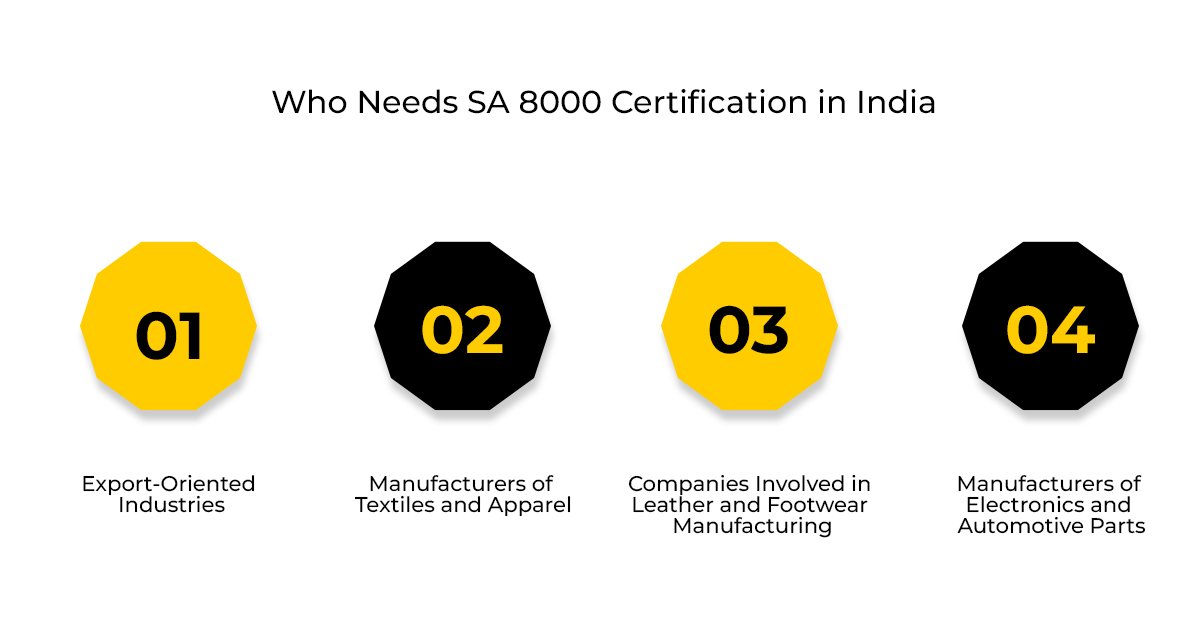
Certification SA 8000 India does not confine itself to any particular industry. But it becomes important for those industries where there is international concern regarding the working of labour. Following is the list of people who usually go for it:
- Export-Oriented Industries
Companies that export their products to developed nations such as Europe, America and others usually have their buyers asking for the certification. Garments, furniture, footwear and sports goods companies are some of the leading industries for SA 8000 certification.
- Manufacturers of Textiles and Apparel
India has been producing large quantities of textiles and exporting it to various countries around the world. Leading fashion brands and retailers are insisting on SA 8000 standard India certification from Indian manufacturers before buying from them.
- Companies Involved in Leather and Footwear Manufacturing
Since leather and its processing and manufacturing require heavy manpower, industries located in areas such as Chennai, Agra and Kanpur go for SA 8000 certification.
- Manufacturers of Electronics and Automotive Parts
As globalisation calls for responsible sourcing of materials, there is increasing interest from Original Equipment Manufacturers and tier one suppliers of electronic and automotive components in SA 8000 certification India.
- NGOs and Social Ventures
Even not-for-profit organisations and social ventures that employ many people in manufacturing can leverage on SA 8000 as a symbol of responsibility and accountability.
>Helpful Guide:- Who Really Needs Sedex Certification? The Truth Buyers Don’t Clearly Tell Suppliers
SA 8000 Certification Requirements for Factories India
It is essential that one understands the criteria that go into getting a factory in India SA 8000 certification. Generally speaking, the organisation should be able to comply with all of the requirements stated in the standard. Below are some of the essential criteria:
- No Child Labour
Children under the age of 15 years (14 in some countries according to ILO Convention 138) should not be hired for work. Appropriate action plans need to be formulated in case children are found working.
- No Forced Labour
Employees must not be asked to pay money as deposits or show identification or forced to work overtime under threat of penalties.
- Safe Working Environment
Companies should ensure that the environment is safe and healthy, conduct training sessions on safety, and keep accident reports.
- Freedom of Association
The worker should be free to associate himself with labor unions and negotiate collectively with employers. If there are laws against this, then other options should be presented.
- Anti-Discrimination
The recruitment process, compensation, training opportunities, and promotion should not discriminate against an individual based on their race, gender, religious beliefs, country of origin, or any other protected category.
- Working Hours
Regular working hours should not exceed 48 hours weekly. Overtime should be voluntary and restricted to a maximum of 12 hours each week, paid at a higher hourly rate than standard.
- Living Wages
Compensation should meet at least the minimum wage level prescribed by law or be comparable to that in the industry, and it should be enough for basic living necessities.
- Social Accountability Management System
A written social accountability management system should be established.
>Helpful Guide:- BRC Certification Without a Consultant: Why 80% Companies Fail?
How to Get SA 8000 Certification in India: Step-by-Step Process
The steps involved in getting SA 8000 certification process India are as follows:
Step 1: Study the Standard
Start off with a detailed study of the SA 8000:2014 (latest edition) standard. You can download the document from SAI’s official website or buy a copy of the same from a certified certification body. Train your management and staff about the requirements of the standard.
Step 2: Perform a Gap Analysis
Compare your organisation’s HR policies, work environment, pay scales, safety protocols, and management processes with the requirements of the SA 8000 standard. Identify the gaps and focus on rectifying them immediately.
Step 3: Develop Social Accountability Policy and Procedures
Draft a social accountability policy and prepare a set of procedures for handling worker rights, health & safety issues, grievances, and management reviews. It is important because the SA 8000 audit India will include documentation as one of its components.
Step 4: Make Improvements
Implement your newly drafted policies and procedures. This may include improvements in the condition of worker accommodations, updates in the employment agreement, fire drills, training sessions, payroll changes, etc.
Step 5: Conduct Internal Audit
Make sure to carry out an internal audit prior to conducting an audit through a third party. Ensure that your policies comply with all documents and interviews from your employees. Address any discrepancies found.
Step 6: Choose an Accredited Certification Body
Select an SA 8000 accredited certification body authorised by SAI. Well-known certification bodies functioning in India are Bureau Veritas, SGS, RINA, and Intertek. Make sure they appear on the SAI website as authorised auditors.
Step 7: Stage 1 Audit (Document Audit)
A stage 1 audit will be done by the certification body, which mainly entails reviewing your documentation, policies, and management system. In some cases, they will take you around your workplace to gain insight into your operation.
Step 8: Stage 2 Audit (On-Site Audit)
This is the key SA 8000 audit India. The auditor spends time in your organisation, interviews employees in private, examines working conditions, checks payroll records, and evaluates adherence to all nine elements of the standards.
Step 9: Corrective Actions and Follow-Up
In case non-conformities are found, you are given time to come up with a corrective action plan (CAP). Minor non-conformities can be rectified prior to issuing a certificate. Major non-conformities need another audit session.
Step 10: Certification and Surveillance Audit
After clearing all tests, you receive your SA 8000 certificate from the certification body. The certificate is valid for three years. Every six months, surveillance audits are performed to ensure continued compliance.
>Helpful Guide:- Top 5 Mistakes Indian Export Houses Make During BRCGS Audits
Cost of SA 8000 Certification India
Factors That Affect Cost
- Number of staff employed and site locations
- Sector the business operates within and associated risks
- Level of current compliance with the SA 8000 standard
- Certifying organization selected
- Site location (metropolitan or rural)
The following table shows an estimation of all expenses related to SA 8000 Certification in India. The cost varies depending on the size of the factory, industry, and certification organisation.
| Cost Component | Min. Estimate (INR) | Max. Estimate (INR) | Remarks |
| Gap Analysis / Initial Assessment | ₹50,000 | ₹1,50,000 | One-time |
| Consultancy Fees | ₹40,000 | ₹1,20,000 | Optional |
| Staff Training & Awareness | ₹20,000 | ₹80,000 | Per programme |
| Documentation Development | ₹15,000 | ₹50,000 | Policies & SOPs |
| Implementation (Infra/HR upgrades) | ₹30,000 | ₹2,00,000 | Variable |
| Internal Audit Cost | ₹10,000 | ₹40,000 | In-house/external |
| Certification Body Audit Fees | ₹80,000 | ₹2,50,000 | Stage 1 + Stage 2 |
| Certification Issuance Fee | ₹10,000 | ₹30,000 | One-time |
| Bi-annual Surveillance Audits | ₹40,000 | ₹1,00,000 | Per visit/year |
| Re-certification (every 3 years) | ₹60,000 | ₹1,50,000 | Full audit cycle |
| Estimated Total (Initial Year) | ~₹3,05,000 | ~₹9,70,000 | SME to Large Unit |
>Helpful Guide:- Cost Of SEDEX Certification India | Save Up To 30% On Audit
Is SA 8000 Mandatory for Export: SA 8000 Certification India and Trade
The short answer would be: Yes, it depends on your buyers. SA 8000 is neither a law nor a regulation in India. But there are a lot of international buyers, especially large retail chains from the EU, UK, and US, who make SA 8000 a contractual requirement. If you do business with such organisations, SA 8000 becomes de factor mandatory.
Some sectors, where there is more pressure from buyers to get social accountability certified in India, are:
- Fashion and Apparel
- Furniture and Textiles
- Luxury Goods
- Bespoke Craftsmanship
- Agricultural Products (on the rise)
Aside from buyer pressure, getting certified as SA 8000 in India will enable you to become part of responsible sourcing initiatives, get into public tenders, and even prove your ESG compliance to your shareholders.
Benefits of SA 8000 Certification India
The advantages of getting social accountability certification in India extend far beyond mere fulfillment of the purchasing requirements:
- Greater access to markets in developed nations who insist on ethically sourced products
- Increased productivity and motivation amongst workers because of improved working environment
- Less likelihood of strikes or labor-related issues
- More favorable brand image and reputation among foreign buyers and investors
- Conformity with objectives of ESG and CSR for sustainable development in the long run
- Competitive edge against other firms without certifications in competing for overseas contracts
- Management practices that lead to greater efficiency
Key Takeaways
- SA 8000 is a globally recognised standard for ethical workplace practices covering child labour, forced labour, health & safety, and worker rights.
- The SA 8000 standard India is administered through Social Accountability International (SAI) and is audited by accredited certification bodies.
- Indian exporters in sectors like textiles, leather, and manufacturing benefit most from obtaining this social accountability certification India.
- The process involves a gap analysis, documentation, internal audit, and a formal SA 8000 audit India by an accredited body.
- While not legally mandatory, SA 8000 is increasingly required by international buyers and can significantly enhance export competitiveness.
>Top Trending Guide:- BRC Full Form: All 3 Meanings Explained – Food, Export and Education (2026 Guide)
Frequently Asked Questions
What is SA 8000 certification?
SA 8000 is an international standard on social accountability. Certification of such kind implies compliance of a company or organization with certain regulations concerning ethical treatment of workers. Those include absence of child labor, forced labor, good health and safety practices, proper working time and reasonable salaries.
Who needs SA 8000 certification in India?
All manufacturers and suppliers in India that export products to other countries in such industries as textiles, leather goods, electronics, consumer goods, etc. have to undergo SA 8000 certification in India. Especially important it is for those manufacturers which provide services to European or American brands.
How to get SA 8000 certification in India?
For getting SA 8000 certification in India a company should start from conducting a gap analysis, develop relevant policies and documents, perform changes where necessary, run internal audit and then contact SAI accredited certification body for final audit. The whole procedure usually takes 3 to 6 months.
What is the SA 8000 certification process step by step in India?
SA 8000 certification process steps in India are: comprehending the standard, conducting a gap analysis, preparing policies, implementing SA 8000, performing an internal audit, choosing an accredited certification body, conducting Stage 1 (documentation) audit, conducting Stage 2 (site visit) audit, implementing corrections, if necessary, and finally obtaining certification, which would then be subject to bi-annual surveillance audits.
What are the SA 8000 certification requirements for factories in India?
Requirements of SA 8000 certification for factories India are as follows: no use of child and forced labour, providing safety at workplaces, freedom of association, no discrimination, maintaining maximum working hours, provision of reasonable wages, and a documented management system. All nine standards need to be met.
Is SA 8000 mandatory for export?
SA 8000 is not mandatory for export from India by law, but many international buyers in Europe, the United States, and the UK insist on this certification through contractual requirements. As a matter of practical experience, SA 8000 is essential for exporters dealing in garments, leather, and furniture.
How long is SA 8000 certification valid in India?
Your SA 8000 certification is valid for three years from the day of issuance. Within this period, you will undergo a six-monthly surveillance audit to ensure continued compliance with SA 8000 standards India.