

FSSC 22000 v6.0, which will certainly become the ultimate food safety, quality, and consumer satisfaction standard by 2026, is intended to provide the criteria of success in a fiercely competitive international food market. Considering the above-mentioned facts, it is extremely important to be aware of the intricate interrelation between the latest edition of ISO 22000, Sector PRPs, and the most updated Additional Requirements.
The guide is to include a detailed list of the requirements to be certified in accordance with FSSC 22000 as well as the entire certification system. The first part of the guide will include the conditions of the Indian companies’ eligibility for certification and the three-tiered clause system, which is the core of the whole certification process. Moreover, there will be a list of all necessary documents for certification including the analysis of food fraud and correspondence with FSSAI regulations.
What Is FSSC 22000
The Food Safety System Certification 22000 (FSSC 22000) is an internationally recognized certification standard that belongs to the foundation FSSC. There are three major parts of the mentioned certification scheme, which include ISO 22000:2018, technical specification for PRPs in the specified sector, and additional requirements of the FSSC scheme. The specified scheme is benchmarked and accredited by GFSI, which means that the scheme can be used as a proof of the food safety proficiency by the international retailers and consumers of food products.
The organizations in India that want to supply their produce to multinational organizations should comply with the FSSC standards as well. FSSC 22000 version 6, which was introduced in 2023, contains FSSC 22000 additional requirements for food fraud prevention and protection, food allergen controls, and environmental monitoring. Any audit after 2026 should be conducted according to the Version 6 of the FSSC 22000 scheme.
FSSC 22000 Requirements: Understanding Eligibility
Before commencing with the certification procedure, it is essential to ensure that one is eligible for the FSSC certificate according to its eligibility criteria. Every firm and every function does not come under the purview of this certificate scheme.
FSSC Eligibility Categories
The FSSC 22000 includes various categories in the food chain. Some of the most important for the Indian industry are listed below:
- Category C – Production of ambient stable products (grains, snacks, confectionary, oils)
- Category D – Production of perishable animal products (meat, poultry, dairy, fish)
- Category E – Production of perishable plant products (fresh cut fruits and vegetables)
- Category F – Production of feeds / pet foods
- Category G – Catering and food services
- Category I – Pre-retail production (retail own brands)
- Category K – Manufacturing of packaging materials
- Category M – Agriculture (crops and livestock)
This particular category represents a technical specification for PRPs. The example is that Category C makes use of ISO/TS 22002-1, while Category K uses ISO/TS 22002-4 for packaging material manufacturers. Correct categorization represents the initial stage of assessing FSSC eligibility.
Key FSSC Eligibility Conditions
In addition to the category match, there are other criteria that need to be met for certification as follows:
- The organisation should be a registered and existing legal body running within the country.
- The organisation should have a food safety management system functioning before auditing the process of certification.
- The organisation should choose a certification body which has been accredited under the FSSC scheme.
- The organisation should accept having its certificate posted on the database of FSSC.
>Helpful Guide:- Think You Don’t Need FSSC 22000? Think Again
FSSC 22000 Requirements: Complete Clause Structure
There are three documents that contain the FSSC 22000 standards. It is necessary to comprehend the levels before reviewing the FSSC 22000 requirements checklist.
Layer 1: ISO 22000 Requirements for FSSC Certification (ISO 22000:2018 Clauses)
The basic structure of the FSSC standard is formulated in accordance with the ISO 22000:2018, so that it becomes the basis for the ISO 22000 requirements for obtaining the FSSC certificate. The 10 clauses of its are in line with the HLS of ISO standards, therefore it can be integrated with other management systems like ISO 9001 and ISO 14001. Main clauses are:
- Clause 4 – Context of the Organization: Issues, interested parties, and the scope of the FSMS should be identified.
- Clause 5 – Leadership: Commitment of the top management, assignment of the responsibilities and food safety policy should be developed.
- Clause 6 – Planning: Risks and opportunities, food safety objectives and change management should be addressed.
- Clause 7 – Support: Proper management of the resources, competence, awareness, communication and documented information should be ensured.
- Clause 8 – Operation: This is the most difficult clause, involving PRPs, hazard analysis, HACCP / OPRP plan and traceability and preparedness for emergencies.
- Clause 9 – Performance evaluation: Internal audit, management review, monitoring and measurement processes.
- Clause 10 – Improvement: Non-conformities, corrective actions and continuous improvement should be managed.
Layer 2: Technical Specifications for PRPs
The Pre-requisite Program (PRP) is the basic hygiene and operational requirements for controlling the risks of food safety before implementing the HACCP system. The following are the technical requirements for PRP:
- ISO/TS 22002-1: Food production
- ISO/TS 22002-2: Food service
- ISO/TS 22002-3: Agriculture
- ISO/TS 22002-4: Food packaging production
- ISO/TS 22002-6: Manufacture of feed and animal feedingstuffs
- BSI PAS 222: Biological ingredients for foods and feeds
- BSI PAS 96: Foodservice and Retail (Food Defence)
The PRP requirements include such areas as building design, sanitation and disinfection, pest control, personal hygiene, water and air quality control, allergen control, and waste management.
Layer 3: FSSC 22000 Additional Requirements
Version 6 brings FSSC 22000 additional requirements that go beyond those contained in the ISO 22000 and PRPs. Some of them are:
- FFVA (Food Fraud Vulnerability Assessment): Threat analysis and mitigation of economic adulteration risks.
- Food Defense: Assessment of the threat to foods due to intentional contamination.
- Environmental Monitoring Program: Testing of environment related organisms on regular basis, especially helpful in RTE groups.
- Allergen Control Program: Measures for prevention of allergen cross contact during production.
- Multi-Site Management: Requirements of organizations with multiple sites operating under the same certification.
- Transport & Delivery: Food safety management during transport.
- Product Labeling: Labeling requirements compliance.
- Logo Usage: Logo requirements for FSSC 22000 certification mark.
FSSC 22000 Requirements: Essential Documents to Prepare
Your FSSC documentation will be used as proof by the auditor who will determine whether or not your system is in place and operational. The following documents related to FSSC 22000 certification are also FSSC 22000 requirements checklists that you can use to mark what you have and see what you lack.
Mandatory Documented Information (FSSC documents)
- Policy on Food Safety and FSBOs (Food Safety Objectives)
- Scope of FSMS (Food Safety Management System)
- Responsibilities and Authorities (Organizational Structure Chart)
- Records of Competence of the Food Safety Team
- HACCP Plan and Hazard Analysis
- PRP Documentation and Records (Corrective Actions, Monitoring)
- OPRP Plans
- Traceability of Products Procedure and Records
- Internal Auditing Program and Report
- Management Review Records
- Records of Non-conformities and Corrective Actions
- Program for Allergen Control and Risk Evaluation
- Assessment of Food Fraud
- Food Defense Plan
- Environmental Monitoring Program (if applicable)
- Supplier Evaluation and Approval Procedures
- Calibration Record of Monitoring Equipment
- Emergency Plan
For Indian facilities, FSSAI schedules, state licenses, and relevant Codex Alimentarius requirements must be reflected in FSSC documents.
FSSC 22000 Requirements and Process
The steps for FSSC certification process in India have been laid out below:
Step 1: Gap Analysis
The first step in the entire process involves conducting a gap analysis. This means that a thorough analysis of the current food safety management system in the organization will be done in relation to the FSSC 22000 version 6, and preferably against a full list of FSSC 22000 certification requirements. Gap analysis will help find out what needs to be set up. Organizations in India normally seek the assistance of consultants/certification bodies in carrying out gap analysis.
Step 2: Development and Implementation of System
The second step is to develop and implement the complete food safety management system in light of the results derived through the gap analysis process. It would include the development of policies and procedures which include food safety policy, HACCP, PRPs, food fraud vulnerability assessment, food defense, allergen management program, and food safety culture activities.
Step 3: Internal Audit
Before contacting an external auditor for certification, there is a need to conduct an internal audit based on all the requirements of FSSC 22000. The internal audit ensures that all the areas that have gaps are found and corrected prior to the certification process. The internal auditors should be trained and independent of the audited area.
Step 4: Stage 1 Audit (Document Review)
The certified accreditation body carries out the stage 1 audit process, which is basically a desk-based evaluation of the documents of your food safety management system. This audit is carried out by an auditor, who determines whether the system has been documented sufficiently to qualify for the stage 2 on-site audit.
Step 5: Stage 2 Audit (On-Site Verification)
In the second stage audit, all the steps of on-site verification need to be completed. The auditors will visit your premises and spend one to a few days to assess the implementation of the procedures that were documented. The auditors will scrutinize your production facility, carry out interviews with your staff members at all levels, review monitoring records, and do traceability. The non-conformances will have to be addressed.
Step 6: Certification Outcome
Once the second stage audit is successfully performed and non-conformances have been sorted out, the certification process is finalized, and the technical reviewer of the certification body gives his/her approval. You will get a certificate that is valid for three years.
Step 7: Surveillance Audits and Re-certification
Annual surveillance audits ensure that compliance is maintained continually. After three years of certification, a complete re-certification audit becomes necessary to prolong the certificate. The maintenance of the food safety management system and internal audit will help in achieving the objective of re-certification.
>Helpful Guide:- Most Common Non-Conformities Found in FSSC 22000 V6 Audits
FSSC 22000 Requirements and Process India
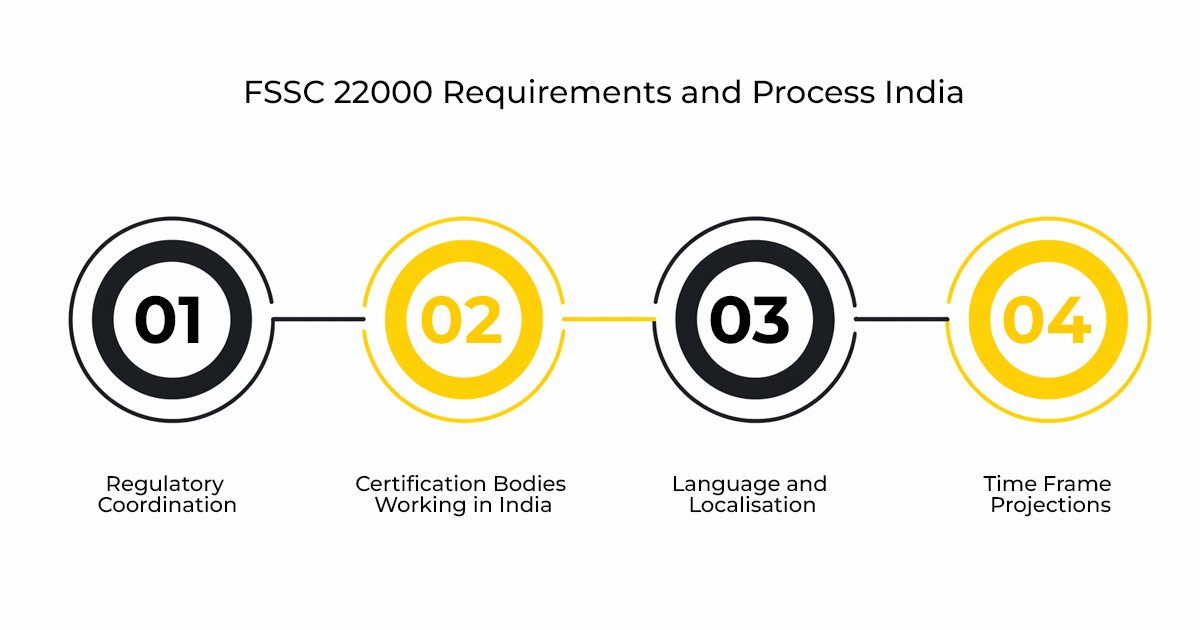
There are also some practical factors to be considered by Indian businesses regarding the implementation of the FSSC 22000 certification process.
Regulatory Coordination
FSSC 22000 is done parallel with FSSAI compliance. The FSSC forms that you create must have any requirement from the Schedule for Food Safety and Standards (Food Products Standards and Food Additives) Regulations and the Hygiene and Sanitary Practices Regulations. Auditors tend to verify whether the compliance of the FSSAI has been included in the FSMS.
Certification Bodies Working in India
Some international certification agencies operating in India have been authorized by FSSC to conduct their audit procedures. Examples of such organizations include SGS, Bureau Veritas, TUV SUD, Intertek, and DNV. It is recommended that you pick a certifying agency that has some experience in your particular food business sector.
Language and Localisation
English will have to be used in all your FSSC documentation and systems, with the local language as well where required for the factory floor staff. The auditors can interview your factory floor staff during verification, therefore language proficiency is an issue of both documentation and readiness.
Time Frame Projections
For a small Indian food producer that has never used FSSC 22000 before, it is likely to be certified within six to twelve months after beginning the process.
>Helpful Guide:- FSSC 22000 Certification Cost In India: Complete Process
Key Takeaways
- Certification criteria for FSSC 22000 include ISO 22000, sector-specific PRPs, and additional requirements of FSSC 22000, thus constituting a three-tier criterion.
- Meeting criteria for FSSC 22000 requires documentation of a food safety management system using FSSC version 6.
- Gap analysis, documentation, internal audit and external audit, including two phases, are included in FSSC 22000.
- Organizations located in India should ensure that their FSSC documents meet the criteria set by FSSAI, along with those of international standards.
- FSSC 22000 is accepted by GFSI and, hence, meets international standards for food safety.
FSSC 22000 Certification Requirements
Get expert support to meet FSSC 22000 certification requirements, including ISO 22000, sector-specific PRPs, additional requirements, documentation, gap analysis, internal audits, and Stage 1 and Stage 2 audit preparation.
Frequently Asked Questions
What are the core FSSC 22000 requirements an organisation must meet before applying?
It is necessary to implement ISO 22000:2018, the relevant technical specification of PRPs, and all additional requirements of FSSC Version 6, providing all documentation proving this fact before the audit.
What is the FSSC eligibility and documentation requirements India organisations should check first?
Indian organizations need to establish that they are in the relevant category of the food chain according to FSSC and have an active licence from FSSAI. They should be ready with all required documents in accordance with ISO 22000 and FSSAI regulation.
How to qualify FSSC certification if our existing HACCP system is basic?
To get FSSC certification with a basic HACCP, it is needed to do a gap analysis against ISO 22000 Clause 8, improve the hazard analysis and validation of CCPs, and implement all additional requirements of FSSC (food fraud and food defense) before your Stage 1 audit.
Is there a standard FSSC 22000 requirements checklist we can use to assess audit readiness?
The FSSC publishes the official scheme requirements document on its website, which acts as an FSSC checklist; also, certification bodies provide pre-audit checklists in accordance with Version 6 requirements.
What is the full timeline for FSSC 22000 certification requirements and process India?
The FSSC publishes the official scheme requirements document on its website, which acts as an FSSC checklist; also, certification bodies provide pre-audit checklists in accordance with Version 6 requirements.
Which FSSC documents are most commonly found deficient during audits?
Food Fraud Vulnerability Assessment, Environmental Monitoring Program, and records of allergens are the main problems identified by auditors; they are new in Version 6.
How to qualify FSSC certification for a packaging material manufacturer in India?
Packaging manufacturers fall under Category K and must implement ISO/TS 22002-4 for PRPs; otherwise, the qualification process, gap analysis, documentation, internal audit, and two-stage external audit, follows the same steps as for food manufacturers.