

Food safety is an important issue in the rapidly expanding domain of the Indian food industry. For all kinds of Indian food companies, be it a small-scale food service provider, a nationwide restaurant chain, or even a food manufacturer, the implementation of HACCP (Hazard Analysis & Critical Control Point) is the hallmark of their commitment to food safety.
While FSSAI ensures the legal structure for food businesses in the country, HACCP serves as a scientific guide for them. It is a process through which potential food safety hazards, biological, chemical, or physical, can be identified and controlled before they pose a threat to consumers.
This blog will provide a step-by-step walkthrough for Indian food businesses to create an FSSAI-compliant HACCP plan. You’ll learn to implement the 7 core principles, manage local hazards, and build a documented safety system that protects your brand and consumers.
What Is a HACCP Plan
HACCP is short for Hazard Analysis and Critical Control Points plan, which is a written procedure designed to identify the different food safety risks in the production process of a particular food business. The concept of HACCP is based on the principle of prevention rather than reaction.
Three major kinds of food safety risks are identified by the HACCP plan:
- Biological risks such as Salmonella, E. coli, and Listeria.
- Chemical risks including pesticide residue, cleaning solutions, and allergens.
- Physical risks like metal fragments, glass, and bone splinters.
With regard to food manufacturers in India, the HACCP plan is no longer considered just good practice; it is expected by the FSSAI in relation to mid-sized to larger sized food establishments.
Is HACCP Plan Mandatory for Food Businesses in India
This is one of the most frequently asked questions by FBOs in India. As far as the current FSSAI guidelines are concerned, there is no direct compulsion of adopting the HACCP system by all categories. However, under the provisions of the Food Safety and Standards (Licensing and Registration of Food Businesses) Regulations, 2011, and Schedule 4 of FSSAI regulations for manufacturers, it can be safely argued that HACCP systems have been made mandatory for certain categories.
In other words:
- The food business with an annual turnover more than Rs. 12 lakh (i.e., Central license holders) need to adhere to the provisions of Schedule 4 which are based on HACCP principles.
- For Exporters: If you are into export, then HACCP certification is essential especially when you are exporting to Europe, America, and/or Middle East countries.
- All those companies which intend to get BRC, ISO 22000 or FSSC 22000 certifications have no other option but to first develop HACCP plans.
Conclusion: Though HACCP may not be legally mandatory, it is highly recommended for all food manufacturers.
The 7 Principles of a HACCP Plan
Before we get into how to develop an Indian HACCP plan, it would help if we first got acquainted with the 7 internationally accepted HACCP principles that should form the foundation of any HACCP system:
- Conduct a Hazard Analysis
- Identify Critical Control Points (CCPs)
- Establish Critical Limits
- Establish Monitoring Procedures
- Establish Corrective Actions
- Establish Verification Procedures
- Establish Record-Keeping and Documentation
How to Create a HACCP Plan Step by Step for Food Business India
Here is a comprehensive guide on how to develop a HACCP plan in steps for the Indian food industry.
Step 1: Develop a HACCP Team
Prior to drafting any document for your HACCP plan, you must form a diverse HACCP team comprising representatives of various departments like production, quality control, sanitation, and even management. Even in small-scale firms, you need to have two to three people with knowledge about the process as part of your HACCP team.
Main duties of a HACCP team:
- Conduct a detailed process flow diagram of the production
- Determine the potential hazards at every stage
- Conduct periodical review/validation of the HACCP plan
Step 2: Define the Food Product and Its Intended Use
Define the food product you manufacture completely. This would constitute the first step in writing a typical HACCP plan format for food producers in India. It involves specifying:
- Product name and category
- Ingredient details and raw materials
- Physical, chemical, and microbiological properties
- Mode of packaging and shelf life
- Storage methods (ambient, chilled, or frozen)
- Target audience (general population, infants, elderly, or immunocompromised individuals)
Step 3: Creation of Process Flow Diagram
Create a process flow diagram depicting all the processes involved in manufacturing, right from the procurement of materials to dispatching the finished goods. This should include all the cleaning and sanitization steps involved. Conduct a walkthrough through your factory premises and compare it with your process flow diagram.
In terms of creating a HACCP Cost plan for the food manufacturing industry, this process forms the backbone of your hazard analysis in the next step.
Step 4: Conduct Hazard Analysis
The second step in the process of formulating your HACCP plan is one of the most important and time-consuming phases. At every point in the process flow diagram, you must conduct an analysis by answering the following questions:
- What all biological, chemical, and physical hazards are associated at each process point?
- How likely and severe could this hazard occur?
- Is the hazard critical enough to be included as CCP?
Common hazards in India, specifically in food manufacturing industry, include the following:
- Aflatoxins in spices, grains, and nuts
- Heavy metal poisoning due to industrial water
- Bacterial and other microbial growth in dairy products and meats due to lack of cold chain infrastructure
- Pesticide poisoning of fruits, vegetables, and grains
Step 5: Determine the Critical Control Points (CCPs)
A CCP refers to a process point where a control can be exercised to prevent, eliminate or minimize food safety hazards to an acceptable level.
To identify a CCP, use the CCP decision tree that is part of the template India HACCP plan. Check:
- Is there a control method present at that stage?
- Does the step aim to control the hazard?
- Can contamination reach unacceptable levels?
- Is the subsequent step capable of controlling the hazard?
The most common examples of CCPs in Indian food manufacturing industries include pasteurization of dairy products, metal detectors for packaging, and cooking or frying temperatures in ready-to-eat (RTE) products.
Step 6: Identify the Critical Limits for Each CCP
Every CCP needs a critical limit that sets the maximum or minimum values that the parameters need to maintain. The critical limits are non-negotiable and are derived from regulatory standards or scientific data.
Critical limit examples applicable to India are:
- Pasteurization temperature: Minimum temperature of 72oC for 15 seconds according to the FSSAI standards for milk
- pH in acidified food items: less than 4.6 to avoid contamination by Clostridium botulinum bacteria
- Water activity (Aw) of dried items: below 0.85 for inhibiting bacterial growth
Step 7: Establishing Monitoring Procedures
Monitoring helps you know whether your CCPs are in control. The HACCP plan should state:
- What needs to be monitored (e.g., temperature, pH levels, metal detection outcomes)
- How this monitoring should take place (e.g., using a digital thermometer, pH meter, or X-ray detection system)
- The frequency of this monitoring (e.g., each batch, each hour, or constantly)
- The persons who should monitor
All monitoring activities must be recorded as part of your documentation, which is mandatory for all HACCP plan templates downloads India.
Step 8: Developing Corrective Actions
In spite of all the efforts put into monitoring activities, sometimes things go wrong. The HACCP plan should indicate what measures will be taken in case of deviation from critical limits. Corrective actions must include:
- The cause(s) of the problem
- Actions taken to regain control at the CCP
- Disposition of the affected food
- Recording the deviation and corrective action
Step 9: Verification Procedure Implementation
Verification means checking whether the implemented HACCP system performs as expected. The following verification measures need to be taken into account:
- Conducting internal auditing of the HACCP system records
- Conducting audits of the monitoring activities and corrective actions
- Microbial testing of the products or environmental samples
- Conducting calibration of the monitoring instruments
The FSSAI inspectors can ask you for the documentation related to verification measures during their audits. Therefore, the HACCP plan for food manufacturers needs to have the verification procedure described.
Step 10: Establishing Documentation and Records
In order to ensure the successful functioning of your HACCP system, appropriate documentation and record-keeping is necessary. Here are the documents required to be maintained under your HACCP plan:
- The HACCP plan itself (including all the seven principles of HACCP)
- Monitoring activity records
- Corrective action records
- Verification activity records
- Training records
Numerous Indian companies want to obtain a HACCP plan template download India. It is a useful starting point, but then you need to customize the template because only such documents can withstand third-party audit.
>Helpful Guide:- FSSAI Registration in India 2026: Application Process, Benefits & Legal Compliance
HACCP Plan Template India: What to Include
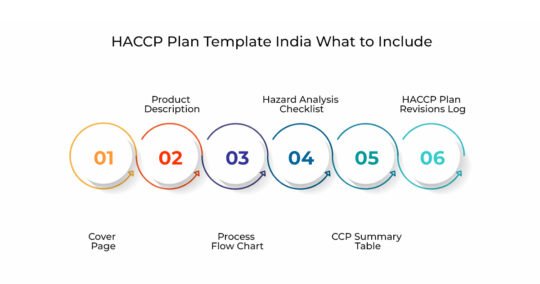
The HACCP Plan Template that needs to be developed in India must include the following sections:
- Cover Page: Name of the company, name of the product, name of the HACCP team, date of formulation and approval
- Product Description: As mentioned in step 2 above
- Process Flow Chart: Representation of all process steps involved graphically
- Hazard Analysis Checklist: Process step, hazard identification, significance analysis and controls
- CCP Summary Table: Identification of the CCP, critical limit, monitoring process, corrective action procedure, verification method, and record keeping
- PRP’s: GMP, GHP, Pest Control, Allergen Controls, Supplier Approval Procedure
- HACCP Plan Revisions Log: Record of changes made to HACCP Plan and reasons thereof
Practical Tips for Implementing a HACCP Plan for Food Manufacturers in India
- Do a gap analysis first: Determine how well your organization currently complies with HACCP requirements before developing the plan.
- Train your team: HACCP is not merely a plan; it’s a mindset. Provide HACCP training to your supervisors and staff members.
- Conform to FSSAI Schedule 4: Your HACCP plan should comply with all safety and hygiene requirements of Schedule 4 as issued by FSSAI.
- Get assistance if necessary: If your business operation is complicated, you may need to involve a food safety consultant for preparing an effective plan.
- Update and review periodically: Your HACCP plan needs to be updated and reviewed every time any change occurs in your products, production methods, or regulatory guidelines.
Key Takeaways
- HACCP Plan is used to recognize, analyze, and eliminate all the kinds of hazards like biological, chemical, or physical in food industry business.
- HACCP is being increasingly preferred by FSSAI, and thus has become almost mandatory for food industry businesses in India.
- The seven principles of HACCP are the basics on which any good HACCP plan format for food industry businesses in India is built upon.
- An efficient HACCP plan template India would not only ease the process but will prevent potential product recalls or legal issues.
- Even small business houses can follow HACCP using an initial basic plan.
>Top Trending Guide:- FSSC 22000 Certification Cost In India: Complete Process
Frequently Asked Questions
What is a HACCP plan?
A HACCP plan is a systematic food safety management plan focused on identifying hazards in the food production process and implementing control measures to prevent them.
What are the steps to make a HACCP plan?
Steps include forming a HACCP team, describing the product, preparing a flow diagram, identifying hazards, determining Critical Control Points (CCPs), setting critical limits, establishing monitoring and corrective actions, verification, and documentation.
Is HACCP plan mandatory for food business in India?
It is not universally mandatory, but a HACCP plan is required for obtaining an FSSAI Central License under Schedule 4 and is important for exports and third-party certifications.
How to create a HACCP plan step by step for food business in India?
Create a HACCP team, map process flow, conduct hazard analysis, identify CCPs, set critical limits, implement monitoring, define corrective actions, verify the system, and maintain documentation.
What is a HACCP plan format for food manufacturers in India?
The format includes product details, process flow diagrams, hazard analysis, CCP identification, critical limits, monitoring procedures, corrective actions, verification methods, and record-keeping.
Where can I find a HACCP plan template download in India?
You can find HACCP plan templates from the FSSAI official website, certification bodies, and food safety consultants.
How to make a HACCP plan for a small food business in India?
Start with your key products, identify high-risk steps, define control measures, and expand the plan gradually as your business grows. A simple working plan is better than none.